
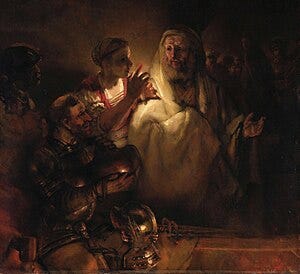
He called the crowd with his disciples and said to them, “If any wish to come after me, let them deny themselves and take up their cross and follow me. For those who want to save their life will lose it, and those who lose their life for my sake, and for the sake of the gospel, will save it. For what will it profit them to gain the whole world and forfeit their life?” — Mark 8:34-36
Who do you see when you look in the mirror? Do you see the reflection of a little boy or girl from your past childhood bedroom? Perhaps it's the young teenager who aspired to become a firefighter, musician, or doctor. We see ourselves in various seasons of life—moments that either define or redirect our identity. That identity, the self, is made up of memories, milestones, and crossroads along the way. Each step takes us closer to what is referred to as the true self or the false self.
The true self is the most authentic version of our identity, when human flourishing is at its greatest. This is not the most likable version of oneself, but it is the kindest. Our true self is not always what we envisioned as a child either, for we yet had become fully formed. More often than not, it is the false self that becomes more visible, even dominant, in our life.
Over our life and spiritual formation, the false self becomes our default. The lines we drew—or that were drawn for us—can lead us to fold inward. This false identity rewards our egos and sees itself as the only one in the mirror of life. It's later in life that we discover who the true self is. Upon that realization of seeing the true self, we must decide if we are willing to lose life in order to gain it. Where does the true self come from, and how do we find it?
It’s not only in pivotal moments that we are formed; our formation also happens in the quiet, mundane moments of life. Each of us is absorbing every experience—both consciously and subconsciously. We have the luxury of the present to look back into the past to see the canvas where our face was woven. Turning back the pages of Scripture, we see God’s original intent for humanity.
Genesis places humanity in the Garden of Eden as images of God. The implications of being created in the image of God are multifaceted. I have covered many of them in previous postings. The focus of this reflection is uncovering the true self behind humanity. It wasn’t until creation included humanity that God referred to it as “very good.” Later on in our story, humanity’s identity becomes questioned, where our false self is revealed.
But the serpent said to the woman, “You will not die, for God knows that when you eat of it your eyes will be opened, and you will be like God, knowing good and evil.” Then the eyes of both were opened, and they knew that they were naked, and they sewed fig leaves together and made loincloths for themselves. But the Lord God called to the man and said to him, “Where are you?” He said, “I heard the sound of you in the garden, and I was afraid, because I was naked, and I hid myself.” He said, “Who told you that you were naked?”... —Genesis 3:4-5, 7, 9-11
Throughout life, we are consistently given a false narrative about ourselves. As much as close friends and family may try to speak truth, we often only hear the serpent’s siren song. Unfortunately, for many of us, the false self’s narrative is all we can hear—even from those closest to us. In my life, I have allowed that narrative to steer the ship into treacherous waters.
The siren song was loudest after the death of my closest childhood friend shortly after graduating from college. I saw him as invincible and inspiring. He inspired me to start writing as a creative endeavor; therefore, his namesake is what my previous pseudonym was named after. He meant and does mean a great deal to me. After his sudden passing, to no fault of anyone but my own, I spiraled in secret. I hid my true self behind a false one. The false self maintained the status quo, whispering to the true self: the only way to live now is for yourself. I found this path comfortable. It numbed the pain of loss, and required nothing of me. My identity, adrift, lost sight of who I was. Apathy was the only thing that felt real. I denied myself nothing, reaping the harvest of a fruitless crop. I came to understand the quote from C.S. Lewis:
If you look for truth, you may find comfort in the end; if you look for comfort you will not get either comfort or truth. —C.S. Lewis
It wasn’t until a mutual friend confronted me that I came face to face with the false self. The false self, you see, is not inherently evil. It is our shadow side, a piece of ourselves that feels abandoned—a part of us needing to take control. The false self flourishes under a lie that you are not good enough. It takes control in an act of self-preservation. The irony of it all is, by taking control, the false self indulges in self-destruction. This feeds the lie that we are depraved and irredeemable in our shame.
The birth, life, death, and resurrection of Jesus form the archetype for human flourishing. To follow Him means we must venture after Jesus, along the Christ path. In doing so, we must forfeit our lives in order to gain life. In facing my false self, I began to walk back down the path that Christ modeled for His followers. A model of what it means to be fully human—created in the image of God. We begin to recognize the false archetype, Adam from the Garden of Eden, as it falls away. We die to the false self and in so finding the whole self—a resurrected true self. My friend loved me enough to tell me I’m worth more than what I had reduced my identity to. The great self-sacrificing love of Christ confronts the false narratives we tell ourselves. It echoes Jesus’ words from the Gospel of John:
And Jesus said, “Neither do I condemn you.”... —John 8:11
We yearn for a sense of identity, grasping at notions of meaning along life’s pathways. Our false self attempts to control the narrative to protect our “nakedness,” but we were created naked. The shame and guilt come from our self-destructive acts that chase happiness, meaning, and community. Following the Christ path, we discover that from the beginning, we are created “very good.” Along this path, we uncover that we must die to the self that sits falsely upon the throne of our lives. We come to understand what Gerald G. May put so well:
We have had God's breath in us since the beginning, and God knows that the fulfillment we long for will come from nothing other than God's very self. Nothing less than God will satisfy the yearning that God has planted within us. —Gerald G. May, Addiction and Grace (New York: Harper, 1988), p. 112
Thanks for reading A Dim Mirror! This post is public so feel free to share it.
Comments
Nothing yet. Say the first thing.
Sign in to join the conversation.