
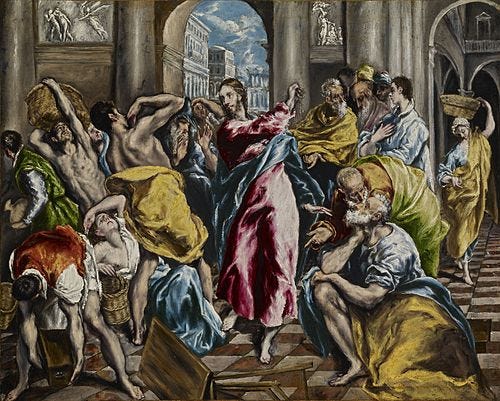
Then Jesus entered the temple and drove out all who were selling and buying in the temple, and he overturned the tables of the money changers and the seats of those who sold doves. He said to them, “It is written, ‘My house shall be called a house of prayer,’ but you are making it a den of robbers.” The blind and the lame came to him in the temple, and he cured them. But when the chief priests and the scribes saw the amazing things that he did and heard the children crying out in the temple and saying, “Hosanna to the Son of David,” they became angry ' — Matthew 21:12-15
Jesus’ entry into Jerusalem is often taught as the triumphant arrival of a coming King. We remember and celebrate Palm Sunday as Jesus fulfills prophecy. This reading, while faithful, misses a key piece of the story. Rome would grow nervous every year during Passover — a festival celebrating the Jewish community’s liberation from Egypt. A time when God overturned the tables of the ruling authorities.
Paraphrasing Mark Twain: history may not repeat itself, but it often rhymes. During Passover, the Roman governor would host a military parade through the western gate of Jerusalem. Through a show of force—armored horses, soldiers—the empire displayed its dominance: a threat of power and authority not to be trifled with.
Contrast this with Jesus’ triumphant entry through the eastern gate — not a show of force, but a procession of palm branches and cries of “Hosanna” from the crowd, meaning “Save us.” All of this harks back to their deliverance from Egypt — a prophetic disruption of subverting the ruling authorities.
This moment precedes our Gospel reading today, where Jesus weaves a whip and overturns tables in the temple. A message directed at the Pharisees and religious authorities, who leveraged their power to enrich themselves. The unholy union of Jewish religious power and the Roman Empire subjected the people to injustice, even as they cried out for a savior. Jesus further angers the Pharisees by healing the blind and the lame right there in the temple. Indignant at Jesus' actions, they set in motion their plot to have him arrested.
Jesus shows us that not all power is meant to be what David Fitch calls “power over.” As Christians following Jesus, we can take hope and victory in his display of "power under." Though this ultimately led to Jesus’ death, we know that death does not have the final say. The evil and injustice of this world can and will be overcome by following closely in the footsteps of our teacher, savior, and Lord —covering ourselves in the dust of our Rabbi.
Special thanks to Zachary Helton for the Palm Sunday historical perspective.
Comments
Nothing yet. Say the first thing.
Sign in to join the conversation.