
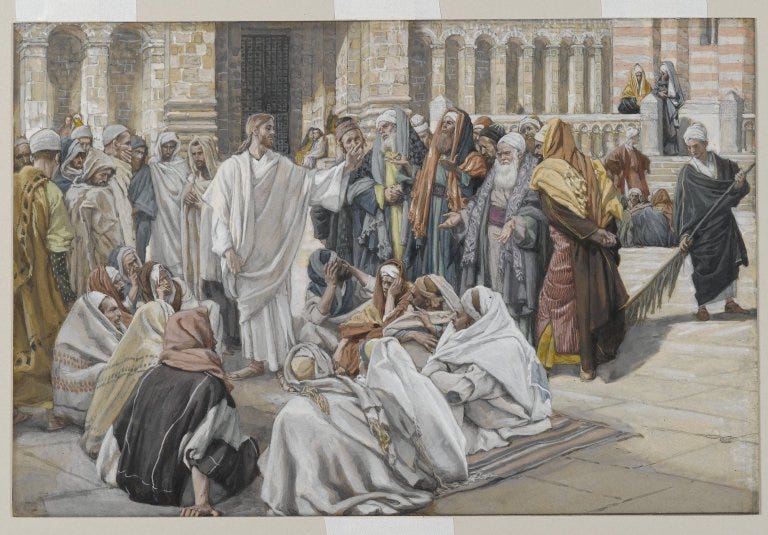
And he cautioned them, saying, “Watch out—beware of the yeast of the Pharisees and the yeast of Herod.” They said to one another, “It is because we have no bread.” And becoming aware of it, Jesus said to them, “Why are you talking about having no bread? Do you still not perceive or understand? —Mark 8:15-16
Reading Jesus’ words of caution regarding the “yeast of the Pharisees” can be confusing with our modern epistemology. Even to Jesus’ disciples, His words were puzzling. In today’s Gospel reading from Mark, we find Jesus and his disciples getting into a boat after a recent confrontation with the Pharisees. This is not His first—or last—clash with Jewish authorities. Throughout the Gospels, Jesus consistently rebukes and challenges religious leaders. Jesus’ rebuke found in Matthew 23 is a fierce critique of power and authority being abused:
“Woe to you, scribes and Pharisees, hypocrites! For you tithe mint, dill, and cumin and have neglected the weightier matters of the law: justice and mercy and faith. It is these you ought to have practiced without neglecting the others. You blind guides! You strain out a gnat but swallow a camel! … For you clean the outside of the cup and of the plate, but inside they are full of greed and self-indulgence. You blind Pharisee! First clean the inside of the cup and of the plate, so that the outside also may become clean…For you are like whitewashed tombs, which on the outside look beautiful but inside are full of the bones of the dead and of all kinds of uncleanness. So you also on the outside look righteous to others, but inside you are full of hypocrisy and lawlessness…For you build the tombs of the prophets and decorate the graves of the righteous, and you say, ‘If we had lived in the days of our ancestors, we would not have taken part with them in shedding the blood of the prophets.’ Thus you testify against yourselves that you are descendants of those who murdered the prophets. Fill up, then, the measure of your ancestors. You snakes, you brood of vipers! How can you escape the judgment of hell? —Matthew 23:23-33
This time, Jesus offers His disciples a word of caution. The yeast serves as a symbol of pervasive corruption within humanity. Yeast causes bread to rise, feeding on the dough until it grows and takes shape. But in Jewish tradition, only unleavened bread—symbolizing purity—was eaten during Passover.
Do you not know that a little yeast leavens the whole batch of dough? — 1 Corinthians 5:6
In warning His disciples, Jesus is pointing out something deeper that Herod and the Pharisees have in common—they both hold positions of authority. And with this authority comes responsibility and stewardship. Authorities lacking moral grounding become a form of power at its worst. Protestant Reformer Martin Luther wrote:
"political office provides the opportunity for the noblest kind of helping activity. It also carries with it great dangers. The greatest danger is that the ruler, instead of serving the people as God intended in giving him his office, will use his subjects to achieve his own selfish purposes and exploit his might and power for personal gain. Not only is unredeemed humanity itself corrupt, but it also corrupts and misuses God's gifts and offices." — Luther's Works 45, p. 121
The yeast of the Pharisees is the corruption that festers in positions of power. It reinforces the need to maintain authority above all else. Feeding upon itself, corrupting those who come with the best intentions. Left unchecked, it grows and becomes a self-serving cycle of preservation.
This is why the condition of a leader’s heart matters. When an individual rises to power, they become subject to new temptations. The crown presents new challenges and opportunities. But worldly power is meant to be viewed as a burden, not a weapon. Augustine of Hippo, the influential Church Father, understood the dangers of man’s vices as an infection in the world’s governing authorities.
"The dominion of bad men is hurtful chiefly to themselves… by greater license in wickedness they destroy their own souls… The bad man, even if he reigns, is a slave, and not of one man, but… of as many masters as he has vices.” – Augustine, City of God IV.3
Authority takes on many forms, and doesn’t have to be as grandiose as a president or a king. In our jobs, churches, and communities, we must recognize that power can easily be subject to abuse. Jesus’ counsel on power applies to you and me alike.
The yeast of the Pharisees grows when we allow our hearts to be poisoned by the seductions of power. Leadership is not meant for domination, control, and cruelty. For the one whose head holds the crown—power and authority are for stewarding those they are entrusted.
This rebuke falls to all of us. We are all subject to pitfalls that success, power, and authority bring. Through service and humility, we can guard against power’s corrupting side effects. It is easy for us to look up and around us, critical of those in authority over us. Only to find, when we have our little chiefdoms, are we holding ourselves to the same standards? Or does the yeast of the Pharisee fester within us? Jesus models a new kind of power and leadership. One where the first are last and the last will be first. He inaugurates an alternative kingdom—one of subversive power—where leadership is measured by servanthood.
A dispute also arose among them as to which one of them was to be regarded as the greatest. But he said to them, “The kings of the gentiles lord it over them, and those in authority over them are called benefactors. But not so with you; rather, the greatest among you must become like the youngest and the leader like one who serves. —Luke 22:24-26
Thanks for reading A Dim Mirror! This post is public so feel free to share it.
Comments
Nothing yet. Say the first thing.
Sign in to join the conversation.