
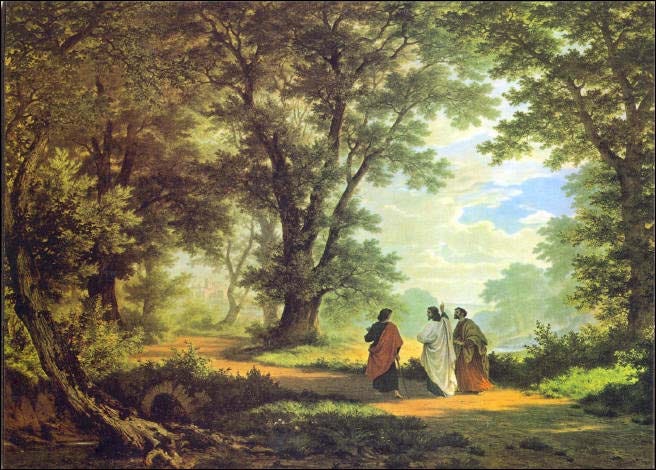
Thomas said to him, “Lord, we do not know where you are going. How can we know the way?” Jesus said to him, “I am the way and the truth and the life. No one comes to the Father except through me. If you know me, you will know my Father also. From now on you do know him and have seen him.
—John 14:5-7
Mythologies are often misunderstood by our modern sensibilities. We often see myths as common mistruths. Terms like ‘myth-busting’ reveal our tendency to correct common misunderstandings. I find the explanations of science do well to give us the how of life, but fall short when providing a why. Meaning, or our why, is what humanity developed myths for. We wanted to prescribe a why and a purpose to existence. These mythologies aren't less true because they are stories. Many are derived from actual events. I believe we shouldn't be so dismissive of myths and stories of old.
Carl Jung described myths as:
Meaning makes a great many things endurable—perhaps everything. No science will ever replace myth [the communicator of meaning], and a myth cannot be made out of any science….[Myth] is the revelation of a divine life in man. It is not we who invent myth, rather it speaks to us as a Word of God. — Carl Jung
It is here I want to pause. I am not anti-science. I find many aspects of scientific discovery edifying and fascinating; at times, strengthening my appreciation for the Divine more so than liturgical ceremonies. However, I agree that we look to religion and science to answer questions they were never meant to uncover. Myths, whether we believe they actually happened or not, teach us truths that can only be unveiled in that manner.
J.R.R. Tolkien and C.S. Lewis would often find themselves in profound discussion about fantasy and myth while sipping on a pint in a pub named “The Eagle and Child” in Oxford. Their “pub theology” birthed much of the foundational Christian literature of the 20th century. Lewis appreciated myths—perhaps like many of us—but was never fully satisfied by them, because they “never actually happened.” He was drawn to them, appreciating the themes, but still resisted the myths as “just fairy tales.” Lewis, before his conversion to Christianity, thought the same about the Gospels. His good friend Tolkien pushed back on these ideas, ultimately leading to Lewis's conversion. Tolkien conceded that Christianity is a myth in the sense that it works on our imagination, mirroring patterns in ancient myths—but he pointed to its uniqueness: it actually occurred in history. Tolkien called Christianity the “true myth.” He told Lewis that all of these myths and stories that he enjoyed were pointing to something. That something was lived out in history through the life of Christ. There is a letter written by Lewis that distills his thoughts from these conversations. He writes:
”The Pagan stories are God expressing Himself through the minds of poets, using such images as He found there, while Christianity is God expressing Himself through what we call 'real things'...Therefore it is true, not in the sense of being a 'description' of God (that no finite mind could take in) but in the sense of being the way in which God chooses to (or can) appear to our faculties." — C.S. Lewis
This conversion led Lewis to write many myths, such as The Chronicles of Narnia. They were stories and myths where the truth shined through—describing a pattern to life that is unmistakably true. One that only sticks with us through archetypical stories.
“The way” is Christ's path as exemplified through Jesus of Nazareth. Humanity does not have authority to claim the name of that narrow path for ourselves. D. T. Niles put it in a way:
. . . when Jesus Christ makes his place and time of appointment with (people) men, he does not always give his name. . . The point is not that there are alternatives to commitment to Christ—other ways by which (people) men can be saved—but that to speak of the finality of Christ is not to tie oneself to where his name is actually pronounced. As he himself tells us, he determines the form and occasion of his presence, and where and to whom he will come incognito. —D.T. Niles
We can only follow the way as God reveals it and leads us. God unveils God’s self through whatever means is fitting. Abraham, Moses, Paul, and the twelve Disciples experienced God as the great I AM in many forms. The Gospel is a path—a story full of truths—that reveals the pattern established long ago to lead humanity back to God. The result is a life in Christ as humanity was meant to be.
Special Thanks to The Culturist for the narrative on Tolkien and Lewis, and Rev. David Perkins for the D.T. Niles quote.
Comments
Nothing yet. Say the first thing.
Sign in to join the conversation.