
Age. A three letter word that has the power to rattle even the most “mindful” of us. You’re either looking forward to reaching a certain age, surprised by the number of candles on your birthday cake or scared by the one coming next.
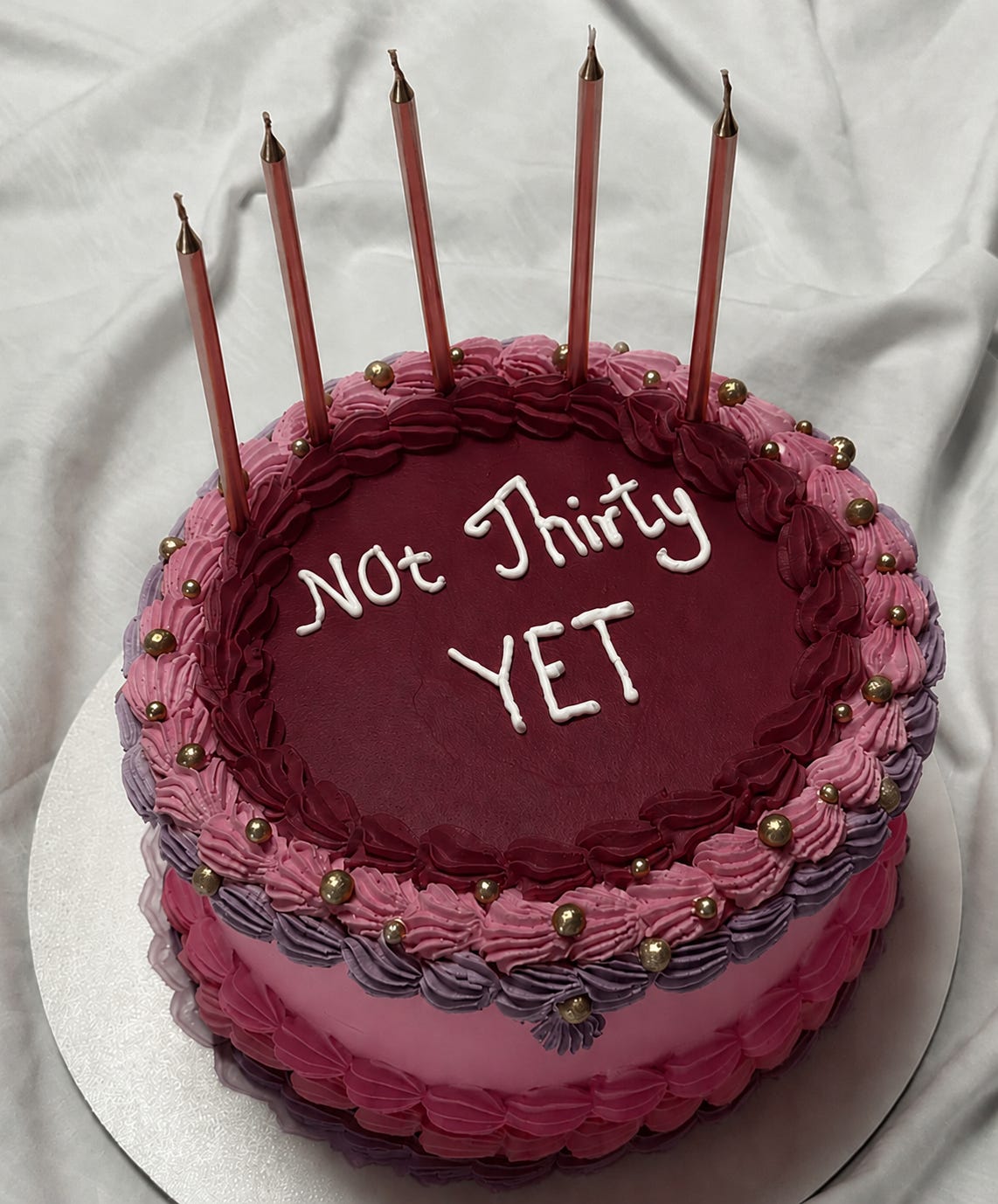
You get a few in betweens that you almost forget to notice and that leave you unphased.
Age isn’t all that interesting to me though. What is, is the non-linear, illogical way we experience it that somehow seems to be universally understood and shared.
In Nothing New Taylor Swift sings “How can a person know everything at 18 but nothing at 22?” which is exactly what this piece is about.
It started with a scroll
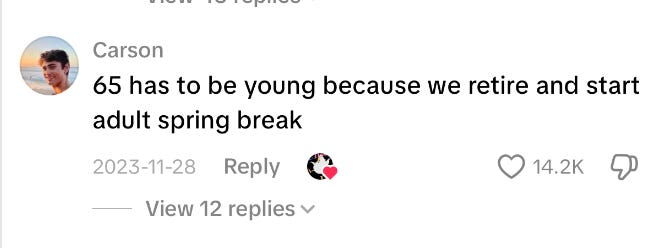
This is the video that inspired this piece. A random TikTok I saw one day suggesting that age is non-linear and really depends on how it relates to the broader societal expectations tied to it. According to the author, at 26 you’re old but at 28 you have your entire life ahead of you.
Not just a feeling
Developmental psychologist Jeffrey Arnett spent years researching why the 20s feel like a prolonged threshold state and argued that the weight we attach to certain ages comes not from the number itself but from the gap between where we are and where society expects us to be. You’re no longer one thing, not yet another. The age doesn’t feel heavy because of the number. It feels heavy because of what the number is supposed to mean, which is why 29 can feel heavier than 31 because it sits before the symbolic cliff of 30.
What the numbers look like up close
The interpretations do vary which I reckon is partly a byproduct of the different schooling systems that let a young person “go out into the real world” at different ages. In the US, you might leave university at 22. In Europe, it might be later. Which then affects and dictates the way you feel about the ages that ensue.
At 23: You are finishing university. You feel pressure and a certain finality of the life you’ve been living up until now. As a result, you feel “old.”
At 24: You start working and you are suddenly the youngest person in your team, making 24 feel refreshingly, or terrifyingly, “young.”
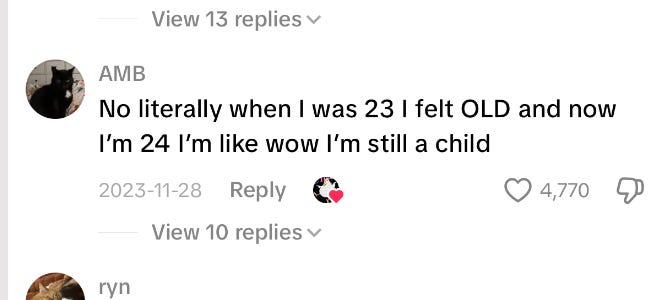
What seems to be the consensus is that between 20 and 26, we’ve got years that feel younger and significantly older than others. So what you might experience is an old year followed by a young year. Your 25th birthday in particular seems to represent the start of your “quarter-life crisis” though for some it only hits at 26 or 27.
What seems to follow are the “trenches” years, which occur between ages 26 and 29. When doomsday (30 candles) arrives, we let go of the pressure and feel reborn again. 30 to 33 then become young ages full of “firsts”.
The infamous 27 club
The brilliant Basquiat, Kurt Cobain or Amy Winehouse. A number with so many deaths attached to it that it’s become a universal reference. It’s the first age when you really do feel old and feel the burden of everything you haven’t quite had the chance to accomplish or figure out, everything you’ve failed at and everything you’ve lost. Yet it also holds the expectation of: you have 3 years left to sort this out because the three zero number is looming above you and it’s a deadline with no extensions.
The collapse of linear adulthood
The other element of this to consider is a bit more unique to this century. Previous generations had clearer sequencing: school, work, marriage, children, homeownership. Now adulthood is fragmented, often delayed or “uno reversed” by divorces before 30. Which means that people oscillate between adolescence, adulthood, reinvention and regression throughout both their 20s and 30s.
Which makes it easier to understand why:
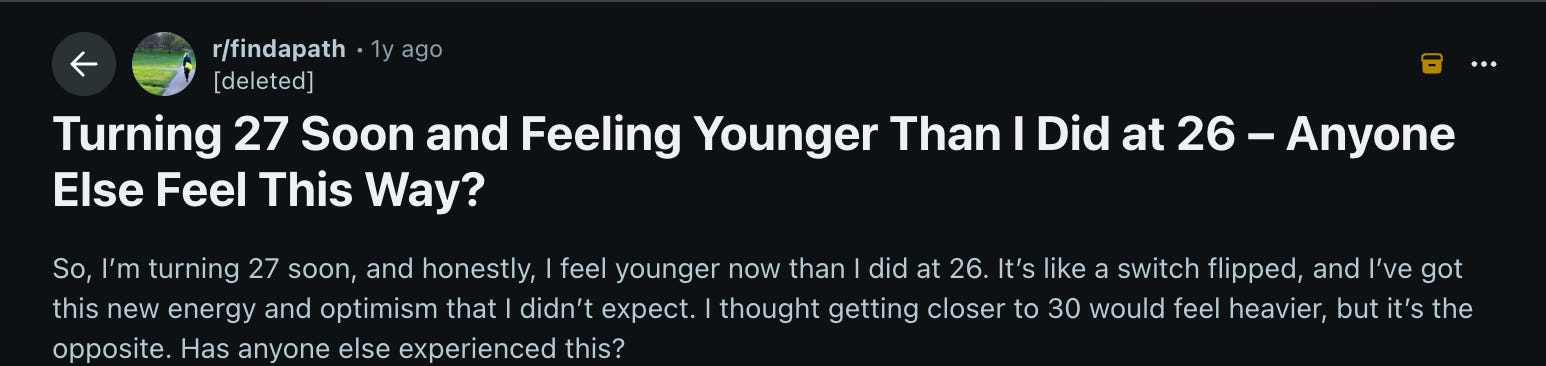
a 31-year-old can feel younger than a stressed 23-year-old
27 can feel expansive
29 can feel terminal
32 can suddenly feel playful again
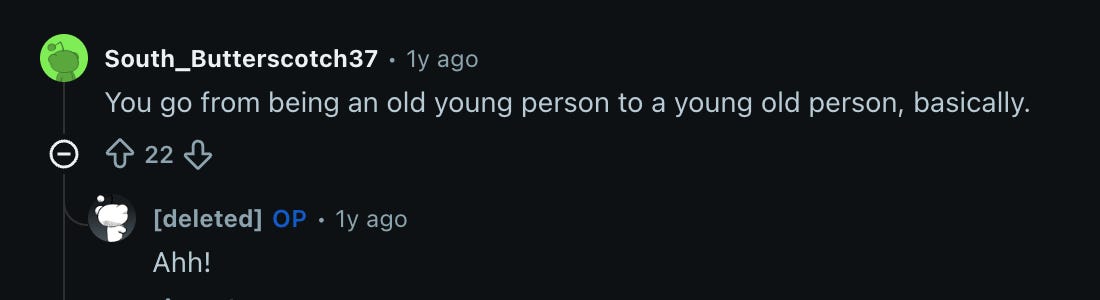
The thing about age
I kicked this off by saying that age has the power to rattle even the most “mindful” of us. And it’s true but it’s not an incessant rattle, it’s one that runs on an irregular schedule.
As one of my favourite writers of all time, Kundera, wrote “Perhaps we become aware of our age only at exceptional moments and most of the time we are ageless.” We aren’t actually thinking of age throughout most of our days. Just a few days ago I was having coffee with my mum and she asked me: “wait, am I 54 or 55 now?” This is of course, partly an evolutionary benefit as again in the wise words of Milan Kundera: “To be mortal is the most basic human experience and yet man has never been able to accept it, grasp it, and behave accordingly.”
If we were aware of our aging every minute of every day, we’d spend our lives in a state of paralysis. That is why it often hits us like a truck when the next birthday comes, the first digit changes and the realisation of another year passing by arrives.
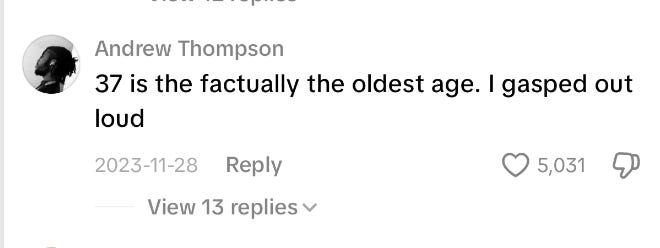
What of it all
This is of course an exploration and by no means an empirical one. For me, understanding that we do experience the “27 blues” together was somehow alleviating. I believe it can illuminate why we feel the way we do about certain life chapters even if it’s only a part of the story. Age is such a colourful experience that it cannot be distilled into rules whether linear or non-linear. In Mrs. Dalloway, Woolf writes that Clarissa feels simultaneously “very young; at the same time unspeakably aged.” The character is 52 at that time yet it mirrors this old tumblr post of a girl experiencing her early 20s that I screenshoted years ago:
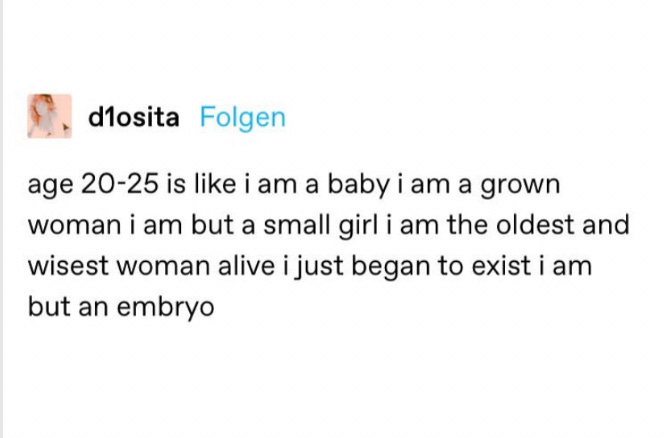
What this all points to is that age isn’t a linear experience of a number derived from our birth certificates. Instead, it’s a story we’re all telling ourselves and each other, one that’s constantly revised and reevaluated. The silver lining seems to be that we are haunted and liberated by the same digits, together.
No posts
Comments
Nothing yet. Say the first thing.
Sign in to join the conversation.