
In 2020, a tweet about some people not having “an internal narrative” went viral.
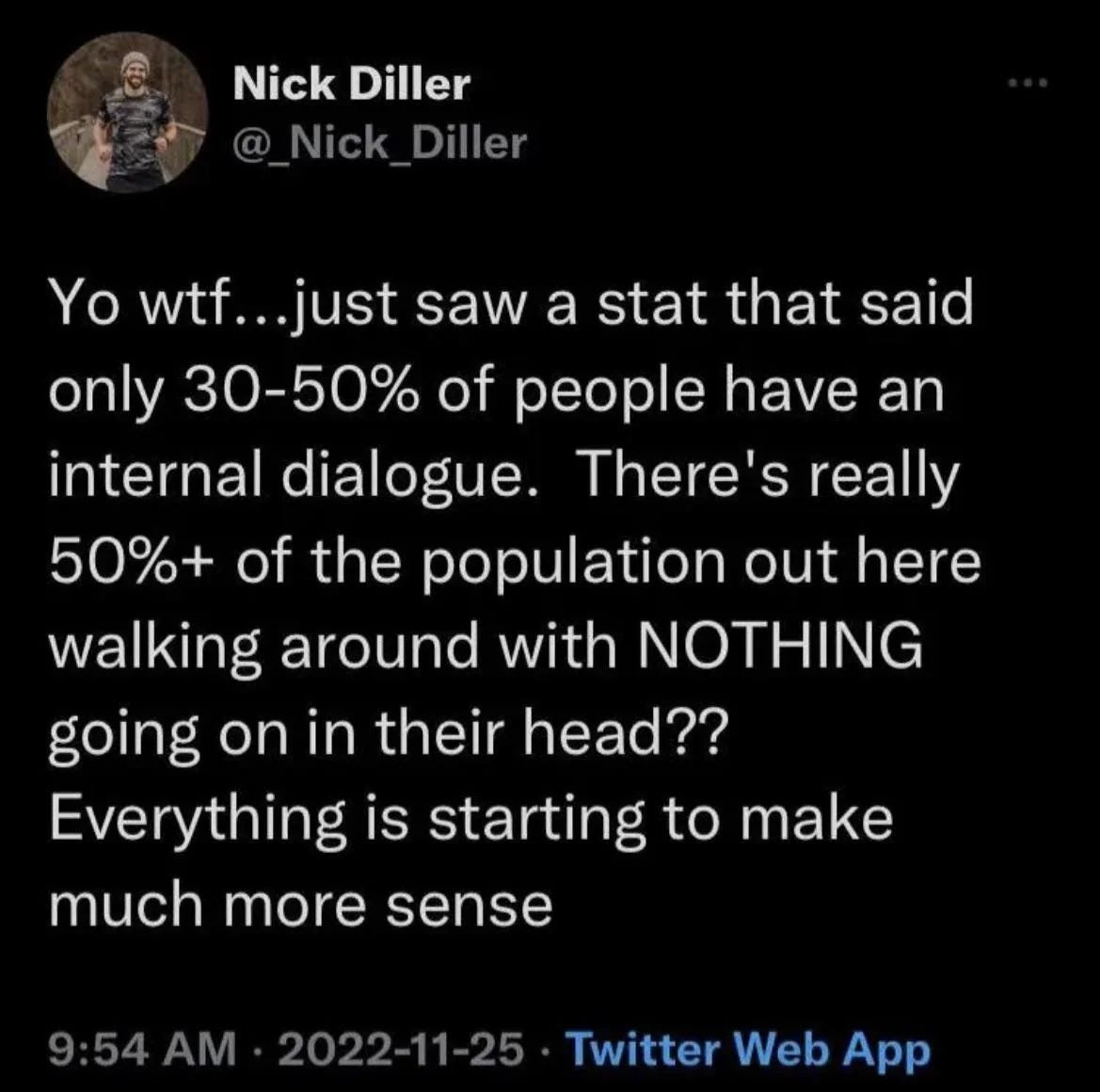
A variation of that tweet now seems to go viral every couple of years, including this one from 2022:
When I watched this interview with a girl who doesn’t have an internal monologue, I fully sympathised with the interviewer who was shocked when the girl described:
not being able to think thoughts in her head (e.g. if she wanted to stand in front of a mirror and say a sentence in her head, she’d have to say it out loud)
that she views sentences as shapes
drawing on the knowledge in her mind the same way you’d use folders and files when constructing a thought, whether a written or spoken one
never daydreaming
It’s wild to imagine that 30-50% of people experience the architecture of their minds so differently than we do. Which is why it’s relieving to know it’s not really true. It’s not clear where the viral claim that “30–50% of people don’t have an inner monologue” originally came from, only that it’s been attributed to psychologist Russell Hurlburt, who’s been studying inner experience for the last 50 years.
The term that denotes the absence or near-absence of inner speech is anendophasia and it was only coined in 2024, which tells you how new the field really is (and hence that we’re still figuring it all out).
What Hurlburt did find in one of his earlier and most frequently cited studies was this: participants carried a random beeper and, whenever it went off, reported what was happening in their inner experience at that exact moment. Inner speech appeared in about 26% of sampled moments, with enormous variation between individuals.* Somewhere along the way, that finding mutated into the headline that 30-50% of people lack an inner voice altogether.
The more realistic estimate of people without inner speech seems to be about 5-10% but even that apparently is a loose “guesstimate”. Hurlburt himself says that there’s no definitive data on how many of us have an internal monologue, or how often we do. The statistic apparently ranges “from zero to 100 percent, and everywhere in between.”*

In a 2025 paper, researcher Lind also emphasized that “low prevalence” doesn’t equal “complete absence”.* Indeed, as with most things in life, the experience of an internal monologue exists on a scale rather than a two-sided coin. Some of us can’t get the voice inside ourselves to shut up no matter what we do, for others, it might speak up a few times per afternoon. For some it might sound like a distinct voice (usually their own), for others it might be quieter, more abstract or more visual. In essence, Descartes’ “I think therefore I am” might land differently depending on whose head you’re in.
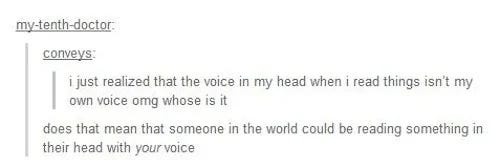
We’re also incredibly bad at being accurate judges of ourselves, consistently underestimating some of our capabilities and overestimating others. For example, in one of Hurlburt’s studies, participants estimated they were innerly speaking about 72% of the time, when their actual sampled rate was 18%.*
5-10% is a lot when you think of all the people you’ve ever met, friends you’ve made along the way, dates you’ve gone on or work relationships you’ve tried to navigate. The percentage isn’t really the point though. What the research actually shows is messier and more interesting: inner monologue is less of tick box and more of a complex, individual experience.
We focus on the differences between each other so much. He’s dyslexic, she’s neurodivergent, he’s an introvert, she’s an ambivert, he’s a Leo and she’s a Pisces. Yet there’s this one aspect of selfhood that we’ve neglected quite a bit.
Imagine finding out your best friend or spouse processes the world and therefore everything you experience together in a radically different way. All the times you’ve processed an argument differently, all the times you interpreted a moment the other way around, all the times you tried to guess what they were thinking (when they potentially weren’t at all).
A friend of mine doesn’t have much inner speech. She says that if she’s biking through a city, there is no voice, only silence, which in her own words can get a bit boring. If I imagine us biking together, I think of her – conscious only of her boredom and the passing scenery, looking forward to the next stimulating input. And then me, visibly cringing while reliving some stupid thing I said to someone 3 years ago.
It’s a humbling reminder that the human mind is still, in many ways, unmapped territory. We move through life assuming other people experience reality the same way we do when that may not be true at all. I, for one, wouldn’t give up my inner voice for anything, it’s my most loyal companion even if I’d throw it in a shredder just to make it quieter sometimes. It’s strange to think someone I love might be moving through the same moments without one – no narrator, no replay, just the thing itself.
But what of it? Well, for one, Do you have a voice inside your head used to sound like a question from a psychiatric evaluation. Now it’s the one I want to ask everyone I’m getting to know (and trying to understand.)
PS: If you’re curious about further accounts of how people without inner speech experience the world, I suggest scrolling through this reddit thread.
References:
https://www.popsci.com/health/does-everyone-have-internal-monologue/
https://pmc.ncbi.nlm.nih.gov/articles/PMC4741522/
https://hurlburt.faculty.unlv.edu/hurlburt-heavey-2018.pdf
https://www.sciencedirect.com/science/article/abs/pii/S1053810008000032?via%3Dihub
https://journals.sagepub.com/doi/10.1177/09567976251335583
No posts
Comments
Nothing yet. Say the first thing.
Sign in to join the conversation.