
“Every reaction is a response to a previous excess.” – Arthur Schopenhauer
There’s a popular concept called the pendulum effect, the idea that human behaviour doesn’t evolve linearly, but instead swings between extremes.
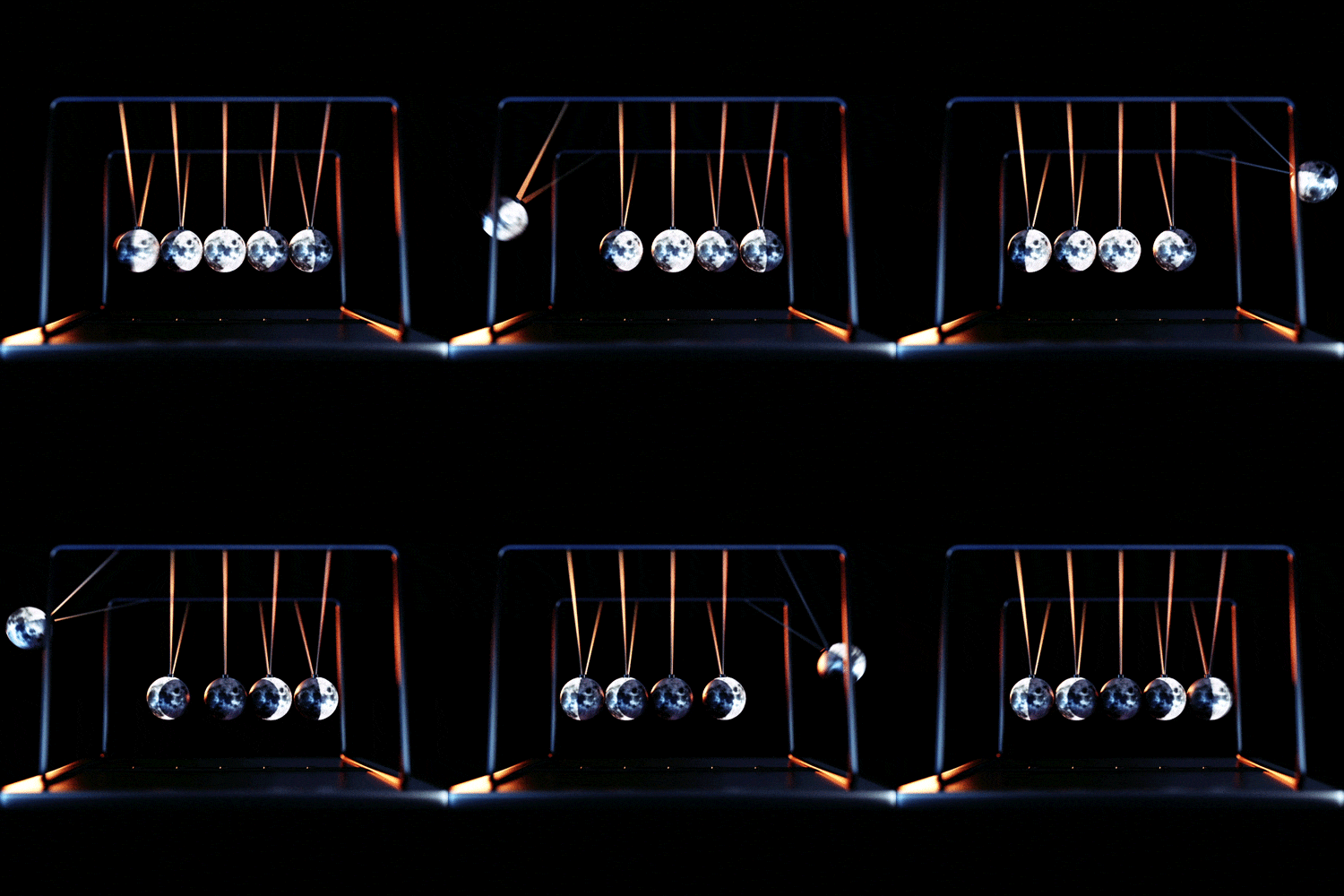
Every era overcorrects for the one before it. Every generation inherits the wounds of the previous and builds something that looks like the cure, until it isn’t.
It reveals how we move between identity and aspiration, between broadcasting our lives in real time and completely vanishing from the online world, between feeling too much and feeling almost nothing. Two extremes always seek balance. The pendulum swings, and we swing with it.
So here’s a brief exploration of the last 15 years of being online, the swings, the overcorrections and what they say about us.
First things first: a brief plunge into context
The pendulum effect has formally or informally been applied to just about every facet of life including art, literary movements and fashion. We swung from baroque’s dramatic excess to neoclassicism’s restrained rationality back to the intense emotion and individualism of romanticism.
excess → restraint → emotion → repeat
Fashion runs the same loop. By the time you finally get to donating your old skinny jeans to charity, they’re back in style and as chic as ever.
So it’s a tale as old as time, but how did it play out when it came to us being online?
Tumblr: a velvet-lined rabbit hole of self-discovery
Lorde’s Royals, Skins, The Perks of Being a Wallflower, Arctic Monkeys, Alexa Chung, Brandy Melville
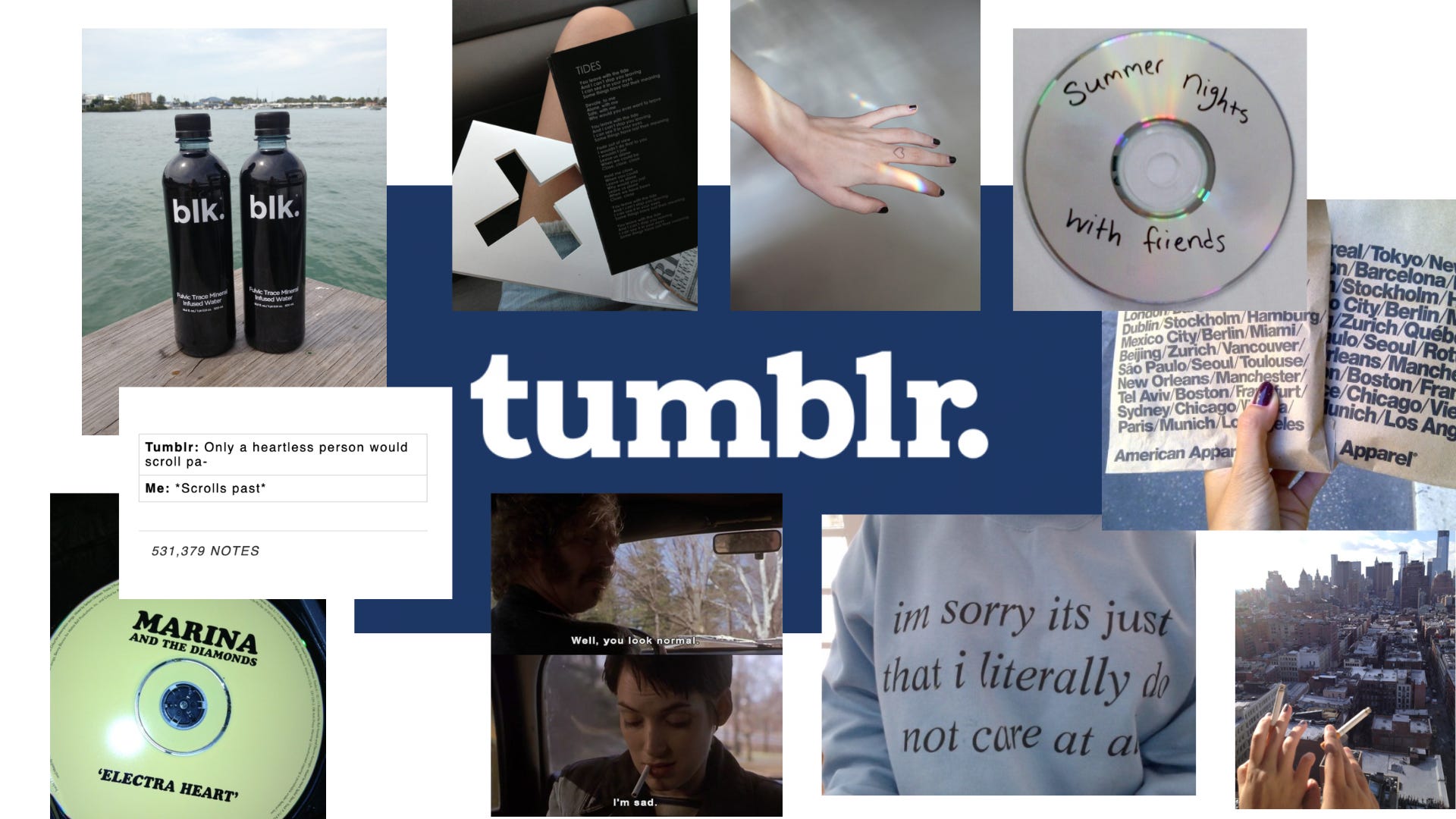
In Alone Together, the sociologist Sherry Turkle writes that the internet offered people “a place to experiment with identity.” Tumblr was the purest expression of this ever built.
Tumblr became a home to a generation of people who wanted an online identity separate from their real-life social circles. A generation raised on the early internet’s promise of connection, before every platform became a machine for attention.
If you were on Tumblr, you were participating, not in a way that declares identity, but in a way that discovers it, builds it reblog by reblog, reference by reference. I keep the Tumblr app on my phone as a relic of that era and consider my Tumblr posts an archive of personal references, the things I used to hone my taste, my style, to decide the things that mattered to me.
Tumblr offered (pseudo)anonymity and with it came a level of freedom we’d never ever experience again when entertaining ourselves online. It was niche, deep, and often dangerously performative in its melancholy and cynical wit. It also came during an era where the internet was still purely about discovery, when monetisation was a word reserved for the offline world. I know because I got a girl who was into HTML and would help people refine the visual of their blogs tweak mine, and paid for it in internet friendship.
But Tumblr belonged to an internet that still tolerated depth without demanding utility, and once platforms became businesses first (Yahoo’s $1.1 billion acquisition being the clearest symbol of that), the gap between Tumblr’s original culture and the new economy of attention became a bridge impossible to cross.
The platform didn’t die, but the culture it housed scattered into Discord servers, into Twitter / Reddit threads and ultimately into the grief of people who still talk about it the way you talk about a restaurant that still exists but just isn’t what it used to be since the owners changed.
I was a Gen Z teenager on Tumblr, but the platform itself was built on a millennial instinct: using the internet to search for yourself. By the time Gen Z came of age online, the internet had become less about identity and more about visibility. That is why Tumblr feels so specific in retrospect: it was the last major platform where identity could still be discovered, before it had to be performed. The nostalgia people feel for Tumblr is not really for the platform itself, but for the last digital space where selfhood did not have to be legible, strategic, or immediately useful.
Instagram: where we performed identity and grew sick of it
Valencia filter, plane wing snapshots, brunch pics, blurry sunsets, Starbucks cups, beach feet pics, captions that perform vulnerability or wit just enough to seem authentic
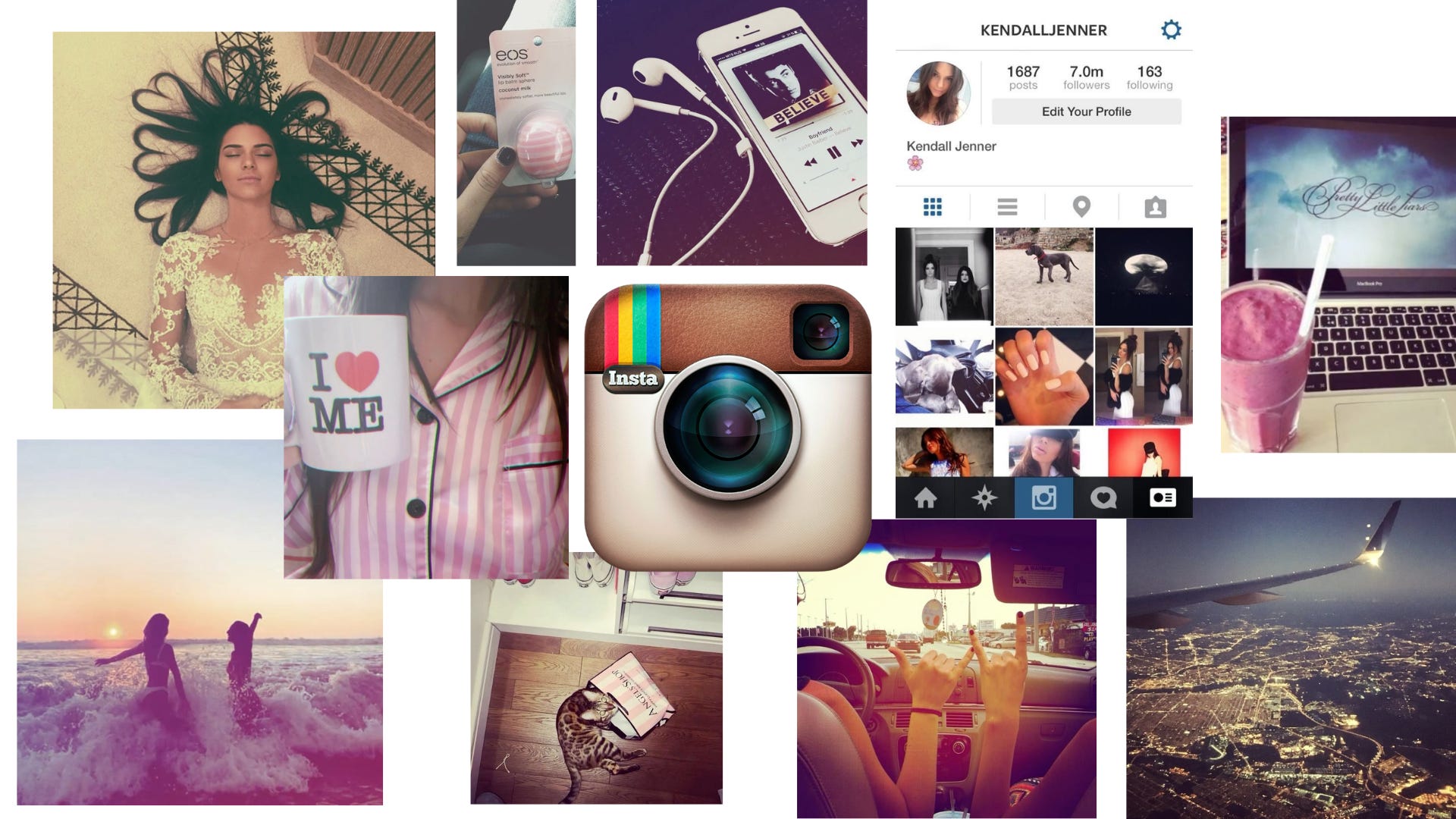
The pendulum reached its turning point when we grew tired of looking inward. And that’s when Instagram entered the picture.
The timing matters. Instagram first launched in 2010, the same year the iPhone 4 arrived with its first genuinely impressive camera. So all of a sudden we have these phones that can take beautiful pictures, which we can square crop and enhance with a filter to compose an image of our life for others to view and admire.
This wasn’t negative at first though. The early years of Instagram had a genuine aesthetic quality where beauty was the beginning of a conversation, where your feed was treated more like a gallery than a “proof of life” broadcast. The original logo was after all inspired by the Polaroid OneStep camera and that’s how it felt at the start: like a collection of captured moments.
The sociologist Erving Goffman had a concept he called impression management – the idea that social life is a performance, and we are all constantly managing the image we project. And the more we got used to constructing an image of our life on Instagram, the more things shifted.
In On Photography, Susan Sontag argued that photography creates a false relationship with reality, that images don’t capture experience, but instead replace it. John Berger understood the other half of this equation and wrote: “we never look at just one thing; we are always looking at the relation between things and ourselves.” What does this mean when it comes to our Instagram lives? It means that you are never just looking at someone’s beautiful kitchen, body or life. You are always simultaneously measuring the distance between that image and your own reality.
As that compounded through years of lives represented rather than lived, the research started accumulating and the consensus was clear. Instagram made us all feel pretty, pretty bad. It turned out that viewing the best version of other people’s lives, continuously, in real time, against the backdrop of your own ordinary Tuesday does not help much. On the side of the one posting, the gap between the projected self and the experienced self – what psychologists call self-discrepancy – widened. People knew they were painting a picture of a life spent in the gym, on sunny beaches, with perfect partners and beautiful friends. They also knew it was only part of the picture, yet was never captured in the pictures. Anxiety followed.
In essence, Instagram started as a tool for aesthetic expression but mutated into a referendum on your life. The performance tax eventually became unaffordable. And when the gap between who you were online and who you actually were grew too wide to paper over with a filter, the only honest move left was to drop out of the race.
TikTok: where we traded our attention spans for an echo chamber
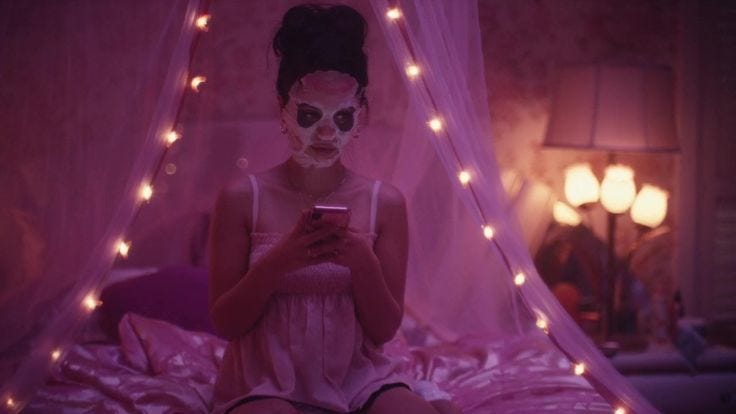
I kicked off the Instagram and Tumblr sections with a set of universal references, those I knew previous users of the platform would understand. There are of course some OG TikTok references that we could pull out – some of the dances, challenges or songs that now make you feel nostalgic for when covid started and we were all stuck at home (here’s a link to a 2020 TikTok nostalgia song compilation just in case).
And it might be my bias caused by the way I experienced the platforms, but I don’t feel like those references really represent the platform. It’s what hooked us at the beginning, but it’s not what made us stay.
TikTok arrived as the antidote to Instagram’s performance exhaustion and quickly turned into a slot machine addiction.
Its founding premise was freedom from effort. No need for followers or for a cohesive aesthetic. An even playing field. An invitation to sit back, relax and enjoy instead of feeling the pressure to join and perform a life you only half lived. Initially, this felt like liberation. TikTok’s early culture had a rawness that Instagram had long since sanded away – bedroom confessionals, chaotic transitions, dances filmed in parking lots at midnight. Polish became uncool. Of course, the fact that this all came at a time when our lives were constrained by 9pm curfews, closed restaurants and not changing your pjs all day helped.
But funny dances and challenges turned into fifteen-second dopamine loops. TikTok became a place where your “for you” page knew your micro-tastes before you could even articulate them. Inviting you to your personal all you can eat feast of the perfect trend that feels both deeply personal and universally contagious. Just one more piece, one more scroll, one more hit.
I have been the devil’s advocate for TikTok more than once, not because I don’t believe it’s had a truly debilitating effect on my attention span, but because I believe that we are the captains of our own algorithm. I have truly seen some of the most unique literary takes, cultural commentary, metaphysics explanations made fun and so much more on there. The issue isn’t content though, it’s format. You just never have time to take anything in, which is why after an hour of scrolling when you ask yourself what did I take in, you rarely have the answer.
This is where TikTok’s psychology becomes genuinely unsettling. The app was designed, with extraordinary precision, around what behavioural scientists call variable reward schedules, the same principle that makes slot machines addictive. You never know if the next video will be brilliant or dull, moving or banal. The uncertainty is the mechanism. The neurologist Judson Brewer has written extensively on how this pattern hijacks the dopaminergic system in ways that erode the capacity for sustained attention. You can feel it in your own body if you’ve used the app – the slight dissatisfaction at the end of a session, the sense of having consumed without eating.
As attention spans shortened, the capacity for the long thought atrophied. Where Tumblr was too deep and Instagram too performative, TikTok became too frictionless. Vapid not because the content lacks cleverness, but because the form rarely allows anything to breathe.
Pinterest: revival of the peaceful aspiration engine
The universal reference? Whatever makes the future of your own life feel exciting.
Around 2022, as people got tired of relating to content on TikTok and definitely didn’t want to go back to performing life on Instagram, something interesting happened. Pinterest, the platform everyone had written off as their mother’s recipe board, began quietly growing again.
I first joined Pinterest around 2012 and never really got it. I probably opened the app four times in the decade that followed. Since then it’s become a regular stop in my “how do you want to waste time right now” Russian roulette and I’m not alone. By 2024 Pinterest had the second-fastest audience growth rate of any major social platform.
The reason, when you look closely, is structural. Pinterest has no comments, no follower counts, no social comparison mechanism. You don’t go there to be seen. You go there to want things. To organise your interior life visually. To ask: who do you want to be next?
That question produces a specific kind of calm. A perfect pilates body? An all-teak everything house? Pin it and consider it a reference for your future self. Mood boards externalise desire without demanding immediate embodiment. They soothe the overstimulated mind by giving it beautiful fragments to arrange rather than a performance to maintain.
78% of Pinterest users report feeling positive after using it, a statistic so alien in the context of this industry that it reads almost like satire.
As Twitter became a rage machine, Instagram a performance platform, and TikTok an anxiety-inducing scroll, Pinterest had accidentally become the only place online that felt like a Saturday evening with a cup of tea – private, soothing, and quietly pointing toward something better.
Substack: where we came back to think
The universal references? Just plain text on screen and your brain not being fried by input.
“The new always appears in the guise of a return.”
– Marshall McLuhan
Substack feels “new,” but it’s basically a return to older forms: letters, essays, serialized thought. It started as a niche tool for journalists and has since grown into something approaching a cultural movement. By 2025 it had over 5 million paid subscriptions. The model is the inverse of everything that had worked before: long-form, slow, often paid, and built on the premise that someone’s sustained attention is worth something.
Where TikTok flattened thought into fifteen seconds, Substack asks you to sit with an idea long enough to not only finish it, but to actually digest it.
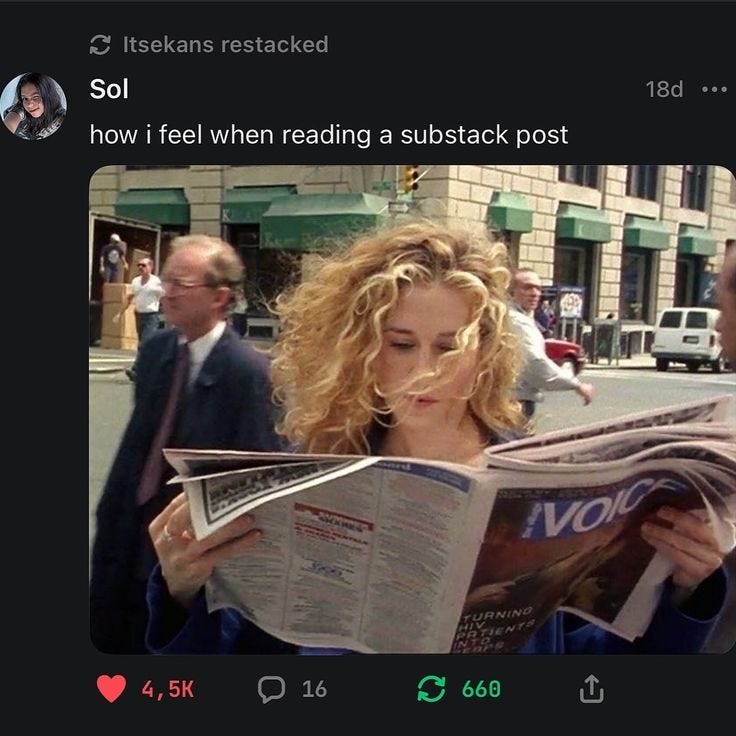
The corrective logic is almost too neat. After years of content designed to be consumed without thinking, people started paying, literally, for the right to think again. And as for those writing, for the first time since Tumblr, the internet offered a space where the most valuable thing you could bring was a point of view, except this time, someone would actually pay for it.
What the dead teach us
In those last 15 years, many platforms have risen and fallen, some have stayed around for a little, some fell faster than they flourished.
There is no better example of this than BeReal and that’s why it’s the one worth revisiting. It had, in theory, everything that the self-correction demanded. It blew up in 2022, when we were in the middle of no longer wanting to perform or watch others perform living on Instagram. TikTok had been around for 2 years and we were starting to get tired of taking our brains on water flume rides from which we’d inherit nothing but diminished attention spans. It also came at a time when covid was finally disappearing from our lives so we actually had stuff to share. Not to mention the human connection deficit we’d accumulated over those 2 years of strange socialising rules we never expected to have to navigate. And BeReal did explode fast but it disappeared even faster.
The sociologist Erving Goffman has an interesting theory about this. He saw human interaction as a theater performance with a “front stage” (public life) a “backstage” (who we are when we’re alone). BeReal tried to make our “backstage lives” public in a way that was meant to foster connection (only to be shared with people you actually know). It failed because, as Goffman understood, as soon as there is an audience, the performance must return. BeReal became just another front-stage performance of “authentic living.”
But when there’s no real reward for your performance, you lose motivation to put it on.
And what of it all?
Each platform solved a problem, then became one. By charting these movements, we can see how we continually negotiate the balance between self-expression and overexposure, stimulation and substance.
The rise of Substack six years deep into the thirty-second video era shouldn’t make sense. And yet it’s happening, which is, I think, the most encouraging thing the last 15 years have to offer: we self-correct. We always have.
This is what the pendulum actually reveals: not that we’re doomed to repeat ourselves, but that we are constitutionally incapable of settling for a solution that costs us too much. Instagram cost us our happiness. TikTok cost us our attention. We noticed, eventually, and moved.
Gen Z gets a particular version of this story. We didn’t adopt these platforms, we grew up inside them, which means the internet’s adolescence and our own happened at the same time, in the same bedroom, on the same screen.
We were always the first ones in and the first ones out. That instinct, it turns out, was less trend-chasing and more self-preservation. Fifteen years online, and the pendulum’s latest lesson turns out to be the most personal one: the ability to direct your own attention is a form of freedom, and we’re only just learning to treat it like one.
No posts
Comments
Nothing yet. Say the first thing.
Sign in to join the conversation.