
Of all the musicians whose accounts I follow on social media, Matt Munisteri’s are among the most consistently satisfying, for several reasons. For one, his short videos often show a master of American plectrum styles up close, sometimes offering a rare glimpse into works in progress. They reveal how some of the most sought-after vintage guitars sound in the hands of a top-shelf working musician, as opposed to the typical blues attorney who collects such instruments. And Munisteri’s worldview, expressed through his words and occasional rants on extramusical topics, really speaks to me.
Munisteri has worked extensively with vocalist Catherine Russell, as her guitarist and longtime music director, and with trumpeter Steven Bernstein’s Millennial Territory Orchestra, among many others. He also co-produced Julian Lage’s solo masterpiece World’s Fair. (I recently had the honor and pleasure of collaborating with Lage on a transcription book of the album.) A self-taught musician who started on bluegrass banjo as a kid, Munisteri is deeply versed in the jazz guitar tradition from its earliest days, but equally at home with country, blues, soul, and other American idioms. He has an archivist’s curiosity about old recordings and historical players, coupled with a warmth and playfulness that keeps his music from ever feeling revivalistic.
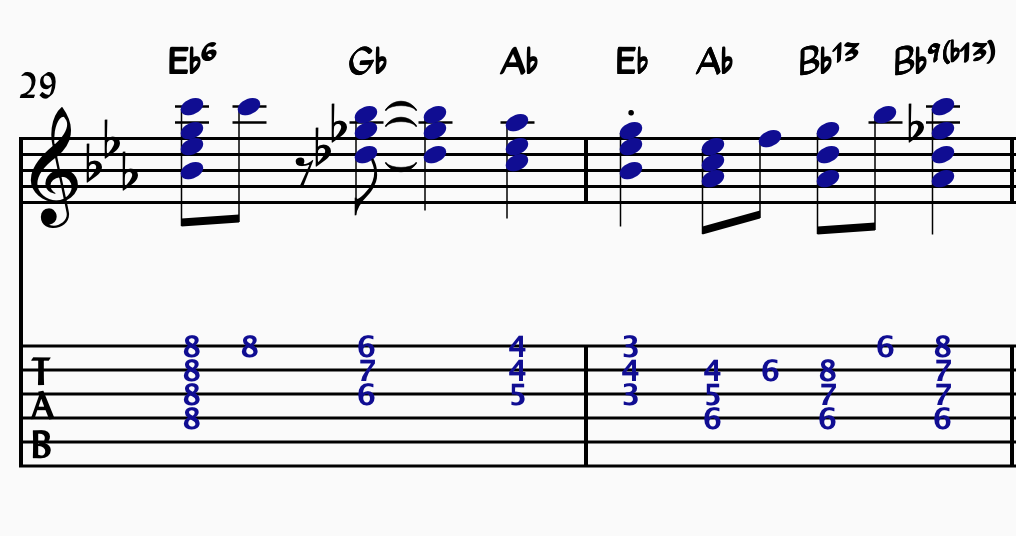
The other week, in the middle of yet another dark news cycle, Munisteri posted an Instagram reel that felt like such a palliative. In the video, he played a loose and joyful solo arrangement he’d been working on of the old standard “My Blue Heaven,” one that owed as much to early jazz guitar pioneers as it did to players in the Muscle Shoals house band and gospel choirs. I transcribed it straight away to better understand it.
I called Munisteri expecting to talk briefly about the arrangement and the guitar he played in the video, but what I got was a wonderfully obsessive tour through 1920s arranging, swing piano, Brazilian music, Snoozer Quinn, gospel, Southern soul, the place of the archtop in American music, and the incredible history of Munisteri’s Gibson Master Model L-5—including a recent intensive modification that woke up its sleepy D and G strings.
The notation for “My Blue Heaven” follows our interview, as does a transcription of Quinn’s “Telephone Blues,” with downloadable PDFs of both.

I love your recent arrangement of “My Blue Heaven.” What are the benchmarks behind it?
Well, it’s kind of just how I hear things, as far as all the inner voicings moving all the time. It’s a little weird, and I don’t get to do it that often unless I’m playing a solo gig, or a duo thing, or maybe a pianoless trio sort of thing. But those types of ideas harmonically definitely come from piano players and 1920s and ’30s arrangers more than anything.
Once I started hearing things like this, it kind of ruined every other type of music. I do the same thing to fiddle tunes. I hear all this movement, and I’ve had to really struggle for a long time to work on my fingering so that everything can sound as smooth as I’d like it to be.
That particular thing I put up there a little rough just because I was like, Oh, this is kind of cool. I want to remember it. And then I was like, Oh, I might as well throw it up on Instagram or something. But I’ve since sort of tweaked the fingerings a little bit more, so even if it’s the same notes, it’s friendlier.
As far as guitar stuff, obviously people like George Van Eps and Allan Reuss, but really probably more just orchestral and big-band and ragtime piano stuff, swing piano stuff, Teddy Wilson.
I’ve been playing like this for a pretty long time, but I sort of went overboard on a lot of it during the pandemic because I would basically spend all day kind of quietly freaking out and cooking food for my family, and then at eight or nine o’clock, whenever, I’d disappear to my practice space in the basement, and I’d be down there until one in the morning pretty much every night.
Beginning in 2024, I started looking through old videos, just trying to see if there was anything worth exhuming from that period, and there was a ton of stuff that I don’t have any memory of having ever worked on. Some of it was really good.
I do remember that something was happening to me at that point. Maybe just from—I mean, it was the first time I’d been not working in 30 years. Really, on the road, in the studios, whatever, but working, playing music. And that was big.
Something happened where I was suddenly able to hear inner voicings and harmonic movement in a way that I hadn’t quite—it hadn’t been as easy for me to hear it. I would work on my own ideas all the time before this, but suddenly I was hearing stuff a lot clearer. I’d work on something for one five-hour period or a couple of nights, and then record a version on my phone and move on to something else.
For instance, I found this version of—I think there are two tunes that Jacob do Bandolim wrote named “Glória,” but one of them, the lesser-known one, is a thing that’s really arranged for his whole group. I did an arrangement where I took four or five voices and arranged it for the guitar. And I found this on my phone and was like, What?
The other day, looking through this stuff again, I found this arrangement of “To a Wild Rose.” It’s a late-19th-century American classical thing. I can’t remember the composer [Edward MacDowell, 1896] and some jazz people have done it. Sonny Rollins really loved it and used to perform it. His versions are incredible. And also Oscar Moore recorded it, and I think his was probably the first version that I heard.
Anyway, I found a version of that, and I had this vague memory of listening to tons of versions of that, including orchestral versions, and I came up with this arrangement. So that I figured out yesterday.
I’m just thinking this stuff sort of works along the line of, it’s almost like American flatpick guitar traditions if it all came from Central and Southern Europe instead of the British Isles, you know?
Comments
Nothing yet. Say the first thing.
Sign in to join the conversation.