
Not long ago, around the time I wrote a post here on a pair of unaccompanied intros that Jim Hall had recorded with the Paul Desmond Quartet on his 1954 ES-175, I happened upon a video of a Montreal-based guitarist whose Instagram feed I follow, coincidentally playing an identical-looking ES-175 that would have shipped from Gibson’s Kalamazoo factory that same year.
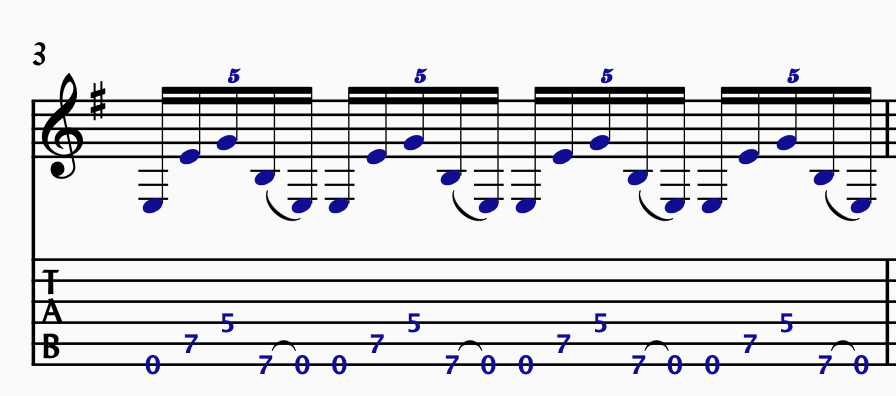
In the reel, Brad Barr—known for his exploratory tendencies in his band The Barr Brothers as well as through his solo work on albums like The Winter Mission—plays a fascinating arpeggio study owing less to the jazz guitarists with whom the ES-175 is associated than to the great minimalist composers like Philip Glass. The piece, which is situated in the guitar-friendly key of E minor, focuses on arpeggios on the bottom three strings, played rapidly in smoothly flowing quintuplets.
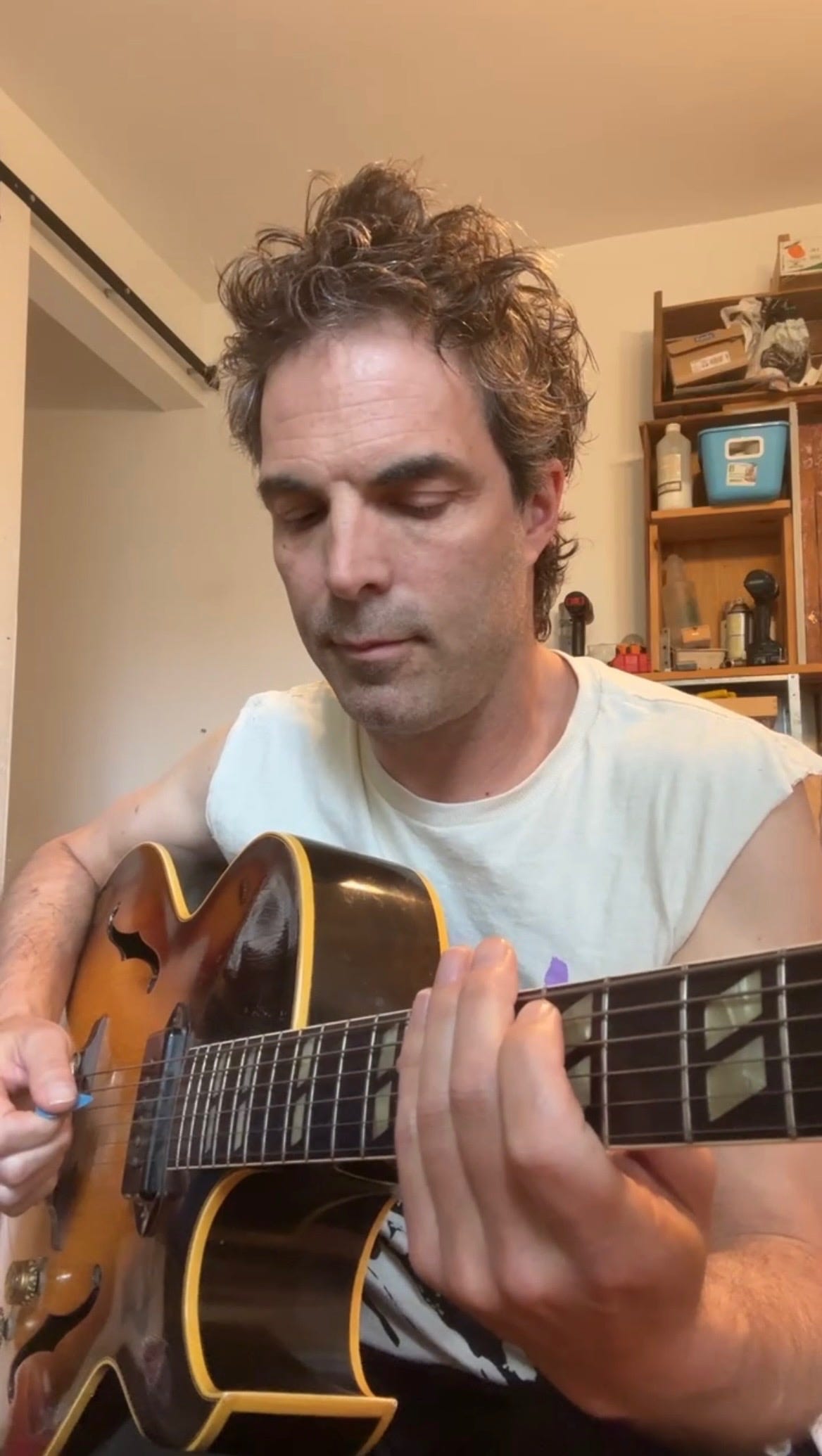
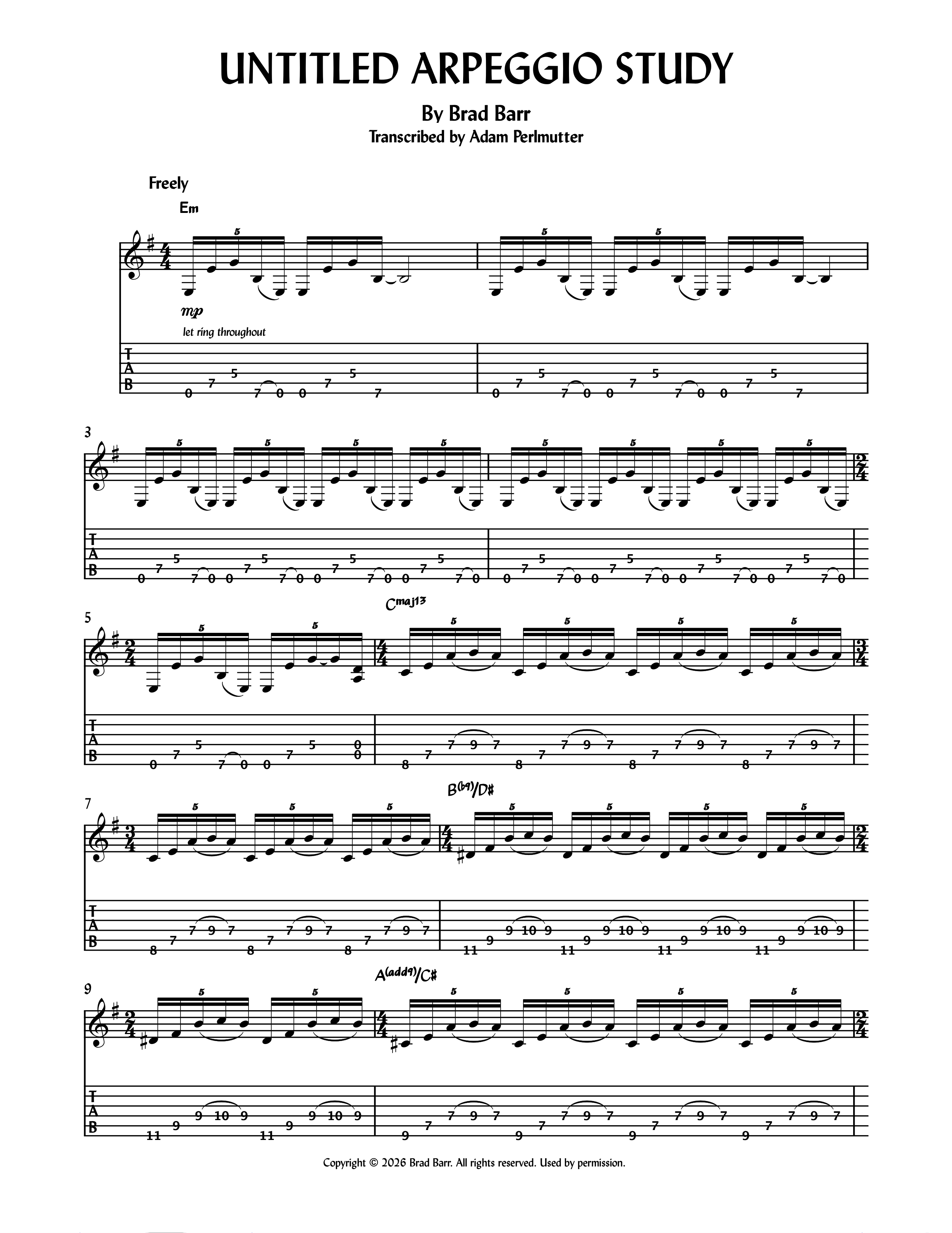
Though transcribing the piece (see notation at the end of this post) gave me a sense of what is going on under the hood, I reached out to Barr to hear more about his thinking—and about that ES-175, which, it turns out, he has played for nearly 30 years. Here’s what he shared:
Despite the rapid hummingbird effect in this piece, the technique I use is actually really simple. I tend to look for ways to reduce the amount of sweat and effort I need to put into my phrasing or riffs. This is a good example of that.
The right hand sticks to a simple, repetitive three-finger picking pattern (thumb/index/middle) on the bottom three strings, and all the flutter motion is created by quick hammer-ons/pull-offs by the left-hand ring or pinky fingers. The chord shapes are mostly three-note shell chords, and in each position, the fun is in finding an adjacent scale tone, chosen from any of the three strings in use, to quickly tap and release.
This technique works equally well on any set of strings, adjacent or non-adjacent. It just happens that in this piece, I’m only using the bottom three strings. Once you have this under your fingers, I highly recommend stretching the technique into new string sets.
Harmonically, I’m mostly staying within E harmonic minor, although I do take some liberties to go outside of the key center (C♯ instead of C natural, F♮ instead of F♯). The shell chords I’m using, and the simplicity of these shapes, help these shifts feel fluid.
Traditionally, a shell chord is made up of a root, third, and seventh. They land very naturally on the guitar and work great for simplifying your voicings. You could also look at them as two stacked intervals: usually a third (between the E and A strings), and a fifth (between the A and D strings).
Almost all the shapes I use here are shell chords, although I do open with a standard second-inversion E minor triad, and use some other inversions with the third, fifth, and ninth as the voicing. In using shell chords, adjusting one or two notes at a time, I find it’s very easy to slide fluidly in and out of the key center. I can take a very chromatic, or 12-tone, approach in the bass voice and it pretty much always leads to an interesting and welcome new voicing.
One thing I’d like to point out about the harmonic motion is that I generally use, as melodic targets, notes derived from the pentatonic scale—in this case, E minor pentatonic [E G A B D]. Even in a harmonic minor key, referring back to the pentatonic scale grounds me. I find that if I follow it in the top voice (here, on the D string), it gives continuity to the movement no matter what’s happening in the low end. They can act as guide notes into some outside harmony.
The guitar I’m using is a 1954 Gibson ES-175 strung with D’Addario flatwound 13s. I bought it from Mr. Music in Allston, MA, in 1997. Inspired by players like Jim Hall, Pat Metheny, and George Benson, I was really looking for a full, round bottom end—an electric guitar that I could feel in my chest.
A lot of plywood archtops from later years feel like they’re still only resonating on the top of the guitar. This one goes all the way through to the back bracing. I believe the heavy strings help with this, too. If you’re looking for a nice archtop, I suggest playing a bunch of them until you find one that you can feel in your whole body.
Comments
Nothing yet. Say the first thing.
Sign in to join the conversation.