
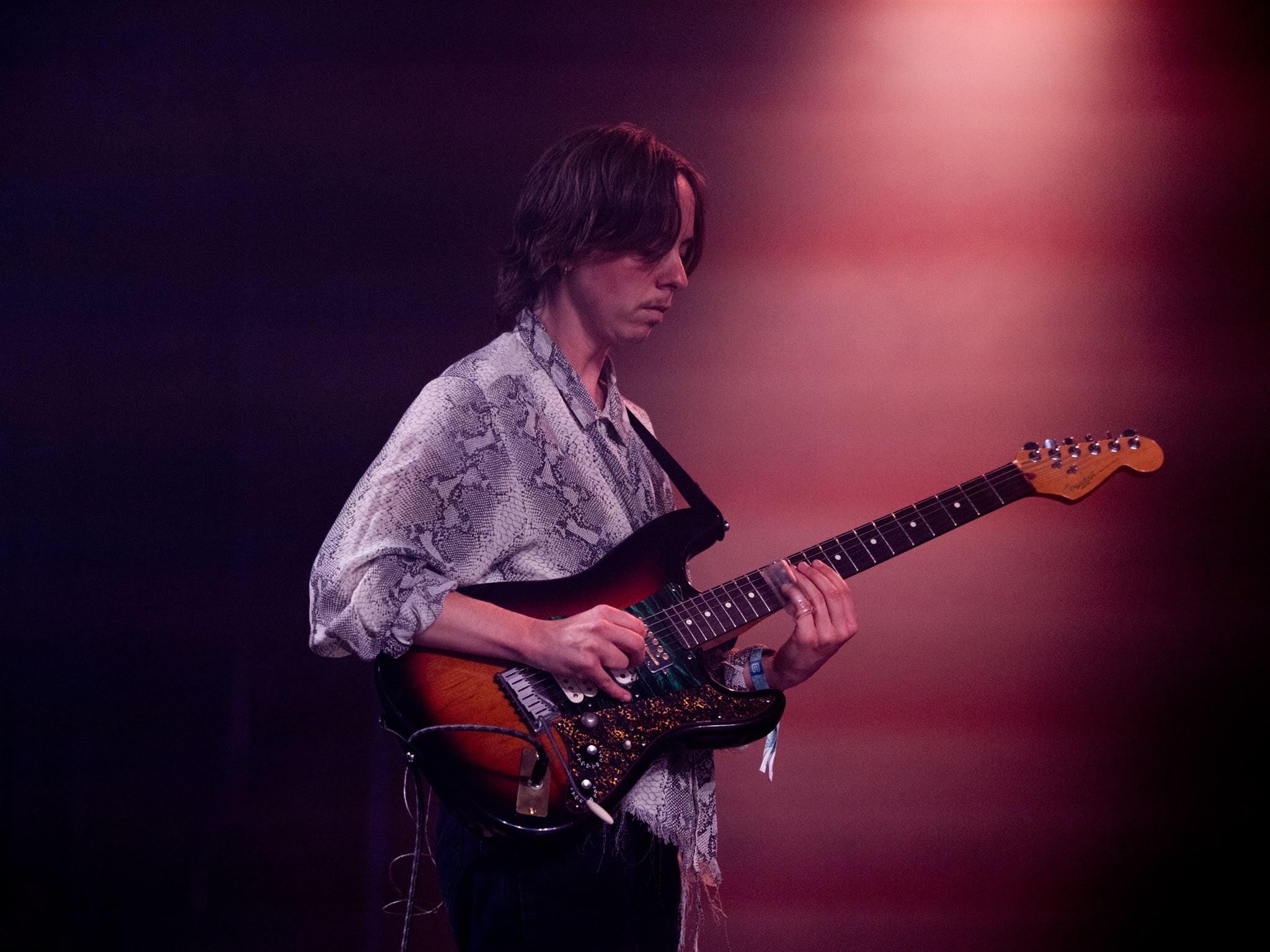
In recent years, I’ve become fascinated with a constellation of guitarists living and working in Los Angeles. There is a wide-ranging group of players, singer-songwriters, and composers—Dylan Day, Harrison Whitford, Madison Cunningham, Adam Levy, Blake Mills, and Meg Duffy, among others—whose circles overlap and who push the boundaries of what the guitar can do while remaining eminently listenable, often crossing over into mainstream musical settings.
Duffy is emblematic of the scene. Since moving to L.A. in the late 2010s, they have become an in-demand guitarist and collaborator, playing with Kevin Morby, Perfume Genius, the War on Drugs, Weyes Blood, and others, with an uncanny ability to conjure up the perfect guitar part for the moment using an unusually broad palette of ideas and sonics. At the same time, through their primary artistic vehicle, Hand Habits, they have emerged as a songwriter with a penchant for uncommon harmonies and nonstandard forms.
I first spoke with Duffy for Premier Guitar magazine in 2017, and at the time was struck by their grasp of the mechanics of music and sound, and by how they pulled everything off using a minimum of gear, owning exactly one guitar—a Fender Stratocaster. After recently happening upon a new Hand Habits song, “Good Person,” with its unconventional harmonic and tonal structures, I thought it was a good time to see how Duffy’s musical life had evolved in the years since.
We recently connected via Zoom about being drawn to the guitar during a turbulent upbringing, their growing stable of instruments and appreciation of new and old gear, their L.A. friends like Mills, the importance of voice leading, and more. Following the conversation are note-for-note transcriptions of a pair of Hand Habits songs, “Good Person” and “Graves,” which offer a good sense of the depth and complexity behind Duffy’s conception of the guitar.
In a recent New York Times profile you reflected on how music became a lifeline during your childhood. What was it about the guitar, specifically, that became the instrument you devoted yourself to?
My first instrument actually was drums. In band, you could choose an instrument, and I chose drums because it’s obviously very cool. But an uncle of mine by marriage and his brother were really into guitar. I moved between different family systems when I was a kid and wound up very close to these two brothers. I had lived with their sister, who played in bands and loved the Beatles. My uncle Richard was a luthier—sort of a hobbyist, but pretty good. Some of his guitars now, when I pick them up, I’m like, “Okay, this is a special instrument,” and not just because it’s sentimental.
I remember playing a guitar for the first time and my uncle Joey showing me the blues scale—just the pentatonic box and it really making sense. Then, much later, learning that you can play the same note in a bunch of different places made it feel like an endless puzzle.
There’s always something new to discover on the guitar. I still feel that way, especially getting into alternate tunings and stuff. But even in standard tuning, there are just so many ways to play it. It can become your own even when you’re emulating someone else.
It also felt really good to play loud. It felt good to try to understand how someone made a sound. I didn’t really get into gear, honestly, until much later—the last five years or so. But I was interested in technique and approach.
As a kid, I was only exposed to classic rock and white guys playing the blues. I remember falling asleep listening to Stevie Ray Vaughan’s version of “Little Wing” and thinking, How does he get that sound when he bends at the 12th fret? It doesn’t sound like that when I play it.
I read guitar magazines and went to Barnes & Noble to pick them up, trying to understand how to read tablature. The guitar provides such a lifeline, I think, for so many people. It came to me at the right time. I just love it. I think it’s the greatest instrument in the world.
Comments
Nothing yet. Say the first thing.
Sign in to join the conversation.