
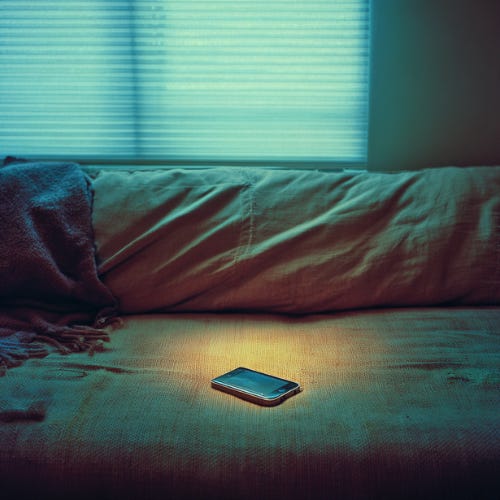
Your phone rings.
You look at it.
You don’t pick up.
Not because you’re busy — you’re scrolling.
But the screen says a name, and the name means a conversation, and a conversation means being somewhere you didn’t plan to be.
So you let it go to voicemail.
Read the transcription later.
Maybe respond.
Probably with a text.
Can this be a text?
That question runs underneath half your social decisions.
The birthday party invitation you RSVP yes to, knowing you won’t go.
The lunch you keep rescheduling until it quietly dies.
The playdate your kid got invited to that you could take them to — but Saturday on the couch is safer than Saturday in someone’s living room making conversation you didn’t budget energy for.
Nothing is safer than something.
So you stay home.
Screen the call.
Let the invitation expire.
And it’s fine. It’s always fine.
Nobody calls you on it because they’re doing the same thing.
We tell ourselves we’re screening for efficiency.
Most of the time, we’re screening for safety.
If you’re new here: I write about coherence — how to connect the many yous so you can act as one.
Last week: integration. Every part of you was right — none of them could do it alone.
This week: the pull — and what your obstacles look like from the other side of following it.
The DM
I hadn’t worked at the company in years. She’d left years before that.
Julie was the paralegal. The one I’d worked with on contract reviews. She was funny and warm and a little territorial about her domain in the way people are when they care about doing something well and don’t trust that anyone else notices. She came from an unconventional background — raised in Ohio, dabbled in the early innings of computer programming, found her way into legal. She liked to write. We had lunch a few times. Enjoyed conversations in the hallway.
And then we moved on.
The way you do.
So when a Facebook message appeared from her years later, my first thought was that her account had been hacked.
“Hey, Adam; I’d like to invite you over for tea in my garden.”
I sat with that.
It was specific in a way that spam isn’t. Tea. In a garden. Not “hey check out this link.” Just: come sit with me.
Something in it felt… human.
Not needy. Not strategic. Not performative.
Just an invitation.
But I still hedged.
“Fancy! Sounds lovely. Did you guys end up moving?”
“Yes, we’re in Rolling Hills Estates. Are you available next week?”
Rolling Hills is on the far south end of L.A. I lived in Santa Monica. On a good day, that’s an hour.
On a bad day — and in L.A., most days are bad days — it’s two.
And here’s where it gets honest.
Looking back, I feel terrible about my response:
“Oh cool! Is there an occasion?”
Then I mentioned LA traffic. Time of day. The drive.
I wasn’t saying no.
I was doing something worse.
I was slowly constructing a no out of reasonable-sounding yeses. Each response polite, warm, friendly — and pointed toward the couch.
Can this be a Zoom?
Can we meet somewhere in the middle?
It took all my energy just to get across one side of Santa Monica.
The part of me running that play?
The efficiency engine — moving to the next thing.
The social calculator — weighing effort against return.
The analytical one — sucking the life out of the invitation by turning it into a scheduling problem.
Every version of me working perfectly.
None of them in contact with each other.
And not one of them in contact with what was actually happening.
That’s drift.
The protective parts doing their jobs brilliantly… while the part that knows can’t get a word in.
Her reply was quick.
“No occasion. I’m fighting stage IV cancer, and to keep me upbeat and happy and spend my time well, I individually have folks over for tea in the garden. I can work around your schedule.”
Everything stopped.
The traffic calculus — gone.
The social hedging — gone.
The slow-motion construction of a reasonable no — collapsed.
Not because I’d decided to be generous.
Because the drive time and the traffic and the couch suddenly looked like what they were:
small things, running a loud meeting about nothing.
I couldn’t not go.
The Garden
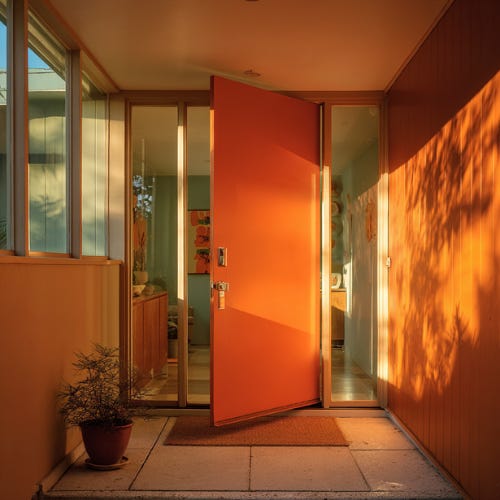
Five days later I pulled up to a midcentury house in Rolling Hills. The neighborhood looked like a revitalized Brady Bunch set — clean lines softened by decades of California growth.
I parked on the street.
And immediately: a new committee meeting.
Was this it? Was I it — the guest of honor, or one of hundreds? What did she remember about me? Was I the Adam she was hoping she’d invited, or would she open the door and quietly realize she’d gotten the wrong one?
I’d brought a plant. Is that what you bring? Or does that look like something you’d bring to a —
Why did I just have that thought.
I walked up to the porch. Stoic.
The house was quiet. She came to the door — skinny, but put together in a way that felt deliberate. Fashionable. In L.A., maybe that’s just the air. But she seemed happy.
Actually happy.
Not brave-face happy.
Inside, the house was already decorated for Halloween.
It was September.
She saw me notice.
“It gives me joy,” she said. “Cause for celebration.”
And something in me started to settle.
The Tea
The backyard was fenced by dense bougainvillea and palms and shrubs. A small water feature up part of the hill. A seating area in the shade. The property looked like life had taken over the design — things growing where they wanted, not where they were placed.
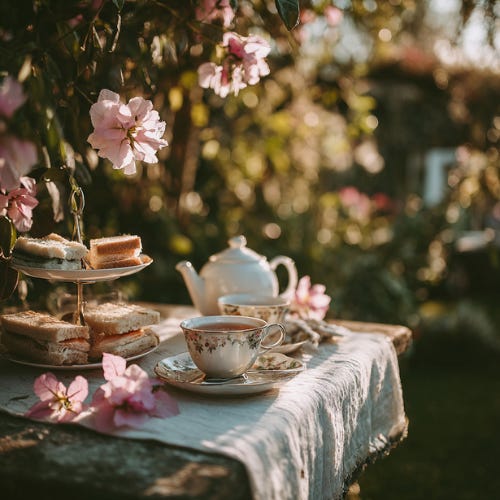
On the patio: a table set for high tea. A tiered tray of sandwiches and cookies. The kind of presentation that says:
I thought about this.
I cared about this.
You matter enough for the good china.
The tea was really good. There was care in how it tasted.
I stopped being aware of why I was there and became aware that I was there.
Not performing a visit to a sick person.
Not being careful about what to say.
Not managing my face.
Just… there. With the tea. With the garden. With Julie.
She told me about the diagnosis. The timing — the beginning of Covid, when she’d been kept in isolation for months. The inhumanity of that. Suffering alone in a system designed to protect you from everything except loneliness.
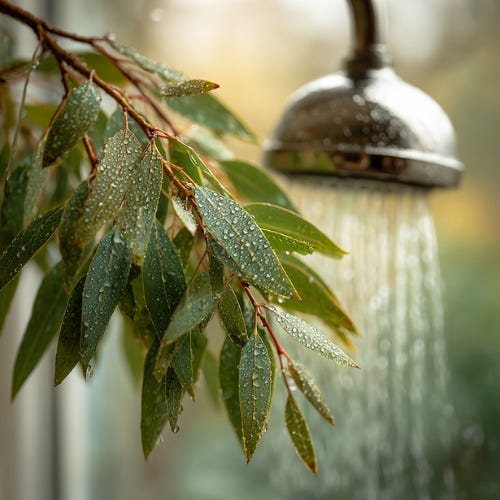
She told me about finding joy in small things. Showers as cause for celebration. Fresh eucalyptus hung in the steam to make the ordinary feel alive.
She told me about psychedelics. Not recreationally. As medicine. The peace they’d brought through images she could hold onto when the body was doing its worst.
She told me she worried about her husband’s coping.
And then her daughter came through — bright smile, easy in the way of someone who hasn’t foreclosed on life because of what’s happening in her house. She greeted the tea table like it was an ordinary afternoon. Which, for this family, it was. This was their ordinary now.
Julie told me the tea garden — the individual invitations — was her way of having the conversations she wanted to have so she wasn’t “hearing things for the first time at her funeral.”
She seemed ready. Not resigned.
Ready.
Like someone who’d decided to live the remaining time facing forward.
And I sat there — the same person who’d been calculating drive times five days earlier — full.

What Disappeared
Here’s what I couldn’t have said at the time but can feel clearly now:
The version of me sitting in that garden was not the version who’d hedged his way through the DM.
The me who was worried about who I was — gone.
The me concerned about who I wasn’t — gone.
The me desperately scared I was someone I never wanted to be — gone.
Not because I’d done something heroic.
Because the situation was so real there was nothing left to perform.
And what replaced the performance wasn’t duty.
It was care.
Belonging.
The quiet, physical sense that this — drinking tea, listening, staying — was exactly where I was supposed to be.
But I can only see that from here.
From the garden side.
Back in the DM, going felt like a cost.
From here, those “costs” look like what they really were:
petty grievances dressed up as reasons.
Traffic.
Time.
Energy.
An hour.
Two.
A couch.
They felt like grim duties from the near side.
From the far side, they’re almost funny.
Not because they weren’t real.
Because they weren’t the point.
The garden was the thing I most wanted and almost didn’t let myself have.
Almost.
That’s the part that won’t leave me alone.
The pull was there from the first message.
My screening was just louder.
And the only thing that almost kept me from it is the same thing that keeps you from answering the phone.
Not malice.
Not selfishness.
Just the low hum of screening.
And underneath that hum — something cleaner.
The good. The true. The beautiful.
Arriving the way it usually arrives:
disguised as an ordinary invitation.
The Dojo
You don’t need a cancer diagnosis to feel the pull.
You just need to stop mistaking it for inconvenience.
There’s something you’ve been meaning to do.
Maybe it’s a person you haven’t called because there’s no “occasion” — just the quiet sense that they matter and you’ve let it go too long.
Maybe it’s something you want to make that you can’t justify on a spreadsheet — a project, a craft, a direction that keeps pulling you even though it makes no practical sense.
Maybe it’s a harder truth — a way of living that you already know is more honest than the one you’re performing… but the gap between here and there feels like too much to cross.
And every time you get close, the logistics take over.
The scheduling.
The “not yet.”
The vague sense that it’s not urgent enough to act on.
You already know what it is.
You’ve known for a while.
And from the other side of doing it, every reason you didn’t will look like what it always was.
Small.
Don’t calculate.
Go.
Julie
A few months after the tea, a message appeared on LinkedIn from her family:
With a very heavy heart, I am writing to let you know that our beautiful mother and wife Julie has peacefully passed away in her home Saturday morning. We are grateful that she had so many adventures and has so many people who love her.
Julie spent her final months doing the opposite of screening. She individually invited people into her garden, made them tea, and had the conversations that mattered.
Not because she should.
Because she couldn’t not.
Harry Frankfurt wrote about this kind of inner constraint. I call it voluntary necessity — when what you care about most and what you do become the same thing. No audience. No willpower. Just a person living from what matters.
That’s different from generosity.
Generosity is a choice.
Julie was past choosing.
She was braver in her dying than most of us are in our living.
And the garden she built — not the physical one, the one made of conversations and real tea and showing up — that garden is still growing.
I carry a piece of it. Her daughter carries it. Everyone who sat at that table carries it.
Not because Julie told anyone what to do.
Because she stopped screening.
And something real took its place.
I hang eucalyptus in my shower because a woman I used to work with told me it makes the ordinary feel alive.
She was right.
It does.
From here, the drive to Rolling Hills looks like nothing.
And that garden is still the best place I almost didn’t go.
See like you’re many. Act like you’re one.
With you in this,
Adam
P.S. Who have you been meaning to call — not text, call — and haven’t? What’s the hedge that’s keeping you from it? I want to hear.
Comments
Nothing yet. Say the first thing.
Sign in to join the conversation.