
In 1971, Arlo Guthrie, son of American Folk legend and left-wing activist Woody Guthrie, was playing in a club in Northern Chicago, under the shadow of Belmont ‘L’ Station. After the show, Arlo, with his guitars strapped over his back almost made it out of the club and back to the hotel when the club owner blocked his path. The owner told Arlo that Steve Goodman, a friend of his wanted to sing him a song. Arlo, tired resisted, saying “Come on man, I don’t want to hear no songs, I don’t like songs, I don’t even like my songs. Why should I listen to other people’s songs,” but then, a short Jewish man with a beaming smile appeared around the corner of the bar with his guitar. Relenting, Arlo let this man sing him one song, on only one condition. He said, “buy me a beer and I'll sit here and drink it and as long as it lasts you can do whatever you want”. Six months later Arlo Guthrie recorded Steve Goodman’s song, which would later become his biggest chart-topping hit.
The post WWII boom in car ownership in the United States transformed the landscape of a nation. The National Interstate and Defence Highways Act of 1956 paved the way for concrete roads as a land use to become almost as common as national parks. But it wasn’t just the physical environment that the automobile changed. The car became more than just a means of transportation, it became central to middle class American identity, from the heart of the auto-industry in Detroit to the rapidly growing suburban sprawl of Southern California. Music began to reflect car culture, especially as songs were increasingly heard on ever-improving car radios. Songs like “Drive My Car”, and “Fun, Fun, Fun” epitomized this trend, with the car symbolising youthful fun. The car was the ticket to that most American of ideas, freedom, for the baby boomer generation.
However, whilst cars dominated the bubble-gum culture of the 1960s, the trains that powered the American miracle for a century didn’t disappear. Well at least not all at once. It was during the economic downturn of the 1970s that the shallow and optimistic culture that had midwifed the car into being this symbol of freedom was discredited as the nation was mired in Vietnam, disastrous economic policies from the Nixon administration and the eventual resignation of the president himself for the Watergate scandal. Furthermore, exacerbating the pain was the oil shock, caused by an embargo of oil from the Arab states in response to American support of Israel. Therefore, during the 1970’s, as the world changed rapidly around them, Americans songwriters returned to trains as a relatable lyrical symbol to use
That song that Steve Goodman played Arlo Guthrie, “City of New Orleans”, was not a city anthem for the largest town of Louisiana. No, “City of New Orleans” was the name of a train service which ran down the Mississippi valley from Chicago to New Orleans. The song describes a trip on the train heading on a “southbound odyssey”. Goodman comments on the precarious state of passenger rail ridership, with the train detailed as consisting of “15 cars and 15 restless riders, Three conductors (and) 25 sacks of mail.” Clearly not a format for profitable rail operations.
As the train travels down the valley, Goodman reflects on the changing world around the railway lines, observing “freight yards full of old black men and the graveyards of the rusted automobiles” instead of what were formerly bustling railroad towns that dotted the mainlines of the states. Suburbanisation and highway construction reoriented the country away from these towns, towards the suburbs of major cities. This detachment of urban development from rail transit was a key part of the death spiral that passenger rail faced in the United States after the war.
Although the trains are on the decline, Goodman reminds us of the life-changing power that the trains once had with the brilliant lines “The sons of Pullman porters, and the sons of engineers, ride their fathers' magic carpets made of steel”. The Pullman porters were the African American service staff of sleeper trains run by the Pullman company. Whilst they faced racism and bad working conditions, the railroads provided a form of upward mobility that was difficult for African Americans to otherwise achieve in the Jim Crow era. Indeed the “sons of Pullman Porters” went on to be the bedrock of the black professional class, boasting amongst their numbers Supreme Court Justice Thurgood Marshall, San Francisco Mayor Willie Brown and Los Angeles Mayor Tom Bradley. In that sense, the trains that their fathers worked on were truly “magic carpets” as Goodman says.
But, as Goodman reflected in his song, that world was coming to an end. Railroad services, including the Pullmans, were being withdrawn East, West and Midwest across America. In the song, as the train passes Memphis and heads into the night, “all the towns and people seem to fade into a bad dream, and the steel rail still ain't heard the news … This train got the disappearing railroad blues”. This personification of the railways is beautiful and brings a sense of darkness to the song, almost as if the train is not travelling to New Orleans, but instead, the scrapyard. In the chorus, Goodman sings from the perspective of the train itself, “Good morning, America, how are ya? Said don't you know me? I'm your native son”. Its almost as if the train has missed the memo. America has not only been dismantling its passenger railroad system, but it has forgetting it too. Once upon a time, the train was the best way to traverse the Mississippi Valley.
Ironically, the City of New Orleans did survive in the long run and still operates today, albeit on a slightly different route. As Amtrak consolidated the American passenger railway system since the 1970s, the route was one of the lucky few that continued operation. It is the only passenger rail connection to Memphis, Tennessee and Jackson, Mississippi.
When they heard Steve Goodman was heard on the radio, people imagined a tall, rugged man from the countryside. However, in actuality he was almost the polar opposite of the kind of person many would expect to be a folk-country singer-songwriter. He was raised in the northern suburbs of Chicago in a Jewish family and attended high school with future Secretary of State, Hillary Rodham Clinton. Short and suburban, Goodman was considered a great intellect by those who knew him, but his greatest passion was his favourite baseball team, the Chicago Cubs.
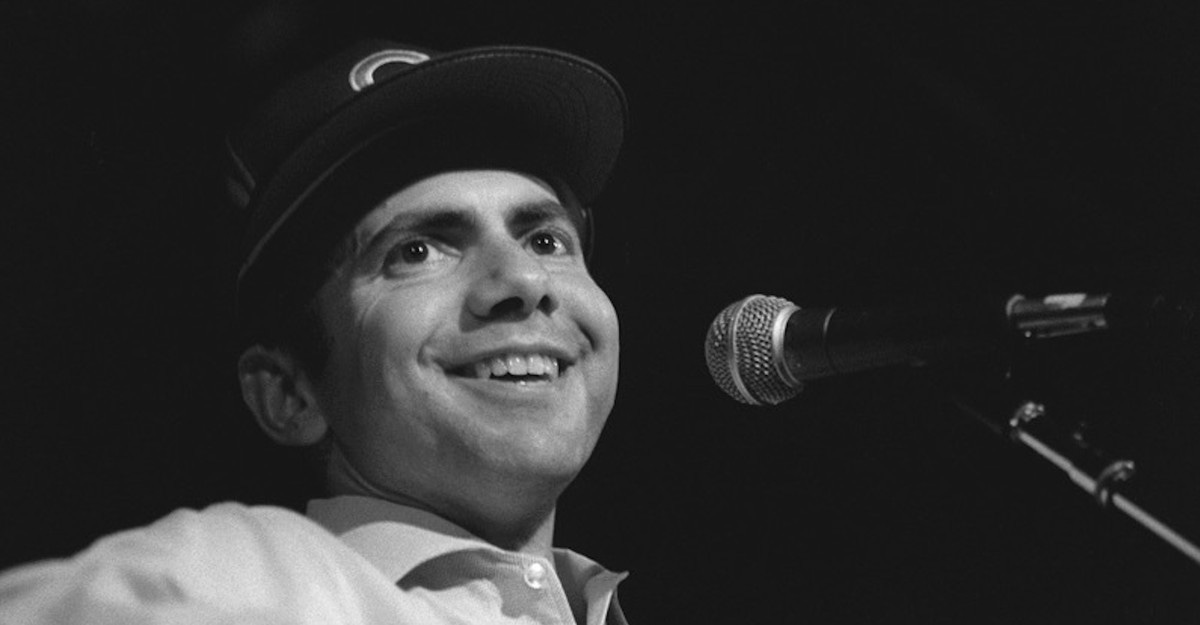
Goodman suffered from chronic leukemia which caused him continuous fatigue. Even when his condition got better, he always considered himself living on borrowed time, which filled him with the determination to leave school to pursue his music career full time. His first big break was when he opened a show for Kris Kristofferson, a country singer who pushed against the Nashville country music establishments slick production, instead believing in a paired back, lyrics focused style of songwriting. Kristofferson saw these values in Goodman’s songwriting and financed the recording of his first album in New York.
Unfortunately, Goodman died at the young age of 36 from his leukemia, but not before writing his most enduringly popular song, about his dear Chicago Cubs, which has become an anthem of the club.
Goodman’s Chicago heritage may give us clues to why he decided to write a song about a train. Chicago was the centre of the American rail network, with the engine of the city being the Union Stockyards during Goodman’s early life. The stockyards took in thousands of animals by rail, and workers took the Chicago Elevated, one of the largest metro systems in the United States to work. But the trains were also how fans travelled to Wrigley Field, where the Cubs played their home games. Living in the heart of the railway system of America, it’s not hard to see why Goodman would be particularly sensitive to what was happening in the railway industry.
Three versions of the song are of note. Arlo Guthrie’s 1972 version which is the most enduringly popular, Willie Nelson’s 1984 version, which won the songwriting grammy (posthumously awarded to Goodman), and of course, Goodman’s 1971 original.
Steve Goodman’s version is upbeat and the most guitar oriented. Flavour is provided by Vassar Clement’s violin twiddling away in the verses, joined by Charlie McCoy’s harmonica in the chorus. There isn’t a lot of dead space in the song, but it does have an endearing train engine forward momentum. Goodman’s voice is clear and strong and has a certain firmness to it that suits the song. The highlight for me is the plagal cascade right at the end, which gives the song a brilliant resolution.
Arlo Guthrie’s version is much more laid back, built around a piano on the left and a guitar on the right. Flavour is provided by Nick DeCaro’s accordion, which gives it an almost town-square feel. However, the best part of the song to me is the backing vocals, featuring Linda Ronstadt of all people, which provide this delightful, soulful, if not mournful, vibe to the recording.
Admittedly, this is my least favourite version of the song. It starts off with some garish harmonica, which I suppose is supposed to represent train whistles. But the pre-chorus is wide and expansive, which is enjoyable. The 80s production may be overdone, but every now and again, we all crave a little bit of excess in our music. Still there is just a little too much reverb on this track
Whilst many passenger trains fell victim to the disappearing railroad blues, this blog wont. The next instalment of this series about trains in the music of the 1970’s will be about Lynyrd Skynyrd, Gladys Knight and how they connect to the issue of race. I hope to have the post up soon.
No posts
Comments
Nothing yet. Say the first thing.
Sign in to join the conversation.