
Melbourne has 369 different bus routes, ranging from the recently introduced 140A to the Night Network 982 service. It is a lot of numbers to remember, and even the likes of myself who spend a not wholly insignificant amount of our hours thinking about buses cannot remember them all.
This is not necessarily a problem – Melbourne is a large city of over 5.4 million after all, spanning thousands of square kilometres from Melton to Pakenham.
However, network legibility is a real problem for most users, with awareness of where different routes go beyond one’s local route being low. Although trip planning apps have helped navigation, there is still a stress barrier in planning irregular trips.
Some cities, such as Toronto, have given their bus routes a text name as well as a number, typically named after the street that the service mostly runs on. For example: 29 – Dufferin. By having a memorable route label, this bus route has a better chance of being remembered.
Whilst such an approach might actually be more viable in Melbourne than in most other cities (due to our gridded road layout – albeit not always mirrored by our bus network), I want to focus today on the numbers themselves.
Memorable Numbers
Not all numbers are equally easy to remember. Consider the difference between 55555 and 82535. Both are equally long, but the first one is more memorable because it is a pattern – five fives. Our minds love patterns, but we also like simplicity.
A number that is round and simple, like 1000, is easier to remember than a complex one such as 3289. The simplest number of all of course is the singular, one and only well – 1. It is perhaps fortunate then that the most important – and likely most well-known – road in all of Melbourne is the M1.
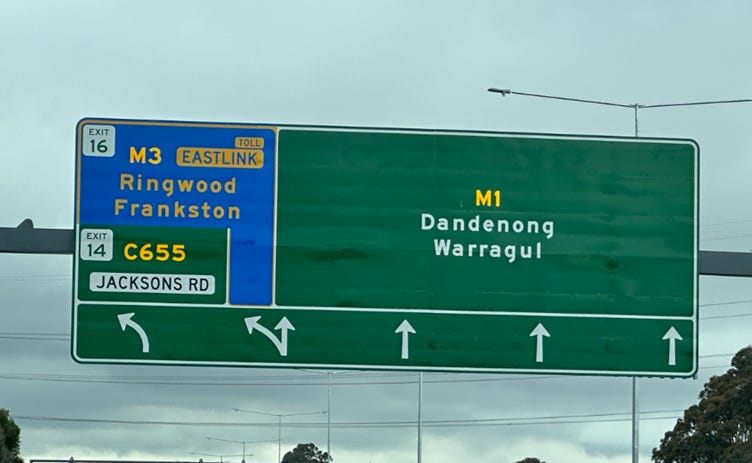
Like roads, the most useful bus routes should have the most memorable numbers.
If you have ever taken the bus to Bondi Beach in Sydney, you will have most likely boarded its busiest, and most frequent route: the 333 – an easy to remember triple number. Another particularly busy and frequent route, linking Sydney CBD to Taronga Zoo, is the 100 – a nice round hundreds number.
Outside of transport, memorable numbers are critically important for talkback radio. Many Melburnians would be familiar with 1300 222 774. Featuring both a hundreds number and a triple number, this is the call-in number for ABC Radio Melbourne.
Assessing the Memorability of Melbourne’s bus Routes
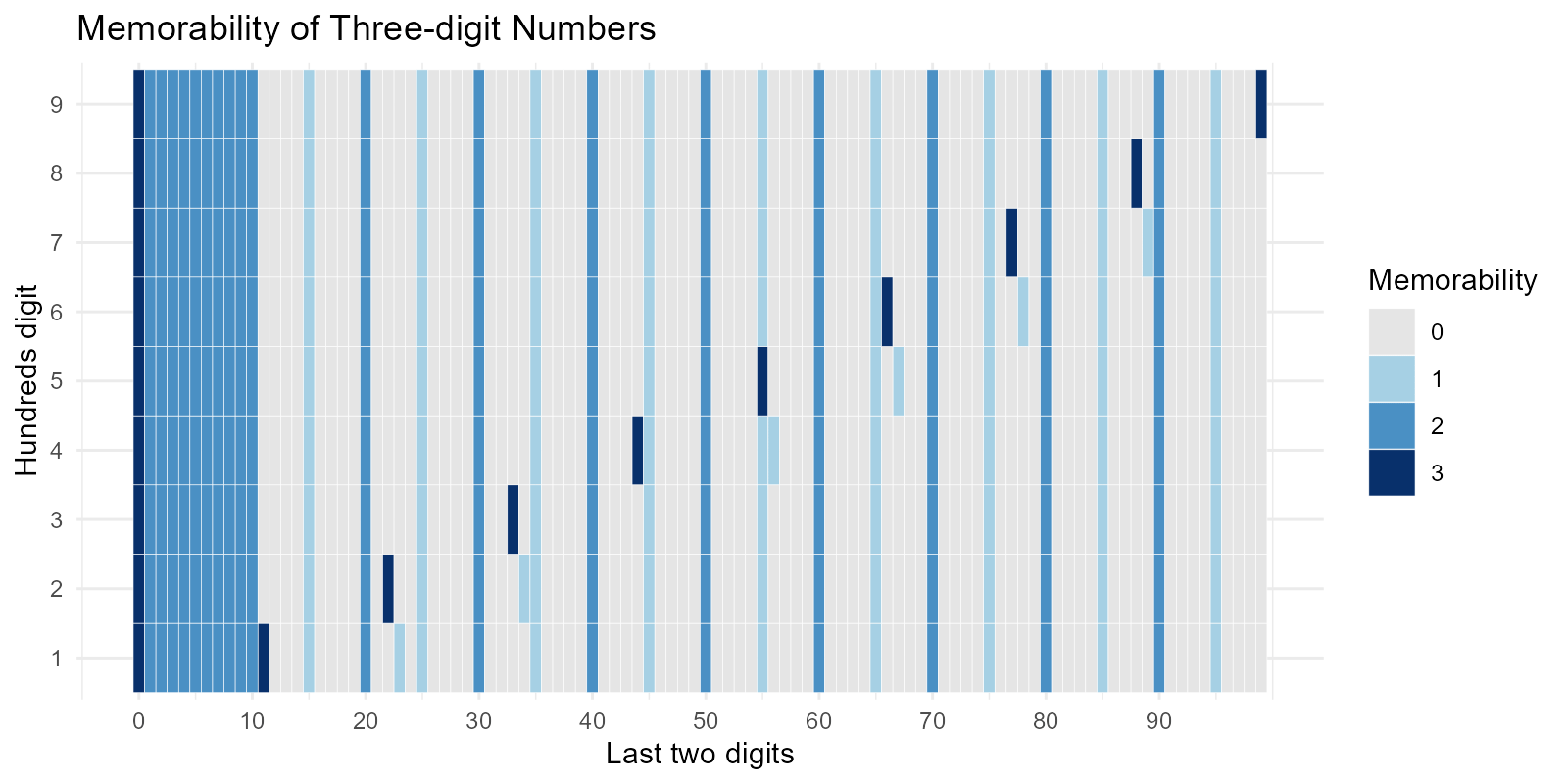
To analyse whether Melbourne’s most frequent and important bus routes possess memorable numbers, we first must classify every three-digit number by memorability. I gave numbers a score based on simplicity and if they contained patterns from 3 (most memorable) to 0 (least memorable):
3 – Hundreds (e.g. 100, 200, 300) and triples (e.g. 111, 222, 333)
2 – Tens (e.g. 990, 880, 350) and middle-zeros (202, 403, 801)
1 – Fives (e.g. 545, 715, 195) and consecutives (123, 456, 789)
0 – All other numbers
Below is a graphic representation of this scheme:
For context, here is a similar chart showing which three digit numbers are Melbourne bus routes:
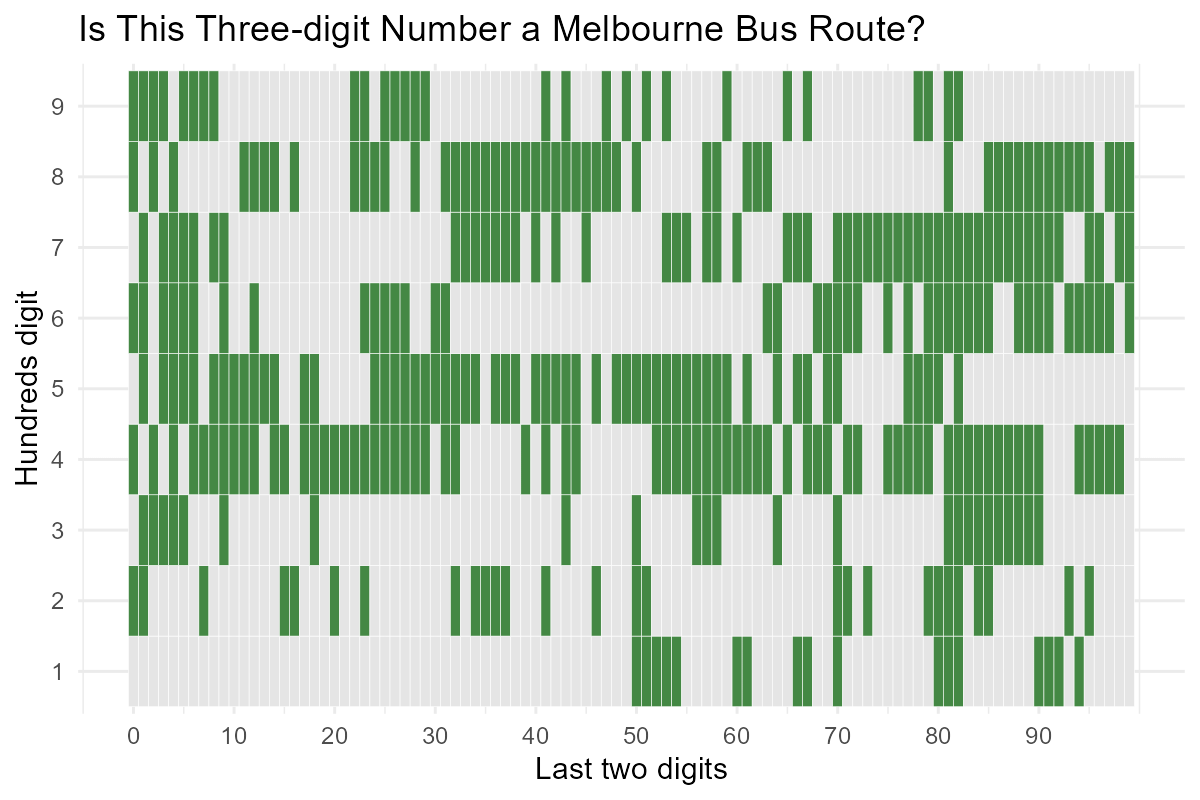
This chart shows Melbourne’s bus network as being numbered in a seemingly random way, with many large gaps. However, the numbers are the product of a long history of schemes, often changing between being operator based to area based. For instance, the 200-300 bus routes were historically government run. For a more in depth look into the history of our bus numbers, check out this video: A history of Melbourne’s Bus Route Numbers
I decided to use the data I produced for FrequencyFinder to describe the average weekday daytime frequency of each of our bus routes.
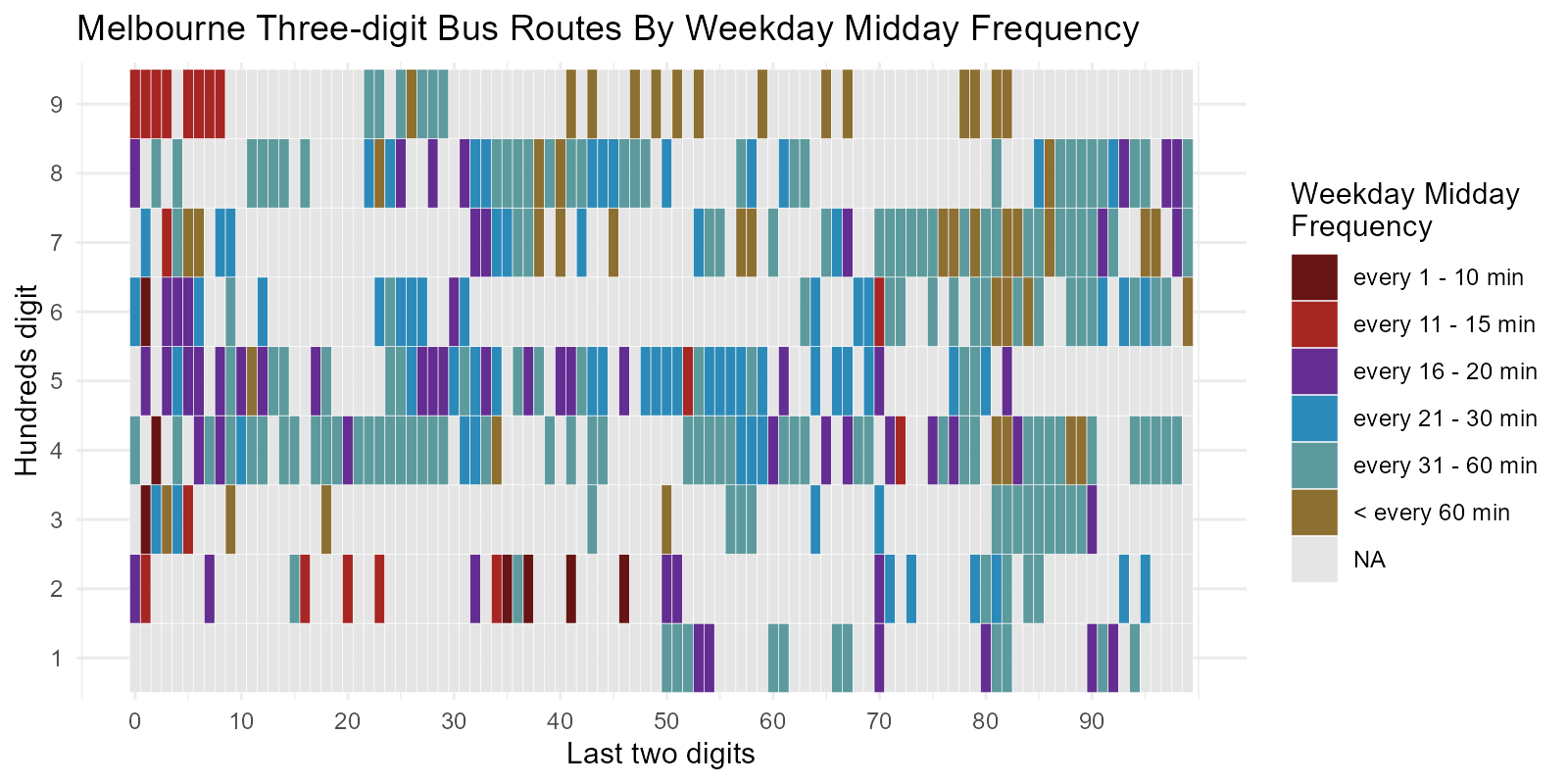
Immediately, some patterns are observable. Routes in the 200s seem to have particularly high frequencies, being largely inner suburban routes, whilst routes in the 400s in the western suburbs have lower frequencies. There are many every 20-minute routes in the 500s, reflective of routes in the inner north, as well as recently upgraded Craigieburn services. The every-15-minute 90x ‘SmartBus’ routes are also prominent, as are the night-network routes with numbers larger than 940.
But is frequency tied to memorability?
I tested this with an ANOVA and found that there was a statistically significant frequency difference between my four memorability groups, albeit with a η² of 0.0838, meaning that differences between memorability group could only explain 8.38% of the frequency variation – a weak effect.
Here is a box plot representing the differences between the groups:
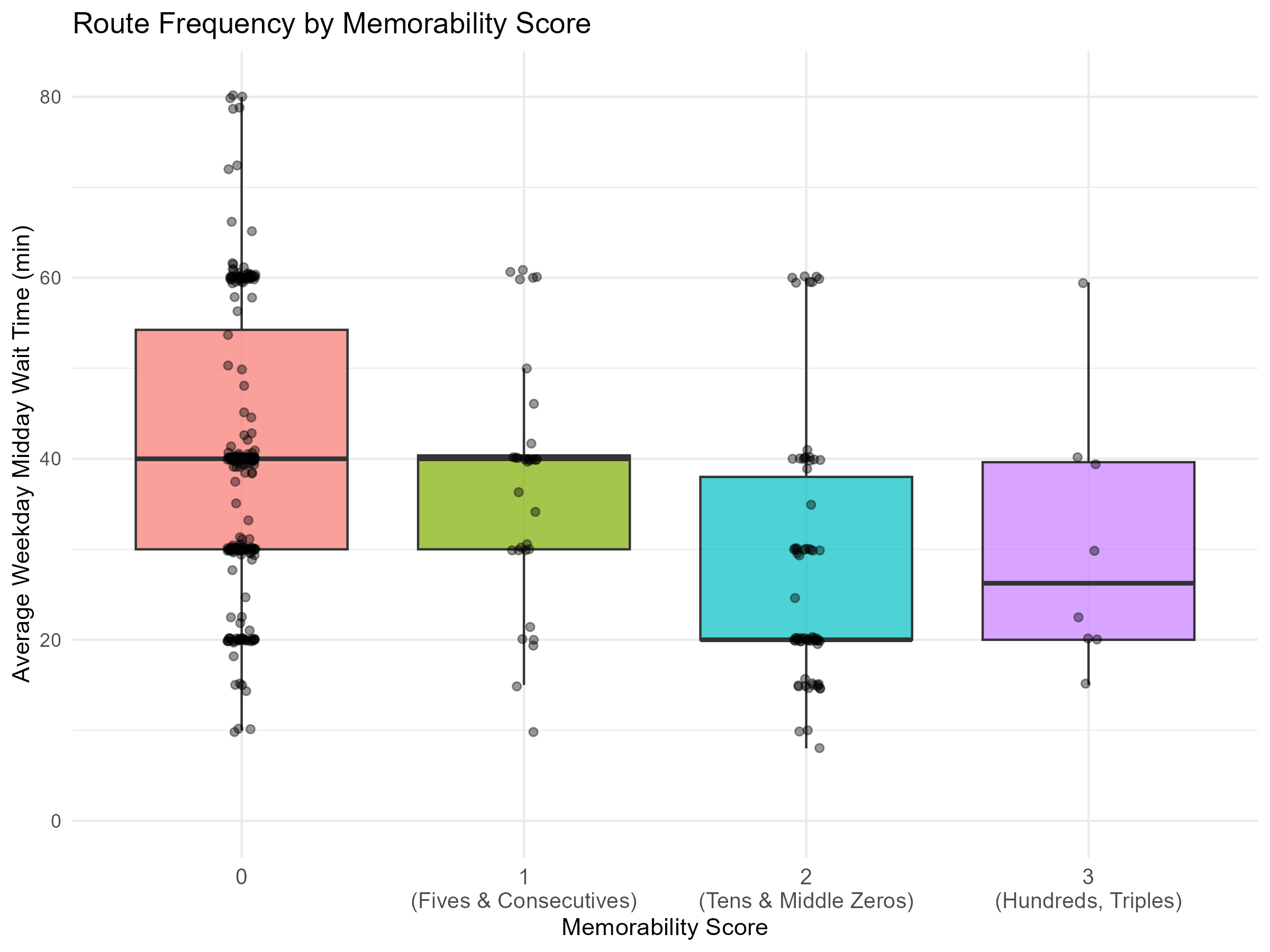
The only statistically robust distinction between the 4 groups was between groups 0 and 2; other comparisons showed suggestive but less certain differences, reflecting increased uncertainty from the smaller sample sizes in groups 1 and 3.
So, Should we Renumber our Buses?
Whilst there was some correlation between number significance and frequency, this is a weak connection. Which brings up the question of whether we should renumber our bus network to ensure the most important, frequent routes hold the most memorable numbers?
Whilst there are plausible network legibility improvements, I think that we should be honest that there is an inherent cost in changing established route numbers. Over years of using a route, people have slowly developed mental associations with these numbers, even if they are initially hard to remember.
So, I lean against a full-scale renumbering, even though I must admit – it would be quite a fun project.
I, however, do think when new routes are added, or routes are significantly changed, we should take the opportunity to choose a number that is proportionally memorable for the significance of the route. For instance, the new 140 is a good number for the route connecting Tarneit to Rockbank. Whilst not so important that it justifies a hundred or a triple number, it will be an important suburban connector once fully operational, worthy of a number that ends in 0.
Bonus: Extra Charts
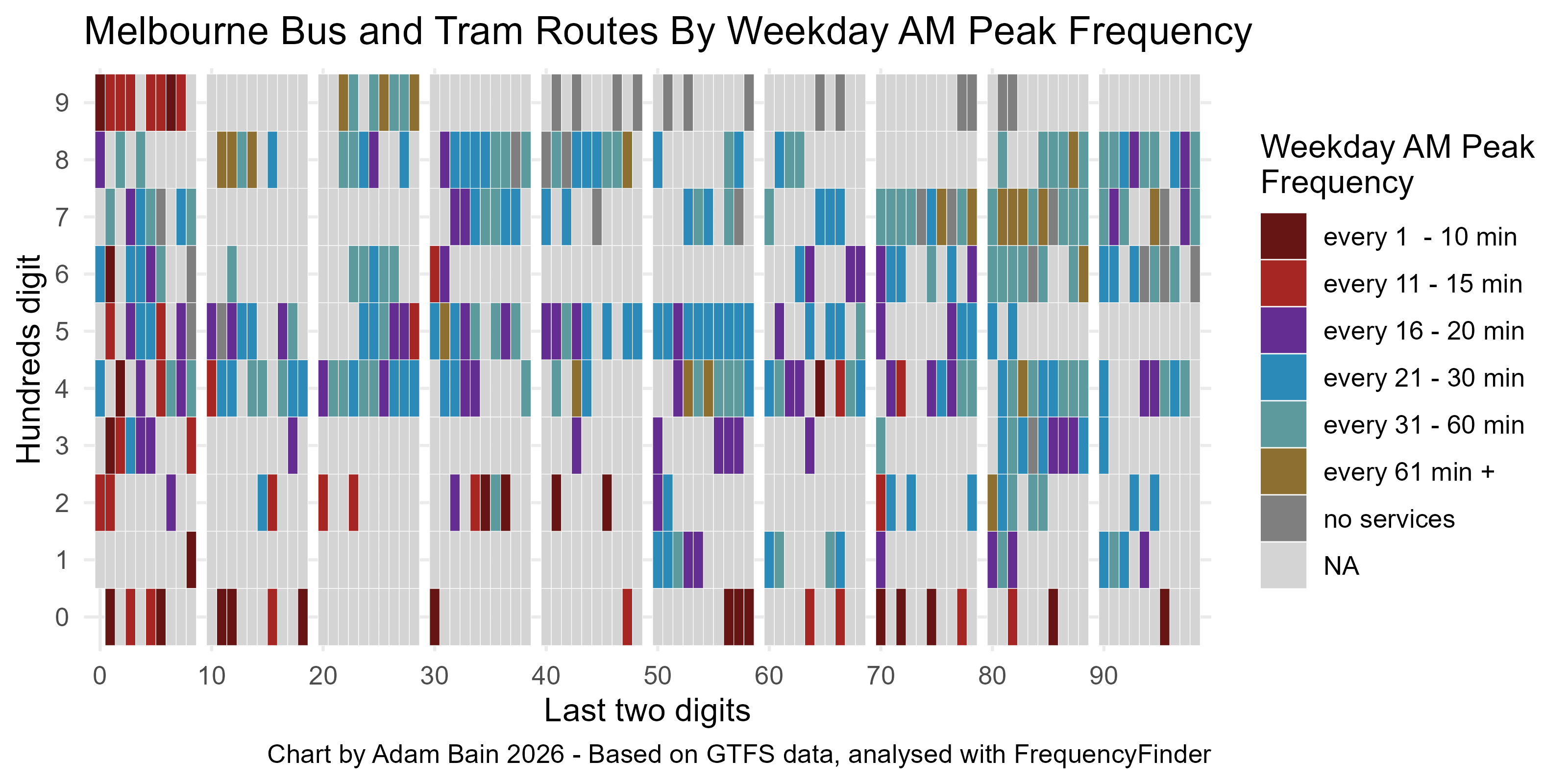
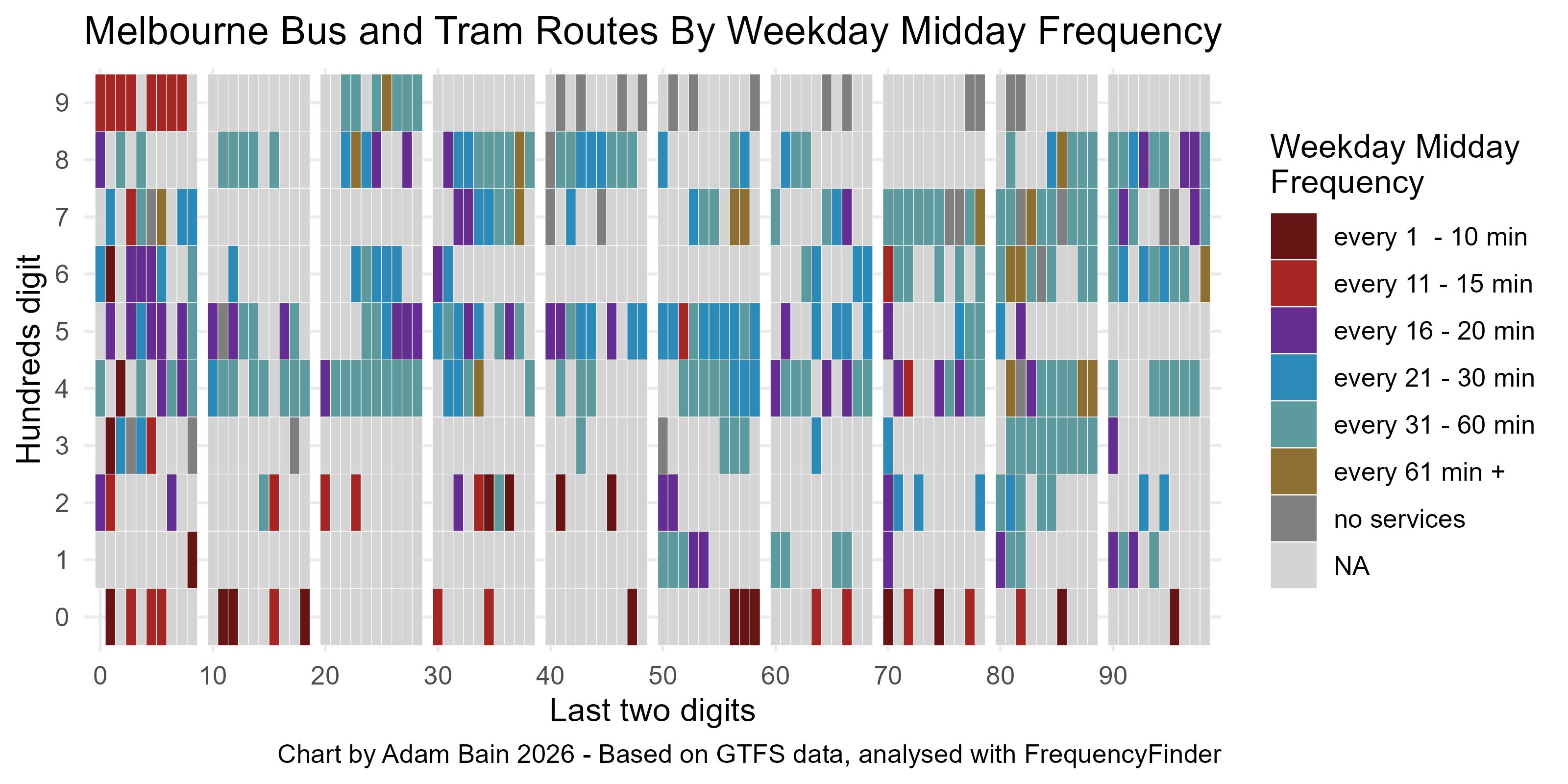
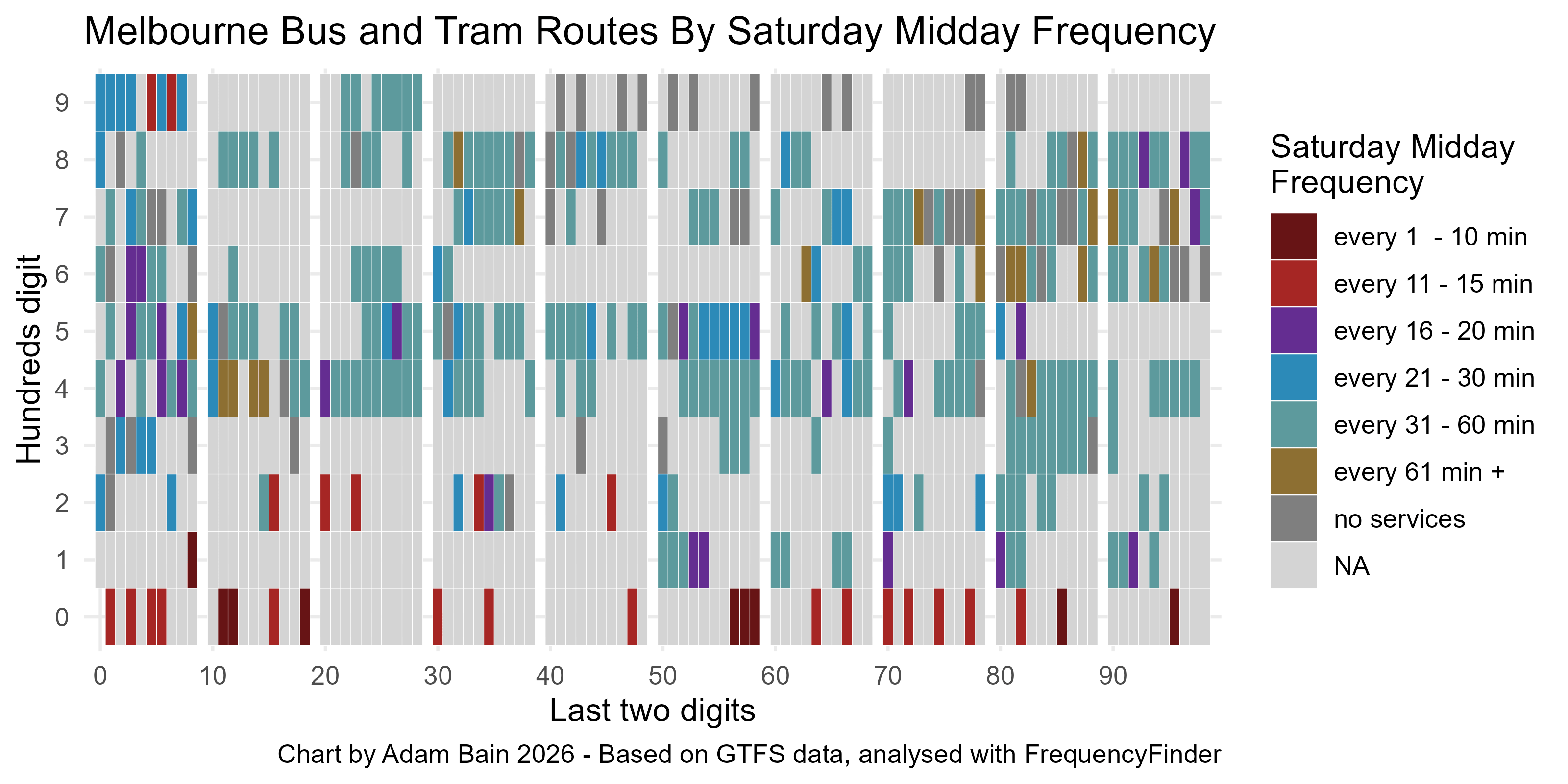
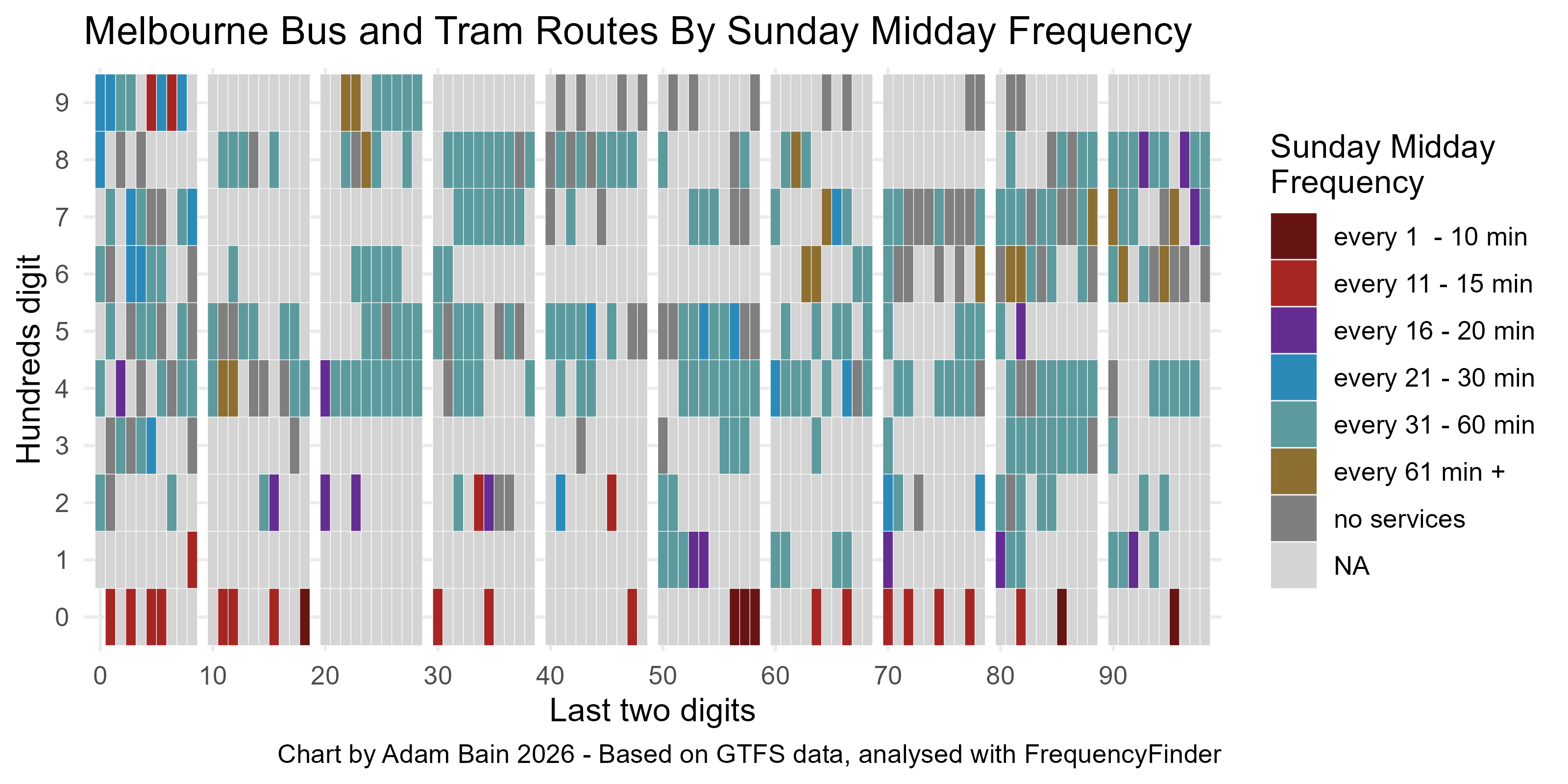
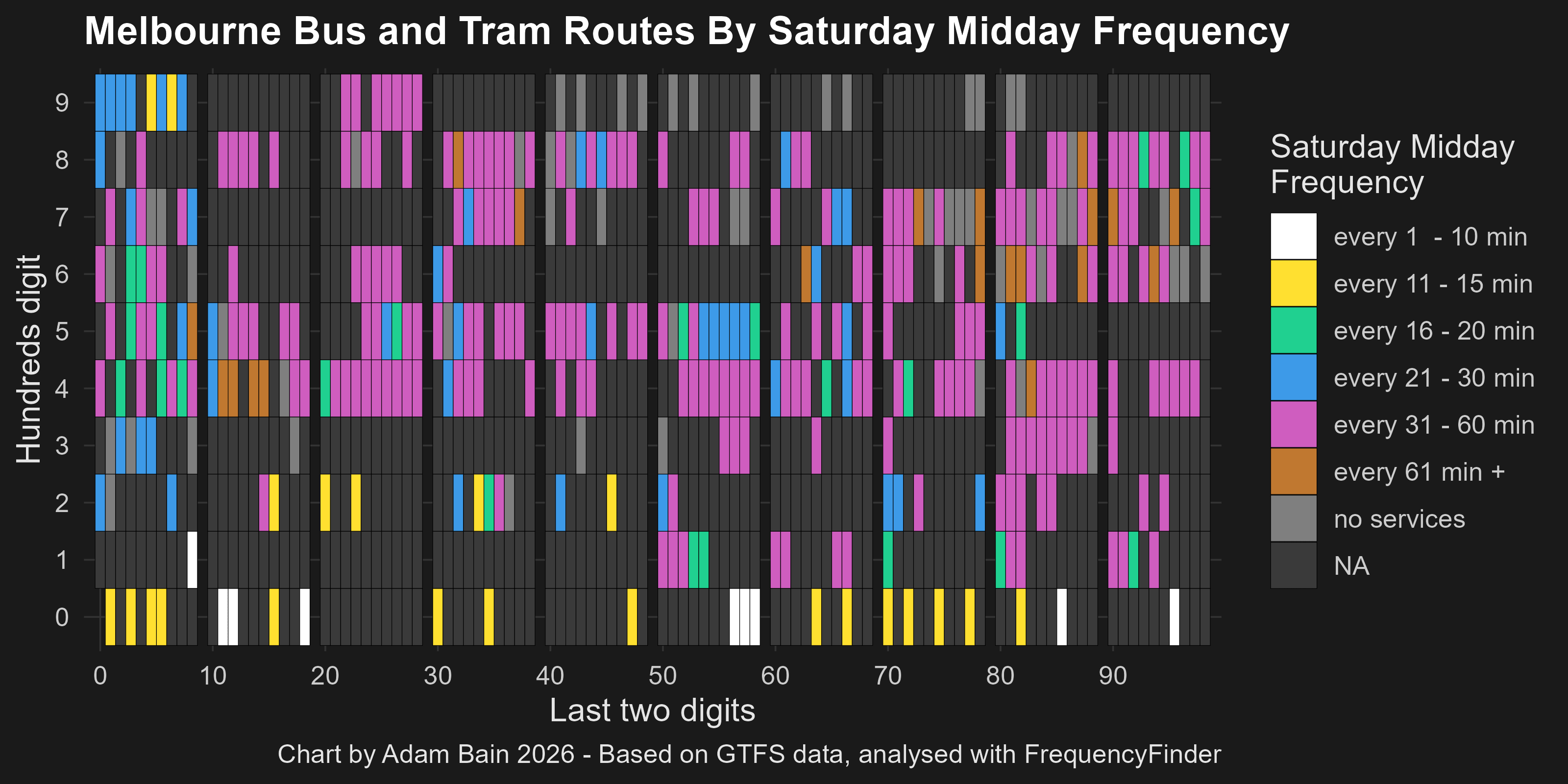
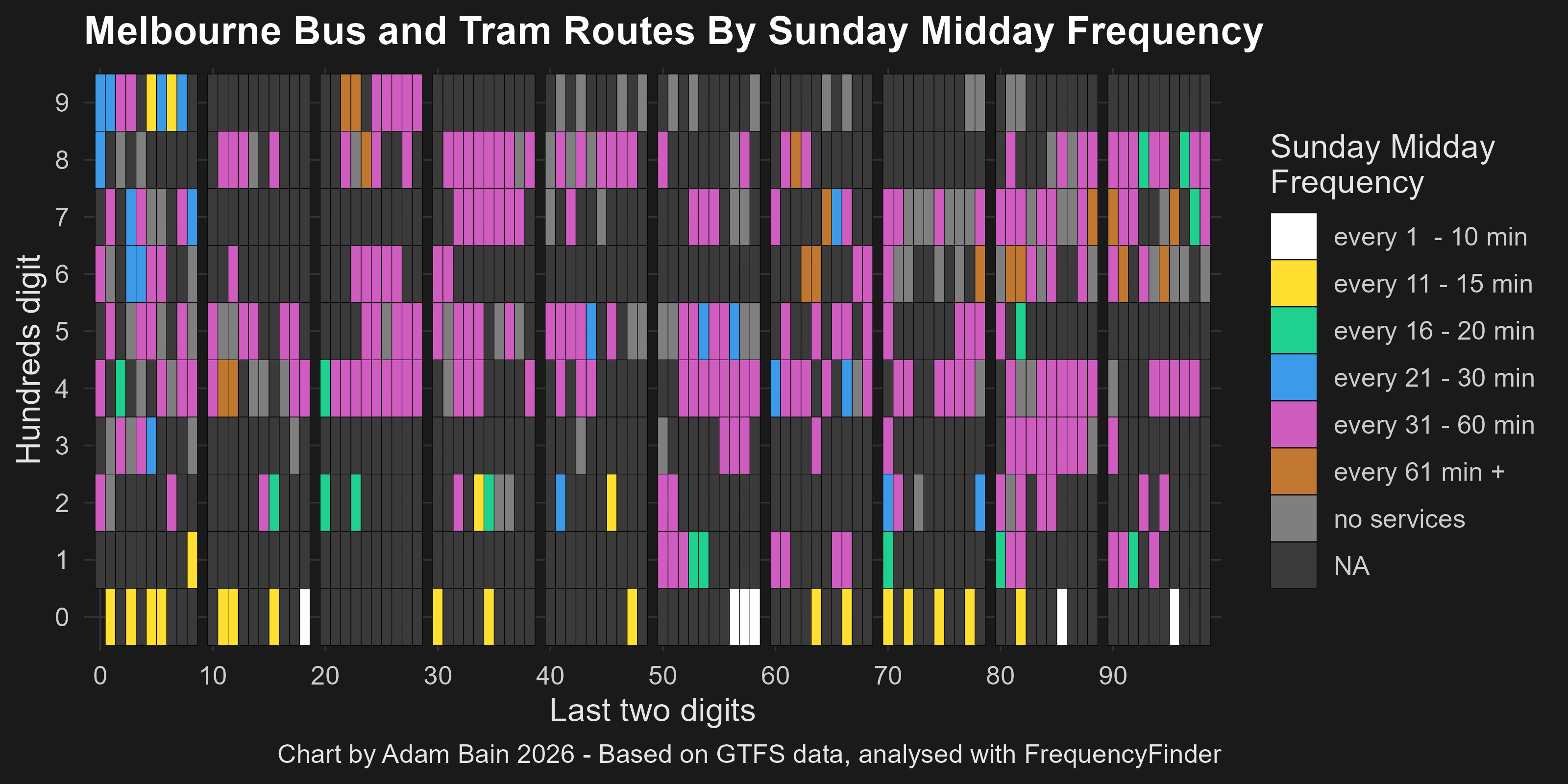
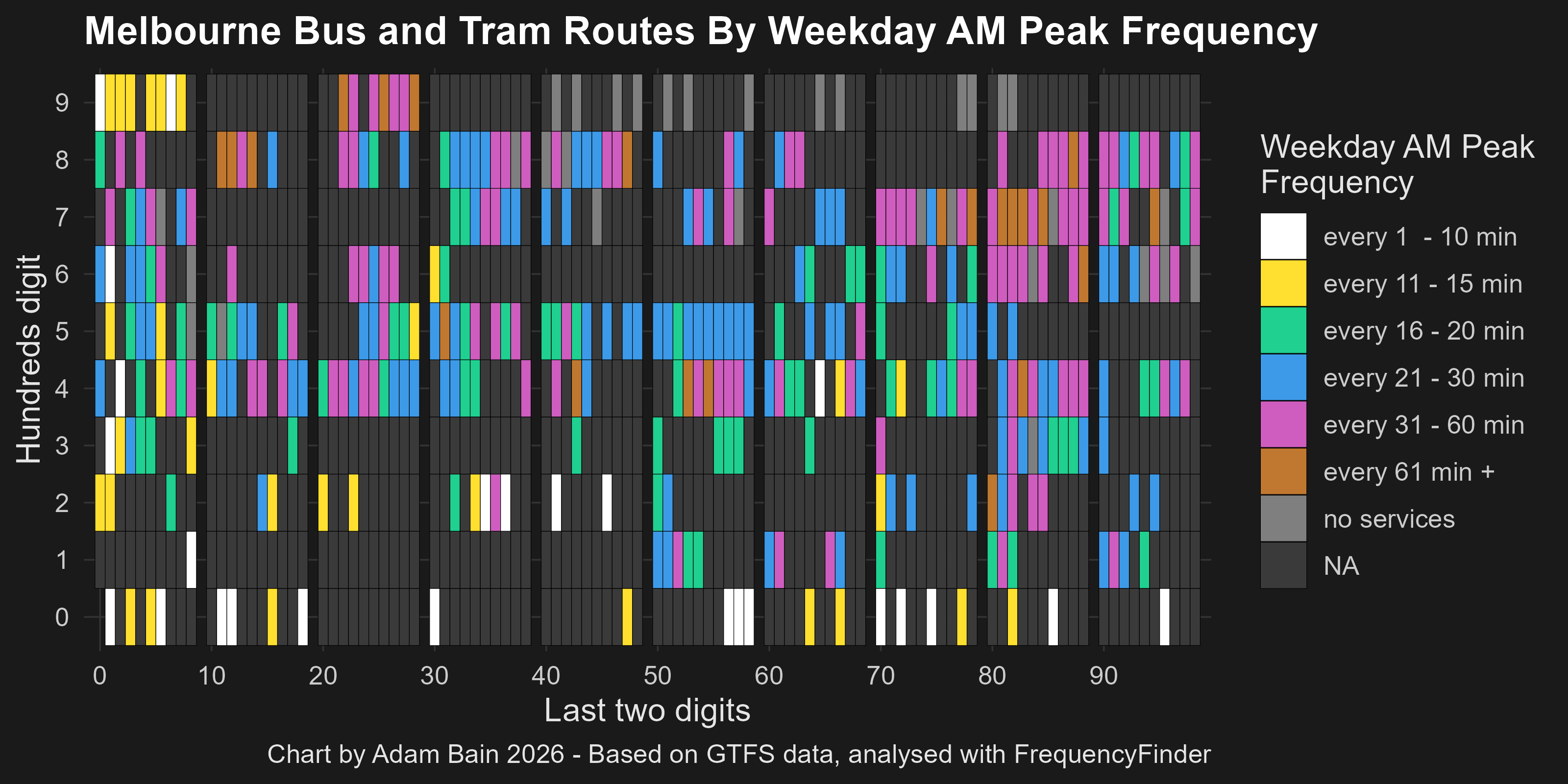
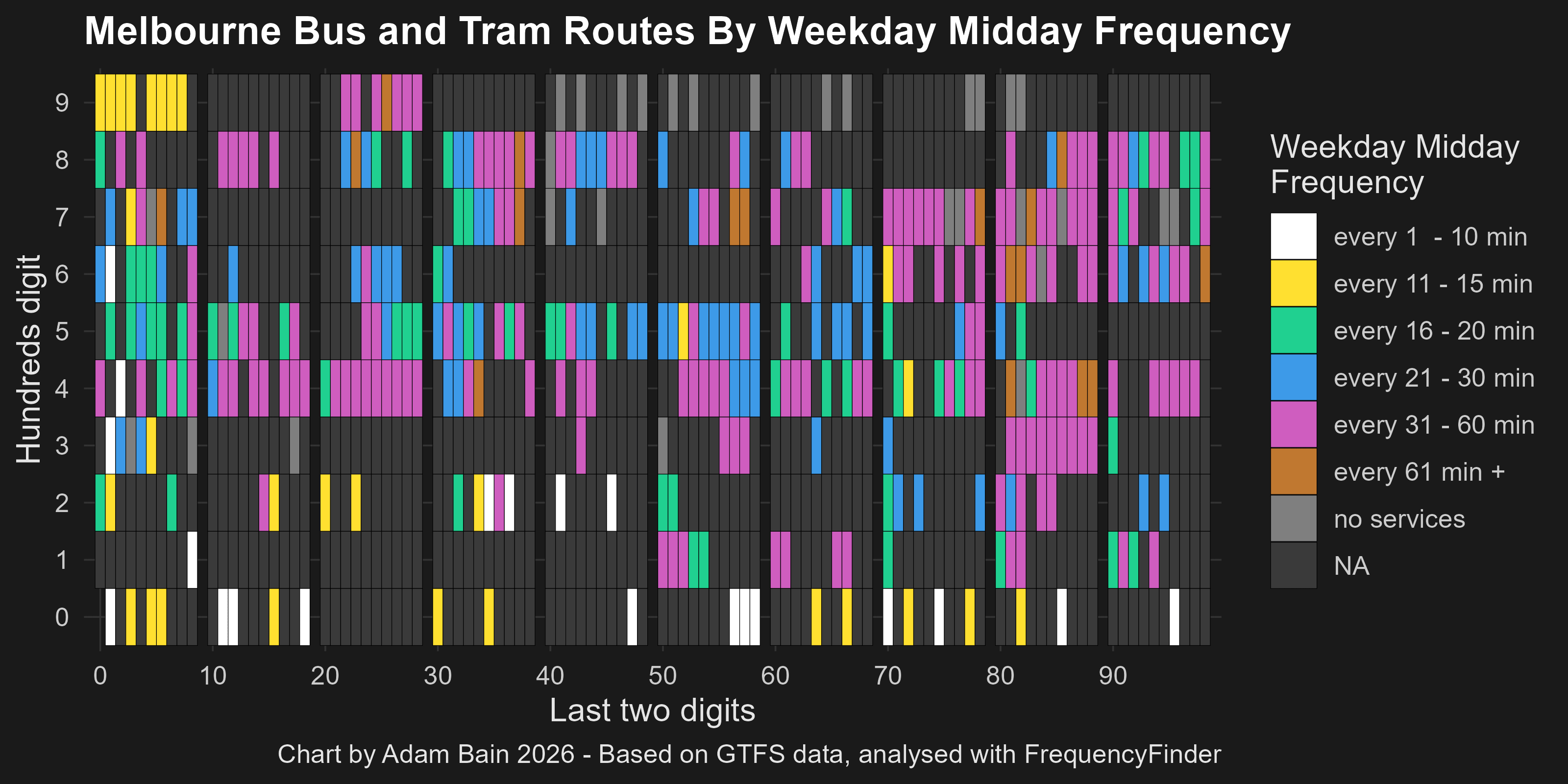
Due to the tile chart’s popularity, I have produced a full set of frequency tile charts (including trams) for Weekday AM Peak as well as midday for Weekdays, Saturdays and Sundays.
Also, dark mode:
Comments
Nothing yet. Say the first thing.
Sign in to join the conversation.