
Boy, is this a lot of TV…
Looking ahead at the remaining ninety-something entries in this challenge, I am beginning to question whether I have accidentally signed myself up for a full-time job. Perhaps a little more foresight would have been useful. Instead, I have committed to watching over one hundred Marvel films and shows before Avengers: Doomsday, writing an essay after every single one, and somehow balancing that with a PhD. Future me is going to have some strongly worded feedback for present me.
Thankfully, Agent Carter Season 2 made that commitment feel worthwhile; yes, even the musical episode, with Jarvis surrounded by feathers and sparkles, certainly makes it an interesting pause in the action drama. The season builds on the tensions, plots and character arcs of the first, but it also changes the stage entirely. Moving from New York to California, Agent Carter enters a world built around reinvention, celebrity and aspiration. New York represents the machinery of post-war America, but, California represents something newer. It represents the emerging cultural power of Hollywood and the promise that anyone can become someone.
Like most dreams, this one has a cost.
Behind the glamour of California’s sunshine and movie studios are the realities that make these dreams possible: racism, corruption, exploitation and the precarious position of immigrants trying to build a life within a society that does not always fully accept them. This season repeatedly asks who gets to participate in this new world, and what they must sacrifice to be recognised as within it. The synopsis tells us:
“Peggy discovers a new city, both old and new friends – and potentially a new love – she's about to learn the bright lights of post-war Hollywood mask a more sinister threat to everyone she is sworn to protect” - comicbookmovie.com synopsis
But perhaps that threat is more pervasive than the plot would have us believe. Through new additions to the cast like Jason Wilkes, Whitney Frost and Ana Jarvis, we start to see that California, to its core, is a place of performance.
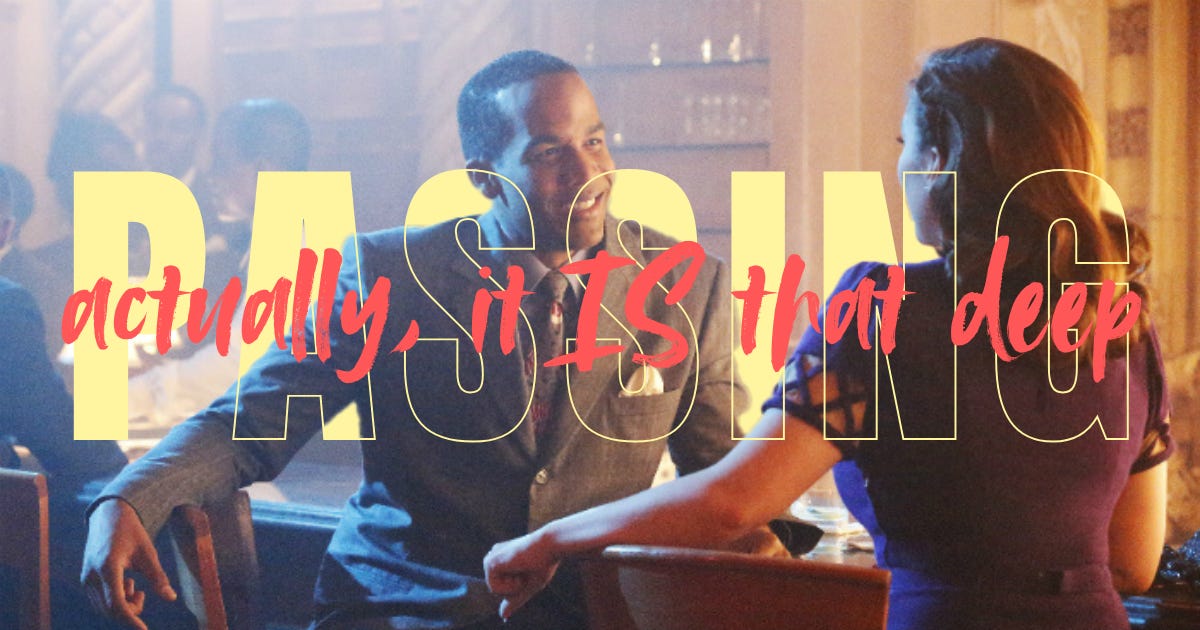
This is where the idea of passing becomes important.
The term has a long and complicated history, most commonly associated with racial identity in the United States. Passing has most commonly referred to the experience of people whose appearance allowed them to be perceived as belonging to a more socially privileged racial category, often to access opportunities, safety or social acceptance denied to them otherwise.
One of the earliest and most influential explorations of passing came through Nella Larsen's 1929 novel Passing, which explored the lives of two Black women who could be perceived as white within segregated America. The novel asks what happens when social identity is not only something we experience internally, but something that is constantly interpreted by others. Passing becomes both an opportunity and a burden: it can provide access to spaces from which someone has been excluded, but it also requires navigating the fear of exposure and the denial of parts of oneself.
Later scholarship moved the discussion of passing away from the individual identity and towards the social structures that make identity meaningful. Passing reveals that identity is not only something we possess, but something that is interpreted, categorised and valued by others. It draws attention to the unequal conditions under which people are recognised as belonging.
Here, Erving Goffman’s The Presentation of Self in Everyday Life (1956) becomes particularly useful. This argues that all social interaction involves some degree of performance, and the act of passing reveals that these performances are not equally voluntary. Some people can choose when to step onto the stage; others are forced onto it simply to participate. Howard Stark’s persona is not comparable to Dr Jason Wilkes professional survival.
Wilkes is not passing in Larsen’s 1929 definition, but he is forced into a performance. His challenge is not concealing who he is; it is navigating a world that has already attached meaning to who he is before he enters the room.
As a Black scientist in 1940s America, Wilkes represents a contradiction. His intellect, education and professional success should make him unquestionably valuable, yet the society around him continually places conditions on that recognition. He is not simply required to be talented; he is required to be exceptional. He must be intelligent without appearing threatening, confident without appearing arrogant, and ambitious without appearing disruptive.
This connects closely to W.E.B. Du Bois’ concept of double consciousness, introduced in The Souls of Black Folk (1903). Du Bois described the experience of seeing oneself both through one’s own perspective and through the gaze of a society that has already constructed assumptions about who you are. The individual is forced to navigate not only who they understand themselves to be, but also how they are interpreted by others.
In many ways, Wilkes’ storyline continues the question raised in Season 1. Peggy Carter asked what happens when someone is capable but denied recognition because of gender. Wilkes asks a similar question through race: what happens when someone has already proven their ability, yet society continues to decide whether they belong?
Wilkes is not alone. Whitney Frost performs the glamorous Hollywood star while struggling against the classed and gendered expectations attached to that role. Ana Jarvis, a Jewish immigrant from Hungary, and Edwin and Peggy, both British immigrants, remind us that belonging is always negotiated. Throughout the season, immigration, nationality, gender and race become different expressions of the same underlying question: who is recognised as belonging, and on whose terms?
Perhaps this is why California works so well as the setting for Season 2. Hollywood is a place built on transformation. It creates stars, reinvents identities and turns performance into reality. Yet Agent Carter asks what happens when the performances required by society are not simply chosen, but demanded.
This is Essay #3 of 102.
Between now and the release of Avengers: Doomsday, I’ll be working through every corner of the Marvel multiverse, using each story as a starting point to explore a bigger question about politics, philosophy and what it means to be human.
If that sounds like your kind of thing, I’d love for you to join me.
Subscribe below to follow the countdown, receive every new essay in your inbox, and let me know your own thoughts in the comments. Whether you agree, disagree, or have a theory of your own, I’d love to hear it.
If you want to learn more about the theories mentioned here, why not check them out? They should be available at your local library or through second-hand book sellers. They are both great reads that say far more than I can fit in this quick 600-word reflection.
Du Bois, W. E. B. (1903). The Souls of Black Folk.
Goffman, E. (1956). The Presentation of Self in Everyday Life.
Larsen, N. (1929). Passing.
No posts
Comments
Nothing yet. Say the first thing.
Sign in to join the conversation.