
“The war’s over, leave it to the professionals”
It would have been so easy for the MCU to pretend that Captain America somehow solved all of Peggy Carter's biggest problems. Steve Rogers recognised her. Howard Stark trusted her. Phillips realised her potential in the SSR. The audience is well aware of her capabilities. Yet when the war ends, none of that seems to matter.
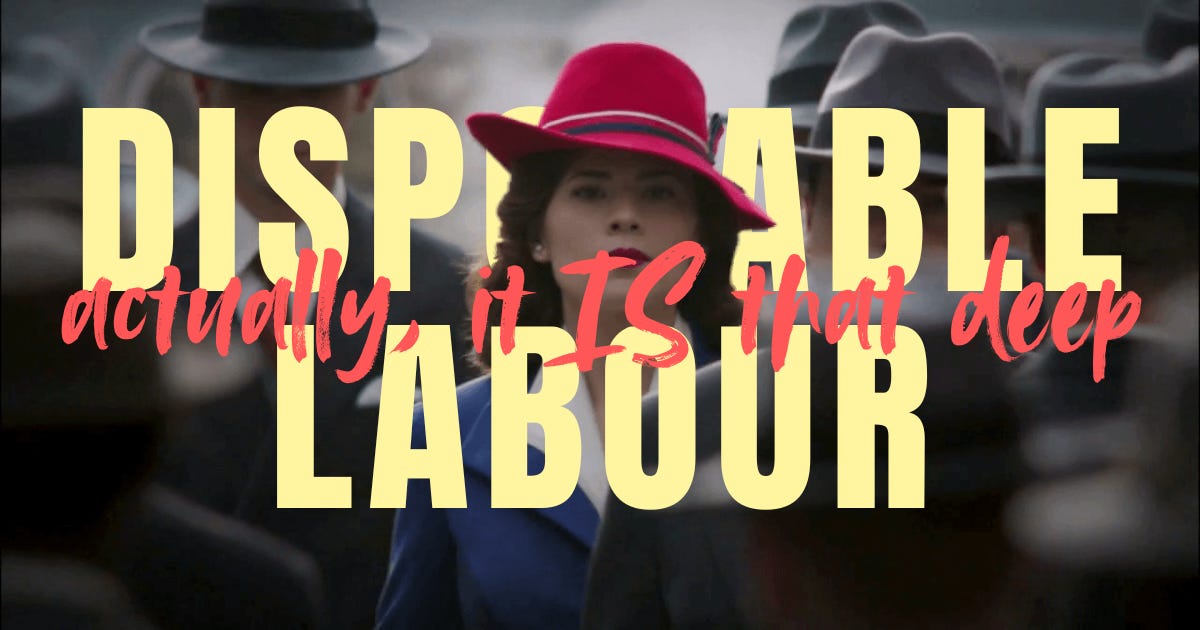
It’s not a stretch to read Agent Carter Season 1 as an exploration of the changing political value of women’s labour in a post-war America. One of the first characters we are introduced to is laid off from their factory job to make way for the men returning from the front. During wartime, her labour was an invaluable service that kept America running: essential. In peacetime, she is disposable.
She isn’t alone. We see through Peggy that it is not one factory, nor a specific ‘typically male’ industry, but an entire societal shift impacting office workers, vetrans and everyone in between.
Having served and practically ran oporations with the Strategic Scientific Reserve throughout the war, Peggy now finds herself relegated to administrative work while the men around her take credit, make the decisions and dismiss her experience. Her first interactions with her colleagues are filled with some pretty aggressive misogyny: full of male bravado, slut shaming, fabricated lies about how Peggy acted during the war (with particular focus on her romantic relationships), weaponised incompatence and nearly every trick in the book to dismiss her and her achievements.
It is clear that we are in a very different time for women from Captain America: The First Avenger. There, Peggy was underestimated, but she still occupied an important place within the war effort. In Agent Carter, the war is over, and so, too, it seems, is the institution's need for women like her. With the men back, the demand has disappeared.
This tension has been extensively explored by feminist scholars who show that institutions do not simply reward merit; they actively produce and police it through gendered assumptions about who counts as a legitimate worker. Joan Acker argues that organisations are built around an “ideal worker” who is imagined as fully available, detached from care (no children or dependents), and implicitly male. Peggy’s wartime success proves her competence, but peacetime exposes the fact that competence alone is not enough when the institution is structured to restore masculine authority. Rosabeth Moss Kanter adds another useful insight here: women in male-dominated settings are often treated as exceptions, highly visible when useful, but never fully allowed to redefine the norm, something proven very true for Agent Carter within the SSR.
Silvia Federici helps explain why this exclusion is so durable. Her work on the devaluation of women’s labour shows how work performed by women is often treated as natural, supportive, or temporary rather than as a source of authority. Agent Carter dramatises this logic. The shift, while portrayed as economic, is ideological; it restores the fantasy that power belongs to men by default.
What makes Agent Carter so refreshing is that it does not simply point at sexism and say “that’s bad” or “that’s mean”. It explores labour and the inequality of efforts through changing times. It dives into how inequality was used within the working class to manufacture stability, both socially and economically, at the cost of women.
Note: While this essay focuses on women’s labour through Peggy Carter’s experience, this wider pattern of labour being valued temporarily and then discarded has historically affected many marginalised groups, including racial minorities and disabled communities.
This is Essay #2 of 102.
Between now and the release of Avengers: Doomsday, I’ll be working through every corner of the Marvel multiverse, using each story as a starting point to explore a bigger question about politics, philosophy and what it means to be human.
If that sounds like your kind of thing, I’d love for you to join me.
Subscribe below to follow the countdown, receive every new essay in your inbox, and let me know your own thoughts in the comments. Whether you agree, disagree, or have a theory of your own, I’d love to hear it.
If you want to learn more about the theories mentioned here, why not check them out? They should be available at your local library or through second-hand book sellers. They are both great reads that say far more than I can fit in this quick 600-word reflection.
Acker, J. (1990). Hierarchies, Jobs, Bodies: A Theory of Gendered Organizations. Gender & Society, 4(2), 139–158.
Kanter, R. M. (1977). Men and Women of the Corporation.
Federici, S. (2004). Caliban and the Witch: Women, the Body and Primitive Accumulation.
No posts
Comments
Nothing yet. Say the first thing.
Sign in to join the conversation.