
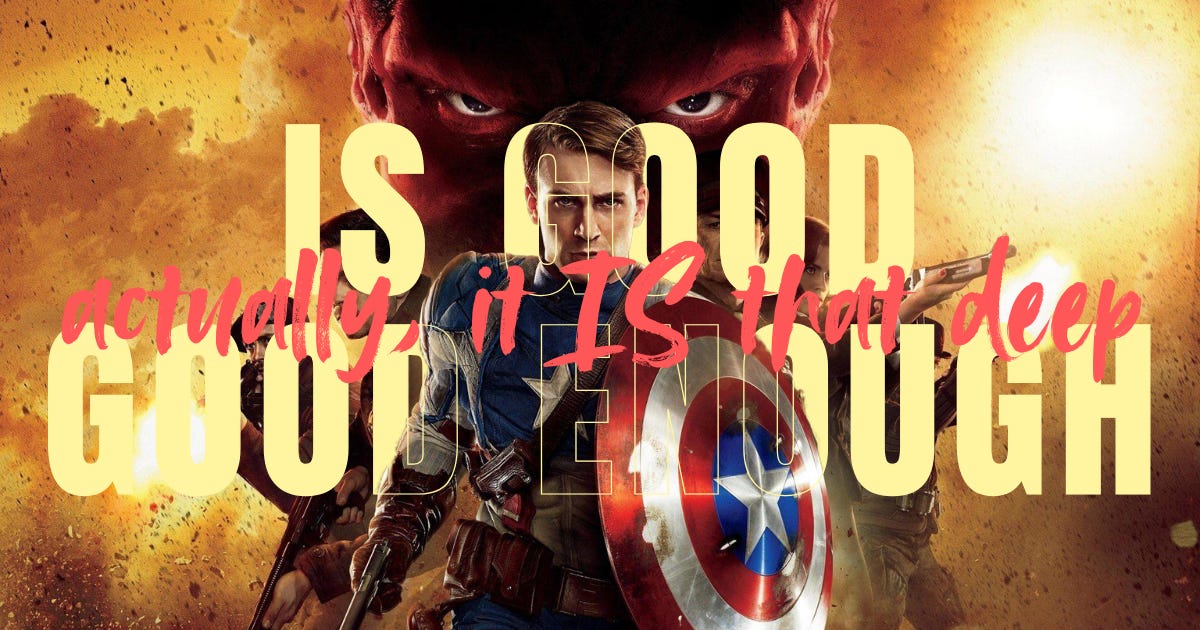
This will forever be one of my favourite films in the MCU. It has everything that makes Marvel work at its best: action, drama, compelling relationships and genuine character development, all tied together with brilliant period aesthetics. The dynamic between Steve Rogers, Bucky Barnes and Peggy Carter is one of the strongest in the franchise, and even before the shield becomes an icon, the film gives us a hero worth believing in.
Although Iron Man was the first MCU film released, Captain America: The First Avenger is where most chronological MCU journeys begin. In many ways, it sets the moral tone for the next 102 stories. Before there were gods, aliens, multiverses or Infinity Stones, there was a simpler question: what makes a hero?
At first, the answer seems straightforward. Dr Erskine rejects the military's obsession with physical perfection, insisting that the super soldier serum should be given not to the perfect soldier, but to "a good man." Steve Rogers enters the film as a catalogue of deficiencies: asthma, poor eyesight, a body repeatedly judged unfit for military service. Yet every rejection becomes another opportunity to demonstrate courage. He keeps getting back up, and that persistence is what makes him stand out long before he ever becomes Captain America.
The grenade scene captures this perfectly. While the other recruits instinctively scatter, Steve throws himself onto what he believes is a live grenade. He expects to die if it means everyone else gets to live. But there is another person who moves towards the danger. Peggy Carter steps forward. It is a subtle moment, easy to overlook because Steve's sacrifice dominates the scene, but Peggy demonstrates the very same instinct. She does not run; she moves towards responsibility. If the film is asking what qualities make a hero, Peggy quietly passes the same test.
This is where The First Avenger becomes more interesting than a simple battle between good and evil. The film tells us that virtue determines who deserves power, but in practice, it shows us that institutions determine whose virtue is recognised. Steve is repeatedly rejected because his body fails to meet the military's expectations of what a soldier should be. Peggy is never considered for the serum at all, not because she lacks courage, intelligence or leadership, but because she is a woman. Both possess the qualities Erskine values, yet only one is recognised as a legitimate candidate.
This reflects what Michel Foucault argued about power. Institutions do not simply distribute power; they produce the categories through which power becomes legitimate. The military is not merely searching for a hero; it is deciding what a hero is allowed to look like (which in turn shapes the power structures of society). Steve only becomes Captain America because Dr Erskine interrupts that process of recognition and sees beyond a body the institution has already dismissed. But even that interruption has limits.
Political philosopher Iris Marion Young argued that injustice is often structural rather than individual, embedded within the assumptions of institutions themselves. Peggy possesses many of the same moral qualities as Steve, alongside years of military experience, strategic knowledge and professional competence. Yet none of these makes her eligible. Her exclusion is not a reflection of her character; it is a reflection of the institution's imagination.
Perhaps that is why the title of this essay is not What Makes a Hero? But is Good Good Enough? For Steve, goodness becomes enough only because someone in power chooses to recognise it. For Peggy, goodness is never enough because no one ever offers her the opportunity. Captain America: The First Avenger, therefore, leaves us with an uncomfortable truth: character may determine who deserves power, but institutions often determine who receives it.
As we move into Agent Carter, that question becomes even more compelling. What happens when someone has already proven themselves worthy, yet still has to fight to be recognised?
This is Essay #1 of 102.
Between now and the release of Avengers: Doomsday, I’ll be working through every corner of the Marvel multiverse, using each story as a starting point to explore a bigger question about politics, philosophy and what it means to be human.
If that sounds like your kind of thing, I’d love for you to join me.
Subscribe below to follow the countdown, receive every new essay in your inbox, and let me know your own thoughts in the comments. Whether you agree, disagree, or have a theory of your own, I’d love to hear it.
If you want to learn more about the theories mentioned here, why not check them out? They should be available at your local library or through second-hand book sellers. They are both great reads that say far more than I can fit in this quick 600-word reflection.
Foucault, M. (1977). Discipline and Punish: The Birth of the Prison.
Young, I. M. (1990). Justice and the Politics of Difference.
No posts
Comments
Nothing yet. Say the first thing.
Sign in to join the conversation.