
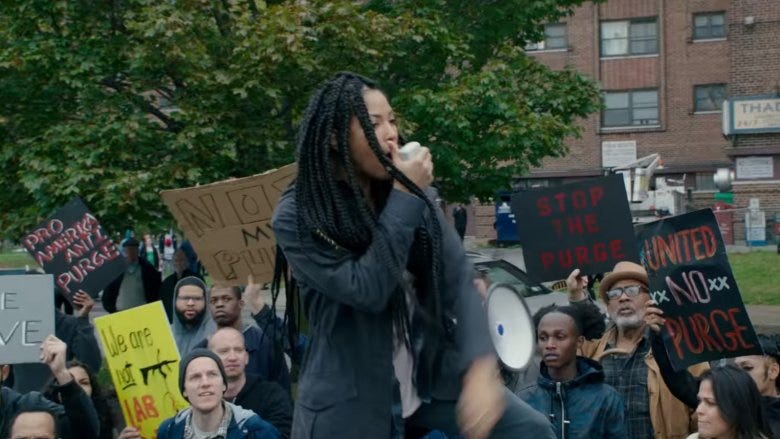
The Purge franchise has never been one to shy away from political themes, slathering its movies with them as thick as the white paint landlords use to cover damp growing in your bathroom.
I kind of like that about these films, though. There is something refreshingly shameless about a movie that refuses to pretend it is not making a point. Not every political message needs to be delivered with the subtlety of a whisper; sometimes it arrives wearing a mask, holding a baseball bat, and shouting about structural inequality.
I’m sure everyone knows the premise by now: in a fictional United States, one night a year makes all crime legal. It is a horror setup, yes, but it is also a really convenient way of asking what happens when violence is made policy, and the people most exposed to it are already living with the least protection.
This film is especially interesting to me because it overlaps so neatly with the question of consent. Not just in the abstract, philosophical sense, but in the very practical research-methods sense: can vulnerable people actually consent to research in a meaningful way, or are they simply responding to the only option available to them?
That is the question this post is really about.
$5000 and the Price of Risk
In the fictional timeline where crime, a housing crisis, and opioid epidemics are out of control, a pilot study is proposed to help “deal” with all the socio-political antagonists. This pilot takes place on Staten Island and offers participants $ 5,000 to stay on the island, with a tracking device implanted in their arm so their behaviour can be monitored.
While paying participants in research is not inherently unethical, in fact, in most experiments, participants are compensated for their time, for travel, for the inconvenience or as a thank you.
But the amount, $ 5000, is staggering. Even for a 12 hour experement, it is an astronomical amount of money, equalling around $417 per hour. Not bad for staying in your homes for a night. Within the context of the film, it is transformative. Characters explicitly frame it as life-changing, enough to override hesitation and minimise perceived risk.
This is where the concept of undue inducement becomes critical. As discussed by Ezekiel Emanuel and colleagues in their framework for ethical research, valid consent requires that participation is voluntary, not shaped by offers that are so attractive they impair judgment.
The issue is not that participants are irrational. It is their circumstances that make the offer disproportionately powerful. Economic vulnerability narrows the field of “reasonable” choices, making acceptance the most viable option.
In that sense, the study is not simply compensating participants. It is leveraging inequality to secure participation.
And that has direct implications for consent. If declining the offer carries a meaningful cost (like everyone around you being 5k richer come morning), then agreeing to it is not entirely free.
Informed Consent: Disclosure Is Not the Same as Understanding
The film makes a point of showing that at least some participants are told that violence (including murder) is a possibility. But it also makes it clear that this information is not uniformly understood.
Early in the experiment, there is a notable lack of participation. People stay indoors, treat the night as uneventful, and assume they can collect their payment without engaging in risk. This behaviour suggests that many participants interpret the experiment as something they can passively endure rather than actively survive.
This gap between disclosure and understanding is central to debates around informed consent. As outlined in Principles of Biomedical Ethics, consent requires not just information, but comprehension. Participants must grasp the nature, likelihood, and severity of risks in order to make a meaningful decision.
If participants underestimate those risks or believe they can opt out of them through minimal engagement, then consent becomes ethically unstable. The film does not show outright deception. Instead, it shows something more subtle and arguably more common: insufficient understanding.
And in research ethics, that distinction matters very little. Consent that is not fully informed is not fully valid.
Paid Participation: Incentivising Behaviour, Not Observing It
The experiment escalates when participants are offered additional money for “further participation.” At this point, the study crosses from observation into intervention.
Participants are no longer simply being monitored; they are being encouraged to act, with financial incentives tied directly to escalation.
From a methodological perspective, this introduces significant bias. Behaviour is no longer spontaneous; it is shaped by reward structures. What is being measured is not how people behave under certain conditions, but how they respond to incentives.
Here, the design actively contaminates its own data.
From an ethical perspective, the issue is even sharper. Participants are not just exposed to risk; they are paid to increase it. Harm becomes a variable that can be amplified through compensation.
At that point, the study is no longer examining behaviour. It is engineering it.
And that distinction fundamentally undermines both its ethical and scientific legitimacy.
The Right to Withdraw: Consent That Cannot Be Revoked
One of the most basic principles in research ethics is the participant’s right to withdraw. Individuals should be able to leave a study at any time, for any reason, without penalty.
In The First Purge, this principle is effectively nonexistent.
The $5000 payment is contingent on remaining for the full duration, creating immediate pressure to stay. More critically, once the experiment begins, withdrawal becomes practically impossible. The island is contained, violence escalates, and leaving is impossible with the closure of all bridges and exits.
A right that cannot be exercised is not a right.
What the film presents is a form of locked-in consent, an agreement that cannot be meaningfully revoked once conditions change. Participants may have consented at the outset, but they are not able to reassess or withdraw that consent as the situation deteriorates.
Which raises a fundamental issue: consent is not a one-time event. It is an ongoing process. And in this experiment, that process is systematically denied.
TAKEAWAY
It does not take a genius to realise that the ‘Purge’ is not an ethical experiment; in fact, that is kinda the point. But what it does reveal, perhaps more effectively than it intends, is how fragile the concept of consent becomes under pressure.
The franchise has always leaned into a kind of consequentialist logic: one night of violence is acceptable if it produces stability for the other 364. What I am arguing here is not about whether that logic holds. It is that even as research, the experiment fails on its own terms.
The participants are selectively recruited, the incentives are disproportionate, the risks are not fully understood, and the right to withdraw is effectively removed.
The fact that the ethics of this experiment are so poor is not incidental; it is part of the point. It exposes the bias, the political pressure, and the predetermined outcomes that sit behind the study. These are aspects deserve their own post to fully get into.
But for now, what matters is this: good research is not just about what you are trying to find out, but how you go about finding it. Ethics is not an afterthought or a bureaucratic step; it is what makes research legitimate in the first place.
And it is worth remembering that this has not always been guaranteed. From anthropology to medical trials, when ethics is overlooked it gives way to exploitation, bias, and harm disguised as knowledge.
Which is, perhaps, the real horror story.
Thank you for reading! This blog is intended as a way to engage with the literature and themes I encounter in my research in a more accessible, reflective format. It allows me to process ideas and share insights without subjecting readers to the full scope of 1.5 years of research.
If this piece resonated with you, I encourage you to explore the literature that inspired it (some references are listed below). Please note that this blog offers only a surface-level introduction, there is only so much a couple of thousand words can capture. Think of it as a precursor to more in-depth journal articles to come.
Please, join the conversation. I would be fascinated to know how your research or experience resonates in pop culture!
[1] The Belmont Report (1979)
[2] Emanuel, E. J., Wendler, D., & Grady, C. (2000) - What Makes Clinical Research Ethical?
[3] Blackburn (2003) - Ethics: A Very Short Introduction
Comments
Nothing yet. Say the first thing.
Sign in to join the conversation.