
One journalist and documentary maker whose work I have admired for years is Simon Reeve. Much of Reeve’s work focuses on borders, geopolitics, and the uneven realities of globalisation. His documentaries frequently reveal stark juxtapositions of power and freedom—inequalities and paradoxes that exist in places separated by little more than a few inches of concrete or a stretch of water.
A striking example appears in one of his documentaries on the Mediterranean when he visits Ceuta. Now, many might not know much about Ceuta: a small Spanish enclave on the northern coast of Morocco. Although geographically located in Africa, Ceuta is politically part of Spain and therefore the European Union. It is one of the only land borders between Europe and Africa, and as a result, it has become one of the most fortified and politically sensitive borders in the region.
What does any of this have to do with some zombie thriller (or zombie-adjacent for those zombie purists)?
The connection lies in a paradox visible throughout Reeve’s visit.
In the forests near the border, Reeve speaks with migrants who have travelled thousands of kilometres to reach this point. Many are waiting for an opportunity to climb the imposing fences separating Morocco from Spanish territory. Some have attempted the crossing multiple times. Some have been injured doing so. Others speak about friends who were not as fortunate. Yet despite the risks, they remain there, waiting for a chance.
Meanwhile, Reeve himself is able to cross borders with relative ease. With a hop, skip, and a short boat journey, he can move freely between countries.
The difference between him and the people he interviews is not intelligence, ambition, or moral worth. Instead, it lies in a small booklet he carries: a passport.
More specifically, a British passport.
Migration scholars often describe this disparity as citizenship stratification or passport inequality, the global hierarchy that determines whose mobility is facilitated and whose is restricted. Sociologist Ayelet Shachar famously described this phenomenon as “the birthright lottery”, arguing that citizenship functions like inherited property: it distributes life chances based largely on the circumstances of birth.
In this sense, the difference between Reeve and the migrants outside Ceuta can be described as an accident of birth.
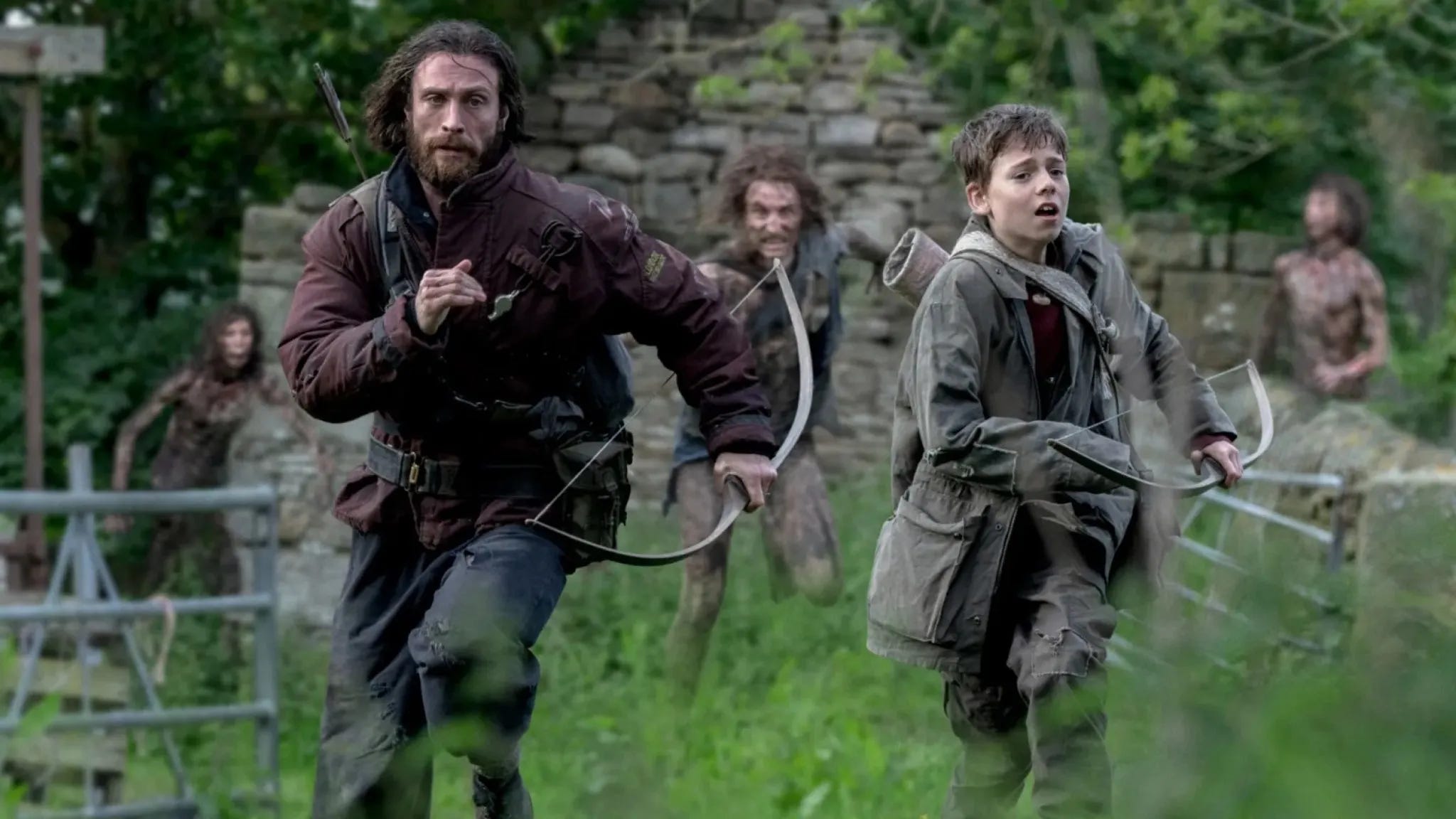
Curiously, one of the most striking cultural explorations of this idea does not come from a political documentary or a migration study, but Danny Boyle’s thriller 28 Years Later (2025).
Perhaps this is because the story is set in the United Kingdom. The film allows viewers to imagine a reversal of familiar assumptions: a country normally associated with global mobility suddenly becomes isolated from the world beyond its borders.
Within this fictional scenario, we see three perspectives: those who lived through the collapse, those who were born into the isolation that followed, and those who encounter the quarantined territory from outside.
Seen this way, the film becomes something more than a post-apocalyptic thriller. It becomes an allegory about borders, containment, and the uneven distribution of mobility in the modern world.
Within this scenario, the circumstances of birth determine everything.
Those born inside the quarantine inherit isolation and supposed doom. While those born outside inherit mobility and security at their sacrifice.
PART ONE: RAISED BY IT
Most public discussions about refugees begin with rupture. War breaks out. A government collapses. A famine spreads. A disaster strikes.
Suddenly, people are on the move.
Images of displacement, crowded boats crossing the Mediterranean, long lines at border crossings, sprawling camps, have become the visual shorthand for what migration scholars call forced displacement.
Yet focusing only on movement risks missing something crucial. Refugees do not enter a neutral global space once they leave their homes. They enter a world where mobility is already unevenly structured. Migration scholars increasingly describe this as a global mobility regime: a system of passports, visas, carrier sanctions, border enforcement practices, and diplomatic hierarchies that determines who can move easily and who cannot.
In other words, the conditions of mobility are not created by the crisis alone.
The legal architecture of refugee protection, anchored in the 1951 Refugee Convention and administered globally by the United Nations High Commissioner for Refugees, recognises the right to seek asylum from persecution. But the ability to exercise that right depends heavily on the capacity to reach a territory where protection can be claimed.
This is where passport inequality becomes visible.
Refugee crises reveal how mobility is already stratified. Individuals fleeing violence encounter borders structured by visa restrictions, surveillance technologies, airline liability rules, and geopolitical alliances that privilege certain passports while constraining others.
Recent conflicts illustrate this dynamic clearly. In the Syrian civil war, for example, years of sanctions, economic collapse, and diplomatic isolation significantly reduced the mobility options available to many Syrians long before they attempted to flee. Even when protection rights formally existed, reaching a territory where those rights could be exercised often required extraordinary risk.
In 28 Years Later, characters such as Dr Kelson, Jamie, and Isla embody a society caught at precisely this point of rupture. They remember the collapse triggered by the events of 28 Days Later, when institutions and infrastructure disintegrated almost overnight.
Yet what resonates is that their situation is not simply a catastrophe, but containment.
Britain in the film has not merely collapsed; it has been sealed off from the rest of the world. The borders surrounding it function less as lines of governance and more as barriers of quarantine.
The film exaggerates the logic of geopolitical quarantine, but in doing so, it foregrounds a question central to contemporary migration debates: What happens when passport inequality becomes so extreme that it turns an entire population into a contained one?
PART TWO: BORN IN IT
If the first generation experiences crisis as rupture, the next generation experiences it as inheritance.
Many displacement situations do not resolve quickly. Refugee studies increasingly refer to protracted displacement, contexts where temporary protection regimes persist for years or decades without durable solutions such as return, integration, or resettlement.
In these contexts, displacement becomes generational.
Children grow up within political and legal systems designed for temporary emergencies, but which gradually become permanent features of everyday life. Scholars often describe this dynamic as the temporary–permanent paradox: arrangements intended to manage short-term crises become long-term structures shaping entire lives.
The generational perspective in 28 Years Later reflects a similar logic.
Spike, unlike the older survivors, has never experienced a Britain connected to global systems of trade, travel, or governance. The quarantine is not a historical rupture for him. It is simply the world he was born into.
This distinction matters.
For those who lived through the outbreak, isolation represents the loss of a previous life. For Spike’s generation, isolation defines the limits of the imaginable future.
In migration research, generational displacement often produces precisely this shift in perspective. Those born into constrained mobility regimes do not necessarily frame their lives around exile or loss. Instead, they navigate the political and institutional structures that already define their environment. Spike’s situation, therefore, reflects something deeper than the survivalist conditions of a zombie apocalypse. It reflects how citizenship and borders shape opportunity across generations.
The issue is not merely whether someone can cross a border.
It is how birthplace determines the scale of the world available to them.
In Spike’s case, the difference is stark: just fifty kilometres across the English Channel lies a society that still participates in global mobility networks. Yet that world is functionally unreachable.
PART THREE: THE OUTSIDERS
The final perspective in 28 Years Later comes from those positioned outside the quarantine.
If the first generation experiences catastrophe as rupture, and the second generation experiences it as inheritance, outsiders encounter the crisis primarily through the lens of containment.
From the perspective of the soldiers stationed around the quarantined United Kingdom, the island has become something more than a country in distress. It is a zone that must be monitored, controlled, and prevented from spreading the infection beyond its borders.
Within the context of the film, this concern is entirely understandable and defensible. The Rage virus represents a genuine threat, and the quarantine exists to protect populations beyond Britain’s shores.
Yet containment also shapes perception.
Distance reduces the complexity of a society to a single defining characteristic: danger.
International relations scholars often describe this dynamic through the concept of securitisation, developed by theorists such as Ole Wæver. Securitisation occurs when political actors frame an issue primarily through the language of threat and protection, allowing extraordinary policies, such as militarised borders or emergency containment measures, to become both legitimate and expected.
Importantly, securitisation does not require the threat to be imaginary. Rather, it highlights how security framing can shape how societies interpret events and prioritise responses.
In the case of quarantined Britain, the security logic is clear: preventing the spread of the virus requires strict containment. But over time, that logic begins to define how outsiders imagine the territory itself.
Britain becomes less a society and more a problem space.
The survivors become victims of oversimplification.
The soldiers stationed along its borders understand it largely through briefings, warnings, and stories about the dangers within. Their knowledge of the place is mediated by the institutions responsible for containing it. This results in characters like Erik, who approach the surviving "natives" with arrogance, judgement and perhaps condescension, fed by a narrative and worldview that situates his way of life as better, as him as the moral, intellectual or social better.
Yet moments of direct encounter reveal how incomplete that perspective can be.
Perhaps the funniest scene in the film is when the Swedish soldier attempts to impress Spike by showing him a photograph of his girlfriend on his phone. We get a satisfying commentary on the aesthetics of a consumer society from a child raised distinctly outside of it. The moment is humorous, but it also reveals the profound cultural distance produced by decades of isolation.
This is where the film’s allegory reconnects with the politics of borders more broadly. When separation persists long enough, it shapes not only movement but also understanding. Populations begin to imagine one another through the limited narratives available to them—stories mediated by distance, institutions, and the policies that maintain the separation.
Borders, therefore, function not only as physical barriers but also as epistemic boundaries, shaping what populations know or believe they know about one another.
They shape how societies see each other.
And once those perceptions harden, the structures that created the separation in the first place become easier to accept as permanent.
CONCLUSION
There is a quiet discomfort at the heart of 28 Years Later.
As a society, it seems we are eager to fool ourselves into thinking the plights of those across our borders, those in war zones, refugees, and victims of political violence, could never happen to us. Maybe because maybe we are professionals with years of education and expertise like Dr Kelson, or simply beneficiaries of an accident of birth.
What makes 28 Years Later such a compelling allegory is that it reverses a familiar hierarchy. The United Kingdom, historically one of the most globally mobile societies, becomes a sealed territory whose citizens cannot leave.
The survivors are trapped regardless of skills, ambitions, and identities. It all matters less than the geopolitical status of the place they were born. This is the unsettling logic at the heart of passport inequality. The fictional quarantine in 28 Years Later pushes this logic to an extreme. Yet the underlying principle is real.
In a world structured by unequal mobility regimes, the difference between freedom and confinement can ultimately come down to something remarkably arbitrary. The place someone happened to be born.
An accident of birth.
Thank you for reading! This blog is intended as a way to engage with the literature and themes I encounter in my research in a more accessible, reflective format. It allows me to process ideas and share insights without subjecting readers to the full scope of what is now, 1.5 years of research and counting.
If this piece resonated with you, I encourage you to explore the literature that inspired it (some references are listed below). Please note that this blog offers only a surface-level introduction (there is only so much a couple of thousand words can capture). Think of it as a precursor to more in-depth journal articles to come.
Please, join the conversation. I would be fascinated to know how your research or experience resonates in pop culture!
[1] Ayelet Shachar (2009) The Birthright Lottery: Citizenship and Global Inequality
[2] Alan Gamlen (2021) The Global Mobility Divide
[3] David Scott FitzGerald (2019) Refuge beyond Reach
[4] Editors - Issa Touma, Malu Halasa, Zaher Omareen (2020) Displacement: Global Conversations on Refuge
[5] Ole Wæver (1995) Securitization and Desecuritization
Comments
Nothing yet. Say the first thing.
Sign in to join the conversation.