
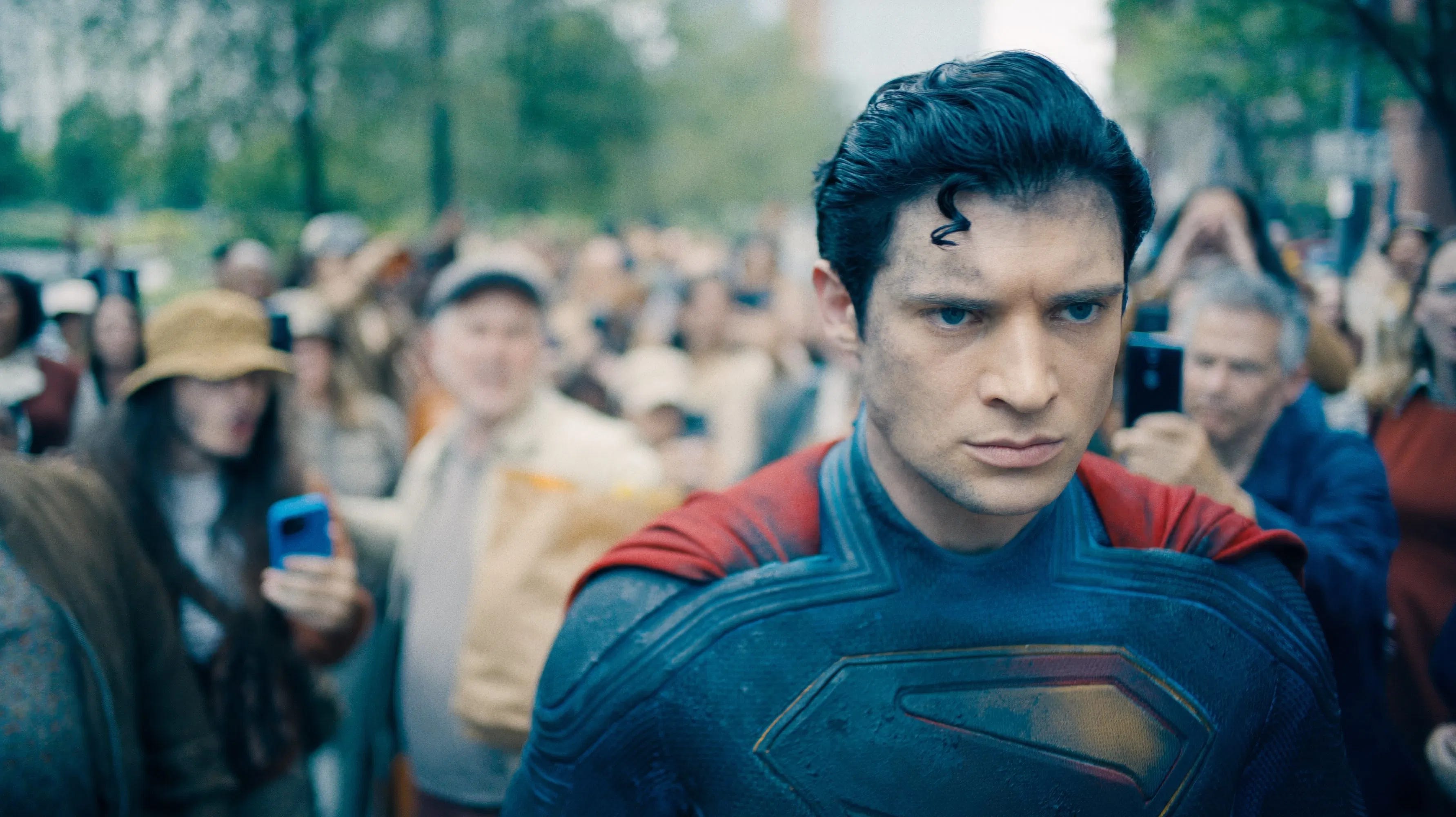
In preparation for watching Supergirl (2026) tomorrow, made only more exciting by the horrible reviews from disgruntled men on TikTok and Letterboxd, I wanted to revisit Superman (2025), which, if you can cast your mind back, was also met with many scathing reviews from anti-immigration and far-right groups that seemingly missed the entire point of the Superman story since 1938, weaponising “comic accuracy”, often incorrectly, I might add, to defend anti-immigrant agendas.
Now this is going to ruffle some feathers, but Superman is by all means a refugee. Just as Paddington Bear, The Doctor of Dr Who fame, and Prince Caspian of Narnia. And while there is still some longstanding debate on whether we recognise a “climate refugee” (if you can call the total destruction of a planet from overmining a “climate” related emergency) Kal-El fled a planet in fear of death, unable to return to it, on pain of death, which by Article I(2) of the 1969 OAU Convention is very much within the realms of the definition.
“every person who, owing to external aggression, occupation, foreign domination or events seriously disturbing public order in either part or the whole of his country of origin or nationality, is compelled to leave his place of habitual residence in order to seek refuge in another place outside his country of origin or nationality.”
But this post is not about the validity of recognising a fictional character as a refugee or not. Don’t take it from me, take it from DC themselves, who recognised Superman’s refugee connections in a Tweet on World Refugee Day 2018.
No, this post is about a more specific aspect of the media's representation of refugees, one that Paddington Bear, The Doctor, and Prince Caspian all share: refugee exceptionalism. The need to be exceptional as a refugee in order to be deserving of the same respect and acknowledgement of rights as non-refugees.
TO BE EXCEPTIONAL
While the film starts three minutes after his first lost battle, there is still no denying that Superman is the embodiment of something exceptional. After all, he is what Luthor spells out as a “Super… man.”
But what does that mean?
Well, if we draw it down to a matter of ability, the first few lines of text in the movie tell us that of the metahumans on Earth, Superman is the most powerful. In media, he is the template, the archetype of the modern superhero: an unmatched combination of flight, super strength, invincibility, and lasers, to name but a few. He has become the cookie-cutter for powerful characters, with iterations such as Ikaris (Eternals, 2021), Homelander (The Boys, 2019–2026), and Omni-Man (Invincible, 2021–ongoing) all, ironically, copying the Man of Steel to show just how easily absolute power can be corrupted. Even DC’s own Shazam (Shazam!, 2019) shows how, in a child’s imagination, the idea of a superhero is Superman.
Enzo Ferrari famously said, “Ask a child to draw a car and, certainly, he will draw it red.” For Ferrari, of course. I might add: ask a child to imagine a superhero, and chances are it’s Superman.
In this instance, we can think about what stories are pushed into the light of anti-refugee rhetoric. Recently, with the World Cup, it has been all the stories of players at the top of their sport who were once refugees. The UNHCR frequently uses celebrities with familial ties to refugee crises. We take an interest because they are renowned. Their fame and ability, therefore becomes a platform for recognition.
If we draw it down to character, we can see this exceptionalism in play within the fight between Superman, the Justice Gang, and the Kaiju that only seems to be called “Thing” in the news reports that follow. While Guy Gardner is revelling in the creative ways he can fight the creature, Hawkgirl is brutally attacking it without hesitation, and Mister Terrific is using drones to blow it apart from the inside, it is Superman who flies around trying to ensure not even a single squirrel is caught in the crossfire.
I have noticed this demonstration of character is another aspect widely used to defend the rights of refugees. The example of Mamoudou Gassama comes to mind: a Malian refugee granted French citizenship by President Emmanuel Macron after scaling four floors with his bare hands to save a four-year-old dangling from a balcony in Paris. More recently, in the 2025 shooting at Bondi Beach, it was Syrian-born Ahmed al-Ahmed and an as-yet unnamed refugee known only by the initials AB who intervened and tackled the weapons out of the attacker’s hands, receiving international praise in the aftermath.
This character, this drive to save one’s fellow man despite fear, these incredible feats of bravery are characteristics that really latched onto people with David Corenswet’s Superman. The ideas of hopecore, of wanting to be a better person, a better man, rang through many viewers.
Ability and character are good things and should be recognised and praised. But the danger arises when exceptionalism becomes the foundation for who we deem valid and entitled to rights and refuge.
TO BE SEEN IS TO BE FEARED
With exceptionalism, however, there is also visibility. And where there is visibility, there are trolls on Twitter nitpicking at every aspect of your being for their own gain, whether personal malice or part of a wider political agenda.
The film barely needs to stretch into fiction here. In his interviews with Lois, Superman is asked directly about public distrust and social media:
Lois: People on social media are suspicious because you are an alien, yes?
Superman: Yes. I’ve been very honest about that. From the beginning. I come from a planet called Krypton. Which is gone now, by the way. Destroyed. Along with all of my history. My parents. They sent me here as a baby to save my life.
This suspicion and hate then manifest more visibly as the story progresses. We see Lex Luthor go on podcasts and talk shows, spinning paranoia, turning public opinion against Superman, and feeding a wave of distrust. It doesn’t matter what Superman has actually done; the fact that he is not from here is enough to make people panic.
This creates a worrying problem: exceptional people inspire exceptional acts.
Superman: No one read me my rights.
Flag: Courts decided those rights don’t apply to extraterrestrial organisms. Therefore, at this point, Superman, you don’t have any rights to read. The government is very well aware of the potential limitations detaining you, so we’ve outsourced your confinement and your interrogation to PlanetWatch.
It is becoming more and more clear that the human rights we have become very comfortable with are not as stable as they appear. In the UK, since the 2024 election, both the Conservative and Reform parties have committed to repealing the Human Rights Act (HRA) and to pulling the UK out of the European Convention on Human Rights (ECHR), framing it around efforts to “stop the boats”.
This was once considered an extreme position, beyond what would be politically comfortable. Yet increasingly, it is framed as a normal and even necessary response. This is where the logic of exceptionalism becomes dangerous. Once rights begin to be framed as something that must be earned (through contribution, usefulness, or exceptionality), they stop functioning as rights.
The narrative of exceptionalism shown in Superman (2025) is therefore one that treads a dangerous line. While ability and character should absolutely be recognised, and demonstrations of bravery and skill rightly praised, they should not become the basis on which we assign rights, recognition, or basic human dignity. That distinction may sound simple when written out like this, but in the present moment, it feels increasingly brazen.
I wish, upon writing this conclusion, I had a more uncomplicatedly aspirational or compelling hopecore answer to offer. Perhaps the popularity of this film, or the sincerity of the response it has generated, might point toward a more generous politics of belonging. But that in itself does not resolve the central issue.
Exceptional people should be recognised as exceptional, but that distinction cannot become the mechanism through which rights are assigned. Because once rights are made conditional on merit, usefulness, or exceptionality, they cease to function as rights in any meaningful sense at all.
Thank you for reading! This blog is intended as a way to engage with the literature and themes I encounter in my research in a more accessible, reflective format. It allows me to process ideas and share insights without subjecting readers to the full scope of 1.5 years of research.
If this piece resonated with you, I encourage you to explore the literature that inspired it. Please note that this blog offers only a surface-level introduction; there is only so much a couple of thousand words can capture. Think of it as a precursor to more in-depth journal articles to come.
Please, join the conversation. I would be fascinated to know how your research or experience resonates in pop culture!
Comments
Nothing yet. Say the first thing.
Sign in to join the conversation.