
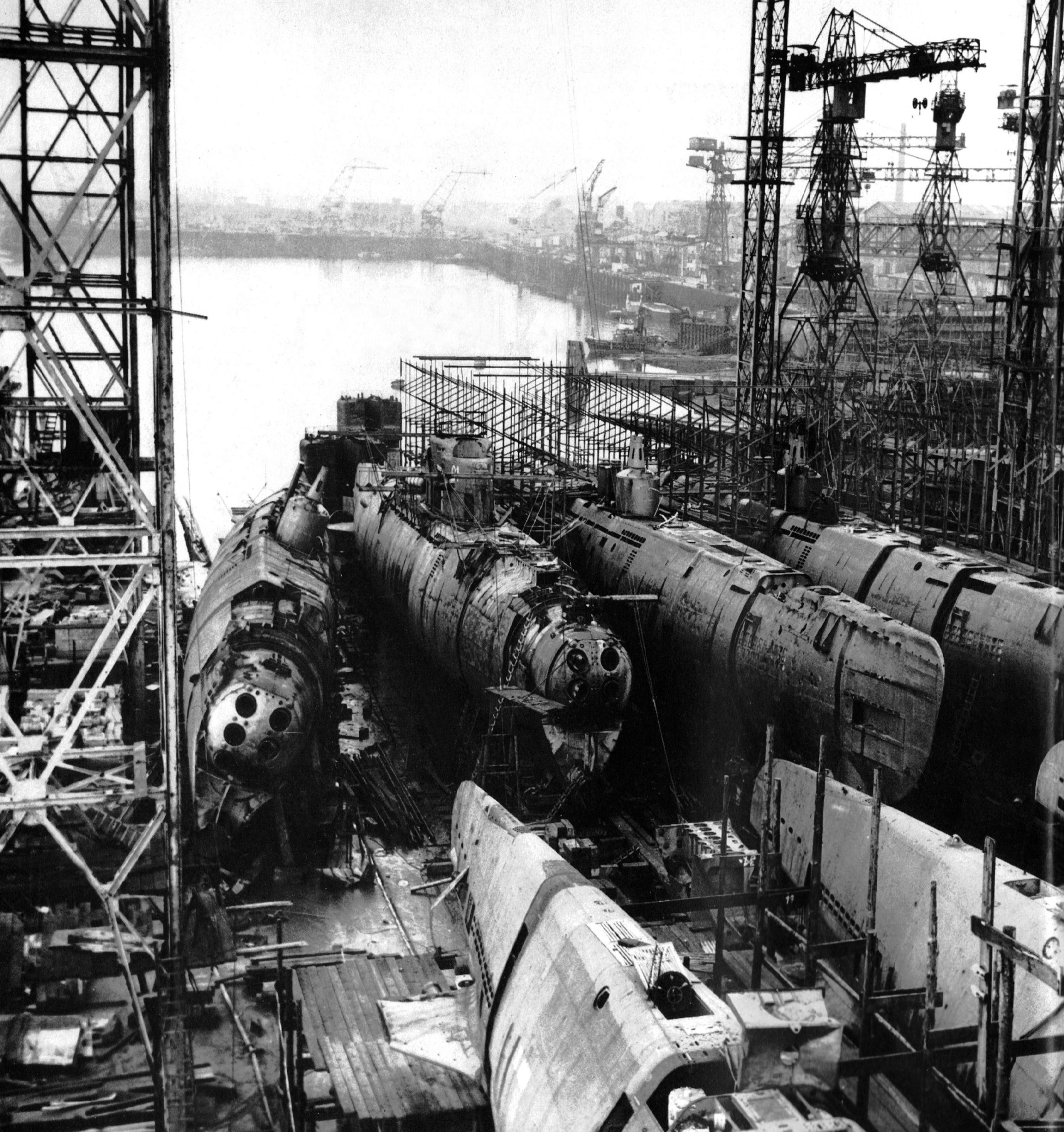
The last months of the war would be violently turbulent for Dönitz’s “Grey Wolves.” Since 1943, Germany’s submarine fleet had suffered defeat after defeat, yet in early 1945 it still believed it could get back into the game with new submarines. In the end, it could not, and the U-Bootwaffe had to confront its future. Two options remained: scuttling or surrender?
Since its strategic failure in May 1943, the U-Bootwaffe had lost the Battle of the Atlantic. Struggling to operate from the Bay of Biscay, its units were caught off guard by the Normandy landings in June 1944. Dönitz’s hurried counterattack produced catastrophic results: two-thirds of the boats committed did not return, while Allied losses (12 transports, 4 landing ships, and 5 escorts) did nothing to alter the invasion’s course. The only positive outcome of this brief and bloody campaign was the first operational use of the Schnorchel, a device that allowed submarines to run on their diesel engines while remaining submerged. Thanks to it, the U-Bootwaffe’s staff believed it might return to the Atlantic in the medium term: as early as July, it sketched a “new submarine war” intended to cut off the Allied armies in France from their supply sources across the sea and across the Channel.
In reality, the inability to use the U-bunkers built in France and the need to operate from distant Norwegian bases reduced this ambitious plan to a coastal campaign in British waters. In strategic terms, Dönitz fell back on the political fanaticism of his crews: “A new submarine war must be and will be our most important objective in the war against the Western powers. That is why the Kriegsmarine and industry must work toward this end with fanatical energy.” Meanwhile, preparations amounted largely to administrative and logistical reorganisation: seven U-flotillas withdrawn from France were dissolved, and their boats concentrated into a new 33rd U-Flotilla based at Flensburg, not far from Kiel. Reprising the role he had already held in France, Kapitän zur See Hans-Rudolf Rösing arrived in Norway in September 1944 as Führer der U-Boote im Westraum (FdU West: “commander of the Atlantic units”). He also placed under his authority the 11th U-Flotilla operating in the Arctic, as well as submarines tasked with defending Norwegian waters. From October to December 1944, these U-boats carried out 31 sorties toward the British Isles or Iceland, but 12 never returned. They were generally boats manned by novice crews on their first war patrols. Across three waves, the U-boats sank only 10 merchant ships and 3 frigates in that zone.
Launched in haste, this “new submarine war” was in fact only a stopgap, intended to bridge the strategic and technical gap between the withdrawal from the Bay of Biscay and the arrival in service of new modern submarines: Type XXI and Type XXIII. It could only ever be short-lived, because the Allies quickly concentrated enormous resources around the British Isles. In January 1945, roughly fifty U-boats were operating in these sectors, but they suffered heavy losses for absurdly small results.
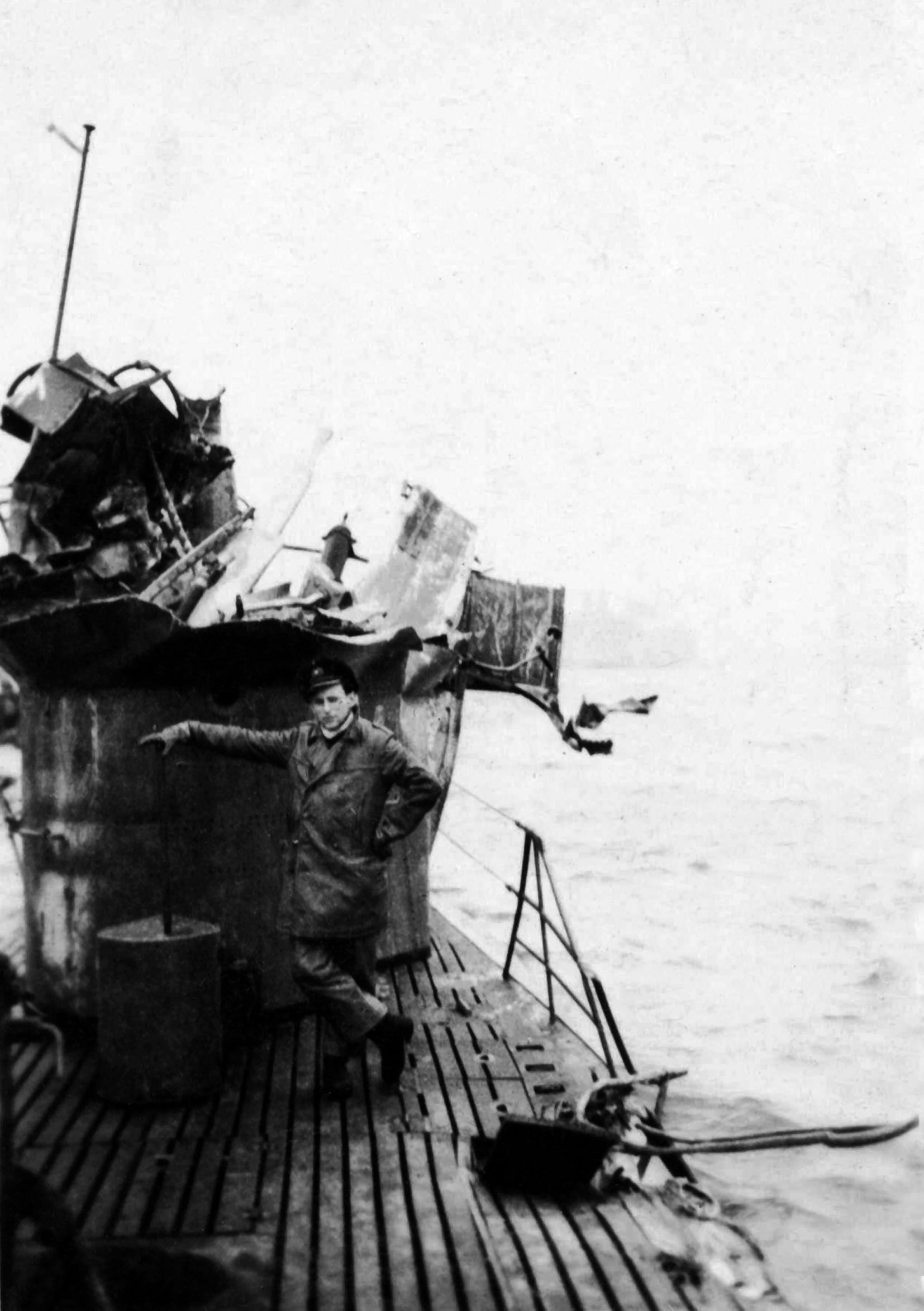
To ease their martyrdom, Dönitz committed everything he had. January saw the first operational deployment of the Seehund midget submarines, whose early attacks were bloody fiascos. And although the crews gradually gained confidence and experience in the following months, results remained derisory: from January to April 1945, the Seehund made 173 sorties, lost 35 units in combat, and sank only 13 merchant ships, a drop in the ocean compared to Anglo-American capabilities. Meanwhile, German motor torpedo-boat flotillas claimed 31 ships sunk across the whole of 1945 (mostly by mines). As for the last-generation submarines meant to reverse the naval war, they arrived too late. In the end, only six Type XXIII boats went on patrol between late January and mid-May, and achieved no tactical or strategic effect.
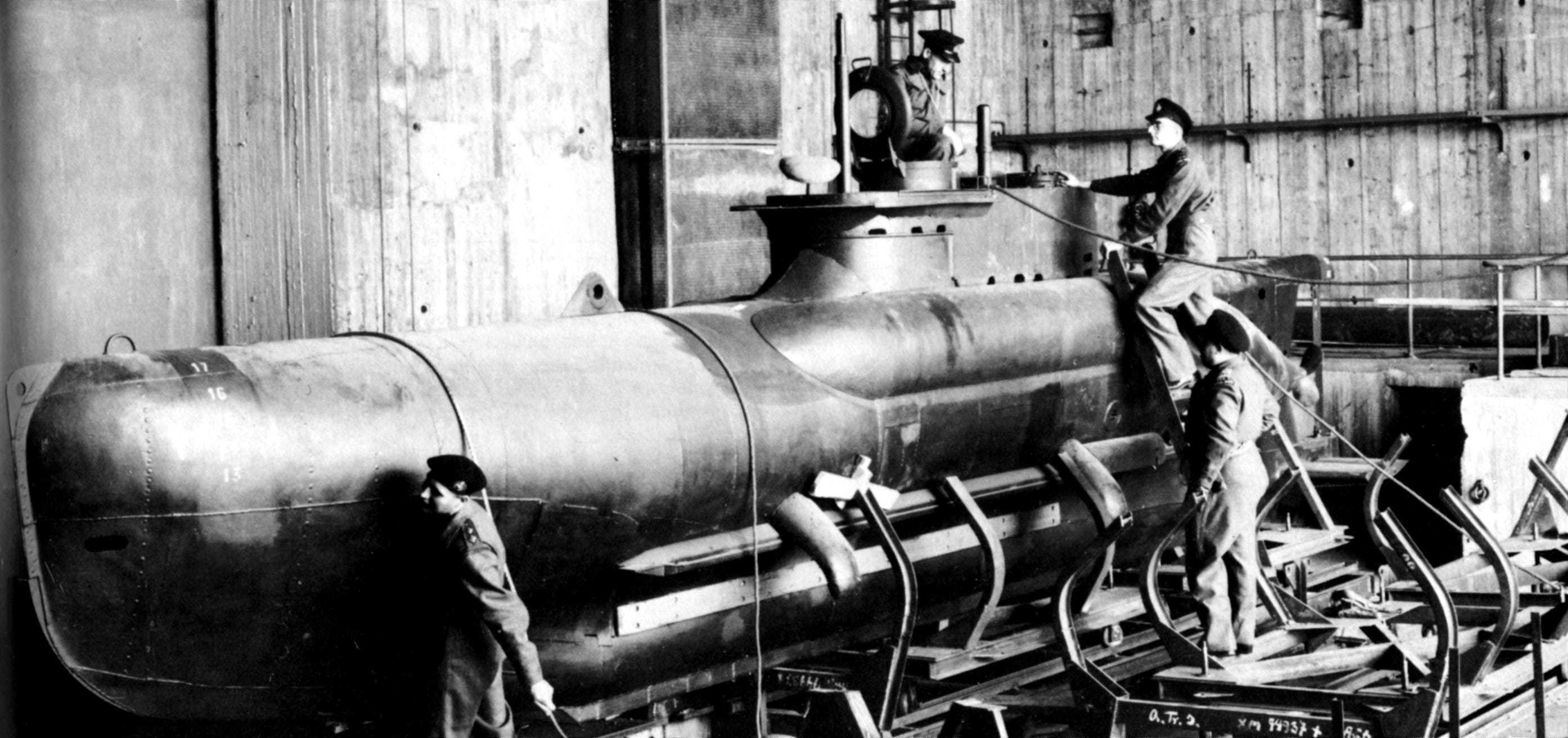
The complexity of these highly sophisticated craft, incessant bombing of ports, shipyards, and communications, intelligence delivered to the Allies by Ultra, and the increasing length of submerged transits (an average of 24 days in early 1945 to reach patrol areas)… everything conspired against Dönitz’s final plan. At this stage, his “new submarine war” was little more than empty words. The increase in losses in March and April in the Atlantic and the North Sea (practically one submarine lost for each ship sunk) determined Dönitz, at the end of April, to withdraw his U-boats from coastal waters. And in April, Dönitz recorded another failure: of the six Type IXC boats he sent to intercept Allied convoys off the U.S. East Coast, four were sunk and the other two returned empty-handed… The Kriegsmarine had played its last card and had already lost.
Thanks for reading! This post is public so feel free to share it.
Dönitz, the Last Führer
From 23 January 1945, the few Kriegsmarine surface units still operational in the Baltic were ordered to take part in evacuating troops and civilians trapped by the Red Army in East Prussia. Operation Hannibal would last 15 weeks, during which the Reich’s territory shrank to a sliver. April and May 1945 were a long agony. With many Soviet naval units entering the Baltic and enemy air presence becoming ever stronger, the sea could no longer be treated as a “German inland sea” for training or moving U-boats. So, a general order to withdraw to Norway was issued to all operational submarines there. Rear Admiral Godt went to Bergen in early May to take command of all boats. This ‘transhumance’ did not escape Ultra either: the RAF concentrated all its resources on routes that were well known. With 56 U-boats lost, including 26 with all hands, April recorded the worst monthly balance sheet of the entire war.
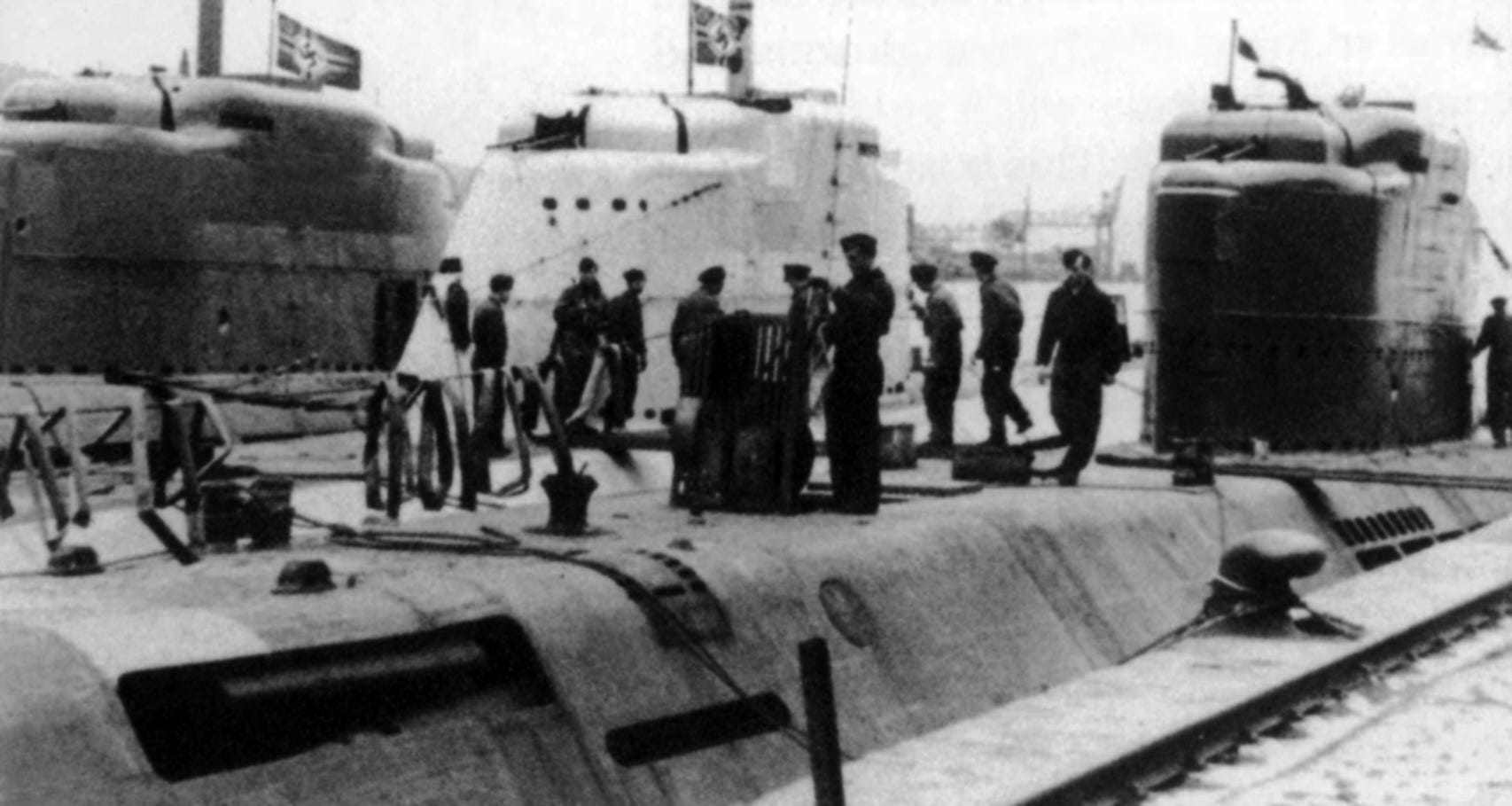
On 20 April, as American and Soviet troops pushed inexorably into Germany’s heart, Hitler appointed Dönitz commander of the country’s North-West military zone. As an aside, around this same date he also asked him to fly some thirty K-Verbände combat swimmers into besieged Berlin to provide close protection: Hitler no longer trusted anyone in the SS and wanted “reliable men”… Several attempts between 27 and 30 April failed, and the operation was abandoned. Dönitz left Berlin on the 22nd to organise his zone’s defence, but the command of the units streaming in - amid indescribable chaos - slipped from his hands on the 27th, taken over by the Army High Command. On the evening of the 30th, Dönitz learned that Hitler - who had just committed suicide - had designated him as successor. Dönitz immediately intensified the evacuation of soldiers and civilians from Prussia, authorising for the first time “unrestricted use of fuel, with the exception of that reserved for submarines.” The U-boats were still expected to patrol the North Sea and Atlantic as bargaining chips in the inevitable capitulation negotiations—negotiations the “new Führer” hoped to conduct only in the West, in the vain hope of continuing the war in the East.
Thanks for reading! Subscribe for free to receive new posts and support my work.
Operation “Regenbogen”
Berlin fell at the end of April, and the country was cut in two. Kriegsmarine units found temporary refuge in ports in northern Germany, Norway, and the Netherlands. Montgomery’s 21st Army Group was about to seize Hamburg and then Kiel, the main concentration point for German U-boats and surface units. Surrender was on everyone’s mind, but German naval culture favoured scuttling operational ships rather than abandoning them to the enemy: had not the Kaiser’s fleet famously scuttled itself at Scapa Flow on 21 June 1919 after surrendering to the British, rather than allowing its ships to be distributed among the victors? The tradition was not uniquely German: the French fleet scuttled itself at Toulon on 27 November 1942, and the Danish Navy did the same on 29 August 1943. In the German case, however, scuttling had been planned for years. Hitler repeatedly insisted that his soldiers should prefer death to captivity, and leave no weapon to the enemy. As early as 1943, the U-Bootwaffe created a secret ad hoc procedure: every unit had a duty to scuttle if its situation was desperate, or if it received the code word “Regenbogen” (“Rainbow”) from higher authority.
30 April: Dönitz ordered all commanders to prepare to destroy their boats, with exceptions for merchant ships and minesweepers. The order covered about 470 submarines, of which only 170 were still operational, mostly from the Norwegian coast. At this point, the crews did not yet know Dönitz was to replace Hitler; the Grand Admiral himself learned only early in the evening that Hitler was dead.
1 May: Dönitz formally took office as Reich President. Anticipating the expected order, three Type VIIC boats scuttled at Warnemünde near Rostock.
2 May: even as scuttling multiplied (29 Type XXI and 3 Type VIIC at Travemünde near Lübeck), the new Nazi head of state issued an order of the day calling on submariners to continue the fight, buying time to evacuate troops and civilians from Courland. In parallel, he instructed his new Kriegsmarine commander, Admiral von Friedeburg, to negotiate with Montgomery for a partial surrender of the zone under his control.
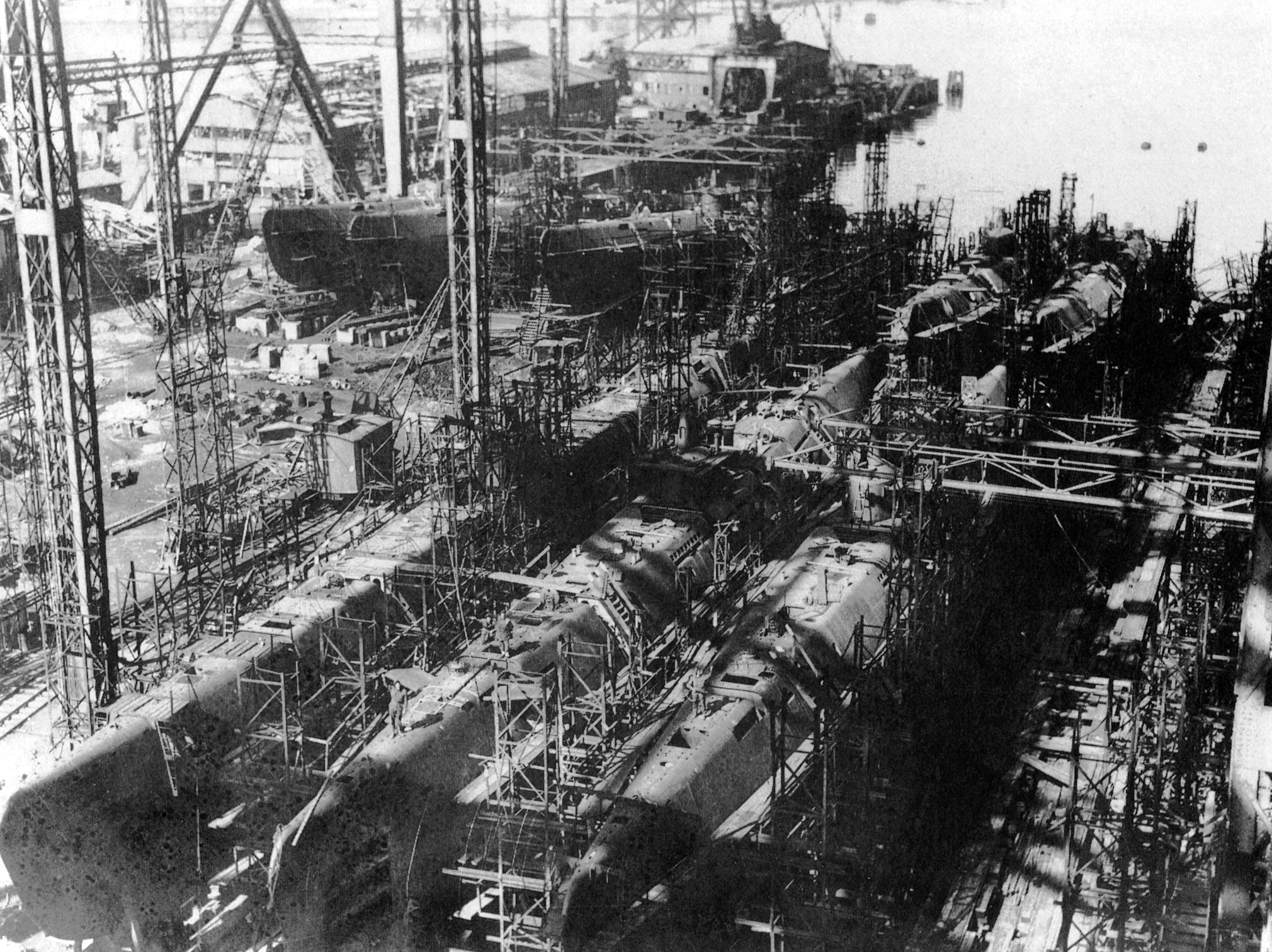
3 May: confusion reigned within the U-Bootwaffe, which struggled to direct operations because Germany lacked functioning radio transmitters. Rösing took over from Norway. The BdU also ordered all U-boats to leave Germany and sail to Norway to join him; immobilised boats were to make scuttling preparations. The order was carried out the same day at Kiel and Hamburg: 39 submarines (mostly Type XXI and Type XXIII) were scuttled.
4 May: with no room to manoeuvre, von Friedeburg was forced by Montgomery to sign an unconditional surrender (the “Lüneburg Convention”) for the units of the three services fighting in north-west Germany, the Netherlands, and Denmark. Politically, it was a failure for Dönitz, who had hoped to negotiate a separate surrender and divide the Allies. Moreover, in exchange for ending air raids and mine-laying in the Baltic, the British demanded the immediate cessation of submarine warfare and the intact delivery of all U-boats. Dönitz was trapped: he could no longer issue the “Regenbogen” order. At 15:14, he transmitted to all submarines the order to cease hostilities and return to base, even as Rösing, now responsible for all submarines in Norway, prepared to destroy units that could no longer fight… That same day, two boats were scuttled in the Kiel Canal and two more at Flensburg.
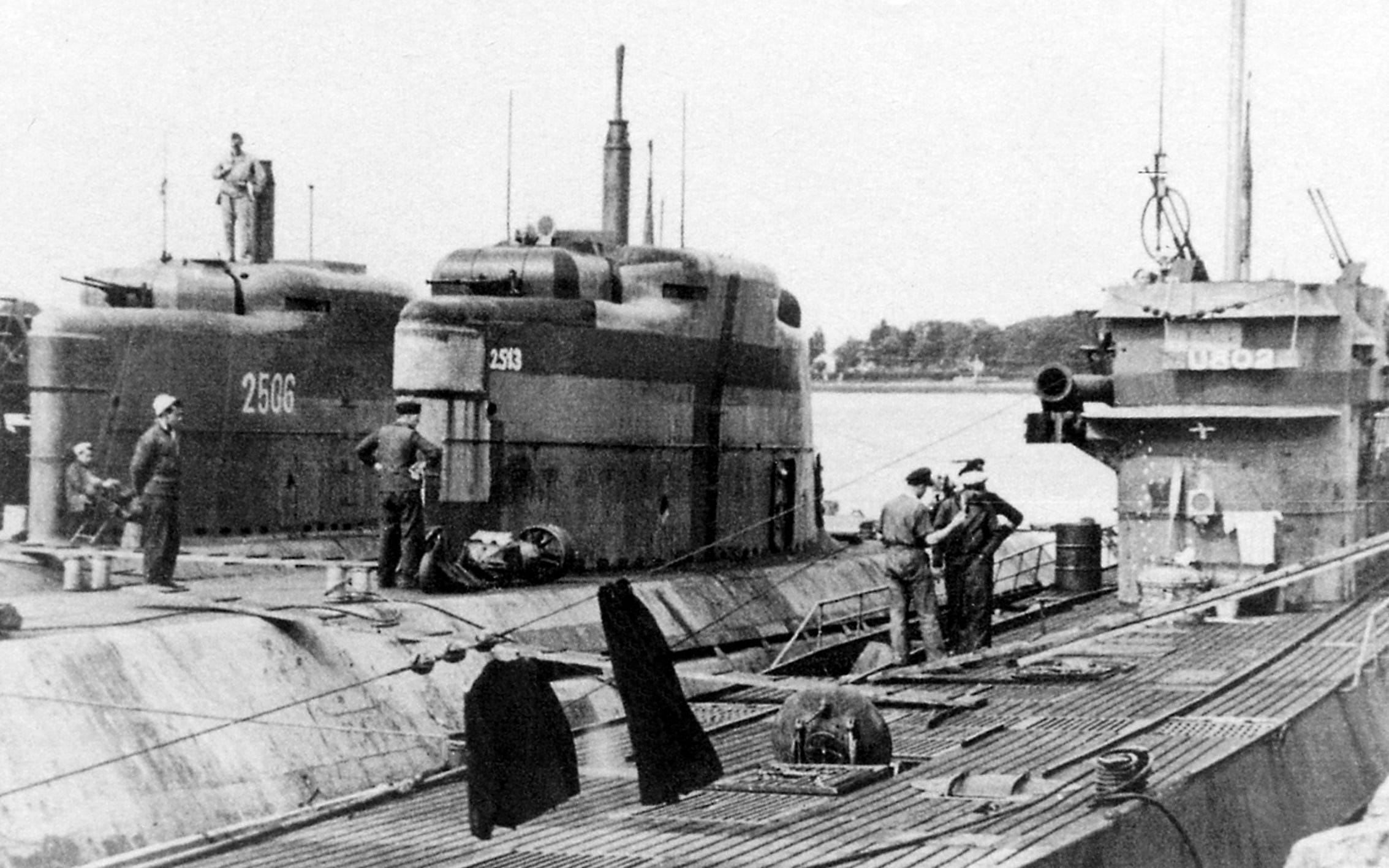
5 May: while the surrender was due to take effect officially at 08:00, all U-boats received at 01:50 a new unsigned message from an unknown transmitter. Its author was never identified, but its content was unambiguous: “New situation. If possible, all U-boats to Norway. Otherwise, if in German or Danish waters, carry out Regenbogen after 08:00 today.” Was this a Dönitz initiative, a way of circumventing the Lüneburg Convention? He denied it in his memoirs: “The surrender was obeyed, except on a number of U-boats whose commanders sank or blew them up during the night of 4–5 May, before the armistice took effect. […] The commanders, convinced that I could have given this order only under constraint, believed they were acting in the way I would have wished.” In any case, eight minutes after this “anonymous message,” a counter-order was sent to cancel it: “To all U-boats: do not carry out Regenbogen after 08:00 today.” But it was already too late, and the initial order was widely followed: 11 Type II, 33 Type VII, 3 Type IX, 22 Type XXIII, 16 Type XXI, and the last four Walter prototypes scuttled that day along various points of the Baltic coast. In North Sea ports, however, U-boats surrendered rather than scuttle, out of time and means, with British troops close at hand. On the fortified island of Heligoland (or what remained of it after massive raids on 18–19 April 1945), seven elderly Type IID school boats and new Type VIIC and IXC/40 training boats were handed over intact by their crews, as were eight more at Cuxhaven (including two Type XVIIB Walter-propulsion boats). Only four Baltic-based submarines chose surrender that day: the Type XXIII U-2351 at Flensburg and three boats at Fredericia (Jutland), one of Denmark’s largest ports.
Finally, at 22:25, with nearly 200 voluntary scuttling deaths among U-boat crews already recorded in a single week, Dönitz broadcast an uncoded radio message to the entire submarine fleet: “My dear submariners! Six years of submarine war are behind us. You have fought like lions. Overwhelming material superiority has reduced us to a limited territory. Continuing the fight from the remaining bases is no longer possible. Submariners! Undefeated and unstained, you lay down your arms after a heroic battle without equal. We remember with deep respect our fallen comrades, who paid with their lives for their loyalty to the Führer and the Fatherland. Comrades! Preserve the esprit de corps with which you have fought bravely, stubbornly, and steadfastly for years for the good of the Fatherland. Long live Germany! Your Grand Admiral.”
6 May: matters calmed immediately. Only one further scuttling was recorded: Type VIIC/41 U-1008, en route to Norway, had been depth-charged the day before in the Kattegat by a Coastal Command aircraft. Too damaged to reach its destination, she was evacuated and sunk by her crew. At 20:26, Dönitz made a second radio appeal to his submariners (this time in code) recalling their heroic actions and the impossibility of continuing the fight. He ended with an explicit order: “Obey Order No. 2 broadcast on [specific frequencies] from the British coast. The return to Norway is cancelled.” Further coded messages followed, case by case, to clarify orders.
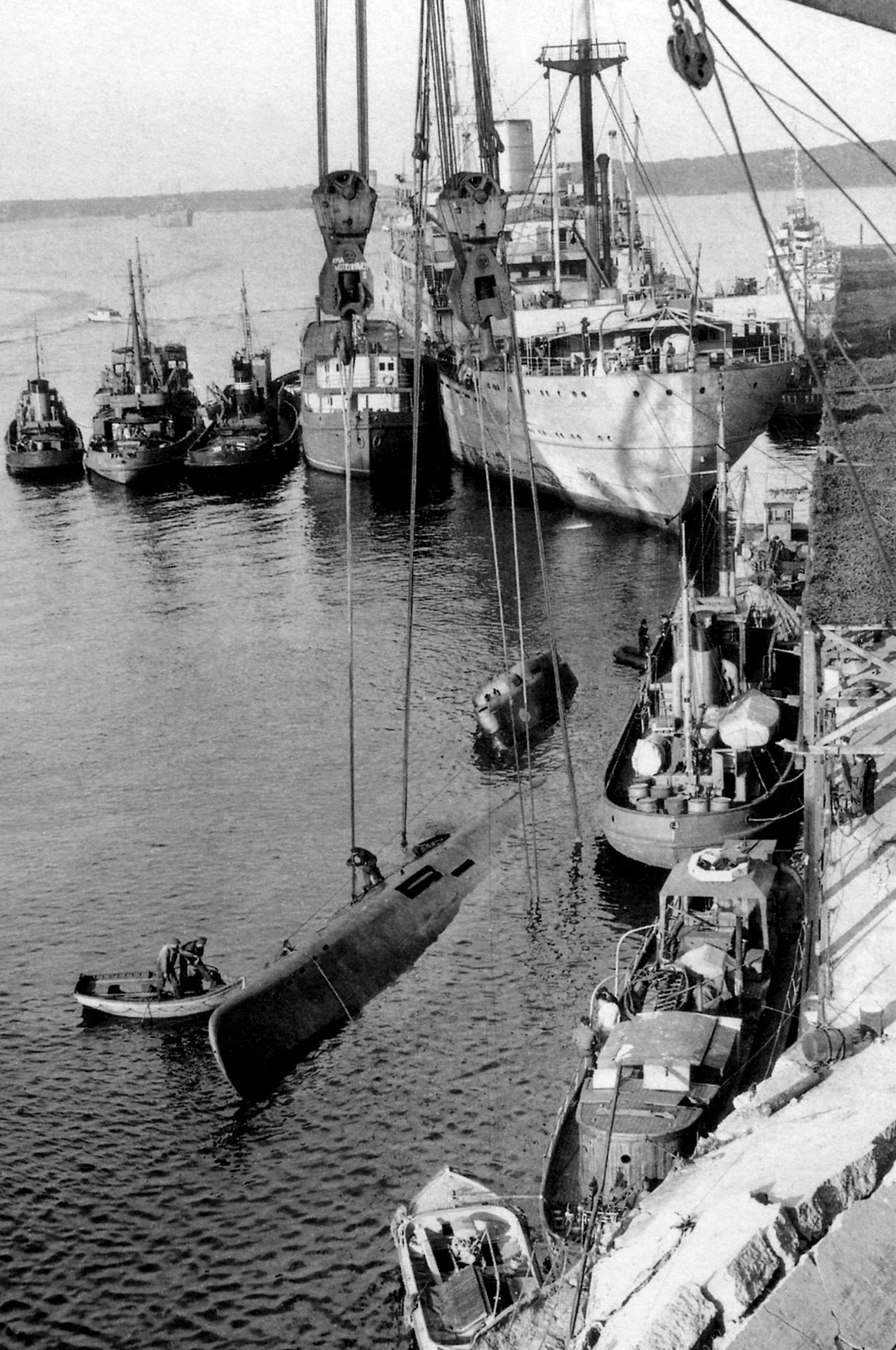
The succession of orders and counter-orders had, unsurprisingly, sown confusion among crews not all alongside. Most scuttled units had been newly delivered or in repair. But most operational boats were at sea, either heading for Norway, or returning to Germany after their final Atlantic war patrol, or even in the Indian Ocean for some Type IX boats. For them, nothing had changed: they still had to evade enemy air patrols and Escort Groups, whose orders remained the hunt and destruction of U-boats. Around twenty German submarines were sunk “on mission” between 2 and 6 May ; proof that the war at sea raged more fiercely than ever. For anyone still doubting it, Rösing issued a final radio warning: “Expect attacks […] off Norway. Our own ASW measures remain in effect.” It was apparently in this context that the last U-boat of the war was lost in operation: on 6 May at 18:39, Type XXI U-3523 was surprised in the Skagerrak by an RAF B-24 Liberator, depth-charged, and sunk with all 58 crew.
The Last Success of the U-Boats
On 30 September 1944, Oberleutnant zur See Vockel took possession of Type XXIII U-2336 and began training her crew at Hamburg. As the training period ended, he was killed in an air raid on 30 March 1945, and replaced by Kapitänleutnant Klusmeier who had lost his own boat, U-2340, in the same bombing. Klusmeier was one of the most experienced Type XXIII commanders: as a BdU staff officer, he had early championed these small Elektroboote, helped develop their tactical doctrine, and participated in exercises aboard several of them.
To familiarise the new crew - now combining men from two different boats - two additional weeks of training were granted. U-2336 finally sailed on 18 April, reaching Kristiansand on the 23rd. A week of sea exercises followed to train the crew in Schnorchel operations. On 1 May, the boat weighed anchor with orders to patrol the estuary off Edinburgh.
With defective radio gear, Klusmeier did not receive the BdU order to stop operations. On the 7th, he arrived submerged off the Isle of May, guarding access to the Firth of Forth. There he detected a small convoy coded EN-91. U-2336 approached slowly to 1,500 m (about 1,640 yd) and then advanced at silent speed (under 4 knots) to fire her torpedoes at three-minute intervals at targets less than 500 m away (about 550 yd). Both torpedoes hit, sinking the Norwegian cargo ship Sneland I and the British Avondale Park, the last victims of the U-Bootwaffe. U-2336 then withdrew cautiously, evading escorts dropping depth charges “blind.” Three hours later, she began her return voyage without having been detected. She surfaced only on 12 May off the Norwegian coast, to discover that the war was over. Soon escorted by Allied aircraft, she reached Kiel on the 14th, after two weeks at sea.
Preparing the Surrender
7 May: at 02:41 in Reims, the unconditional surrender of German armed forces was signed by Generaloberst Jodl as representative of Reich President Dönitz. Among other provisions, both sides agreed on a surrender procedure for U-boats still on patrol or in transit; it would be broadcast every two hours. All units at sea had to surface and surrender to the nearest Allied forces as quickly as possible, identifying themselves by radio (on dedicated frequencies) and reporting their position every eight hours. They also had to hoist, prominently, a black or blue surrender flag by day and show navigation lights at night. Ammunition was to be thrown overboard; torpedoes and mines neutralised; and gun breechblocks removed. The Allies again insisted on taking U-boats intact and on strict compliance with instructions.
The British estimated they might seize up to 160 U-boats (at sea or in port in Germany and Norway) and organised accordingly:
Submarines in the Western Approaches or the North Sea were to proceed to Loch Eriboll, a deep-water anchorage on Scotland’s north coast—remote and easily defended. The Royal Navy had maintained a secondary base there since the Great War and, from August 1944, intended it as an internment site to avoid congesting the heavily used Scapa Flow. German submarines were ordered to follow one of two pre-plotted routes to avoid interfering with surface-ship traffic and to arrive at Eriboll between sunrise and three hours before sunset.
Loch Eriboll was the main rendezvous point, but others were designated. Beaumaris Bay (Anglesey, Wales) was to receive submarines in the Irish Sea; boats in the Channel were to go to Weymouth; boats in the Baltic to Kiel. Submarines operating in the Mediterranean would be gathered at Gibraltar; and boats in other Atlantic sectors not mentioned were to proceed to one of three rendezvous points off the U.S. East Coast (off Nova Scotia, Maine, and Maryland).
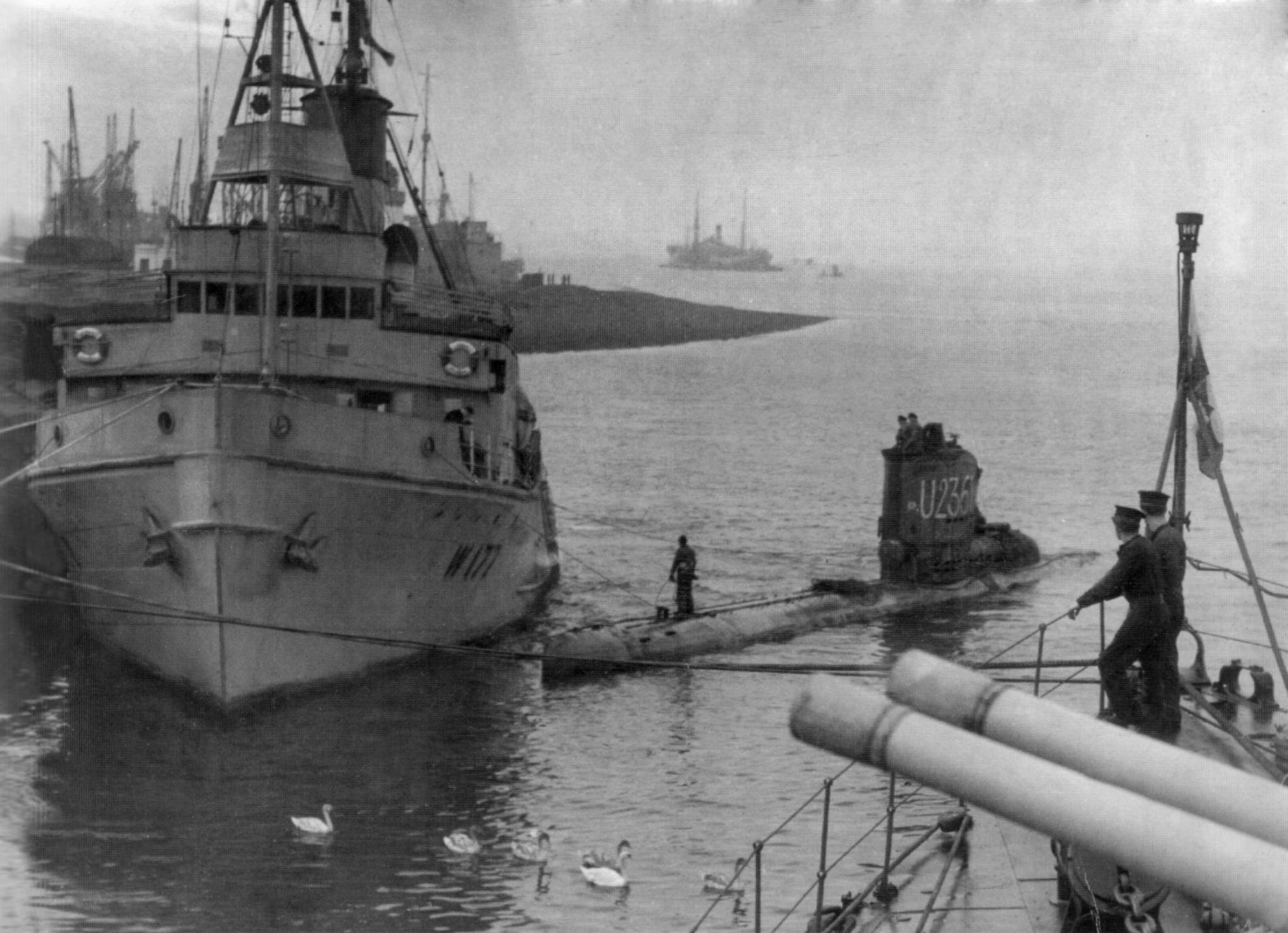
8 May: anticipating the official capitulation at noon, Rösing broadcast at 01:25 a radio message forbidding U-boats to put to sea or to be transferred between bases, and reiterating the ban on scuttling. Confidential documents were to be destroyed, while weapons, equipment, Enigma machines, and current codes were to be preserved. At 13:20, he issued final instructions: “Codes and messages handed over to the Anglo-Americans and the Russians. Transmissions in plain language. Take into account very-long-wave broadcasts from Rugby [the British transmitter] which will soon transmit our messages.”
Operation “Pledge”
9 May: on the first day, 95 boats surrendered, most of them in Norway, but also U-510, trapped in the Saint-Nazaire pocket. The Allies were not yet present at Narvik, and to avoid reprisals against submariners by the local population, the 15 submarines there were transferred to Trondheim on 15 May, under Kriegsmarine escort! Meanwhile, Type VIIC/41 U-1105 was the first submarine still at sea to surface (on the 9th at 09:07) and report its position. She reached Loch Eriboll the next day under escort, shortly after two other boats had reported in. On the British side, the U-Bootwaffe’s surrender was codenamed Operation Pledge. The 21st Escort Group was responsible for receiving and escorting the defeated boats to the Scottish anchorage; it was reinforced on the 19th by frigates from the 9th (Canadian) Escort Group to cope with the influx, though far fewer submarines arrived than expected. In May 1945, 33 U-boats were temporarily interned at Eriboll; the total may have reached around forty in June. Each boat was inspected and formally disarmed before being sent on to a military anchorage, either Lough Foyle (Lisahally) in Northern Ireland or Loch Ryan on Scotland’s west coast.
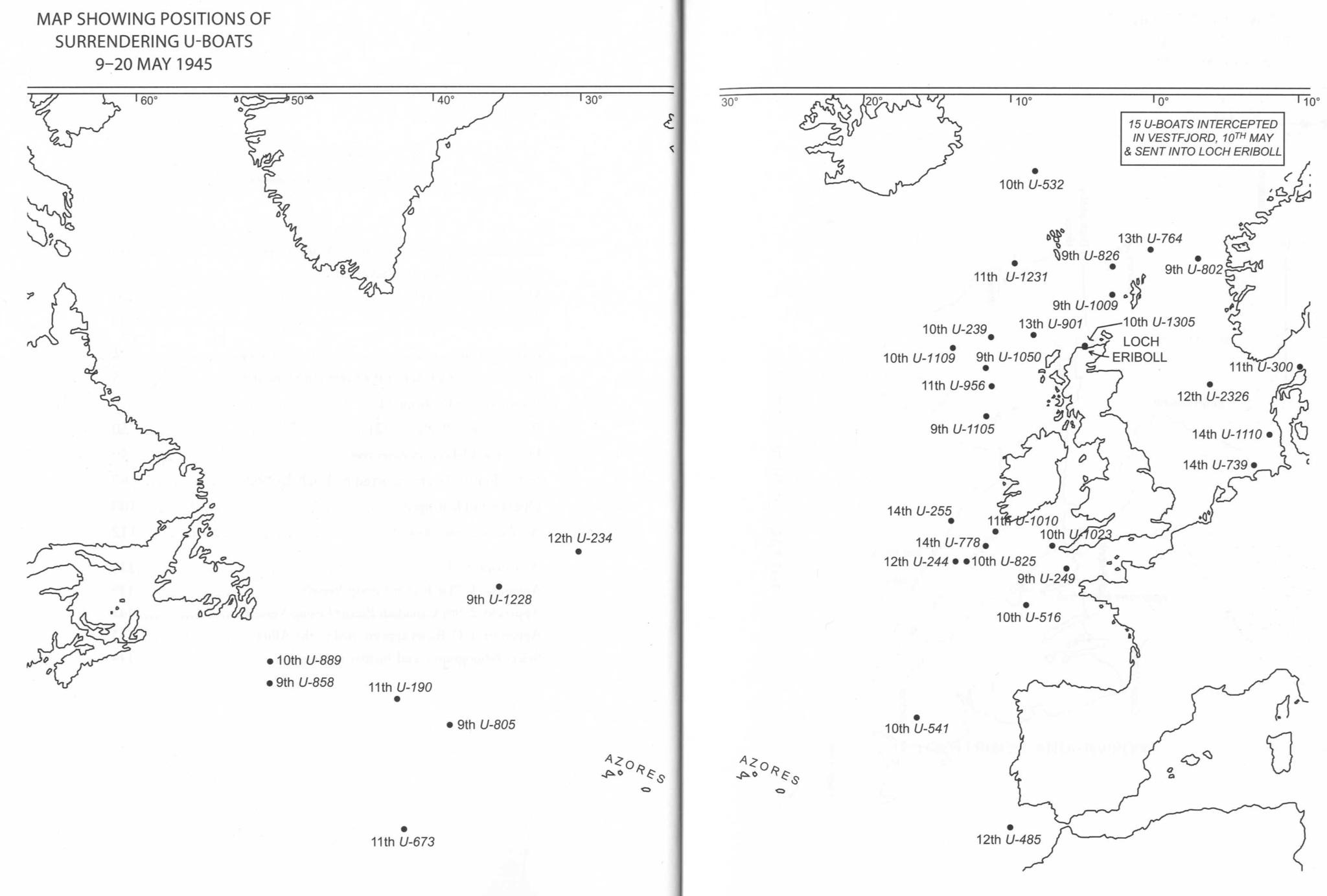
9 May – 30 June: the effective surrender of the U-boats took place largely between 9 and 19 May. Crews handed over their boats en masse; very few chose scuttling. Once disarmed, submarines captured in Danish and Norwegian waters were sent in groups to Loch Ryan or Lisahally and, from 24 May, also to Scapa Flow once it became clear Norwegian ports were completely clogged with units awaiting transfer. From 30 May to 5 June, 64 “Norwegian” submarines passed through the Orkneys before proceeding to Lisahally or Loch Ryan. All “Grey Wolves” based in Denmark or Germany still seaworthy (i.e., 35 boats) were gathered at Wilhelmshaven and transferred into the Irish Sea in June. Other rendezvous points saw little use: only two patrolling submarines surrendered at Gibraltar, three at Portland; to these were added seven boats returning to a Norwegian port at the end of patrol, and nine more arriving at a Canadian, U.S., or Argentine port.
By late June 1945, the U-Bootwaffe was already only a bitter-glorious memory. In addition to the 28,000 of 40,900 submariners engaged during the war who died in combat - and the 5,000 more languishing in POW camps - the submarine fleet itself no longer existed. Of roughly 1,200 U-boats commissioned between 1935 and 1945, 784 were destroyed in operations (or in port by air raids), and more than 200 are believed to have been scuttled at the end of the conflict. In total, 156 German submarines surrendered to the Allies in May and June 1945. 137 of them would be sent to Lisahally or Loch Ryan before being distributed among the victorious navies.
Comments
Nothing yet. Say the first thing.
Sign in to join the conversation.