
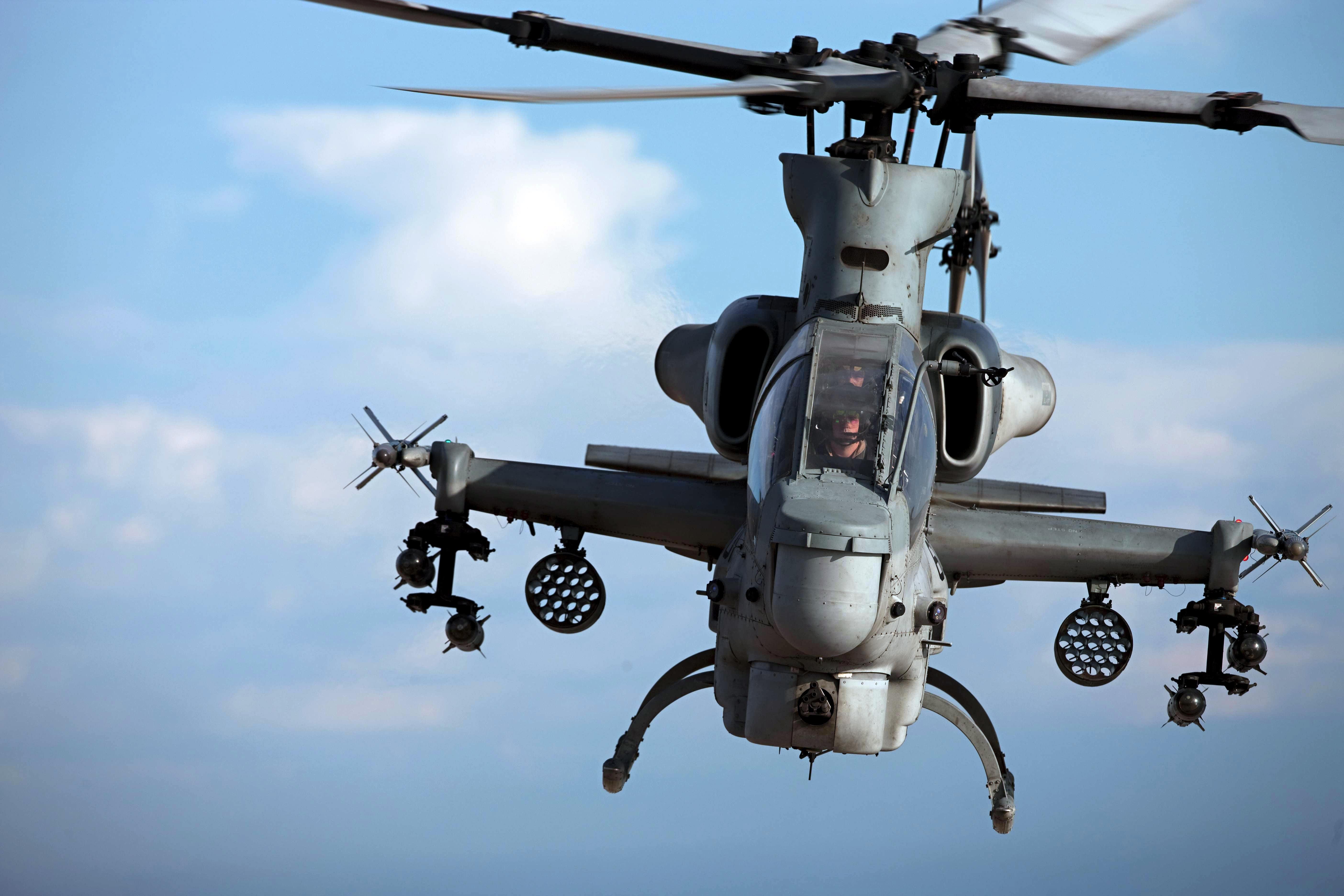
From time to time, Action Stations steps outside strictly naval history, a deliberate breathing space to tackle other corners of military history. Since everyone is talking a lot about helicopters and air warfare these days (with the war in Iran), I thought it would be a good idea to revisit an American aircraft that revolutionized this field in the 1960s. Especially since Iran was one of its users…
Iroquois and Sioux on the Warpath
In 1962, in the Vietnamese jungle and rice paddies, the U.S. Army could now rely on a new means of tactical transport: the HU-1A Iroquois helicopter, later redesignated UH-1 and nicknamed the Huey. A few months later, the machine that was supposed to do little more than medical evacuation was being used mainly as a battlefield taxi. The GIs quickly found flaws: lightly protected—or not protected at all—it was especially vulnerable when putting troops on the ground, because at that moment it could not return fire effectively. It therefore needed an escort.
A stopgap solution was found quickly: a number of UH-1s were armed with rocket launchers, grenade launchers and machine guns to make attack runs around landing zones. Nicknamed “gunships” by the GIs, these aircraft became indispensable as American involvement in Vietnam grew ever larger; the Army leadership began thinking about a helicopter designed specifically for air-to-ground strikes.
A little earlier, in June 1962, Bell had presented Pentagon officials with an intriguing prototype: the D255 Iroquois Warrior, which looked like a helicopter with the fuselage of a two-seat jet grafted onto it. Its streamlined body, very narrow cockpit and tandem seating made it fast, even though it reused many UH-1C components—its rotor system, engine and transmission in particular. This reduced development costs while relying on proven technology. Its weapons load was substantial: a remotely operated nose turret for grenade launchers, a belly mount for a 20 mm cannon, and external pods for anti-tank missiles and rockets. In short, Bell’s demonstrator looked like an excellent ground-attack aircraft—and it caught the Pentagon’s attention. The concept still had to be turned into a real programme.
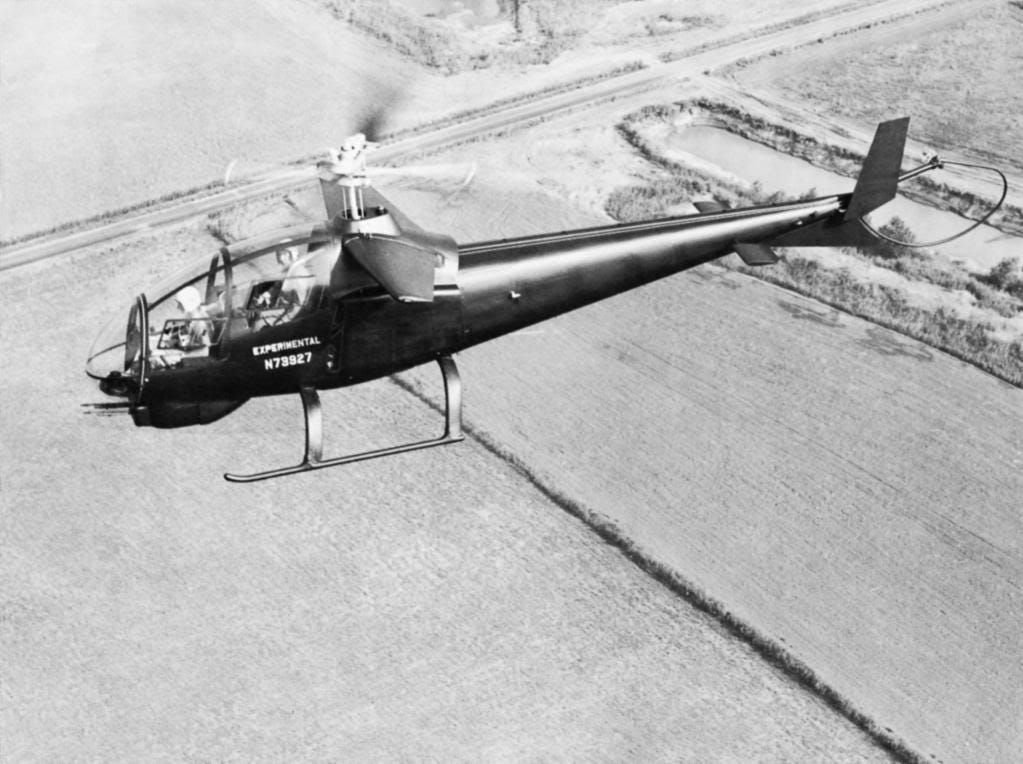
With that in mind, Bell proposed in December 1962 the Model 207 Sioux Scout, based on the military version of the Bell 47 (built in 6,000 examples in many variants). The Bell 47 was notably the first helicopter to serve as a medical evacuation aircraft in Korea from 1950 to 1953, and it remained in service in many countries. The Model 207 retained the Iroquois Warrior’s strengths: two M60 machine guns in a chin turret, stub wings for weapon pods or external tanks, and a tandem crew (pilot in the rear and gunner/copilot in the front). A demonstrator flew in July 1963. The Army tested it in early 1964, but although it was highly manoeuvrable, it was judged too small, insufficiently protected and underpowered for the role envisioned for air-mobile brigades. In October, the Army launched a competition for an ambitious heavy attack helicopter programme: the Advanced Aerial Fire-support System (AAFSS). It was won by Lockheed with the AH-56 Cheyenne, which would never enter service and was cancelled in 1972.
The AH-1G Huey Cobra
True to its approach, Bell held its course by developing - on own funds - a new streamlined, narrow, light and agile aircraft: the D262 (Model 209), essentially a redesigned, smaller version of the D255. The original two-blade 540 rotor received a stability augmentation control system; the fuselage profile around the turbine followed the Sioux Scout’s lines; the landing skids were retractable; and the fuselage used aluminium honeycomb for lightness. Despite undeniable paper advantages, the “209” still had to prove itself. In January 1965, Bell invested one million dollars to build a demonstrator despite losing the AAFSS competition. Vietnam was validating Bell’s preference for small, reliable aircraft, while Lockheed struggled with a complex, costly and overly innovative programme. The U.S. Army soon realised this and, fearing it would not field attack helicopters for several years, asked several manufacturers for an interim aircraft that could be put into production quickly. When the Model 209 rolled out in September 1965, it arrived at exactly the right moment. In April 1966, convinced by a series of tests, the U.S. Army ordered 110 examples for $20.5 million. The Model 209 was then redesignated UH-1H before being renamed in July as the AH-1G (“A” for Attack; “G” identifying the variant). Until then, U.S. Army helicopters had all received nicknames taken from Native American peoples (Sioux, Cheyenne, Iroquois). But for legal reasons (Piper Aircraft also used Native names), the Pentagon had to choose something else. In Vietnam, however, the gun-armed UH-1 Hueys were already being called “Cobras.” The new attack helicopter replacing them would therefore become the Huey Cobra.
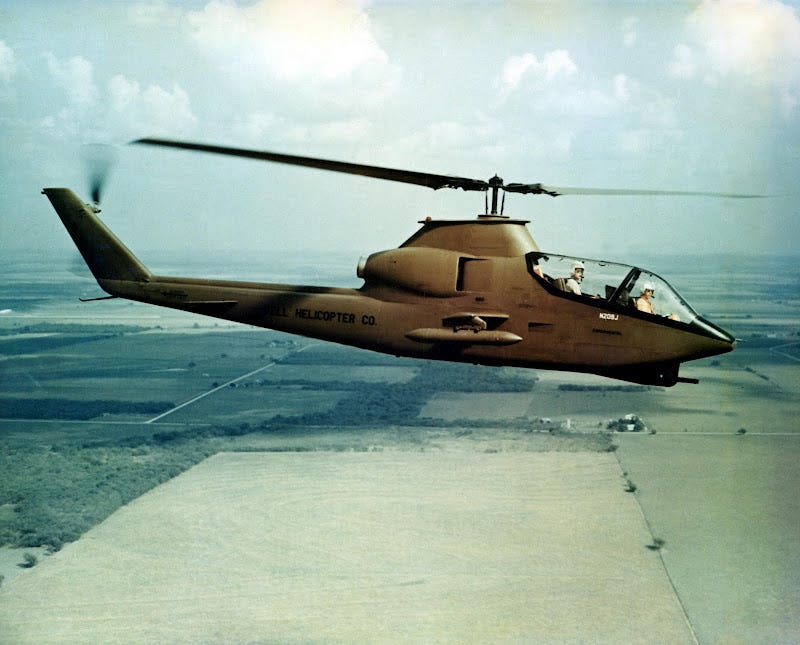
Designed for series production, it differed from its predecessor in several ways: the skids were fixed; the canopy was plexiglass rather than armoured glass; the rotor blades were different; and the cockpit was protected by ceramic armour side panels. The helicopter was powered by a Lycoming T53 gas turbine—designed by the German engineer Anselm Franz (the father of the Junkers Jumo 004, the Third Reich’s first turbojet produced in series, notably for the Me 262)—the same engine as the UH-1, delivering 1,100 hp. It could reach 227 km/h and cover 574 km. Above all, it provided formidable fire support: the stub wings gave the aircraft excellent stability, making it a highly appreciated firing platform.
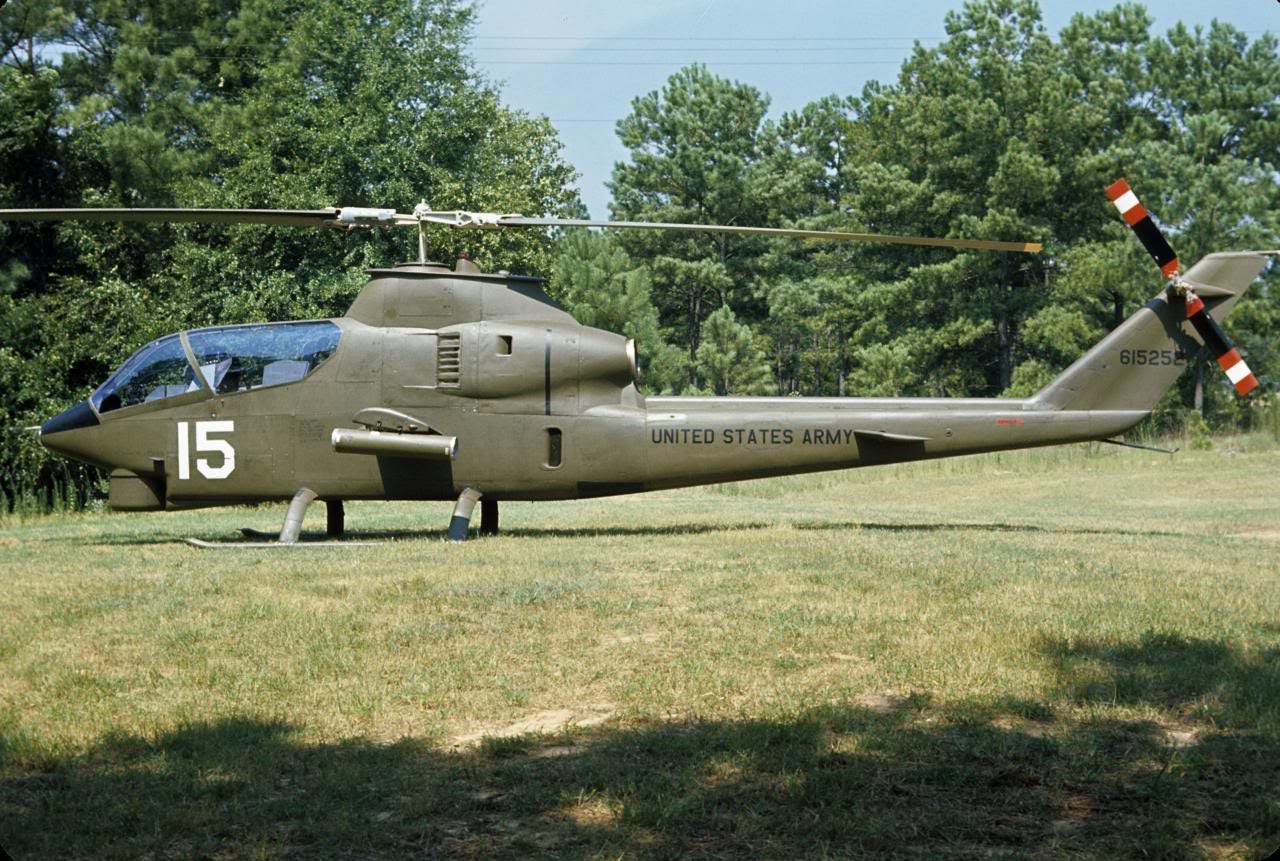
The first examples came off the line in June 1967 and were sent to Vietnam two months later. Their rocket salvoes and the accuracy of their fire proved particularly lethal to the Viet Cong, and pilots appreciated the helicopter’s small footprint and manoeuvrability, which allowed it to land in extremely tight spaces. The first “kill” credited to a Cobra was a Viet Cong sampan sunk in the Mekong Delta on 4 September 1967… during a training flight. Its moment of glory came on 8 October, when two AH-1Gs of the 334th Armed Helicopter Company, escorting ten Iroquois, prevented the Viet Cong from attacking the troop transports with devastating fire. Better still, they destroyed four bunkers and fourteen sampans.
Thanks for reading! Subscribe for free to receive new posts and support my work.
A Modular Arsenal
Early operational feedback was therefore very positive. A further 838 Cobras were ordered in October 1968, then another 170 in January 1970, and a final 70 in 1971. The Marines also ordered 38 AH-1Gs, enabling them to wait for a future navalised version. Between 1967 and 1973, Bell would thus produce 1,226 Cobras for the U.S. Army and the USMC. The design was so sound that over six years of production it saw only three minor changes:
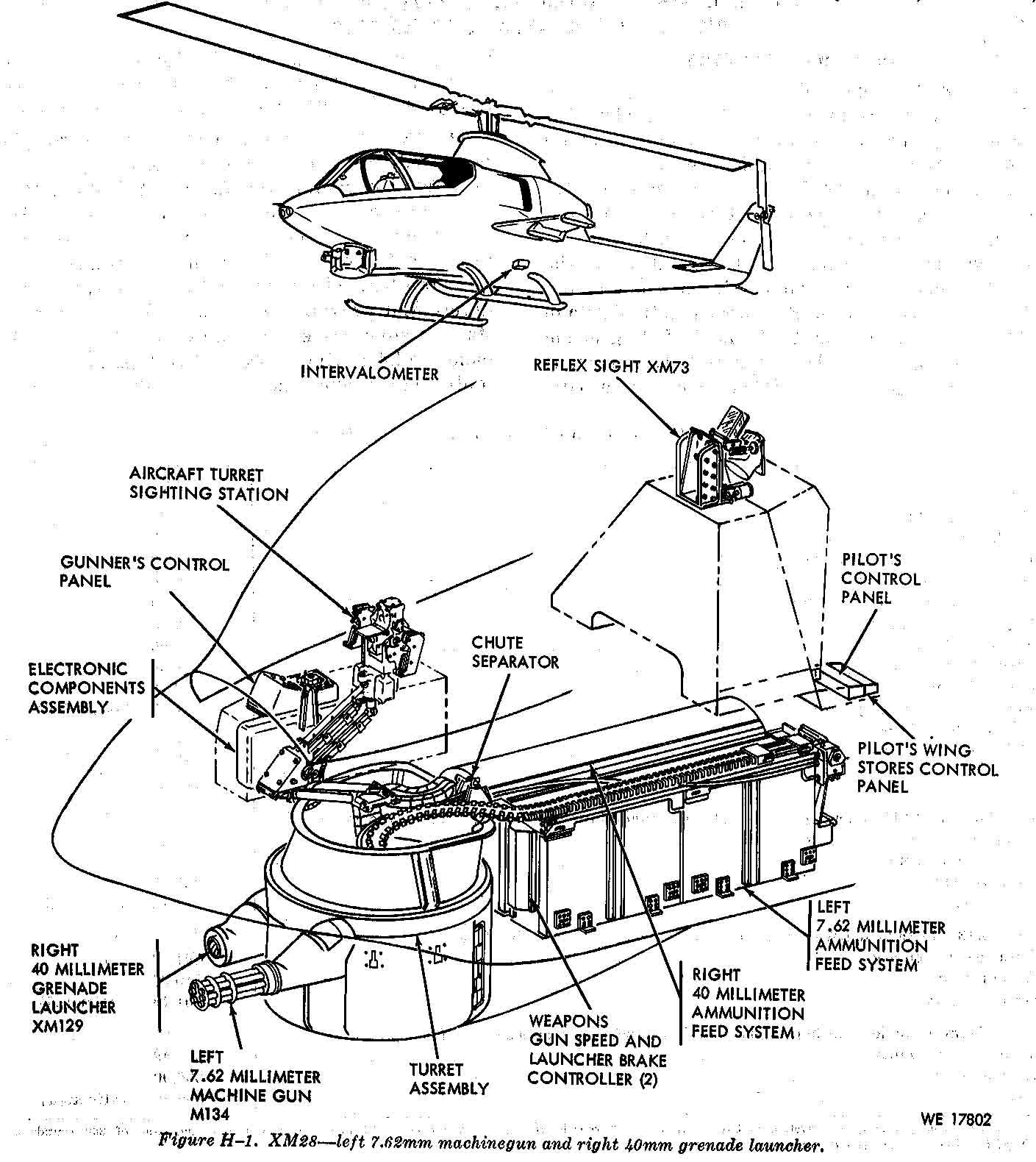
The original chin turret, the M64 (manufacturer designation: TAT102A), carrying a 7.62 mm M134 Minigun (21° elevation, 50° depression, 230° azimuth), was soon replaced by the smaller M28 (TAT141), which could mount either two 7.62 mm GAU-2B/A Miniguns, or two 40 mm M129 grenade launchers, or one of each (25° elevation, 60° depression, 230° azimuth). It was so well liked that it spawned several sub-variants and would still equip the AH-1Q and AH-1P/S.
The tail rotor moved from the left to the right side of the fin for improved stability in flight.
The two landing lights in the nose were replaced by a single retractable light.
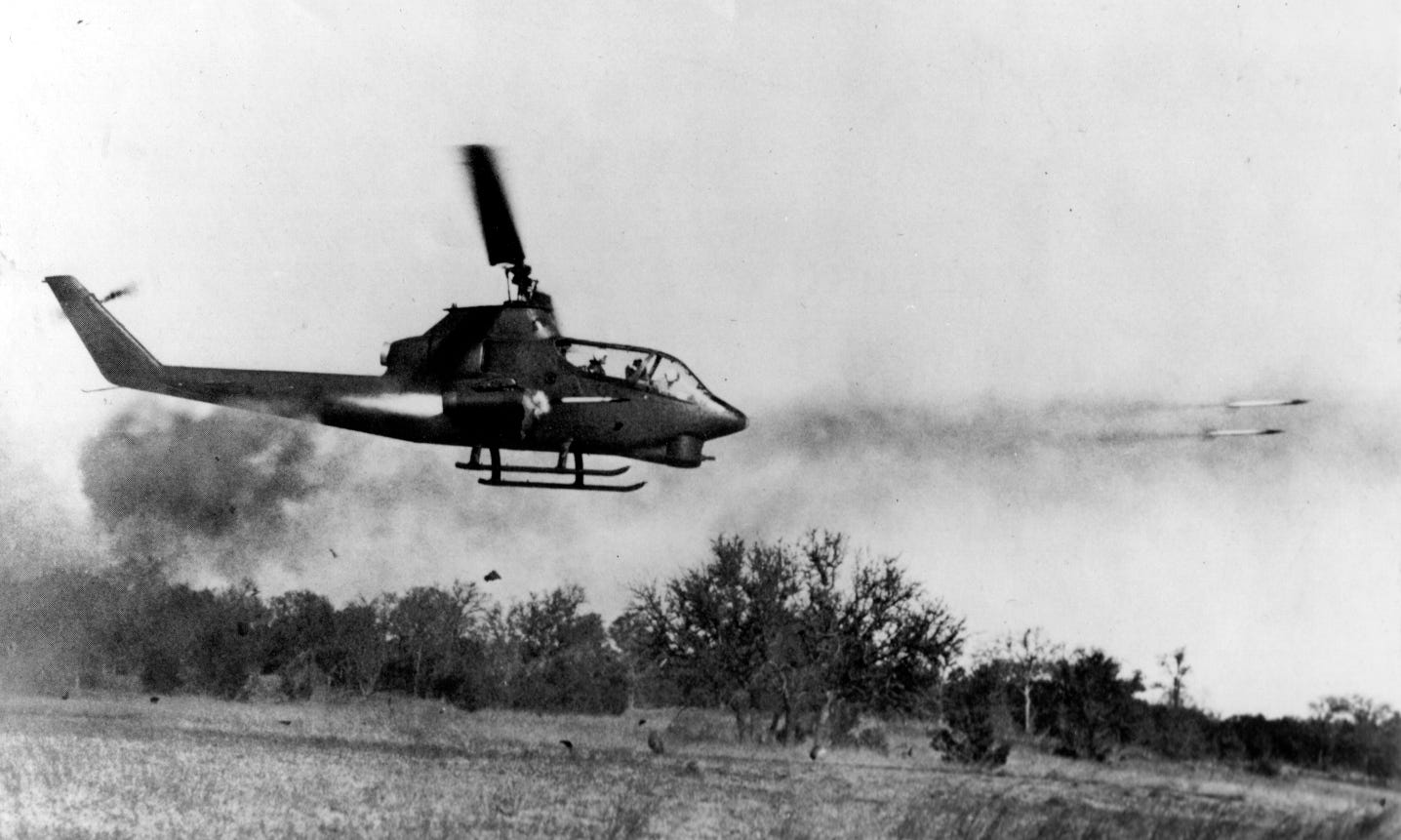
In Vietnam, many Cobras were configured as “Light Scout” for reconnaissance or escort missions: under each stub wing, an M18 machine gun (1,500 rounds) and a pod of seven 70 mm Mk 4 Folding-Fin Aerial Rockets. If they replaced that loadout with two 19-rocket Hydra 70 pods on each side, they were called “Heavy Hog” and could launch 76 70 mm projectiles in a single pass (fire-support mission). In late 1969, 377 Cobras were equipped with the M35 weapon subsystem: an M195 six-barrel 20 mm rotary cannon (a shortened version of the M61A1 Vulcan) fixed under the left stub wing, fed by 950 rounds stored in the fuselage and controlled either by the gunner or by the pilot. The M35 was very often paired with an M18E1 Minigun fixed under the right stub wing.
Thanks for reading! This post is public so feel free to share it.
The AH-1J Sea Cobra
The Marine Corps did, however, have one major criticism of the Cobra: it was single-engine. The USMC operated it from amphibious assault ships, and the aircraft often had to fly long distances over water before reaching its target. Better, then, that it not be vulnerable to engine failure—and the best solution was two engines, so one could compensate if the other stopped. In May 1968, the USMC ordered 49 examples of a navalised version, the AH-1J Sea Cobra. Development would take time, and unable to wait, the Marines sent their AH-1Gs to Vietnam the following year. Feedback was enthusiastic. “I flew several missions [escorting CH-46s] before coming back from one of them with a bullet strike on my Cobra,” recalled a veteran. “The AH-1G was not often fired at, because the enemy had learned it wasn’t very prudent to shoot at a gunship. […] The Cobra really was a saviour for many Marines on the ground as well as for the CH-46 and CH-53 that supported them. Honestly, I don’t know what the Corps would have done without it.” In May 1971, the last USMC AH-1Gs still in Vietnam returned to North Carolina after two years of intensive use.
Meanwhile, Bell worked on the Sea Cobra. Beyond twin-engine propulsion, the USMC requested a rotor brake for deck landings and, above all, a new turret armament, judging the existing one too “light” for its missions. In 1968, Bell proposed a “heavier” version featuring a Pratt & Whitney TwinPac T400 (two 900 hp gas turbines coupled together) and a new chin turret armed with the three-barrel M197 20 mm cannon (derived from the M61 Vulcan). Minor changes were then made to integrate the new powerplant and turret (18° elevation, 50° depression, 220° azimuth), which increased the AH-1J’s weight by more than 200 kg. In addition, the stub wings now had four hardpoints for rockets, bombs, Miniguns, and so on. Between 1969 and 1970, the Sea Cobra underwent extensive USMC testing. In February 1971, the first four helicopters were sent to Da Nang and then took part in Operation “LAM Son 719” in Laos as escorts. In 1973, twenty new Sea Cobras were ordered, and the last would be delivered in 1975.
Iranian Cobras
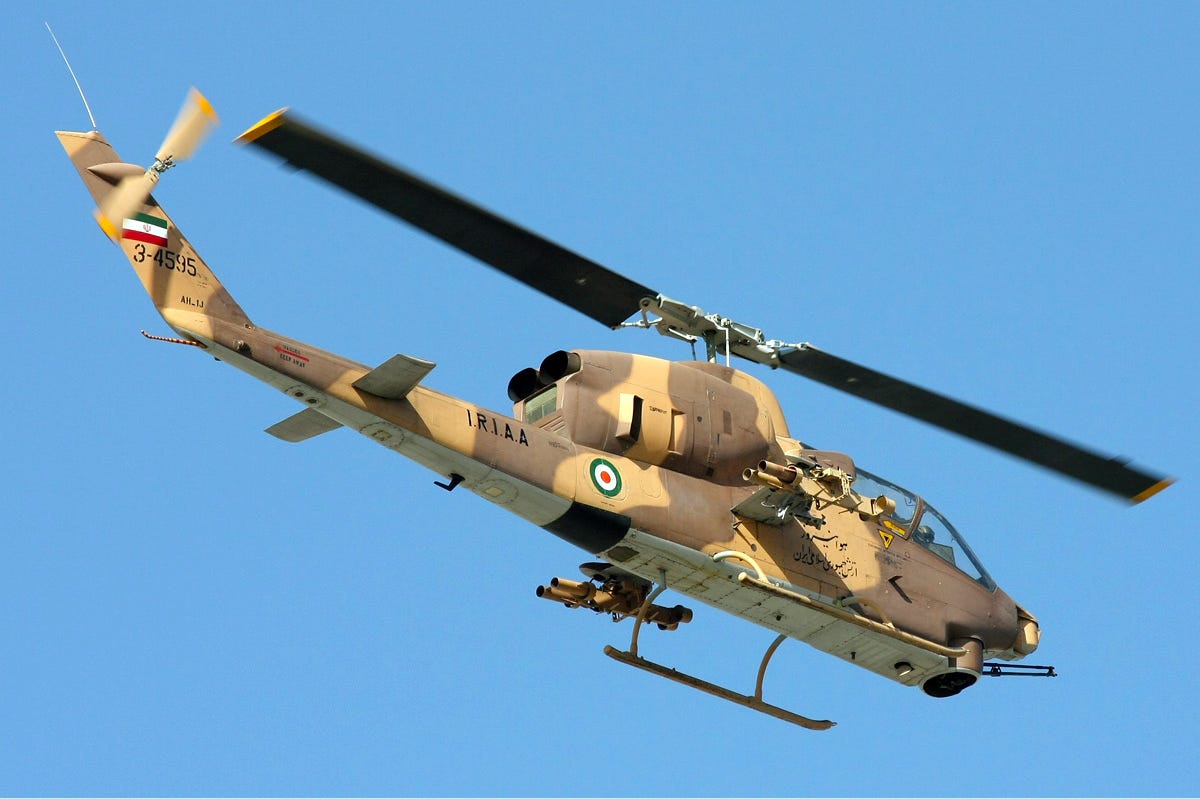
In 1971, Bell delivered 202 AH-1J International Cobras to the Shah’s army—an export version. These helicopters differed from USMC aircraft by using a T400-WV-402 turbine (1,675 hp) and a stronger transmission. In addition, one third of them had TOW capability. But in 1979 Iran became an Islamic republic, and around a hundred aircraft were lost in the war initiated by Iraq. They nevertheless played a key role in stopping Iraqi offensives in 1988. That same year, two helicopters were destroyed by Soviet MiG-23s after violating Afghan airspace. Thereafter, Iran had only about fifty operational Cobras, largely because of the U.S. embargo on essential spare parts. To keep using a helicopter that had proven itself, Tehran began producing missing parts locally, then developed national programmes to modernise avionics and onboard systems.
The Cheyenne Trail: AH-1Q and AH-1S
In autumn 1972, after nearly six years of development, the Army cancelled its AAFSS heavy anti-tank helicopter programme. Lockheed’s AH-56 Cheyenne was too expensive, too complex, too innovative—in short, far from operational—while the Pentagon urgently needed such an aircraft. In the event of war with the USSR, stopping the “red armored tide” in the famous Fulda Gap would require supporting forward-deployed ground forces in West Germany with a dedicated anti-tank aircraft to restore a measure of balance. In the medium term, that role was intended for the AH-64 Apache, but the aircraft was not yet ready. So, for lack of anything better, the Army turned to the Cobra as an anti-tank platform. Tests showed the choice made sense: at night and/or at low altitude, the Cobra was an outstanding tank hunter. Its weak point was vulnerability to anti-aircraft fire, so it needed escort.
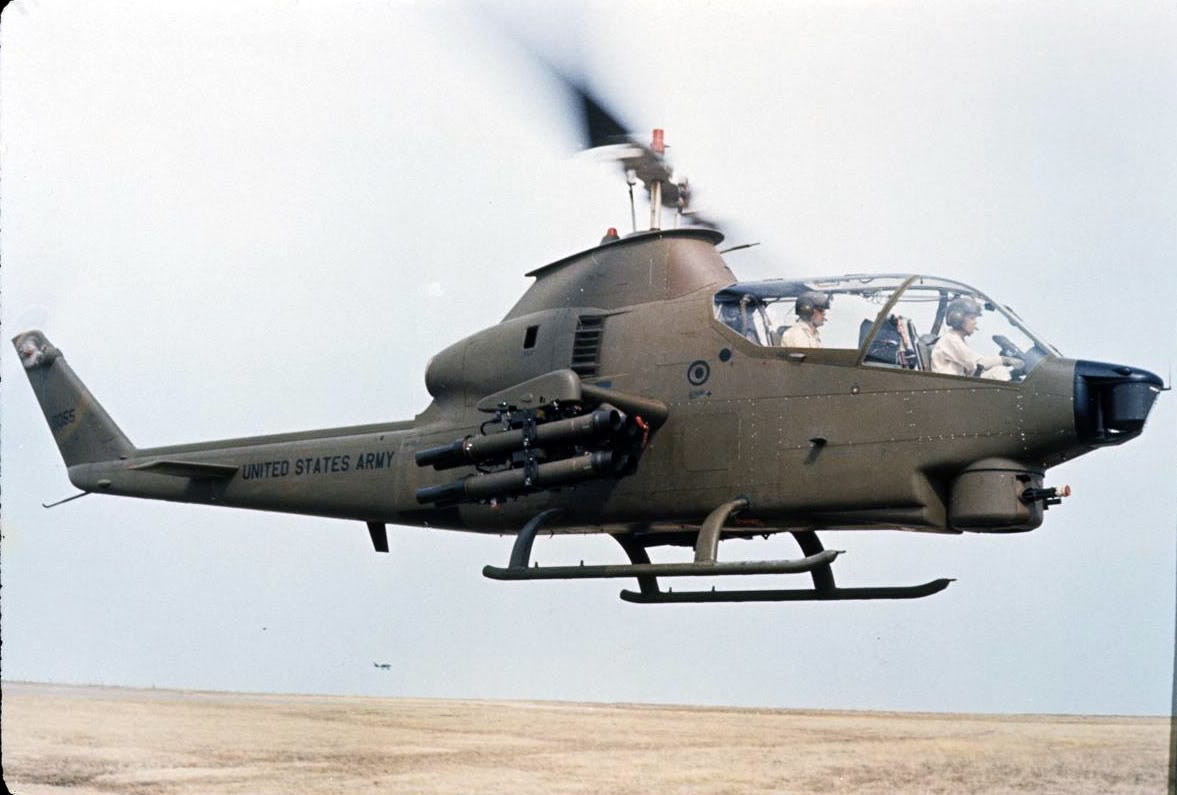
In March 1972, the Army asked Bell to integrate the BGM-71 TOW weapon system on the Cobra. This recent wire-guided missile had been intended for the Cheyenne. Bell modified a platform previously studied for the UH-1 and adapted it to the Cobra under the designation M65. It included a four-missile launcher pylon mounted under each stub wing—without preventing the carriage of Mk 4 rockets—and a gyrostabilised telescopic sighting unit in the nose to guide shots. Note that the pilot’s helmet also received an auxiliary laser sighting system. The result was highly satisfactory, and in 1974 the Army ordered the conversion of 101 AH-1Gs into AH-1Q “TOW Cobras” for more than $59 million. It was soon planned to bring the total number of conversions to 290, but early field feedback confirmed what tests had shown: the two pylons and eight missiles (more than 220 kg) weighed the Cobra down, making it less manoeuvrable at low altitude in tactical flight. To address this, Bell replaced the original engine with a much more powerful turbine (1,800 hp), the T53-L-703—requiring changes to the transmission as well. In total, 290 AH-1s of the G or Q types were modified into AH-1Ss. In 1976, the Pentagon ordered new overpowered Cobras, recognisable by their flatter canopy (older models had a rounded canopy) and by the shape of the nose fairing.
Variations on a Theme
After the AH-1S entered service, the “TOW Cobra” family continued to grow, with each new version improving on the previous one. The AH-1P/E/F were therefore updates—necessary in the middle of the Cold War—but they did not fundamentally revolutionise the Cobra’s offensive capabilities.
AH-1P: between 1977 and 1978, Bell delivered 100 modernised aircraft to the Army, with a new engine, a new transmission, a composite rotor, tapered blades, and a cockpit designed for nap-of-the-earth flight.
AH-1E: between 1978 and 1979, 98 new aircraft were delivered with a “universal” M97 chin turret for the three-barrel M197 20 mm cannon already used on Sea Cobras. This version also carried a new 70 mm rocket-launcher weapon system.
AH-1F: from 1979, Bell converted 387 AH-1Gs and produced roughly 143 new aircraft, about fifty of them for the National Guard. They incorporated all previous improvements plus a completely new electro-optical suite and various refinements (Stinger missile capability, rotor-level wire cutter, etc.).
King Cobra, Super Cobra, Viper
The Cobra rendered good and faithful service, but the Army still regarded it as an interim solution before the operational arrival of a heavy anti-tank helicopter designed specifically for the mission. Since the Cheyenne’s cancellation, however, no other project had found favour at the Pentagon. Bell therefore proposed working on a heavier, modernised version: the Model 309 King Cobra. In September 1971, Bell built two prototypes—one single-engine and one twin-engine—combining the best of the Cobra and the Sea Cobra. Externally, it differed from the AH-1J with a “buzzard beak” nose and a ventral fin. Above all, it was 40% heavier than its predecessors and introduced welcome innovations: a large-capacity 20 mm ammunition drum, quieter rotor blades, improved night and infrared vision, helmets with integrated sighting, and more. Nevertheless, in summer 1972, the U.S. Army definitively rejected the project.
To preserve the experience gained, Bell continued working on a heavy demonstrator intended to compete with the future Apache. The Model 409 was designed to carry a 30 mm cannon and up to 16 TOW missiles, possibly laser-guided Hellfires. It was also fully armoured, and its sensors were optimised for night combat. After a crash during tests, Bell lost the competition to Hughes’s Apache in 1976—but it used its research to offer the Marines an improved Sea Cobra: the AH-1T combined the Model 309’s fuselage, engine and transmission with the Army “TOW Cobra” anti-tank capability and armour, plus new electronic terminals for flying, aiming, firing and evasive manoeuvres. The AH-1T entered USMC service progressively from October 1977. Deployed to Lebanon in 1982, it was above Grenada (West Indies) in 1983 that it truly saw combat.
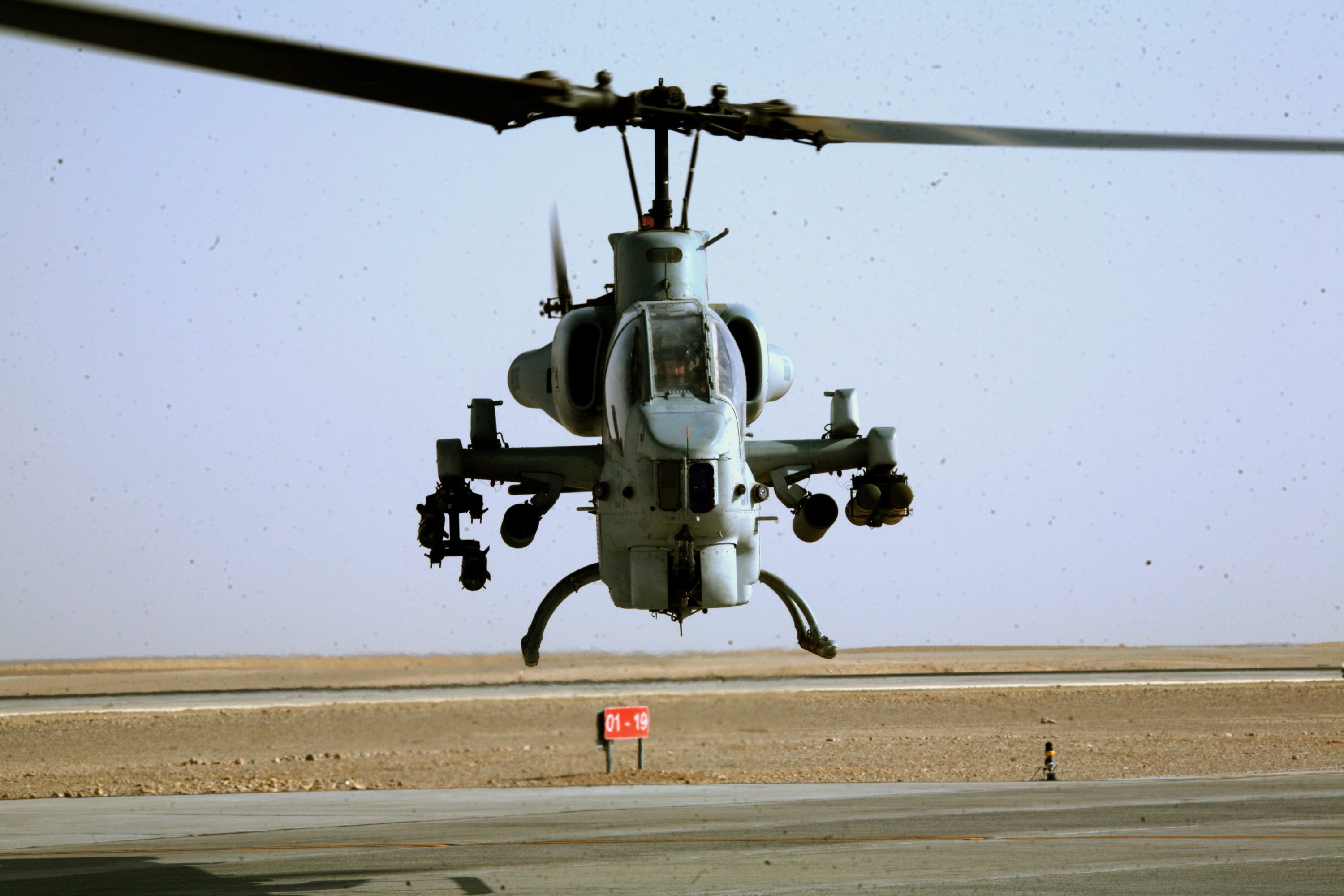
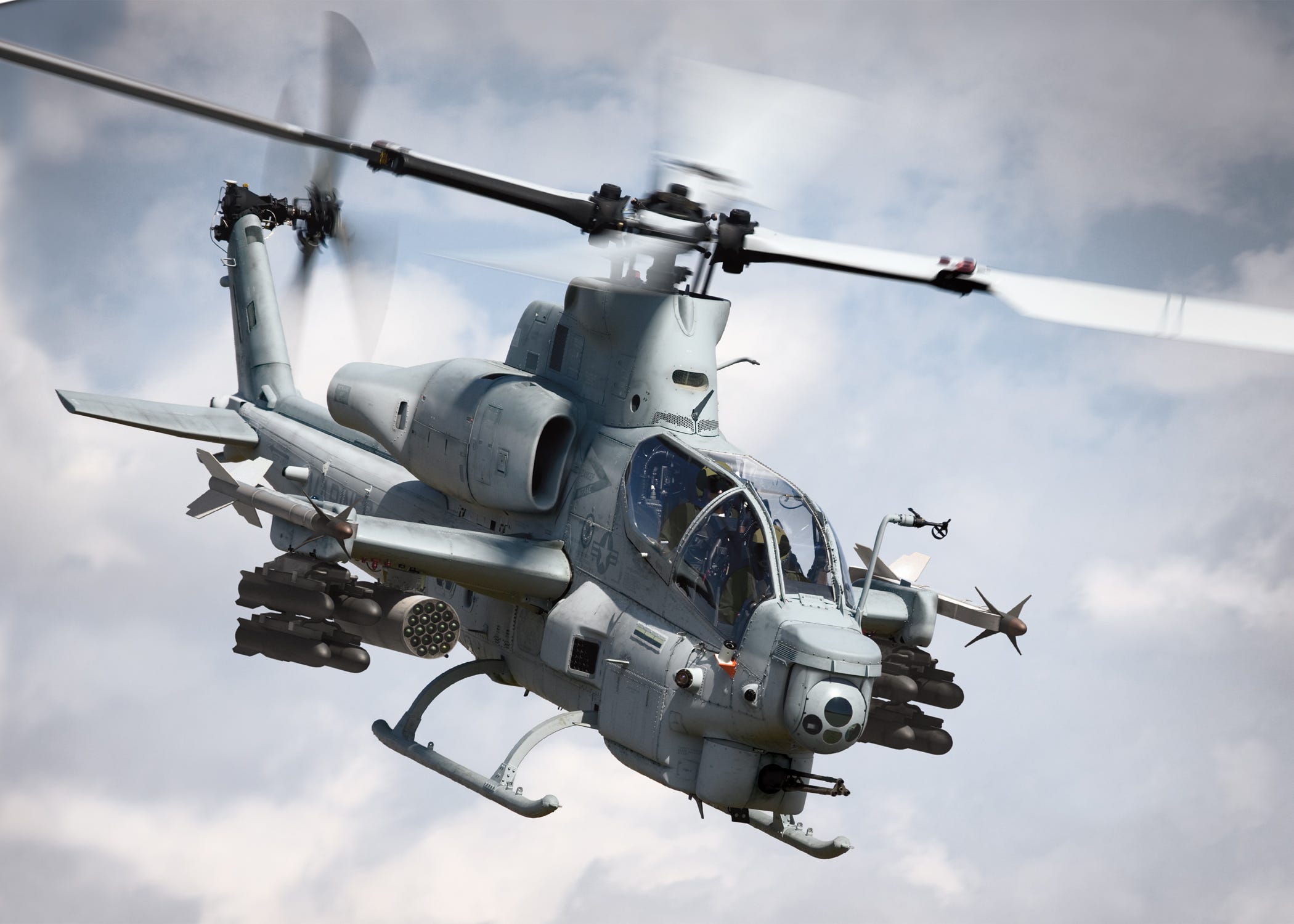
That new version still did not fully satisfy the Marines, who looked to the Apache to complement their aviation fleet. “Too expensive!” Congress replied in 1981; the USMC therefore turned again to Bell for the AH-1W Super Cobra, an updated AH-1T. Eighty-five new aircraft were delivered in the early 1990s to serve as escort and all-weather fire-support platforms: air-to-ground (TOW and Hellfire) and air-to-air (Sidewinder). Night-fighting capability was massively improved through advanced sensors, electronic countermeasures and state-of-the-art radar systems. In 1996, 180 AH-1Ws were in turn converted to the AH-1Z Viper standard: third-generation thermal imaging, laser designator, automatic decoy dispenser, a “TopOwl” helmet designed by BAE Systems, and more.
Cobra’s Venom
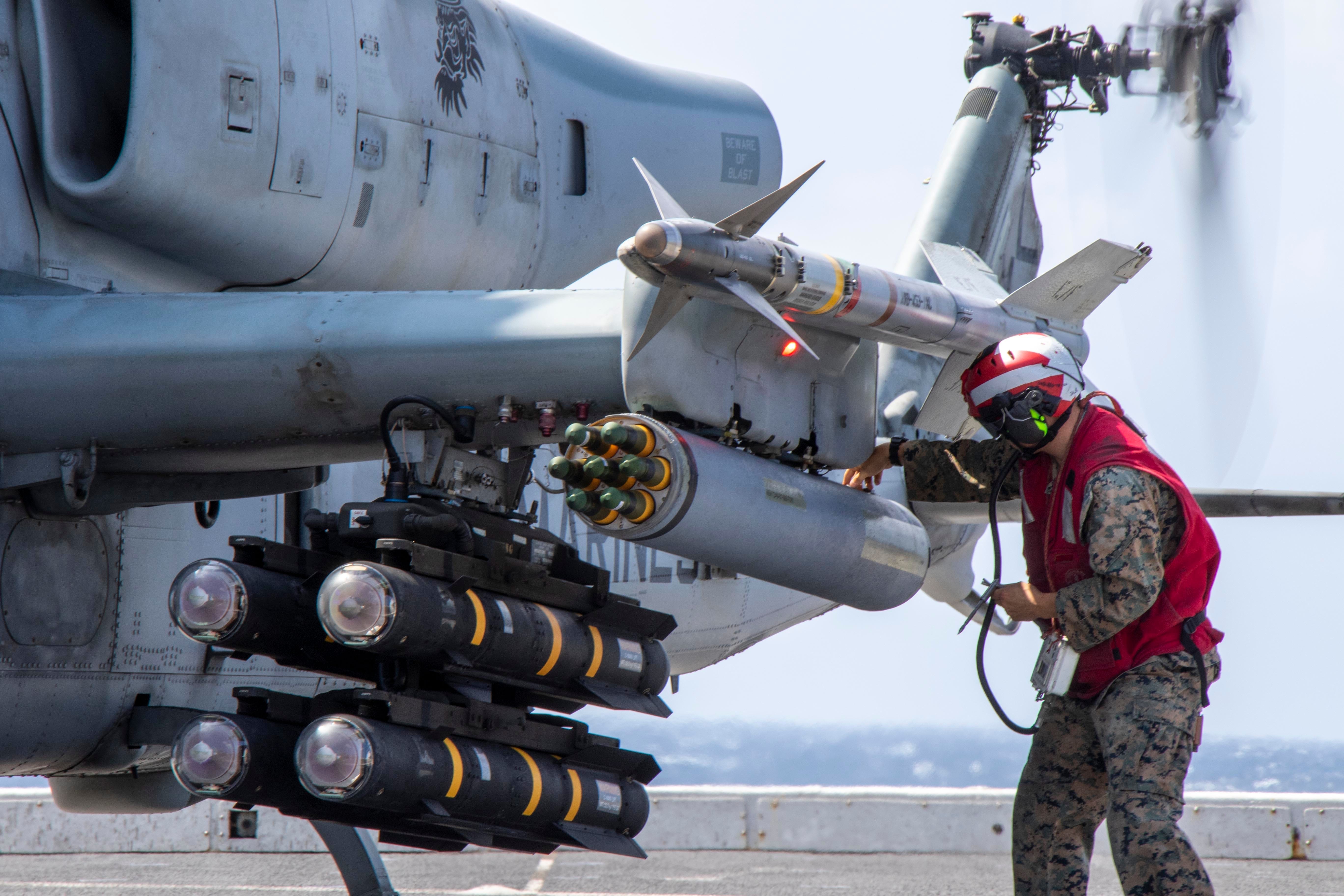
After Vietnam, Grenada and Lebanon, the Cobra was used intensively during the First Gulf War against Iraqi tanks: 91 Sea Cobras and 140 Army aircraft destroyed hundreds of armoured targets (more than 200 for the AH-1W alone) for the loss of three helicopters (through accident or malfunction). In 2001, the Army permanently retired its Cobras; only the USMC could deploy AH-1s to Afghanistan, and then again to Iraq two years later. They proved exceptionally reliable there, and none was shot down though many were hit by heavy machine-gun fire or light anti-aircraft weapons. The USMC finally retired the AH-1W SuperCobra in October 2020, but continues to operate the AH-1Z Viper. In 2026, the U.S. Marine Corps is clearly betting on continued modernisation of the Viper by giving it the right weapons for today’s threat envelope, especially in the maritime domain : under NAVAIR’s Precision Attack Strike Munition (PASM) effort, the USMC is moving to arm the AH-1Z with L3Harris “Red Wolf” launched effects, designed to deliver kinetic or non-kinetic effects and, crucially, to push reach out to over 200 nautical miles (about 370 km), a step-change compared with traditional helicopter munitions that typically operate at much shorter ranges.
Comments
Nothing yet. Say the first thing.
Sign in to join the conversation.