

It is still all about the Strait of Hormuz.
We are now entering week 10 of the Strait of Hormuz closure.
To this point, markets have been “looking through” this crisis and are not necessarily pricing in the significance of the drop in energy supplies and other commodities.
In fact, the NASDAQ and the S&P 500 made new highs last week!
Someone is wrong.
The consensus is that the closure will not be a major issue, and others have delved deep into the data and view the potential for a major economic dislocation as very high.
As far as Iran is concerned, I am sticking to my view that they have spent several decades preparing for this conflict. They understood that one of the weapons at their disposal was the closure or threat of closure of the Strait of Hormuz.
Given that this is existential for the Iranian regime, I maintain that they will continue their Nash Equilibrium strategy. No matter what the US says or does, keep traffic flows constrained and wait for commodity prices to crumble the global economy, thereby forcing the US into concessions.
One of the analysts I have been following on oil inventories is HFI Research on Substack. They published an excellent public article about where we are going over the next few weeks if the Strait stays closed.
There’s a scene from Top Gun where Tom Cruise goes head-to-head against Viper. Goose says, “Holy shit, we are going head-to-head. I can’t believe we are doing this.”
This was what PauloMacro said to me when I described to him the incoming US crude inventory draws I was compiling.
Yes, I guess we are really doing this.
As I sit here compiling the tanker flow data I’m seeing in the US Gulf, the thing that should be duly noted is the following:
-We are still offloading some of the tankers inbound laden with crude. These are temporarily keeping US crude imports elevated. The same VLCCs discharging crude turn into export volumes in 1-2 weeks.
-We have an armada of empty VLCCs headed for the US, which will drain US commercial crude inventories dry.
-All the while, we will continue to drain product inventories in the US. Petroleum product exports are expected to remain near all-time highs.
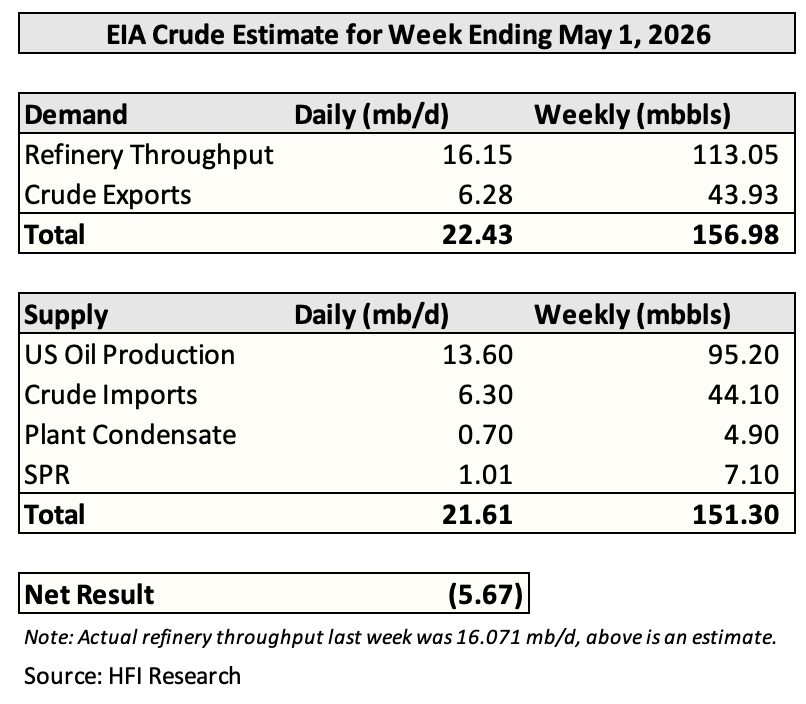
I guess we are really doing this. We are really going to just watch the Strait of Hormuz stay closed, and onshore oil inventories plummet. US product storage is already approaching seasonal lows for this time of year, and the next few weeks will push us into brand-new territory.
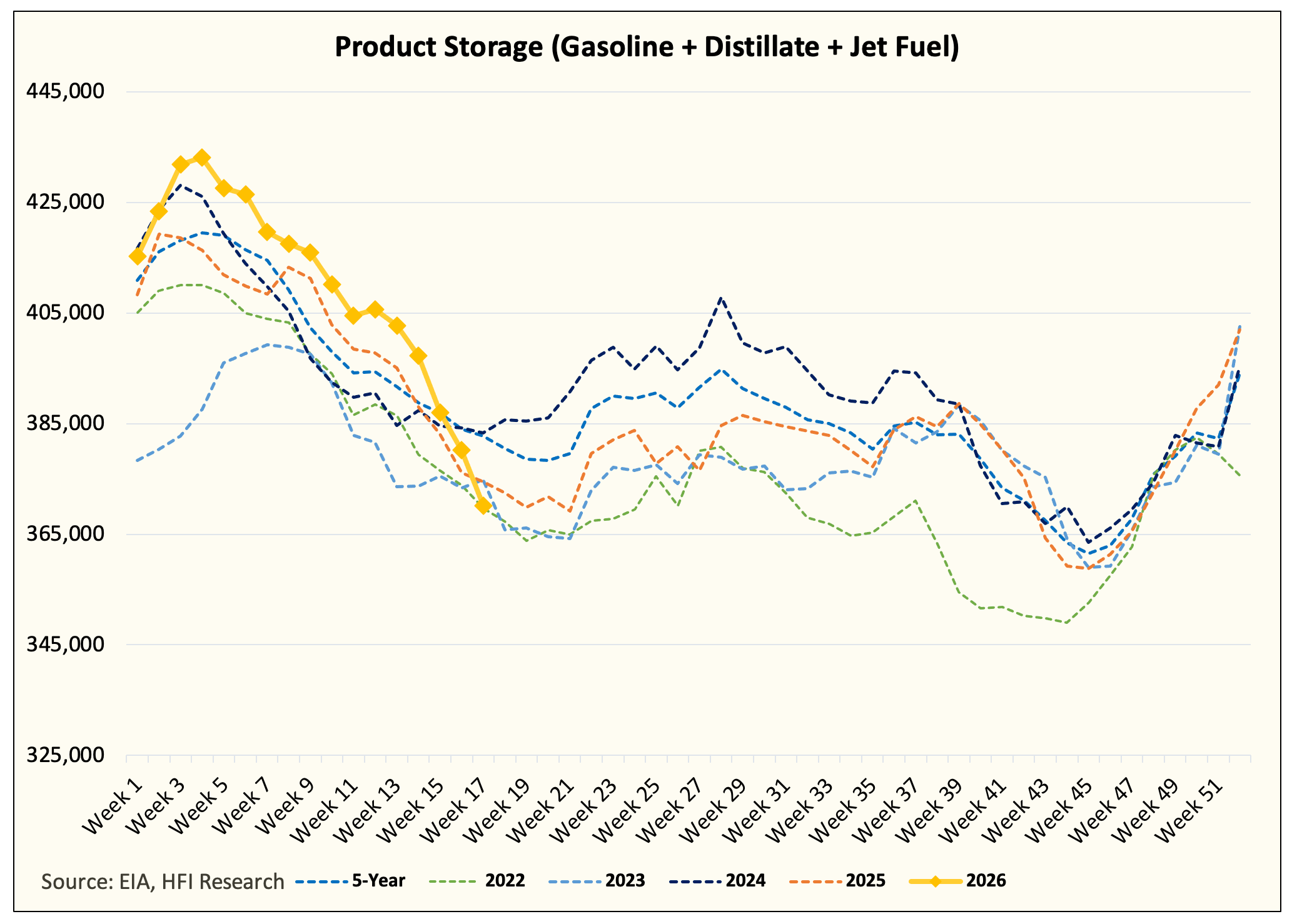
I think, regardless of how this plays out, oil prices will likely be at a new higher level as geopolitical risk gets priced into oil.
There is also a rising chance that we see an oil price spike that takes us to new highs and fully causes a severe economic recession or, dare I say, depression. Not sure the stock market makes new highs in that reality.
I sold all my large-cap oil producers (I have kept my oil services stocks), but I am looking at mid and small-cap oil producers, especially those with rising production and/or stock buybacks.
Here is a preliminary list of potential candidates.
Whitecap Resources (WCP) — 122,135,462 shares; 10% of public float.
Baytex Energy (BTE) — about 66.2 million shares; 10% of public float.
ARC Resources (ARX) — 57,967,896 shares; 10% of public float.
Tamarack Valley Energy (TVE) — 47,744,705 shares; about 10% of public float.
Athabasca Oil (ATH) — 46,976,750 shares; 10% of public float.
Birchcliff Energy (BIR) — 26,769,197 shares; 10% of public float.
Headwater Exploration (HWX) — 19,020,755 shares; about 10% of public float.
Vermilion Energy (VET) — 15,259,187 shares; about 10% of public float.
Saturn Oil & Gas (SOIL) — 12,078,583 shares; 10% of public float.
Surge Energy (SGY) — 9,597,280 shares; about 10% of public float.
Parex Resources (PXT) — 9,407,490 shares; 10% of public float.
International Petroleum (IPCO) — 6,468,077 shares; 10% of public float / ~5.8% of shares outstanding.
Obsidian Energy (OBE) — 6,458,536 shares; 10% of public float.
Gran Tierra Energy (GTE) — 2,925,720 shares; 10% of public float.
It is a mix of large and mid-caps with an emphasis on Canadian names.
I am still researching some of these, so expect an email in the near future if I unearth something I decide to add to the portfolio.
In the most recent week, I discussed in my YouTube video that, due to the closure of the Strait of Hormuz, we are now facing the potential for much higher food prices. In fact, there is a good possibility we will see famine in some developing countries.
Could rising food prices or outright shortages lead to political and social unrest in some countries? It is quite possible!
This is due to the cessation of urea and ammonia exports from the Persian Gulf. This region accounted for around 30% of the world's fertilizer exports.
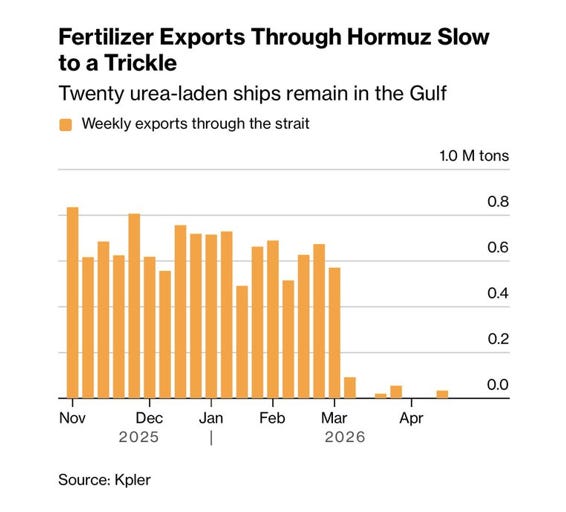
As I mentioned before, we are in the planting season in the northern hemisphere (it is ending now). I have reported numerous anecdotes regarding farmers choosing not to plant due to high fertilizer prices or outright inability to acquire it.
This is a real problem.
70% Of Farmers Can’t Afford To Grow All Their Crops
The War in Iran and the impact on oil and energy have continued. Gas hit $4.12 a gallon on Monday, April 27. As The Hill wrote, it’s the highest price since the beginning of combat.
National gas prices, all formulations, are worse than the publication wrote. Other than the $5 per gallon price in June 13, 2022, it’s the highest price since August 1990, according to data from the U.S. Energy Information Administration.
The result is wreaking havoc on farmers. An agricultural lobbying group, the American Farm Bureau Federation, ran a survey and found that 70% of farmers couldn’t afford all the fertilizer they needed.
“Fertilizer pre-booking rates varied significantly by region, with just 19% of Southern producers reporting fertilizer purchases secured ahead of the season, compared to 30% in the Northeast, 31% in the West and 67% in the Midwest, reflecting differences in planting decision timelines and exposure to recent price increases,” the AFBF wrote. Farm diesel prices, which fuel the heavy machinery used in the industry (other than small-scale farms that don’t produce the majority of food crops in the country) are up 46% since the end of February, according to the organizations.
Ag prices are now starting to reflect these facts.
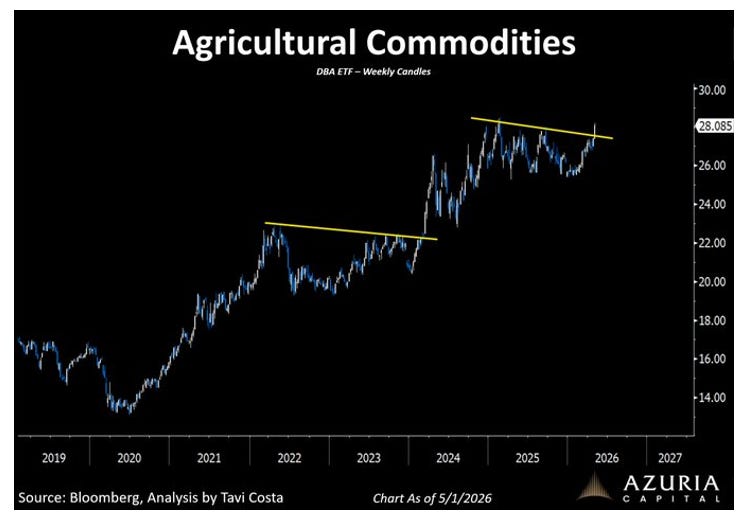
How do we take advantage of this?
I have publicly stated that I was in CF Industries (CF). This is a urea/ammonia producer based in the US. Good opportunity as they use cheap US natural gas to make high-priced urea.
Planting is finishing, so urea demand will now decrease. This is reflected in the urea price, which is rolling over. This may become an opportunity after the urea price bottoms.
The most lucrative way to play this is via futures. I don’t recommend this unless you understand futures and have experience trading them. You will be trading on margin, and these things are going to be volatile.
If you don't know what you are doing, and most people don't, you could be right about where Ag’s are going trend-wise and end up losing money, a lot of money.
The global lithium market is set to enter a near-decade-long deficit as a lack of mine investment weighs on the supply of the EV battery metal, according to Canaccord Genuity.
In a note published Wednesday, Canaccord analysts said they expect a “material market deficit” to begin in 2026, given that supply tightening has more than offset near-term demand weakness.
This deficit, they added, could last until 2035. Even if rising lithium prices through 2027-28 could ignite a supply response, that would still fall short of their demand growth forecasts, the analysts said.
In recent months, lithium prices have shot up amid persistent supply concerns, driven by the suspension of a key mine in China, one of the world’s leading suppliers. Earlier this year, Zimbabwe, another top producer, introduced a ban on raw lithium exports, exacerbating the market conditions.
I am adding a lithium position to the AIA Portfolio. See the Portfolio section below the paywall.
Below is the list of critical minerals for which the US is 50% or more reliant on imports.
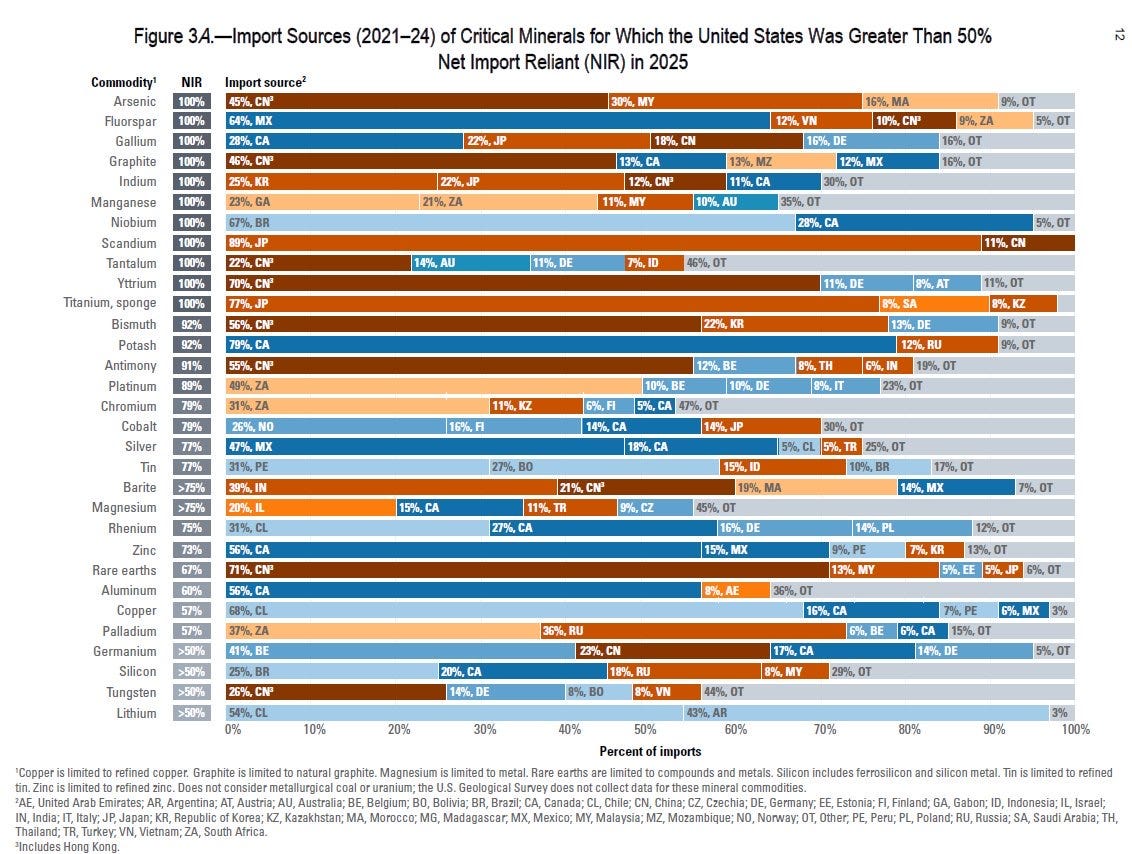
I have a view that there will be a tremendous amount of money to be made by front-running the US government's investments (throwing billions at the problem) in companies that can mine or produce these minerals in the US or even in US-allied countries (Argentina?).
Could the US build strategic reserves of some of these minerals? At this point, I think almost anything is possible.
This theme will likely become a more important part of the AIA Portfolio going forward.
I am dipping my toe back into gold mining shares. I am a long-term bull (3-5 years) on gold, as I have indicated in many Substack articles and my weekly YouTube videos, for several reasons, also discussed many times. One of the main reasons is the out-of-control US Government debt, which has now crossed 100% of GDP.
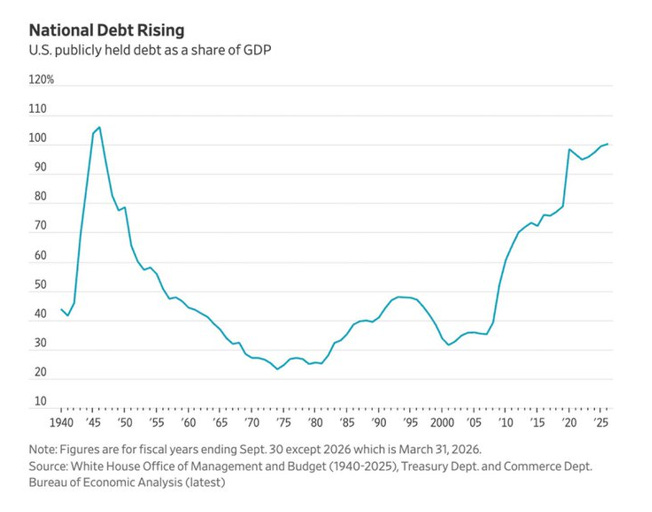
More debt means more money printing, as there is no plan to pay off this debt or even control or reduce spending. Now add the entitlement programs (SS, Medicare, etc) which are not paid for, and you get the point.
I am trying to find emerging producers with the ability to build production volume amid the current high gold price (and, hopefully, a rising one).
I am a big admirer of Pierre Lassonde, the founder of Franco-Nevada. He is famous for creating a junior mining investing concept known as the Lassonde Curve.
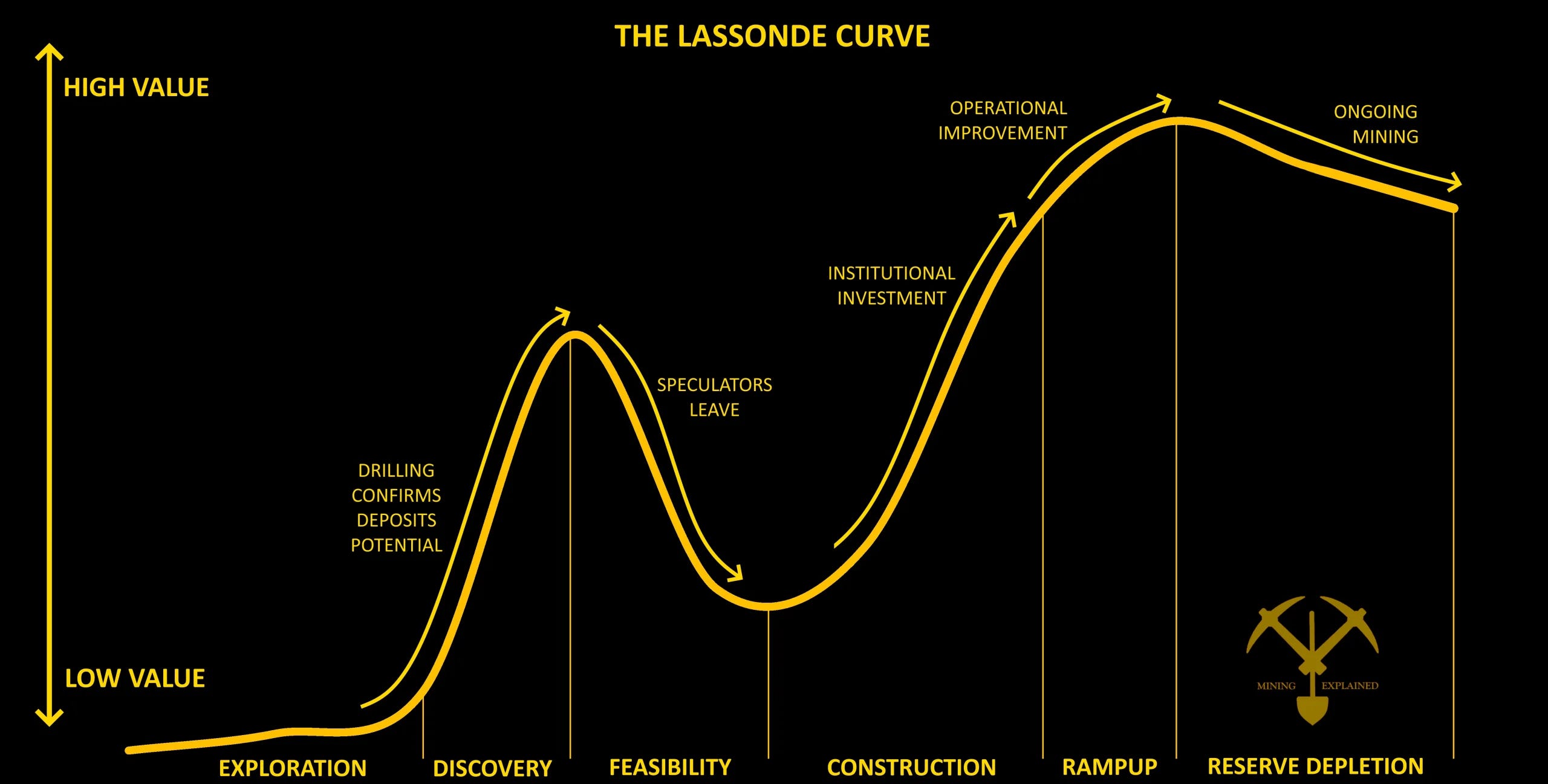
According to the Lassonde Curve, there are optimal periods to buy junior mining stocks. Of course, this is a general rule, not a guarantee that it plays out for every stock. Mining is hard, and stuff happens. Nevertheless, this is a good guide for speculating in junior mining stocks.
When are the best times to buy a junior mining stock, according to Lassonde?
Before or immediately following a major discovery. The trick is knowing what’s an actual discovery versus noise in the crowd.
As feasibility studies are completed and the project has been de-risked, but before institutional investors begin piling in. Prices remain depressed following the exit of speculators chasing quick wins, but improvements are close at hand.
When construction has been completed and operations have commenced, but growing pains are not yet over. Impatient investors are taking money off the table early despite potential value remaining.
The last bullet point is applicable to this month’s portfolio addition.
Comments
Nothing yet. Say the first thing.
Sign in to join the conversation.