

Most copper supply models are built on company guidance, but Benchmark Mineral Intelligence highlights a persistent gap between production guidance and actual output.
The firm’s analysis separates target vs realized production across the top 10 copper miners — showing which companies delivered on expectations and which fell sort.
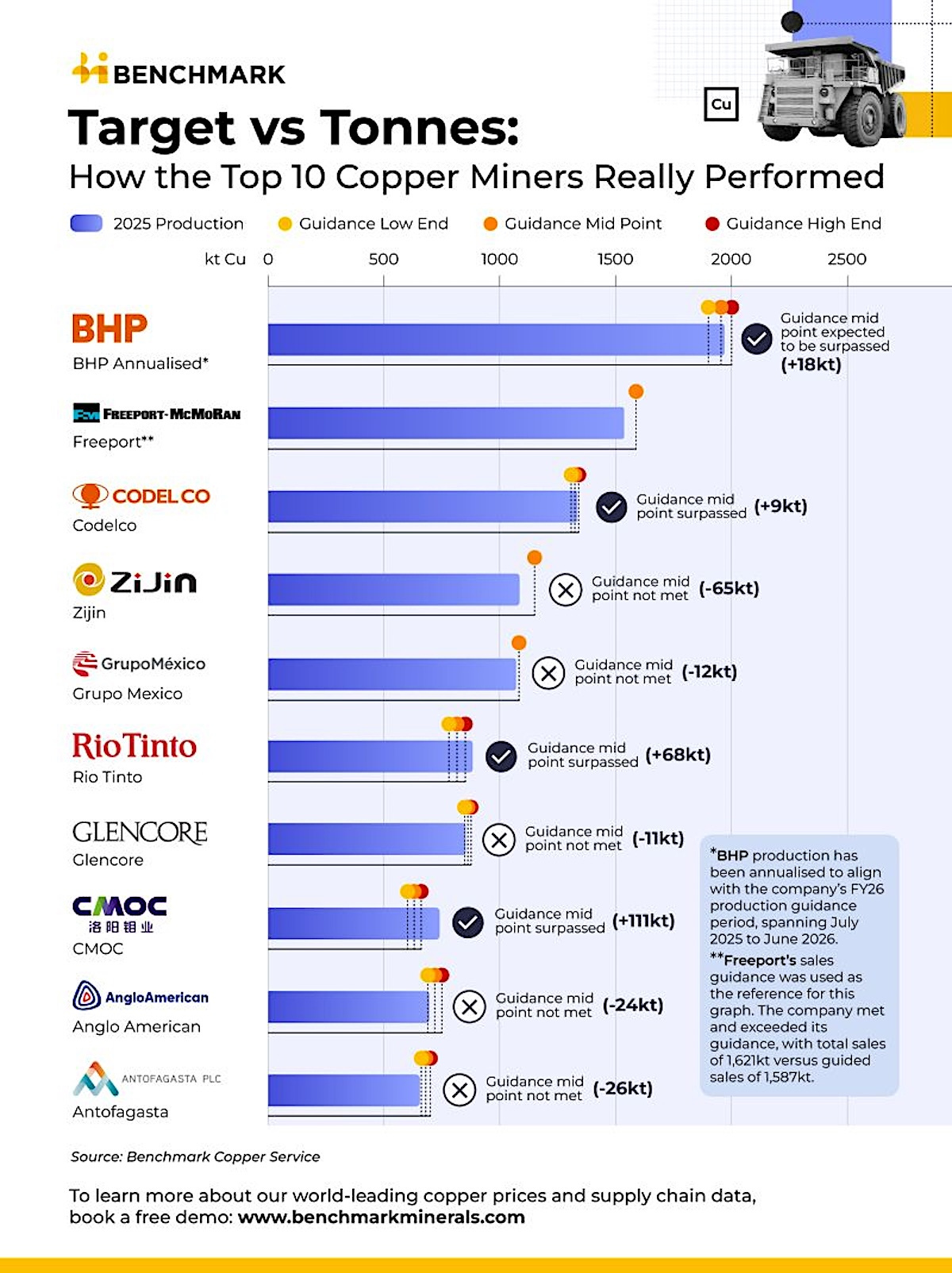
Many copper producers are not hitting their production targets. This in the face of rising demand and shrinking supply. I am bullish on copper over the mid- to long-term.
The world’s largest uranium producer is holding onto pounds. That sentence would have read as contrarian a few years ago. Today, however, it now describes official state policy.
Within the space of a single earnings cycle, the investment narrative around Kazakhstan has undergone a structural reorientation. The Mineral Extraction Tax (MET) reform introduced a tiered regime that reaches 18% on volumes above 4,000 tU per mine, with price surcharges up to 2.5% above $110/lb, actively disincentivizing volume maximization into a rising price environment.
Amendments to Kazakhstan’s Subsoil Use Code tightened JV transfer thresholds and, critically, established that upon contract expiry, subsoil use rights revert to Kazatomprom control rather than being extended on existing terms. The direction of travel is toward greater state control over both the economics and the operation of Kazakh uranium production.
I have discussed the fact that as the world becomes more multilateral, we will see various blocs adopt resource nationalism to prioritize their own supply chains and those of their allies. Bullish uranium.
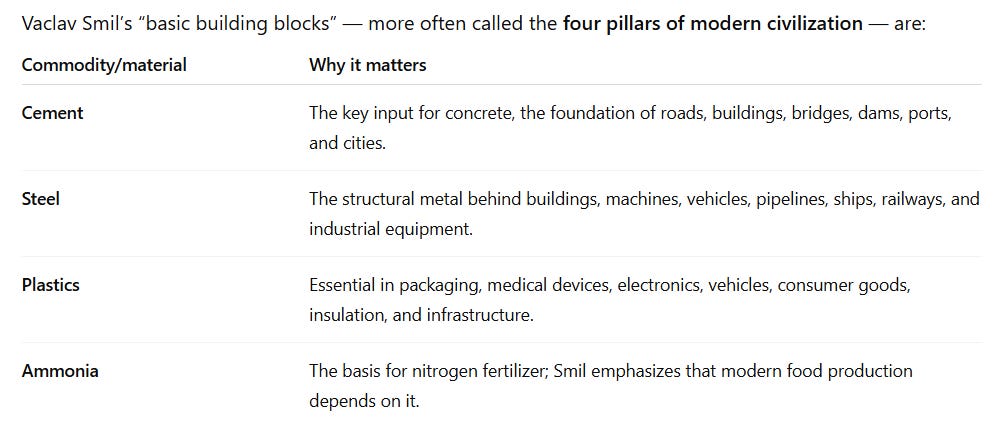
Smil’s point is that modern society is not built primarily on software, finance, or services, but on these enormous physical material flows. In his wording, these four materials “form the four pillars of modern civilization”: cement, steel, plastics, and ammonia.
From the Time article:
And these four materials, so unlike in their properties and qualities, share three common traits: they are not readily replaceable by other materials (certainly not in the near future or on a global scale); we will need much more of them in the future; and their mass-scale production depends heavily on the combustion of fossil fuels, making them major sources of greenhouse gas emissions. Organic fertilizers cannot replace synthetic ammonia: their low nitrogen content and their worldwide mass are not enough even if all manures and crop residues were recycled. No other materials offer such advantages for many lightweight yet durable uses as plastics. No other metal is as affordably strong as steel. No other mass-produced material is as suitable for building strong infrastructure as concrete (often reinforced with steel).
I would note that all of these materials stand on the shoulders of fossil fuels. Consider this, as the Strait of Hormuz remains closed.
This is the next disaster.
The global agricultural and industrial complex is heading into a poly shock, with an upstream sulphuric acid and Naphtha supply crisis colliding directly with a forecasted severe El Niño, generating generational system risks for 2026–2027.
Sulphuric acid is a critical upstream chokepoint; approximately 45% of global consumption is dedicated to the wet-process production of phosphoric acid for phosphate fertilisers.
This chemical bottleneck is currently being compressed by the near-total closure of the Strait of Hormuz, which accounts for approximately 49% to 50% of sulphur & Naphtha flows, and by China’s unprecedented mandate to halt all smelter-by-product sulphuric acid exports from May 2026 to protect its domestic agriculture.
(skip)
The convergence of higher nutrient application costs and climatic stress guarantees widespread yield destruction, forcing global agribusiness and sovereign risk systems into a cascading polycrisis spanning food security, delays in the green-energy transition, and severe macro-financial spillovers.
Significant declines in crop yields are shaping up to be severe.
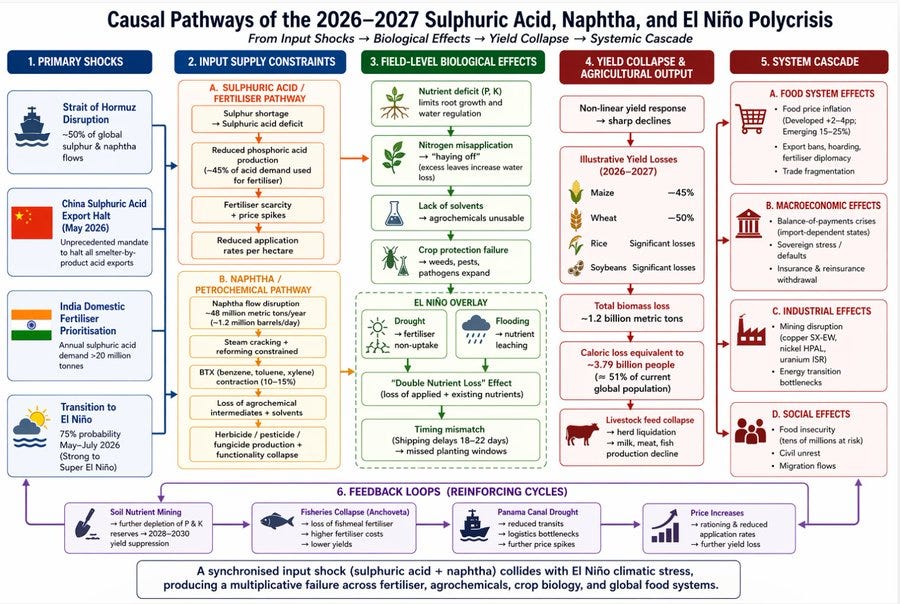
This is an excellent article that will allow the layman or generalist investor to get up to speed on how precarious our agricultural systems really are.
In my view, and I have said publicly, most of the developed world will likely be able to have enough food as they will just outbid the poorer countries. The reason we have 8 billion people on the planet is due to agricultural inputs, many of which are petroleum-based.
The longer this goes on, the worse this gets for the world and especially the poor people. We could see significant political instability. Revolution is only nine missed meals away.
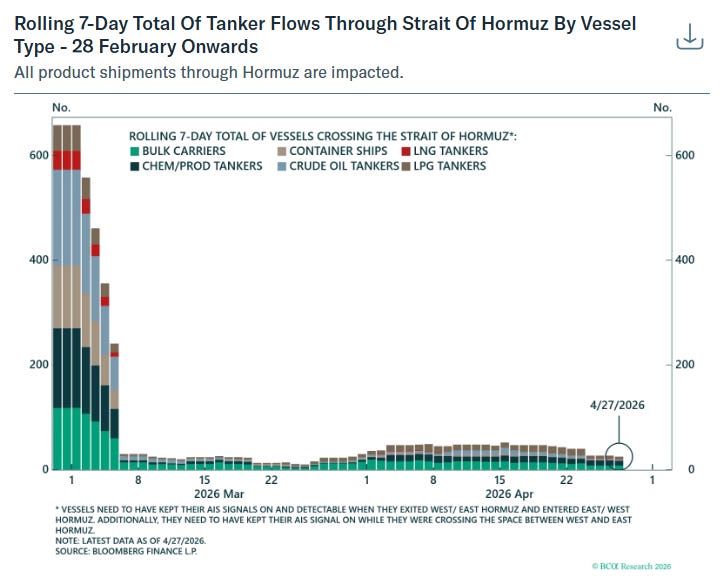
Traffic through the strait up to 4/27/26.
That’s all for this week.
John Polomny
Comments
Nothing yet. Say the first thing.
Sign in to join the conversation.