

By the time you receive this issue, we will likely be four months into what I have called a massive heart attack for the global economy. The de facto closure of the Strait of Hormuz.
There have been so many false starts on a peace deal, or at least a deal to open the Strait of Hormuz, that I have lost count.
All of this yo-yoing is causing significant volatility in the oil market, in particular.
There are many opinions on the energy markets, and you can find any potential outcome that suits you.
My own view is that no one knows exactly how this will resolve. However, there are some things we can know and build on.
I would say unequivocally that the world runs on oil and gas. There is simply no argument that, without a sufficient and growing supply of oil and gas, the modern world will struggle to maintain the economic status quo.
When 10-14% of the world's oil supply is cut off via the closure of the Strait of Hormuz, this is a big deal. I have been comparing this to a massive heart attack for the world economy.
Many analysts, including me, thought that with the closure of the Strait of Hormuz and the removal of 20% of the world's oil supply, we would have experienced a large rise in oil prices.
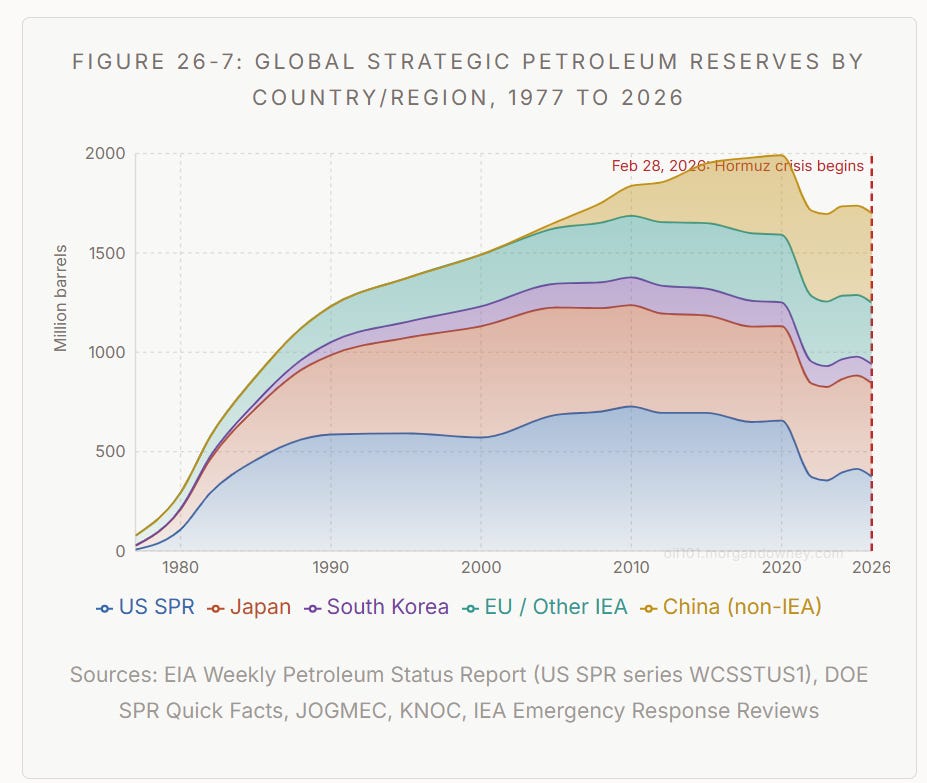
This has not happened as many of us under-estimated the amount of oil in storage and in various countries’ strategic petroleum reserves.
I would also suggest that there has definitely been manipulation of the oil market, given the US administration's BS communications about peace deals and the obvious moves in futures markets that someone always seems to know about before the administration announcement (someone always knows). Below is a list of the previous five “deal” announcements and what crude oil did in the aftermath.
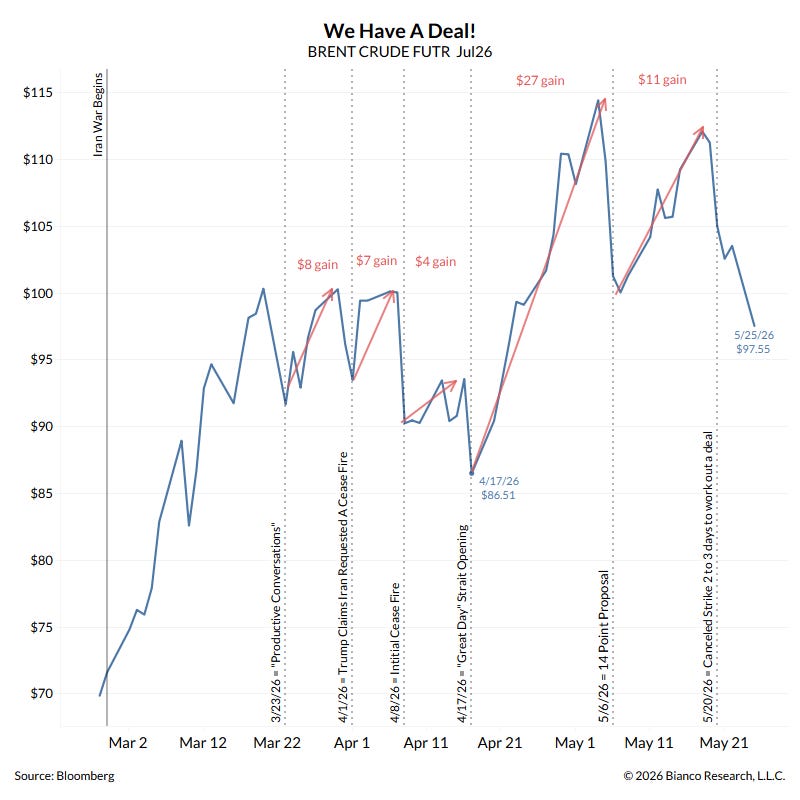
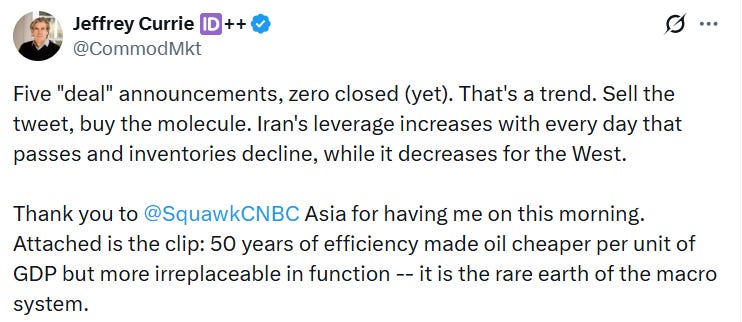
Sell the Tweet, buy the molecules indeed!
The next fact is that the storage is not limitless.
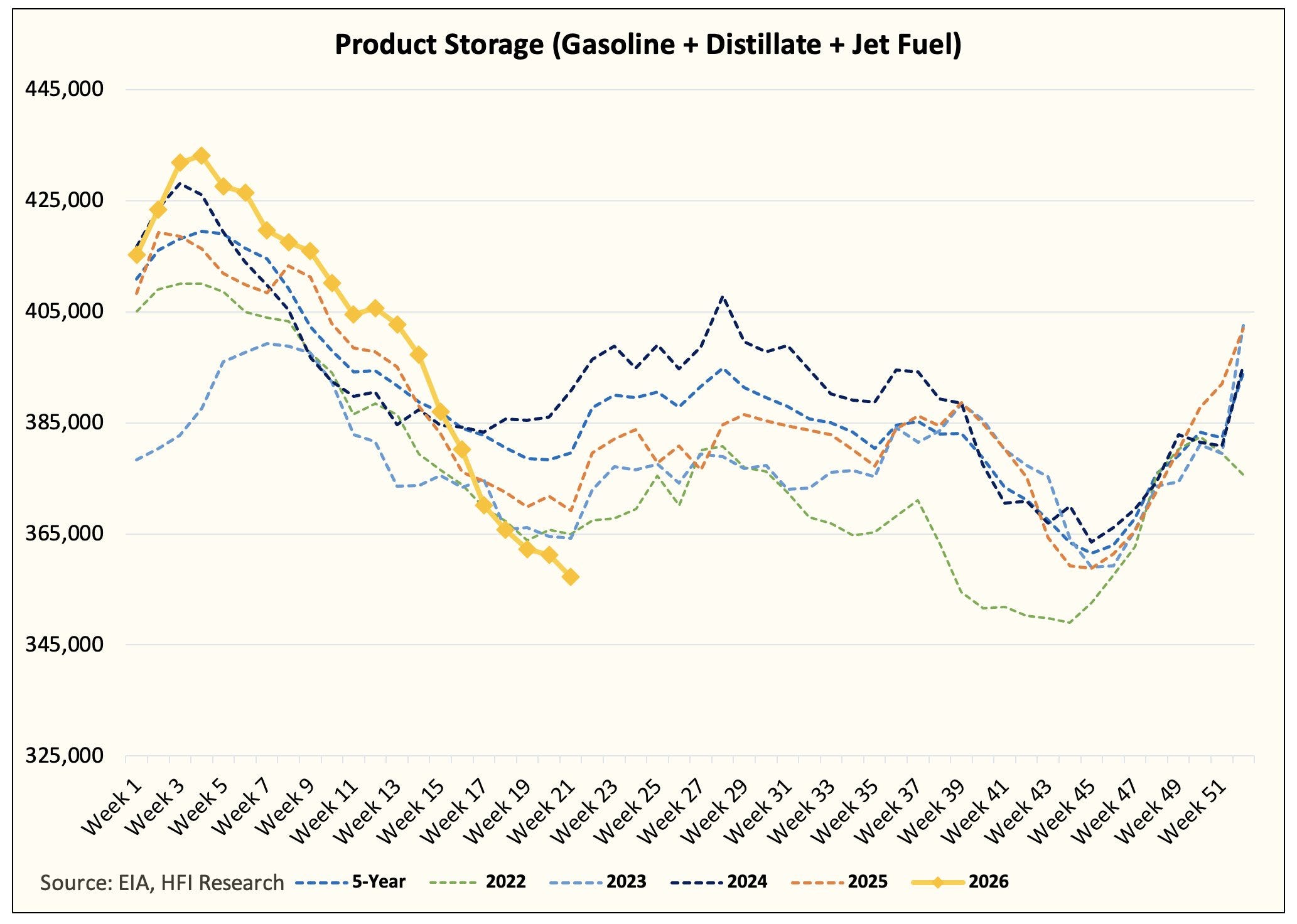
Oil is one thing, but products (gasoline, diesel, jet fuel, etc) are what matter. Oil must be refined into usable products, and those inventories are already at five-year lows as we enter the summer travel season.
In fact, refinery runs are just now eclipsing the previous highs prior to COVID.
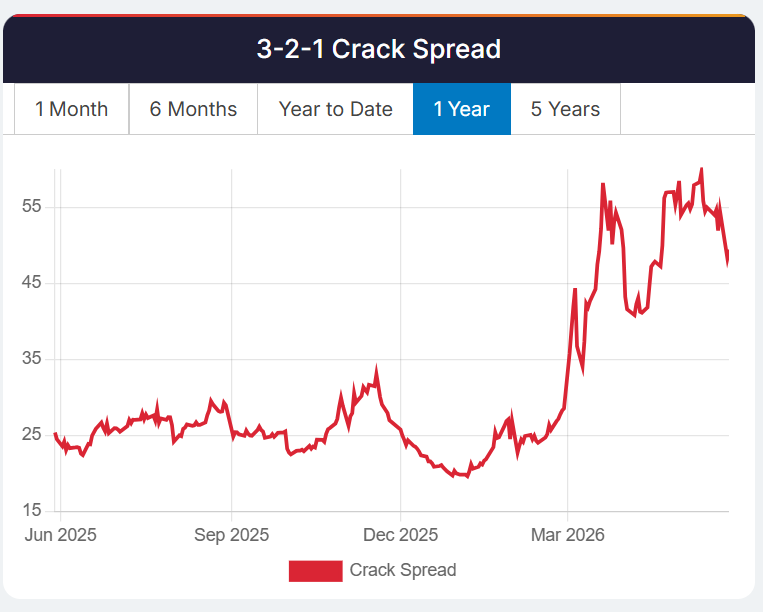
The US refineries are pumping out as much as they can to take advantage of higher crack spreads.
I am a generalist investor and not an expert in the oil inventory market. I do follow people who are in the market and understand the oil markets.
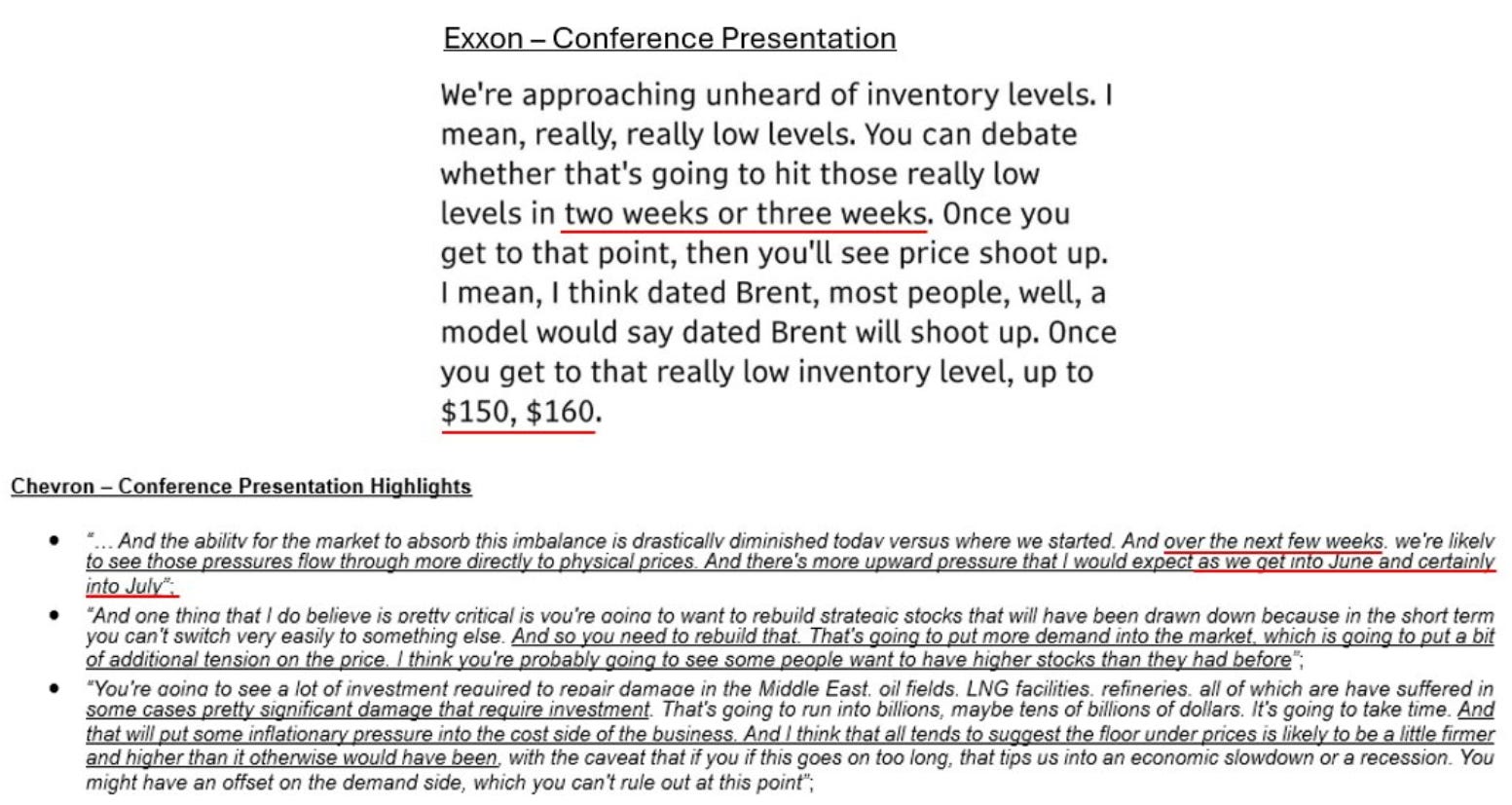
Their view is that, at current draw rates, we are likely to be in trouble by the end of June or early July.
Oil executives agree.
In the short term, it doesn't matter if everything restarted 100% today; it would take months to years to get things back to some sense of normality.
Many things need to happen.
You need tankers bottled up in the Persian Gulf to transit to their destinations.
Tankers need to offload, then return to the Persian Gulf to begin drawing down storage, which is full, before production can be restarted.
This assumes that whatever agreement is made holds up and that hostilities don’t resume.
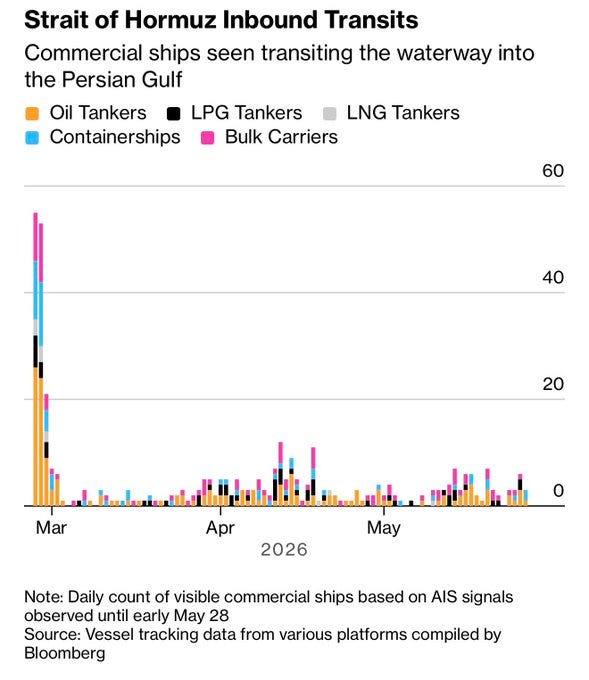
Currently, a small number of ships are getting out, but few are returning. Ship owners are not going to hazard ships and crews, and insurance companies still need to price the risk to even write policies.
We will see.
But John, the Strait will open soon (Trump said so!), and in a few months, this will all be a memory.
Well, maybe not.
This is certainly what the market is hoping for and forecasting based on current oil prices, but there are some issues.
If you were Iran, would you relinquish your hold on the Strait of Hormuz and control of the world’s oil supply? You just absorbed everything the US threw at you militarily and did not fold, thereby strategically defeating “the biggest and best military” in history.
John, are you serious? The US was not defeated.
Then why can’t the US open the Strait of Hormuz? If the US could open it militarily, it would. By the way, the Red Sea ship traffic is still well below what it was before the Houthis attacked ships two years ago.
Why should the Islamic Republic of Iran negotiate with the US, an entity that Russian foreign minister Sergei Lavrov described as “agreement incapable”? The US breaks most of the deals it makes. In fact, the US started hostilities twice while negotiations were ongoing with Iran!
Who is to say that if the US makes a deal during this administration, the next one won’t just ignore it and resume sanctions and hostilities?
Iran wants reparations and the lifting of sanctions. If they can keep their enriched uranium, that would be great, too. No one ever attacks North Korea because they have demonstrated a nuclear weapons capability.
If you were advising the IRGC, what would you suggest? I would suggest they build and demonstrate a nuclear weapon capability.
But John Iran is being strangled economically because it cannot export oil. We just need to continue the blockade for a while, and Iran will fold.
Maybe.
This is the story we were told about Russia four years ago and Cuba decades ago. More sanctions, and they will fold.
Sanctions don’t work. Iran has been subject to sanctions for decades.
I am not naive. Iran is hurting economically. Prices are inflating, and there is economic deprivation in Iran. Iran likely wants a deal, but on terms that will not force it to endure this again.
The question is whether Americans will accept hardship once it comes. The Iranians have been here before, but Americans, I suggest, will not tolerate high fuel and food prices for the ambiguous and seemingly ever-changing reasons we started this war of choice in the first place.
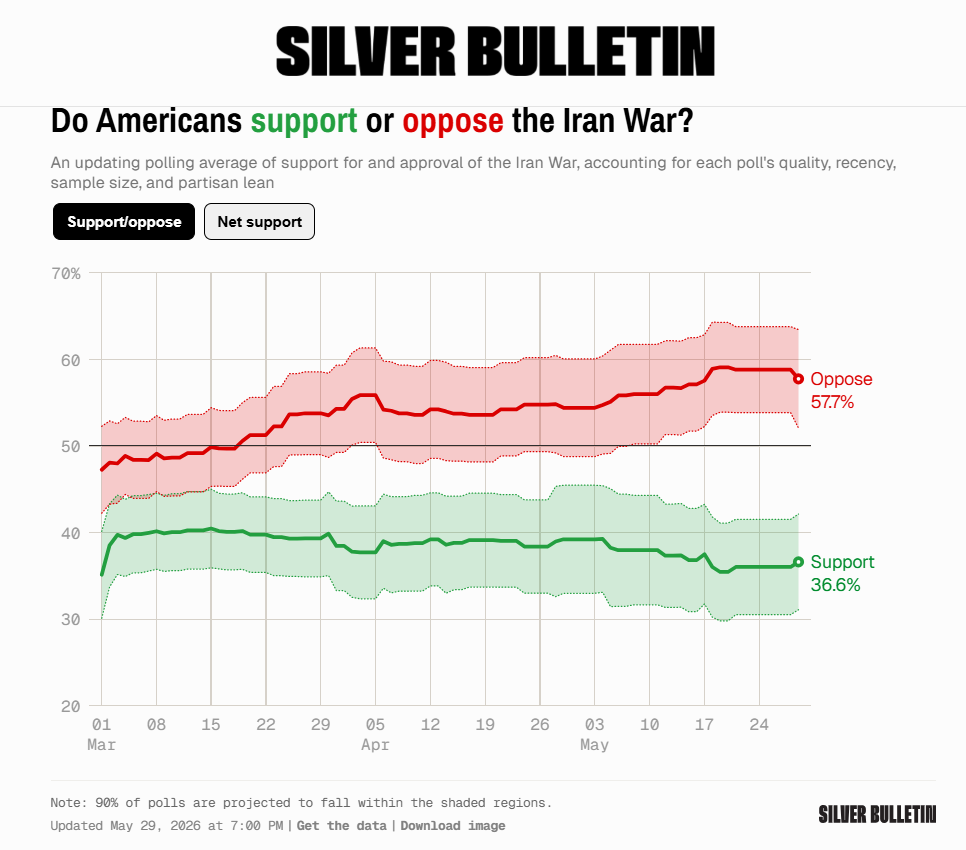
In the short term, this is a game of chicken in my view. Can Iran hold out long enough for the SPRs and storage to hit bottom, and for oil prices to soar along with gasoline and diesel prices, thereby forcing the Trump administration’s hand?
I am not sure $8 gasoline and $10 diesel will go over well with Americans as we head into a Congressional election.
But can Trump even end this? What can he get Iran to accept that is not considered worse than what Obama negotiated with the JCPOA? The JCPOA that Trump and Mike Pompeo canceled back in 2018.
Notwithstanding the fact that he is under tremendous political pressure from various sides to continue the war.
In the long term, many other issues are at play and will likely lead to structurally higher oil prices.
Morgan Downey wrote the book on oil markets, “Oil 101.”
He recently wrote a long article/chapter update that discusses some of the long-term issues that will result for the oil and gas market. You can check it out here. I am going to focus on a few snippets.
The Hormuz premium is permanent. Even after the strait reopens, the demonstrated willingness and capability to close it changes the risk calculus for every barrel of Gulf crude. Before February 28, the market priced Hormuz closure as a tail risk with near-zero probability. That probability is no longer near-zero. War-risk insurance premiums on Hormuz transit will remain elevated for years. The forward curve for Gulf crudes will carry a structural premium over Atlantic basin grades. Every long-term supply contract with a Gulf producer will be renegotiated with force majeure language that accounts for what actually happened.
Qatar and global LNG markets. Qatar ships 80 Mtpa of LNG almost entirely through Hormuz. Qatar declared force majeure on March 4. European gas prices doubled in a week. The crisis demonstrated that Hormuz is an LNG chokepoint as much as an oil chokepoint. Global gas markets are the most challenging to model forward because a large portion of supply chains are new, built after Russian pipeline gas to Europe was reduced following the Ukraine invasion and the US became a major LNG exporter. These new trade flows are untested under stress.
New bypass pipelines are now inevitable. Saudi Arabia announced a feasibility study to expand Petroline capacity from 5 to 7 Mbpd. The UAE is studying a second pipeline to Fujairah. Iraq is reviving the Basra to Aqaba pipeline. Kuwait is exploring a route to a Saudi Red Sea terminal. Lead times are 3 to 5 years.
I would definitely take the time to read the whole chapter, as it will get you better informed than most investors on this subject.
The whole situation in the Middle East will remain unstable. This instability and the desire for countries to insulate themselves from future disruptions (e.g., non-Gulf suppliers, larger SPRs) will likely create attractive investment opportunities.
I am adding a new oil and gas producer to the AIA Dividend Portfolio that does not drill wells but has demonstrated success in increasing production and reducing costs.
There is also a nice opportunity in another situation with the company that could yield a multi-bagger if it works out.
You can access this information by subscribing to the AIA Newsletter.
Comments
Nothing yet. Say the first thing.
Sign in to join the conversation.