

It has been three months after the outbreak of the US/Iran war, and the world is still dealing with the ongoing effects of an oil price shock.
Not only is that having an inflationary impact on the prices of many goods & services, but it’s also raising increasing concerns of the availability of oil supplies.
Could the world soon start experiencing an inventory shortage of oil -- the essential fuel that enables global commerce?
Or will the recently announced peace deal between the US and Iran allow us to avoid that fate?
To find out, we have the great good fortune to talk today with Jeff Currie, Executive Co-Chairman of Abaxx Markets.
I think, in the longer term, Jeff Currie will be right with respect to higher commodity prices. The consensus is that the Strait of Hormuz will open and everything will go back to normal.
However, when I look at the Memo of Understanding, there are many ways this can go off the rails.
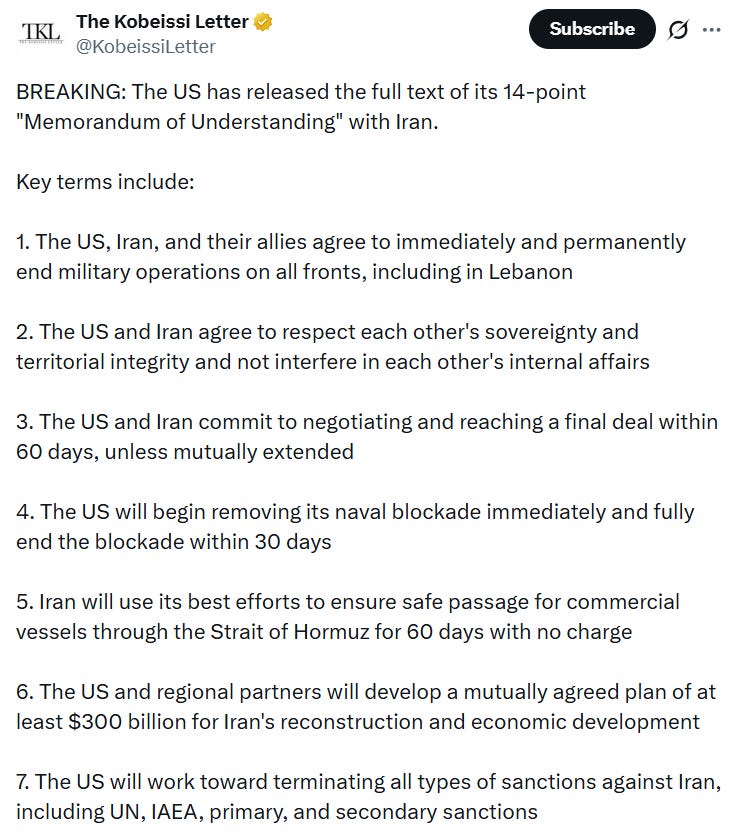
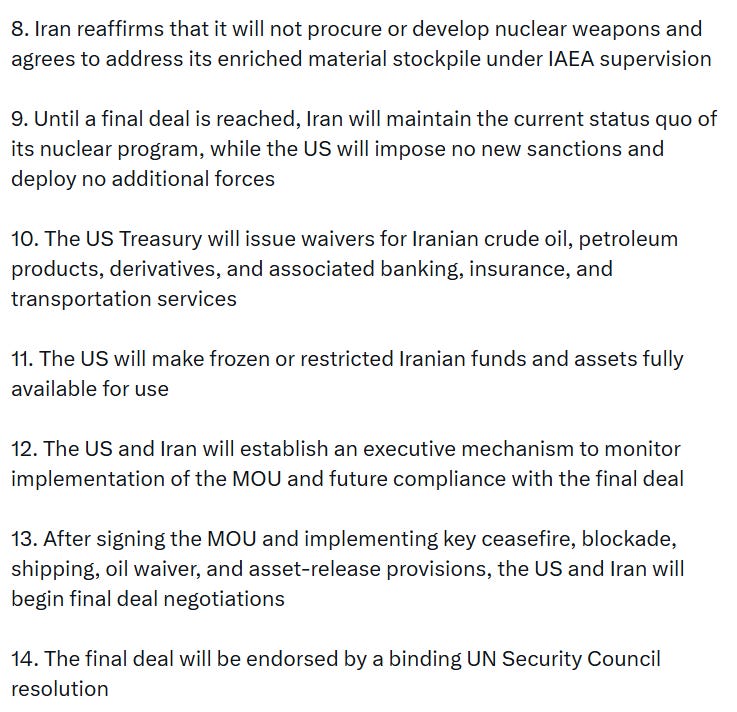
In my view, this is a strategic defeat for the US. This is a worse outcome than the JCPOA that Obama negotiated and Trump canceled.
The bottom line is that the Trump administration was weeks away from seeing the possibility of higher oil prices as strategic reserves were depleted. I think someone finally got the President to understand what the potential for $ 100-plus oil prices would mean for the economy and the election in November.
In typical Trump fashion, he is spinning this as a great deal.
I have no idea what will happen, but Iran comes out great in my view. They get a stoppage in hostilities and a chance to come up for air, rearm, and prepare for the inevitable resumption of hostilities.
Not sure how anyone can argue this is a win for the US and Israel.
The IRGC maintains control and will now be cashed up for round two whenever that comes.
The US has been shown to be a paper tiger, and its vaunted Navy has been shown to be obsolete by the emergence of drones (air and sea) and sophisticated missile technology.
China, Russia, and North Korea are watching.
The continued decline of the US empire.
An article by Jeff Currie on commodities.
In February 1977, Jimmy Carter addressed the nation from the White House library wearing a cardigan sweater. The thermostat had been turned down. The message was unambiguous: energy is finite, security is earned, and comfort has a cost. Two months later, in what became known as the Moral Equivalent of War (MEOW) speech, he named the program to build a secure domestic energy base the ‘energy transition’ — a term that had nothing to do with the environment and everything to do with what happens when a foreign power controls your fuel supply. Nixon had already launched Project Independence; Ford had signed the Strategic Petroleum Reserve (SPR) into law.1 Carter was naming the security imperative every serious government already understood in private: the most irreplaceable input to the modern economy was also the most geopolitically exposed. The press named it MEOW and Congress ignored him.
When Carter told Americans the energy shortage was a crisis, the admission was honest and politically fatal. His political successors drew the obvious conclusion, and thus the abundance illusion was born: never admit to scarcity. Fear may drive policy, but greed is what gets the votes. And thus the template became reassure markets with words and hundreds of millions of barrels from strategic reserves and hope that talking down prices would bridge the gap until supply returned and the problem quietly resolved itself.
It has worked for every US Administration since Bush Sr. The inventory buffer became the policy. Consume the insurance, call it abundance, and avoid the pain of rebalancing. The hard work Carter asked for — building the physical capacity to never need the buffer — was quietly abandoned. The energy transition gradually became an environmental project, eventually losing much of its security logic and curdling into a polarised fight over green and brown that has lasted a quarter century.
That template is being applied again today — and markets have accepted it. Prices have fallen nearly 20% from their 2026 peak. A Goldman Sachs survey of 839 institutional investors conducted between June 1 and 3, 2026 found a record two-thirds expecting oil prices to fall further — the most bearish reading in the ten-year history of the poll. The same bearishness is visible in energy equities sold to pre-war lows and long-dated futures pricing a swift return to normality. This confidence has created both physical and financial destocking in hopes of buying lower in a matter of weeks — the abundance illusion reproducing itself one position at a time. China’s decline in crude imports has become the consensus explanation — the world’s largest importer facing “demand destruction,” the market rebalancing rationally. It is a compelling narrative, but in my view it is also wrong.
Great article on resource market potential.
I’ve now written two pieces on the economics of AI datacenters (Piece 1, Piece 2). Nothing shakes me from my view that these are deeply negative ROIC investments. Yet, hyperscalers have continued to plow ahead and build them anyway.
First, they’ve used up most of their annual cash flow, then they’ve taken on debt to fund them, and now Alphabet (GOOG) has even resorted to its first major equity issuance since 2004 (with Meta reportedly considering one as well now). Despite their desperation to build datacenters, I haven’t seen a single financial model that shows one with a positive ROIC. It’s sort of surreal to watch, as any sane human would long ago have reversed course. But no, these guys are simply in a never-ending race to build datacenters.
The only recent historical comparable that I can think of is last decade’s shale patch. While I’m not involved in datacenters, I did have a unique window into shale through my frequent calls to shale CEOs, pleading with them to stop drilling wells with negative ROICs at then-current strip prices. I see a lot of the datacenter mentality, through the lens of those calls. Let me combine a few dozen of those shale oil CEO calls, and build you a composite collage of the typical conversation.
I discussed this in last Saturday’s Weekly Update video. I, along with others, have been pointing out for a while that many of the MAG7 are no longer the high-margin, asset-light businesses they once were.
They are not building data centers or power plants, which require large capital investments. The problem is, where are the profits? We have seen this before: growth in a revolutionary new industry with no profits. It goes on until it can’t. I am not sure we have reached that realization yet, but I think it is coming. Then the crash and the reallocation of capital, which hopefully is into our favored sectors.
In this episode of LEVRD, Matt sits down with Tribeca Investment Partners' Guy Keller for a deep dive into the uranium market, nuclear energy, and the ASX-listed uranium sector.
Despite uranium equities suffering a brutal sell-off over the past 12 months, Guy argues that the fundamental supply-demand picture remains extremely strong and that uranium prices ultimately need to move significantly higher to incentivize the next wave of mine development.
The discussion covers everything from Chinese investment in uranium projects and utility contracting, through to the outlook for some of the ASX's largest uranium companies.
That’s it for this week.
John Polomny
Comments
Nothing yet. Say the first thing.
Sign in to join the conversation.