

Portfolio returns for Q2 2026
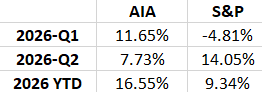
The AIA Portfolio was up +7.73% versus +14.05% for the S&P 500
The AIA Dividend Portfolio was down -5.83% versus +14.05% for the S&P 500
YTD returns below.
AIA Portfolio
AIA Dividend Portfolio
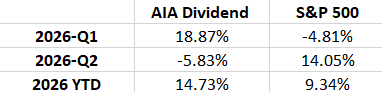
Although the Dividend Portfolio was down for Q2, both portfolios are still ahead of the S&P for the year.
One of the things I have been doing recently to generate cash is buying shares of several consumer-staple companies. Things like Campbell Soup (CPB), General Mills (GIS), ConAgra (CAG), and Clorox (CLX). These stocks are bombed out and out of favor. Many of them are decent dividend payers.
I have also been writing covered calls and cashed covered puts on these types of stocks. I am doing it in a tax-deferred account, creating a snowball effect. They are not that volatile, and I am keeping to shorter expirations. Rinse and repeat as cash pile grows.
I am not doing this in the AIA Portfolio because it is not within its mandate, which is focused on asymmetric upside.
Not actual cannibals, but companies that consistently buy back their own shares.
One historical example is Teledyne and its legendary chairman, Henry Singleton.
Singleton was not a stock promoter. He was an engineer and mathematician, trained at MIT, who co-founded Teledyne with George Kozmetsky in 1960. The company began in electronics and control systems, but Singleton quickly realized that the real opportunity lay not simply in building a single operating business. It was to build a machine for compounding capital.
In the 1960s, Teledyne became a classic conglomerate, but with far more discipline than most conglomerates of that era. At the time, the stock market loved “growth” conglomerates, and Teledyne’s stock became highly valued.
Singleton used that expensive stock as currency. He issued shares to buy smaller companies at much lower earnings multiples, effectively trading overvalued paper for real operating businesses.
By the late 1960s, Teledyne had acquired roughly 130 companies across aerospace, defense electronics, specialty metals, hydraulics, insurance, consumer products, offshore drilling equipment, and other industrial niches. Teledyne’s stock rose from about $15 to $65 in 1965, giving Singleton the currency to accelerate acquisitions.
The key point is that Singleton was not empire-building blindly. He was arbitraging valuation. When Teledyne traded at 40x–70x earnings, he issued stock; when acquisition targets could be bought at lower multiples, the deals were accretive to continuing shareholders. But when the conglomerate boom ended, and acquisition prices became too high, Singleton stopped. That was the first important lesson; he did not need to keep doing what had worked yesterday. He changed when the facts changed.
Then came the part that made Singleton a legend. In the 1970s bear market, Teledyne’s stock collapsed, and its P/E fell below 10. Wall Street had lost interest in conglomerates. Singleton concluded that the best acquisition available was Teledyne itself.
Starting in 1972, he began large stock buybacks. From 1972 to 1984, Teledyne completed eight common-stock tender offers and one preferred-stock tender offer; over that period, more than 85% of the common shares were retired, and including open-market purchases, the total repurchase reached more than 90% of shares.
This was radical at the time. Buybacks were not yet a standard corporate finance tool. Many observers thought Singleton was admitting that Teledyne had run out of growth. In reality, he was shrinking the share count while the underlying businesses continued to generate cash. That caused earnings per share to explode. The buyback math was simple but powerful; if the business is worth more than its stock price, every share repurchased increases the remaining shareholders' ownership interest.
Singleton’s philosophy was not “financial engineering” in the modern negative sense. It was rational capital allocation. He cared less about reported quarterly earnings and more about cash flow, return on capital, and per-share value. He once explained his approach by saying, “Just buy very good value,” and the market would eventually recognize it.
The stock performance was extraordinary, though the exact figure depends on the measurement period. One study says an investor who bought Teledyne in 1966 earned a 17.9% annual return over the next 25 years, turning $1 into about $53, compared with roughly 6.7x for the S&P 500. Another summary says that under Singleton’s leadership, from roughly 1961 to 1990, Teledyne compounded at about 20% annually, versus about 11% for the S&P 500.
The best results came during the buyback phase. Shareholders who held Teledyne from the first 1972 buyback gained about 3,000% by 1983. That is the key to the Teledyne story. Singleton used an overvalued stock to buy businesses, then used business cash flow and debt to buy back undervalued stock. He did not seek growth for its own sake. He sought per-share value.
Teledyne’s lesson is that capital allocation can be as important as operations. Henry Singleton built the company, stopped acquiring when deals no longer made sense, and bought aggressively when his own stock was cheap. This allowed the math of shrinking shares plus growing cash flow to work for the patient shareholder.
The reason I have related the Teledyne story is that I think this month’s Portfolio addition might be in a similar situation with a manager that understands capital allocation and the power of buying back one’s own stock.
Comments
Nothing yet. Say the first thing.
Sign in to join the conversation.