

Your Social Security benefits could be cut by a quarter in 2032. Here’s what to know
Americans’ Social Security benefits will have to be cut by roughly a quarter in six years due to depleted funds, according to a June 9 report from the Social Security Board of Trustees. That’s months sooner than the group had estimated in 2025.
For years, the trustees and experts have been warning about Social Security’s unstable financial footing. An aging population, low birth rates and worsening income inequality have driven the program to pay out more in benefits than it takes in from taxes.
“The program has been paying out more in benefits, more than it takes in in revenues, and that creates the financing gap that can’t go on forever,” said Shai Akabas, vice president of economic policy at the Bipartisan Policy Center.
What I find amusing about this whole discussion is that many people just did not prepare for old age and retirement.
You see it in the comments of any article or video on this subject. I paid into this, so I am entitled.
As I have pointed out many times, this is not an insurance policy, a retirement account, or an investment plan. This is a welfare transfer payment subject to policy changes mandated by Congress. This was already decided in a Supreme Court case in 1960, Flemming versus Nestor.
Flemming v. Nestor (1960) was a landmark Supreme Court case that ruled Social Security benefits are not a contractual right, establishing that Congress can alter or terminate them, even for those who have paid into the system. The Court upheld the termination of benefits for Ephram Nestor, an immigrant deported for past Communist Party membership, finding that the Social Security system is a social welfare program, not a private insurance contract, and that the termination did not violate his Fifth Amendment due process rights.
Life circumstances and bad luck do cause some people to end up indigent. This is what the program should be based on.
The vast majority of recipients just didn’t make good choices over their working lives. They are now reliant on a program whose future rests on the whims of politicians.
Yes, this will get fixed, but only at the last minute. We will likely see a combination of higher taxes, higher retirement ages, higher income thresholds for taxation, and, if that is not enough, the government will monetize the debt it issues to cover the expense.
It all goes back to the root problem that the French economist Bastiat determined back in the late 19th century.
“The state is the great fictitious entity by which everyone seeks to live at the expense of everyone else”
This mindset leads to moral and economic decay, as it encourages dependency rather than self-reliance. He believed that such attitudes ultimately harm society by fostering a culture of entitlement rather than one of responsibility and productivity.
Bottom line: structure your life so you are not dependent on the state.
John Polomny returns to The Royalty King Report — and quite a bit has happened since December. Maduro removed. The Strait of Hormuz “double closed.” Oil round-tripping back to the mid-sixties. Gold pulling back from $4,000+ while central banks keep accumulating.
John’s argument: none of the specifics were predictable, but the volatility was. We are in the endgame of the post-WWII order, drone and missile technology has obsoleted the aircraft carrier the way the carrier obsoleted the battleship, and the world is resolving into three zones of influence — the Americas, Eurasia, and Asia. The question is not how to predict it. The question is how to position for as many potential futures as possible.
In this conversation we cover:
Why the U.S. Navy can no longer keep the sea lanes open — and what that means for oil
Doug Casey’s three-flag rule: bank in one country, live in another, invest in a third
What multi-generational “old money” families actually do differently (timber, time horizons, and the Mulliez family motto)
Why the passive index is now the risk, not the safe option
Amerigo Resources and the Walter Schloss playbook: debt → dividends → buybacks
The exchanges correction: why quality croupiers going on sale is the whole game
Gold’s remonetization, the Cantillon effect, and why the central banks are telling you the answer
Oil manipulation: SPR drains, record shorts, and a $75 crack spread screaming for crude
Uranium’s silent all-time high in the term price — a growth industry with no new mines
Copper, the AI capex bubble, and what happens when the money stream ends
Land, water rights, and the hidden assets nobody is valuing
I am pivoting capital to “permanent capital”.
This episode we are joined by Mr. Cole Smead - CEO of Smead Capital Management - a registered investment advisor headquartered in Phoenix, AZ with offices in Jersey City, NJ and London, UK., with assets of approximately $6 billion under management.
Cole Smead, CFA is Chief Executive Officer and Portfolio Manager where he oversees all activities of the firm. He is the final decision maker for all investment decisions in the firm’s international equity portfolios.
Cole has been with the firm since its founding in 2007. Prior to joining Smead Capital Management, he was a Financial Advisor with Wachovia Securities in Scottsdale, AZ. He is a member of the CFA Institute.
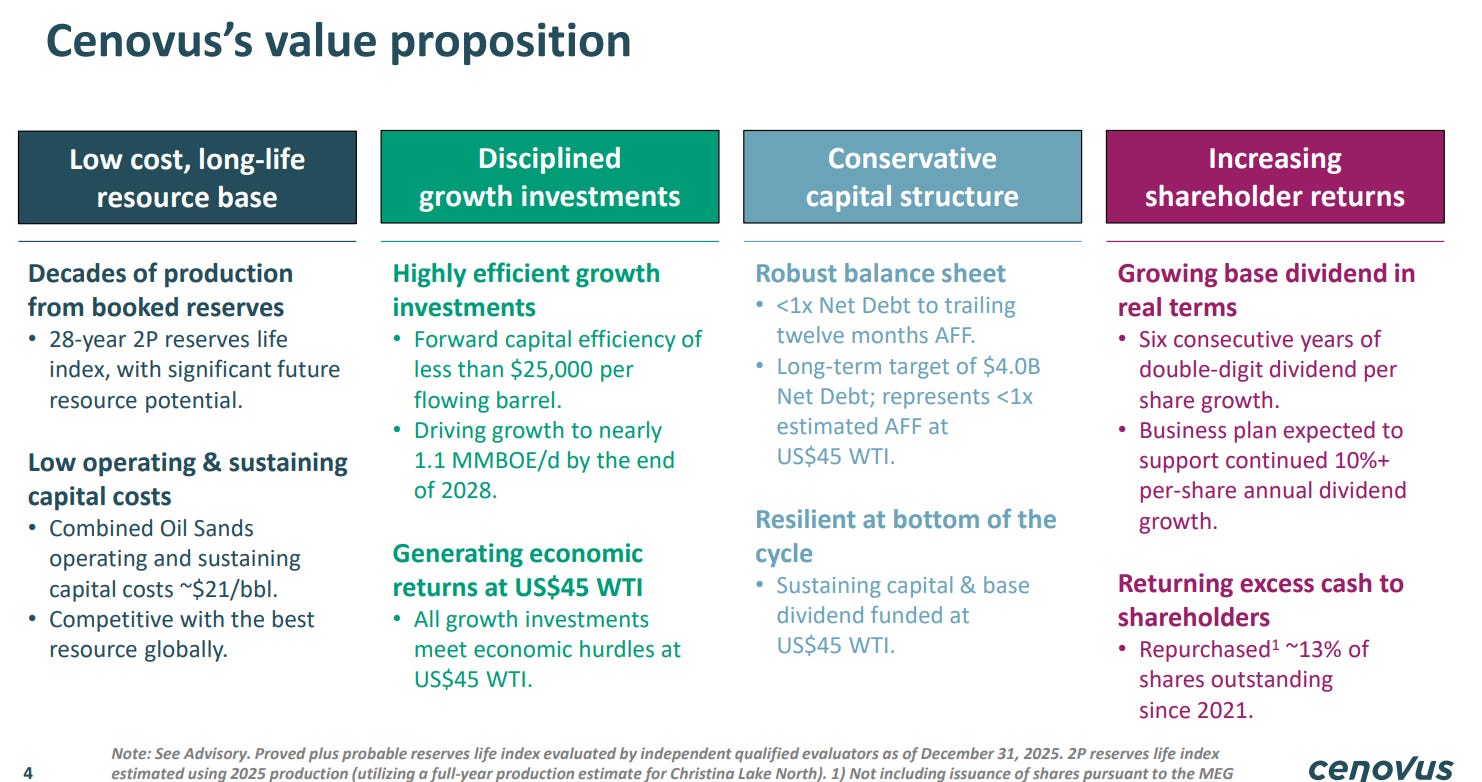
Among other things we learned about 25% ROE at 2x Book: Finding Value in Canadian Energy.
Interesting comments on valuations in Canadian Energy, in particular Cenovus (CVE).
Former AIA portfolio holding MEG Energy was bought out by Cenovus.
That’s it for this week.
John Polomny
Comments
Nothing yet. Say the first thing.
Sign in to join the conversation.