

AI Needs More Natural Gas Than America Has
Matt Smith joins us to explain why the United States may be approaching a historic natural gas shortage—and why the market is not yet pricing it in. After 18 months of bottom-up research across producing basins, pipelines, processing infrastructure, LNG exports, and AI power projects, Matt argues that the country could begin drawing down gas storage at unprecedented rates as early as 2028, with major implications for electricity prices, hyperscaler economics, and the American consumer.
In June, Matthew wrote a letter to a small group of confidants laying out the full case behind his natural gas forecast. He has allowed us to publish it. You can read the full letter here: https://colossus.com/wp-content/uploa...
From the letter:
By 2030, we are likely to exhaust working natural gas storage. The fuel everyone thinks is abundant is not.
By 2029 and 2030, natural gas will be in frighteningly short supply relative to structural, incremental demand for the fuel. This does not portend a modest price increase.
Certainly a contrarian thesis. Nevertheless, a worthwhile read in my view. As a generalist investor, I don’t have the expertise to refute this, but it’s worth keeping on my radar screen. My main thesis going forward is scarcity.
Actionable Intelligence Alert is a reader-supported publication. To receive new posts and support my work, consider becoming a free or paid subscriber.
The U.S. oil reserve is at a 40-year low - but the government says there’s still plenty of breathing room
Energy Department says operational minimum for the storage caverns is about 70 million barrels, a level far lower than oil industry estimates
Crude stockpiles in the U.S. Strategic Petroleum Reserve have fallen to a more-than-40-year low. Above is a facility at the Bryan Mound site in Freeport, Texas.
Commodity experts on Wall Street have long been fixated on the risks associated with U.S. emergency crude-oil supplies running too low. The Department of Energy says they’ve got it all wrong.
The U.S. Strategic Petroleum Reserve, the world’s largest publicly known supply of emergency crude oil, has fallen to a more-than-40-year low. That’s set off alarm bells on Wall Street.
With U.S. commercial crude inventories and supplies in the SPR falling again last week, there’s “less breathing room” in terms of supplies at a time of “intense global uncertainty,” said David Russell, global head of market strategy at TradeStation, in emailed commentary. “The SPR draws can’t continue forever.”
We shall see. I am staying bullish oil until I see Iraq and Kuwait resume full export capacity. That is my canary in the coal mine, if you will.
Trump says we are good, so take that for what it is worth.
https://youtube.com/shorts/jjdAy3z8Nrc?si=jnowdp7nzvtPkcp0
An interesting and useful gold stock timing tool
The folks over at Incrementum, the publishers of the annual “In Gold We Trust” chart pack, have come up with something I find interesting.
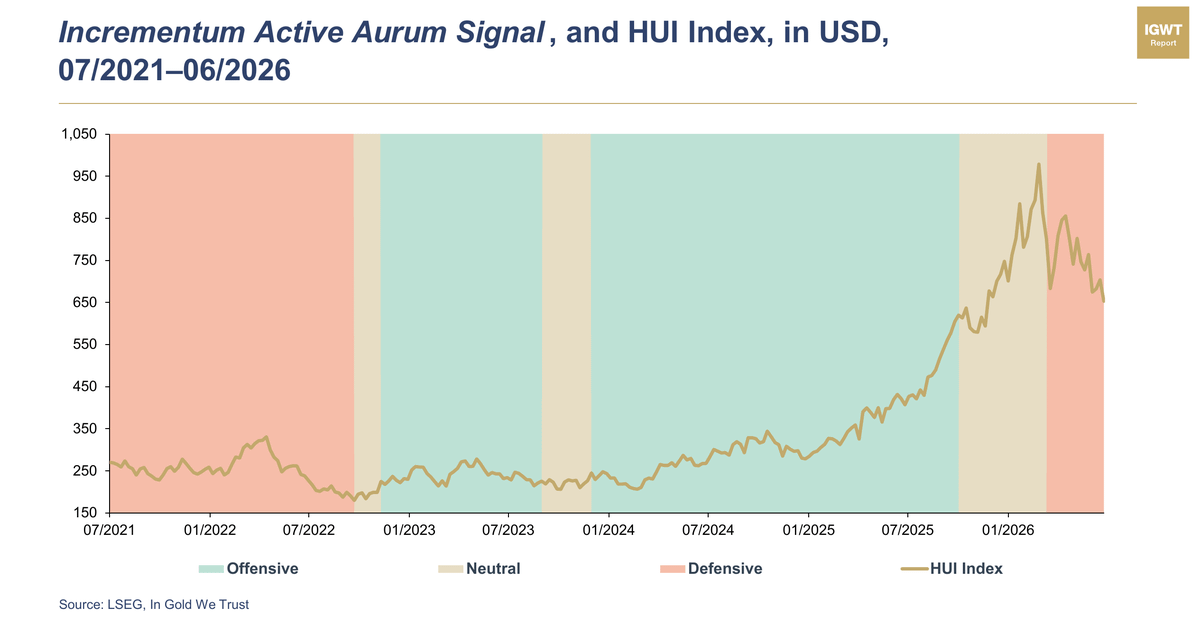
The Incrementum Active Aurum Signal times our exposure to gold mining equities in three modes: Offensive, Neutral, Defensive. It turned Defensive ahead of the Q2 drawdown.
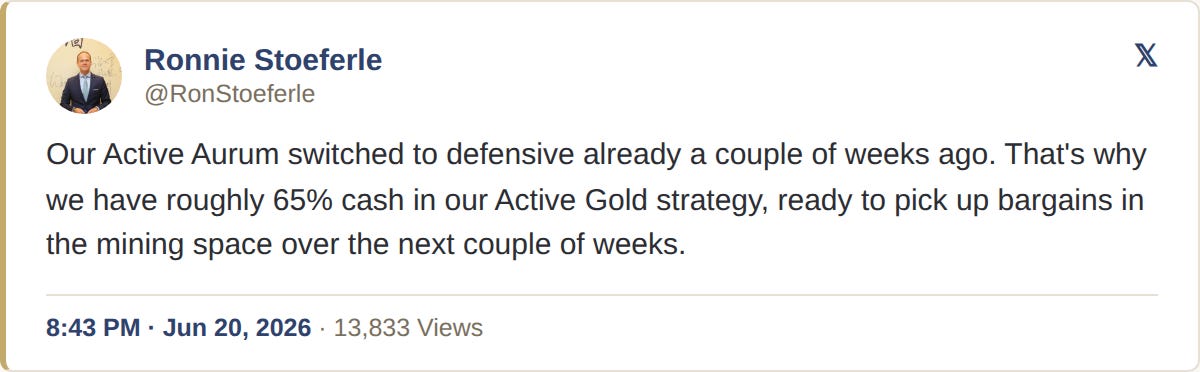
Positioned before the fall, holding cash to act while others digest the loss. The miners bore the brunt of the correction, their leverage to the metal cutting both ways: in March, gold fell 11.52 percent while the GDX miners fell 20.78 percent.
We do not read that as a verdict on the companies, but as a dislocation. These are businesses carrying the healthiest balance sheets the sector has seen and margins at record levels, now priced well below what that strength deserves. That is why the desk is raising cash to buy, not to flee.
Following the recent correction, the sector’s previously overbought condition has shifted into a short-term oversold reading. Against this backdrop, exposure is being rebuilt cautiously and selectively, while maintaining a disciplined focus on risk.The results of this active approach are reflected in the strategy’s track record. From 15 February 2024 to the end of June 2026, the active strategy gained 144.1%, compared with an 88.7% increase in gold in euro terms. Annualized volatility was 22.2%, close to that of gold at 20.4% and materially below that of GDX at 38.2%, while the Sharpe ratio of 1.92 was higher than for both comparators.
It appears the indicator catches most of the moves in the GDX. I ran it through AI, and this was the conclusion.
The IAAS appears to be a thoughtful and potentially valuable tactical risk-management framework. Combining contrarian market indicators with mining-margin fundamentals is more defensible than relying on a single technical indicator.
Nevertheless, the evidence does not yet justify accepting the reported 9.76% CAGR as a reliably achievable historical result. The correct interpretation is:
A promising proprietary allocation model with internally consistent and economically plausible backtest results—but not yet an independently verified source of alpha.
The most persuasive future evidence would be publication of a timestamped monthly signal history, exact execution rules, complete net return series, rolling-period results, and several more years of genuinely out-of-sample performance.
That’s it for this week.
John Polomny
Comments
Nothing yet. Say the first thing.
Sign in to join the conversation.