
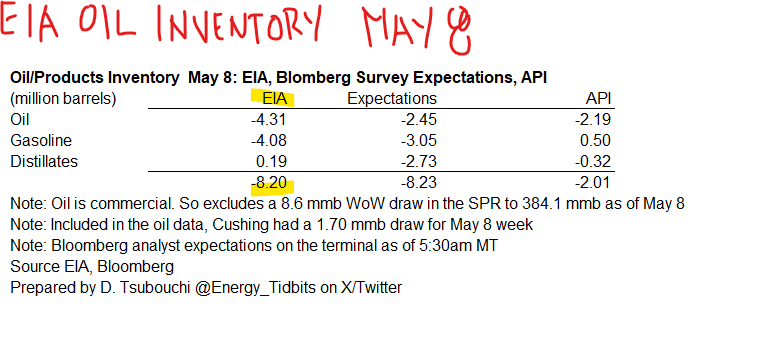
This is the third week of large crude oil and product draws. As I have said on my weekly videos, pretty much everything is based on the situation in the Strait of Hormuz. As of now, most market participants are continuing to ignore this issue. At some point, it will be the only issue the market will care about.
Even if the bombs stop tomorrow, the math doesn’t. The flow that vanished in March is now the inventory that isn’t on the dock in May.
(skip)
For a portfolio, this is a rotation question, not a forecast question.
The rotation is from things priced on narrative...AI multiples, growth-stock optionality, anything trading on a discount-rate assumption that no longer holds at $112 oil... toward things priced on physical throughput. Producers with free cash flow at current prices. Energy-services names whose order books finally fill after a decade of capital starvation. Deepwater drillers with multi-year contracted day-rates. Refiners with complex configurations that can capture distillate cracks. Pipeline and terminal owners who collect a toll on every molecule that moves through the system.
The denominator helps too. When oil holds above $100 for a sustained stretch, energy producers earn that revenue in a currency the central banks are still actively debasing to fund the deficits the war has accelerated. The income is real. The denominator is variable. The asymmetry sits in the gap between the two.
Pretty decent article that goes into some depth on what is happening in the energy market.
The bottom line, in my view, is that the world needs a defined (and growing) amount of energy to sustain day-to-day economic activities. If you just stop 10-15% of that, then the economy has to adjust downward in activity to balance the energy needed with what is available. That means higher prices to kill non-essential demand. Not sure how the NASDAQ makes new highs in that environment.
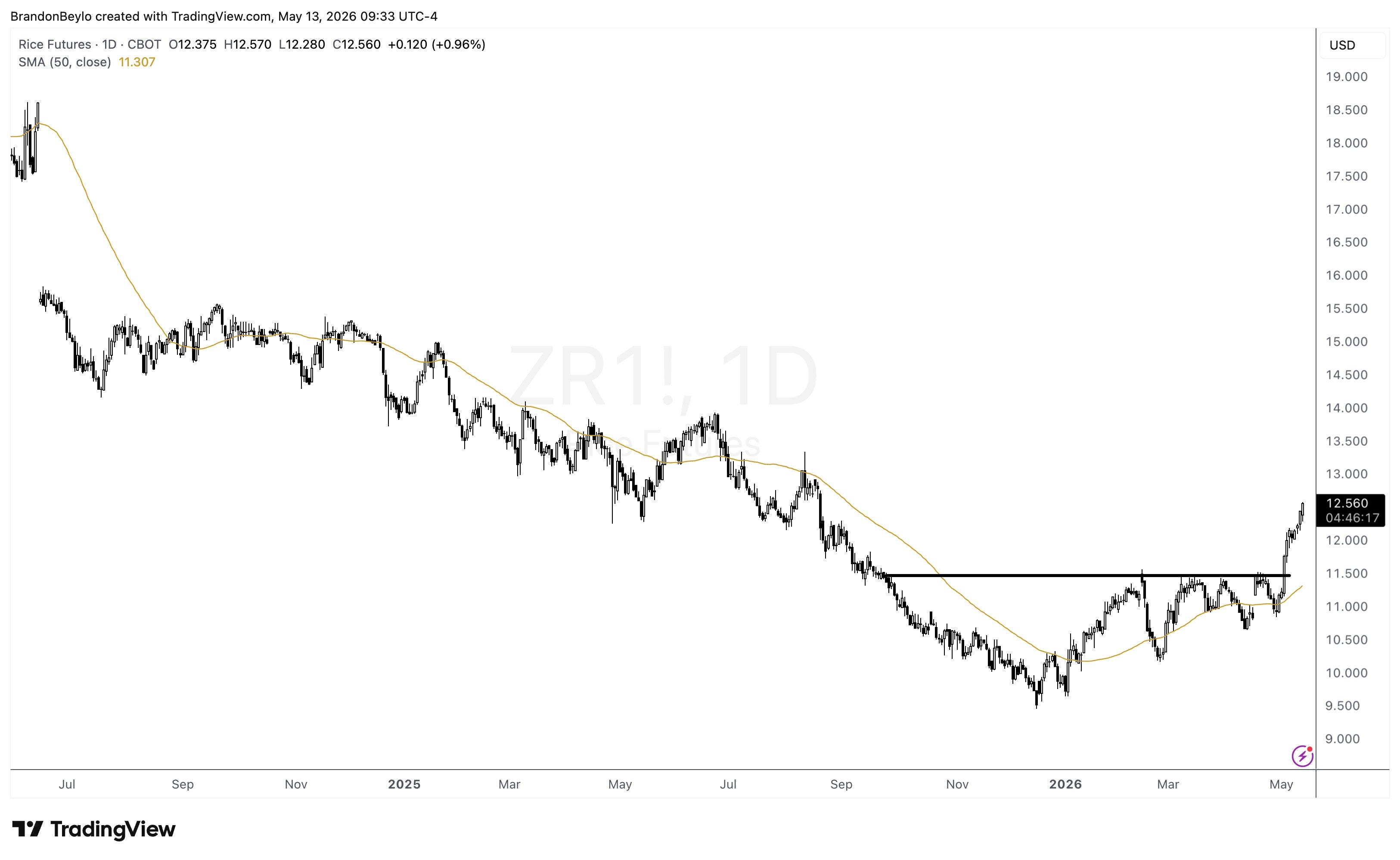
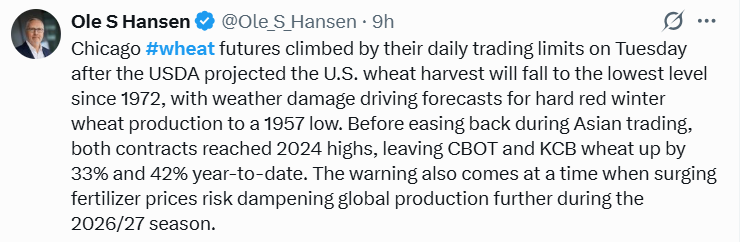
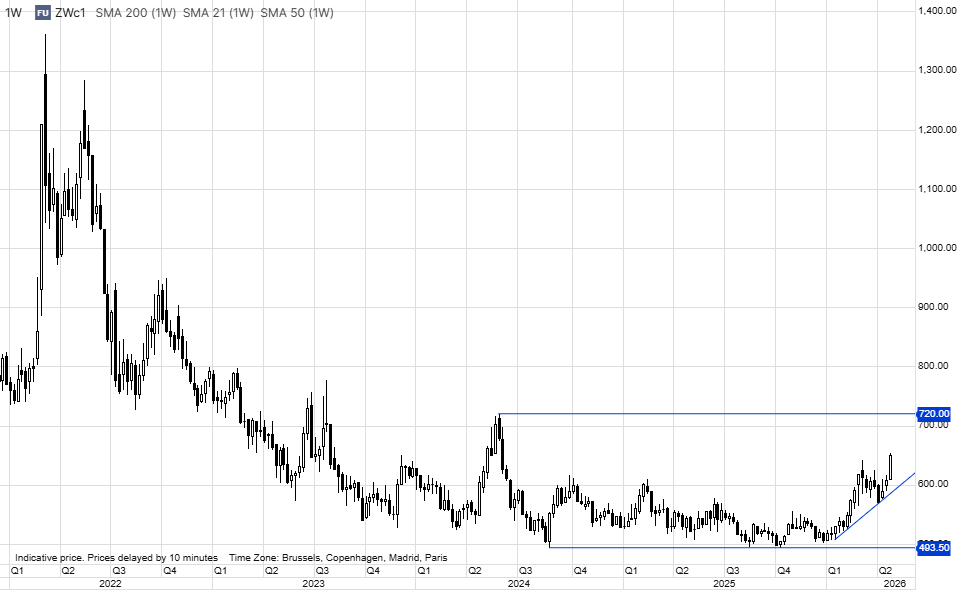
USDA is forecasting the lowest wheat harvest since 1972. Wheat prices are moving higher, but have not broken out yet. This bears watching.
U.S. wholesale inflation came in hot last month. Producer prices rose 6% from a year earlier, the highest point in more than three years, as the Iran war pushes up energy prices and intensifies pressure on companies to pass along their rising costs to consumers.
The Labor Department reported Wednesday that its producer price index — which tracks inflation before it hits consumers — shot up 1.4% in April, the biggest monthly gain in more than four years.
All of the numbers released Wednesday caught economists off guard and altered the dynamic at the U.S. Federal Reserve and its fight against inflation.
Prices are rising at a time when Americans are already frustrated by the high cost of living. Affordability is likely to be a key issue when voters go to the polls Nov. 3 to determine whether President Donald Trump’s Republican Party maintains control of the U.S. Senate and House of Representatives.
“This report will set off alarm bells at the Fed and add fuel to the political conversation about affordability,″ wrote Carl Weinberg, chief economist at High Frequency Economics. “The results are so far above expectations that this update will set off alarm bells in the financial markets, too.″
Why affordability will be a key issue in the 2026 midterm elections
Since the pandemic, Americans have ranked the cost of living (often labeled “affordability”) as the top problem they want America’s leaders to address. The typical household budget has many different components, of course. Some of them, such as health care, have been pressuring families for several decades. Problems in other areas, such as housing, have become acute only in recent years.
But the rapid rise in overall prices since the beginning of the pandemic has merged these areas into a broader public concern. Although average hourly wages have risen by 30.8% since then1, costs for many core elements of household budgets have risen even more, and most Americans feel that they are at best running in place.2 Because the rate of price increases remains well above the Federal Reserve Board’s target of 2%, this concern shows no sign of abating, and the effects of the war with Iran will make matters worse.
Consumer prices normally follow producer prices up or down with a two-month lag. Affordability is the number one issue among voters, and this is why you will see political volatility as politicians cannot solve these issues. Dopey voters who think their vote actually matters will continue to vote for anyone who says they will fix it. How’s that working out?
Yet politicians created many of the issues and benefit from the oligarchy and vested interests that put them into power. Why would they vote to get rid of the inflation machine that is the Federal Reserve, or actually deal with the ripoff that is the US Healthcare system? Maybe not starting another war in the Middle East would have kept gas prices down?
Interests that are stripping you and your family of money give politicians a lot of money to maintain the status quo and keep the money flow going to them.
There is a website called OpenSecrets that catalogs all of this. You can research by politician, industry group, PACs, etc. Politics is all about money and who gets it and who gives it. It is all out in the open, not hidden, yet people think these people represent them. They represent whoever gives the most money.
LOL! What are the ordinary people going to do? Vote harder?!
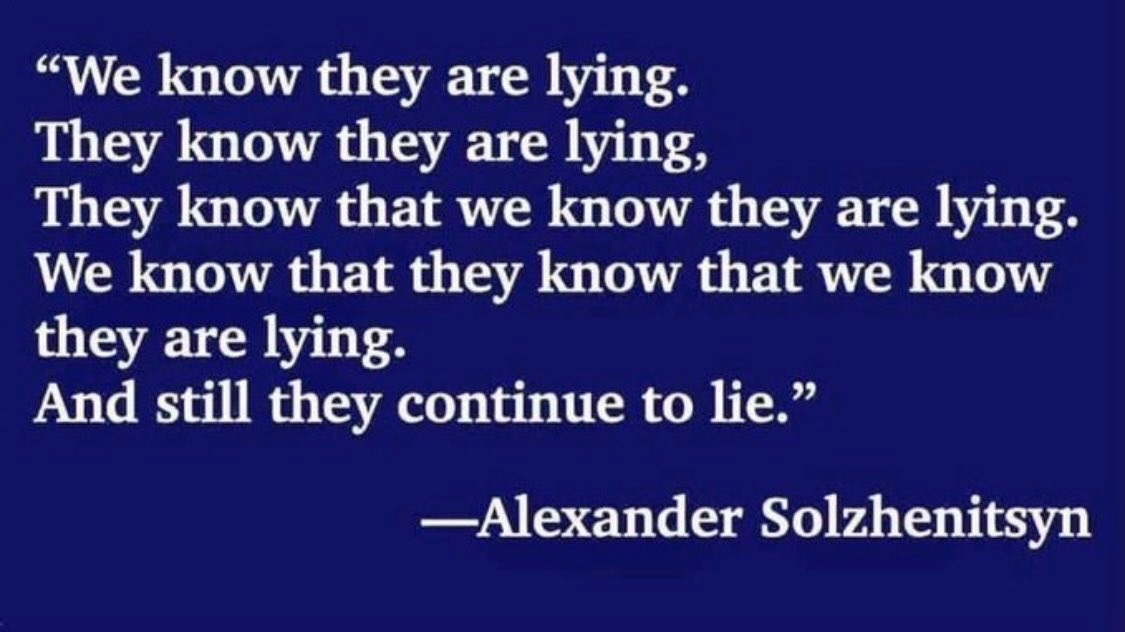
Here at AIA, we try to see things as they are, not as we want them to be.
We understand that no one is coming to save us. Learn to profit and hedge yourself while the masses “vote for change” that never comes.
That’s it for this week.
Regards,
John Polomny
Comments
Nothing yet. Say the first thing.
Sign in to join the conversation.