
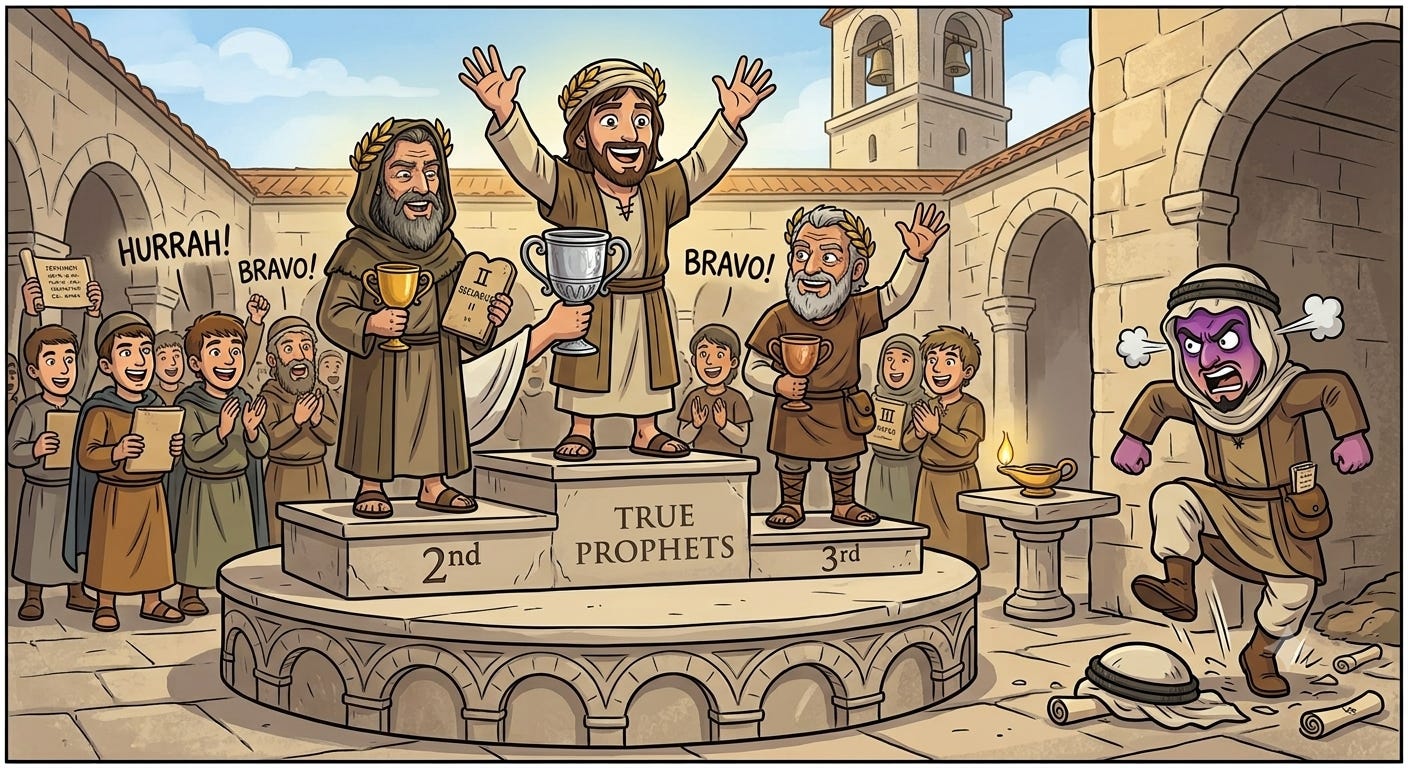
Matthew 23 is the sharpest test Jesus ever set for religious leadership. Run Moses through it and he stands. Run Muhammad through it and something else happens.
By A. C. Rosenthal
Before the test, a word of respect, because a man who designs a test, because wants a particular individual to fail, has already corrupted the result. This is why the test i am using is not my own. And this is also why a “Prophet” who designs their own test should be suspected of rigging the game.
Muhammad accomplished what almost no man in history has accomplished. He took a fractured, warring, idol-worshipping tribal society and welded it into a single people under a single God within his own lifetime. He preached the oneness and majesty of the Creator with a conviction that has not dimmed in fourteen centuries. Whatever else is true, the sincerity of the man who fled that cave in terror is not seriously in doubt, and the discipline he instilled in his followers reshaped a quarter of the world. I am not going to pretend that is small. It is one of the most consequential lives ever lived.
But consequence is not the test. Hitler was consequential. Genghis Khan was consequential. The question Jesus forces in Matthew 23 is not how much a man accomplished. It is what his religion did to the people underneath it, and what it did to those who tried to tell the truth inside it. That is a harder question, and it is the only one that matters here.
The standard Jesus sets
Matthew 23 is the most concentrated judicial indictment Jesus delivers against any class of people in the Gospels. He levels seven specific charges, and each names a structural failure of religious leadership: what these men did with the authority they were given, how they treated the people under them, and what their religion actually produced.
The charges are not about doctrine in the abstract. They are about the relationship between a teacher’s inner life and his outward practice, between the burden he lays on others and the one he carries himself, between the God he claims to represent and the God he actually resembles.
That is exactly the right framework for weighing Moses and Muhammad. Not whether they claimed prophetic authority. Both did. The question Matthew 23 forces is what they did with it.
And Jesus opens by establishing the benchmark himself. The scribes and Pharisees, he says, sit in Moses’ seat, so obey what they teach from it, but do not do what they do, for they do not practice what they preach. Notice what this does. Jesus is not attacking Mosaic authority. He is affirming it. The seat is legitimate. The law is legitimate. The failure is in the men occupying the chair, not the chair. Which means the standard the Pharisees are measured against is, implicitly, Moses himself.
So Moses enters as the standard. Muhammad enters as a third claimant. Jesus is the judge.
The first woe: shutting the door
“You shut the door of the kingdom of heaven in people’s faces. You yourselves do not enter, nor will you let those enter who are trying to.”
The charge is gatekeeping that excludes. The teacher stands in the doorway not to welcome people in but to keep them out.
Moses does not stand condemned here. The entire Mosaic system was architecture for access: the sacrifices, the feasts, the priesthood, all of it built to bring a people near to God. Moses built the entrance. The Pharisees blocked it.
Muhammad stands condemned here, though the mechanism runs in the opposite direction. In Christianity the door is Jesus, for those trying to enter. They must enter through Him. In classical Islamic law the door is bolted against anyone trying to leave. Apostasy carries the death penalty in every major school of sharia. The questioner faces social ruin. And the Quran itself reframes the demand for evidence as a spiritual defect, so that doubt becomes proof of the doubter’s corruption rather than a step toward truth. A door bolted against departure is not an improvement on a door shut against entry. It is the same failure, refined.
Comments
Nothing yet. Say the first thing.
Sign in to join the conversation.