
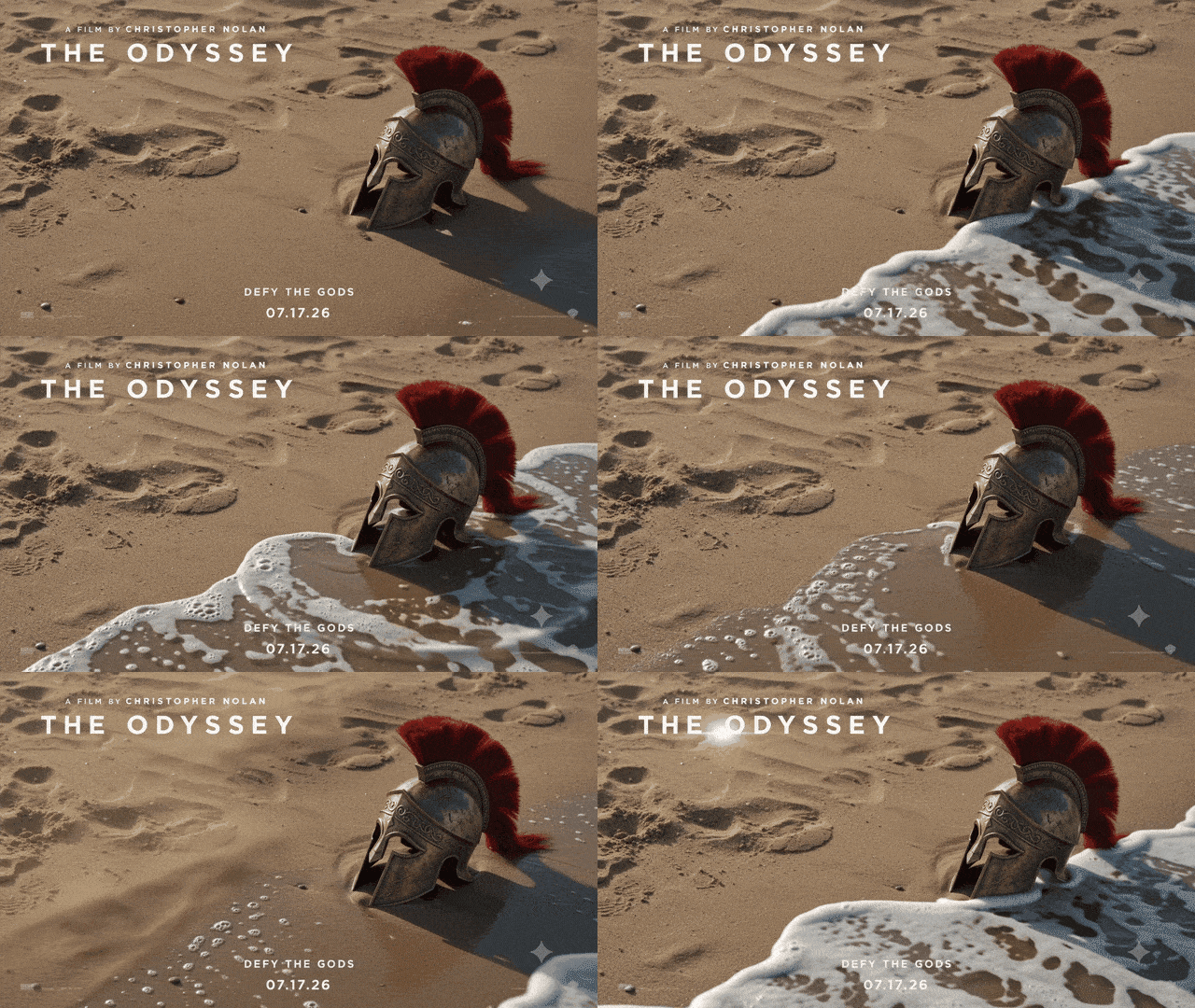
A curious thing happened with Christopher Nolan’s Odyssey. People fought bitterly about it for months before most of them could have told you what was in it. The film became a battleground before it became a movie. An editor of a respectable journal reportedly called a colleague a moron for disliking it. Readers online accused anyone who praised it of being a paid stooge, and anyone who panned it of philistinism. And the loudest early arguments were not about whether the film was any good. They were about who was allowed to appear in it, and whether a poem written twenty-seven centuries ago had sufficiently respected women.
This is the litmus test that the movie IS NOT just a film, but a sermon. “Just a spoonful of sugar helps the indoctrination go down”. The most-discussed film of the year drew its heat almost entirely from questions external to the film itself, and largely from trailers, interviews, and a magazine profile rather than from the finished work. There is an Ideology labeled “virtue” that this film, like others, is attempting to ram down the public’s throat. This tells us something before we ever reach the theater. The silver screen has become a territory we fight over and The Odyssey is the most recent battlefield, and more then just an old poem we read. The question is why, and what exactly is being fought for.
My answer is that underneath the noise sits a single real question, and it is not about representation or spectacle. It is about inheritance: what a filmmaker owes to a story he did not create, that belongs to a people who are not him, that sits at the root of a civilization. That is the question this piece is about. I do not believe that the questions this article addresses are about the medium the argument is presented through, but about the message of the argument itself. And that is key. Liest the conversation be hijacked, and become about the poem only.
Begin where the poem begins. Its first word is andra. A man. Not war, not glory, not even the hero’s name, which Homer withholds until the eleventh line. Just a man: driven across the sea, who will lie and suffer and disguise himself and lose everything and keep going, trying to get home. Twenty years after he left Ithaca, ten after Troy fell, Odysseus wants one thing, and the whole poem is built to ask what a man even is after that much war and wandering. Still a husband to the wife who waited? Still a father to the son raised in his absence? Still a king, if he walks into his own hall dressed as a beggar?
And what is home, when you finally reach it? The Greeks had a word for the homecomings of the war’s survivors, the nostoi, from which we get nostalgia, the ache of longing for a home that may no longer exist. Ithaca in the poem is not merely a rocky island. It is a dream of a life that time has already carried off. Odysseus will reach the island. Whether he can ever truly reach home is the question the poem leaves open, and it is a far stranger and sadder question than any adventure story needs to ask.
That is the poem Christopher Nolan inherited. A three-thousand-year-old meditation on identity, memory, and the impossibility of return, wrapped inside a story of monsters and gods and revenge. The question worth asking is not merely whether his film is good. It is whether he understood what he was holding, and whether he had the right to do to it what he appears to have done.
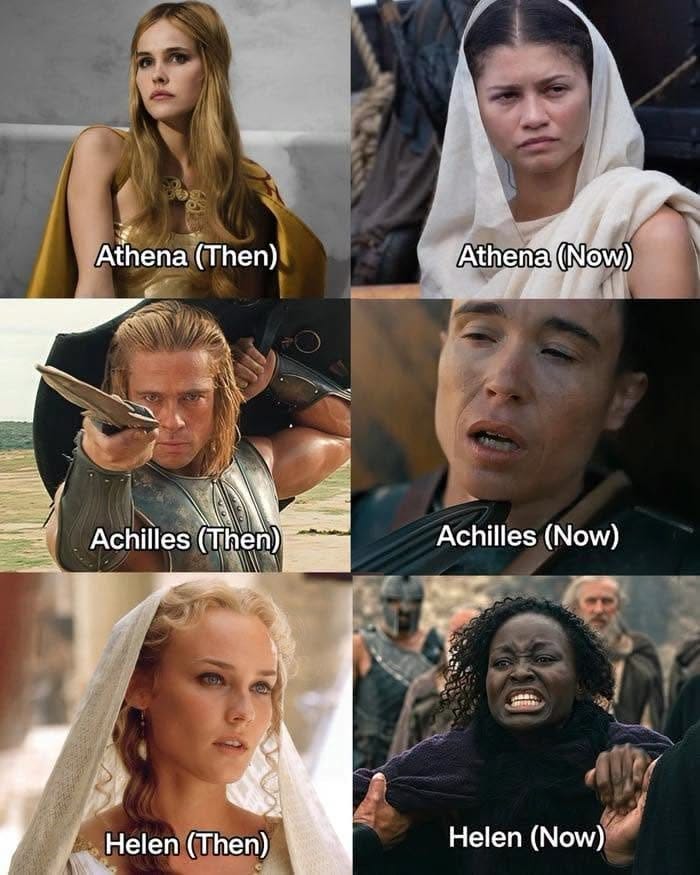
Here is the standard I want to argue from, stated plainly before any particular casting choice, because the principle comes first and the examples only test it.
When you take up a story that belongs to a people, that sits at the root of a civilization, you inherit a responsibility along with it. You may interpret it. You may stage it in your own idiom. Every generation praises the newest song, and it should; the bard is allowed to sing in his own voice, and because it is his, it will be new. But there is a line, and it is not subtle. On one side is telling an old story in a new way. On the other is rewriting an old story to serve a new agenda: taking a work that means one thing and making it mean the opposite, or making it mean nothing, while keeping its famous name on the marquee. The first honors the inheritance. The second defaces it.
And when the thing being defaced is the foundational epic of a specific people, that people has every right to be offended. Something that belongs to them, that carries their memory of who they were, is being altered to flatter someone else’s present. That is not interpretation. It is expropriation.
Test the principle by turning it around, because a rule worth anything runs in both directions.
Suppose I set out to film the life of Harriet Tubman. And suppose I decided the story needed reworking to suit my sensibilities, so I cast the slaveholders as black men and cast Tubman herself as a tall, fair-haired Scandinavian woman, pale as a figure out of Norse legend. Suppose I explained, in glowing magazine profiles, that the historical facts had always felt too neatly resolved, and that I had chosen to complicate them. The response would be immediate and furious, and it would be right. I would have taken a story that belongs to a people, a story about their suffering and their heroism, and hollowed it out, wearing its title like a skin suit while draining its meaning. “It’s just a movie” would persuade no one. Nor should it.
So the question for Nolan’s defenders is simple, and I have not heard it answered: why does the standard reverse when the story is Greek? Why is rewriting one people’s inheritance an atrocity, and rewriting another’s an act of enlightenment? A rule applied in only one direction is not a principle at all. It is a preference wearing the costume of one. And the tell is this: the same voices that would lead the protest against my imaginary Tubman film are the ones instructing the Greeks to sit down and be grateful.
If you value unflinching, historically grounded analysis that mainstream outlets soften or ignore, consider upgrading. Paid subscribers get:
Several new, full-length articles every week.
Carefully researched pieces you won’t find elsewhere.
Full access to the complete premium archive
Archive of in-depth writing, research, and commentary — all in one place.
Entry into the subscriber chat
A private space for serious readers and thoughtful discussion.
Comments
Nothing yet. Say the first thing.
Sign in to join the conversation.