
The last essay said God puts something in front of you and trusts your eyes. This one is for the people who looked and saw nothing, and it begins with the man who saw more than anyone and collapsed anyway.
The last essay argued that God does not overpower your reasoning. He puts something in front of you and trusts your eyes. Job got a tour of the cosmos instead of an answer. Thomas got a wound offered to his hand. A woman at a well got a fact about her own life and an invitation to come and check.
Which leaves an obvious problem, and I would rather raise it myself than let it sit in you unnamed.
What about the people who looked and saw nothing.
Not the ones who refused to look. The ones who looked hard, in the right direction, for years, and got weather. Who prayed in the worst month of their lives and heard the furnace cycle on and the house settle. Who did precisely what the last essay recommended and came away with an empty room and a growing suspicion that the room had always been empty and they had been addressing the furniture.
I am not going to tell you that you did it wrong. That is the standard answer, and it is a cruel one, because it puts the failure on the person least able to carry another. I want to do something else. I want to take you to the man who had the most spectacular sensory confirmation of God in the entire Old Testament, and show you where he was standing eight days later.
Elijah called down fire on Mount Carmel in front of the whole apparatus of a state religion. He soaked the sacrifice, drenched the altar, filled the trench with water until the whole construction was an argument against itself, and then the fire came and took the offering and the wood and the stones and the soil and the water in the trench, and a nation fell on its face. If a sufficiently undeniable sign is what settles a human heart, Elijah was settled for life. He had seen more than Thomas. He had seen more than almost anyone who has ever lived.
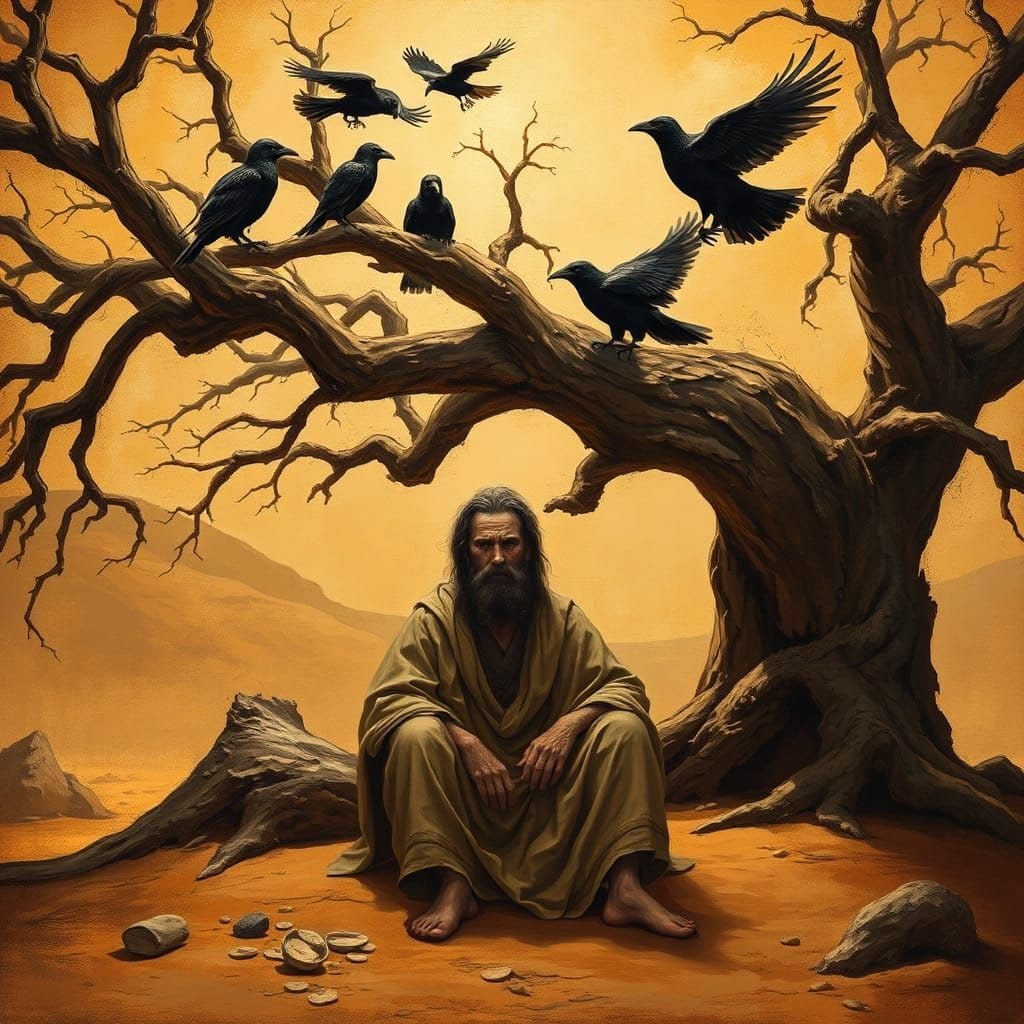
Then one woman with political power sent him a threatening message, and he ran into the desert and asked God to kill him.
I have written elsewhere about what God did under that tree, and I am not going to repeat it here, because the tenderness of that account deserves its own room and it has one. What I left alone was the mountain, and the mountain is the part that speaks to the person who has been listening for years and hearing nothing.
Sit first with the sequence, because it quietly demolishes something almost everyone believes without ever examining it. We assume that one clear sign would fix us. One undeniable event, and we would be steady afterward, and the doubt would have nowhere left to live. Elijah is the control group for that theory, and the theory does not survive him. He got the fire. He got it publicly, at enormous stakes, with the outcome hanging on it. And a week and a half later he was suicidal in a wilderness, and his own summary of his position was that he was the last one left and there was no point in going on.
The fire did not carry him. Nothing external does, for very long. That is not a defect in him and it is not a defect in you, and if you have been holding out for the sign that would finally end the argument, the man who got it is telling you what the sign is worth eight days on.
Now the mountain.
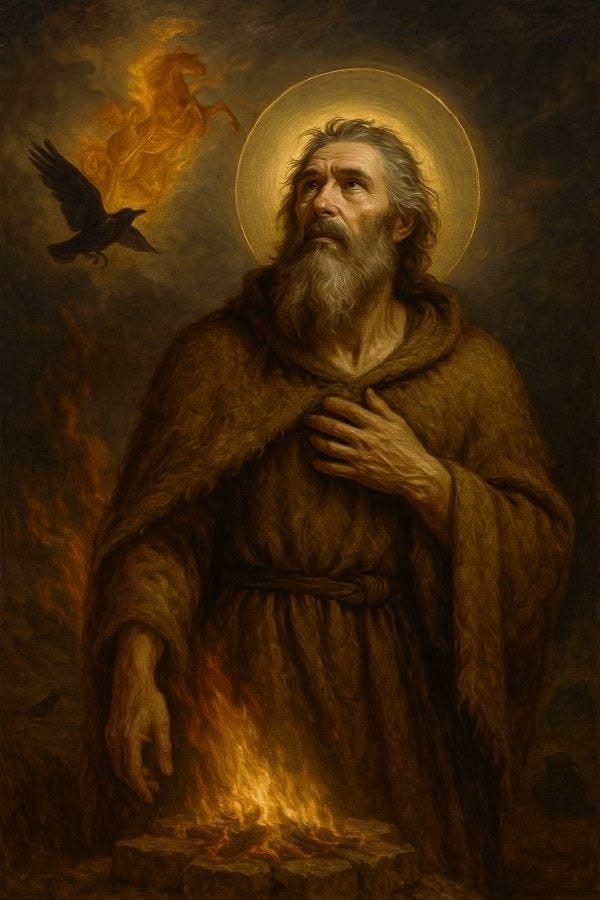
God tells him to go out and stand, because the LORD is about to pass by. And what comes first is a wind strong enough to tear the mountains apart and break the rocks, and the text stops and says, flatly, that God was not in the wind. Then an earthquake, and God was not in the earthquake. Then fire.
Fire. The exact medium of his greatest hour. The one thing in all the world that this particular man had every reason to be watching for, the signature, the proven method, the thing that had worked in front of a nation eleven days earlier.
And God was not in the fire.
After the fire there is a sound, and the Hebrew is strange and beautiful and no translation quite carries it. A thin, crushed quiet. A low whisper. The sound of a fine silence.
That is where he was.
Understand what that scene is doing, because it is doing it on purpose. God ran the entire catalogue of spectacular manifestation, one item after another, including the specific one this man was certain to be expecting, and he was in none of them, and the sequence is plainly staged for someone who had learned to associate God with volume. The fire on Carmel was real and it was God’s. But God is not reachable by escalation, and a man who has learned to find him only in the spectacular has learned something that will not hold him on the day the spectacular does not come.
Let me say what I am not saying, because this is exactly where it gets misused.
I am not saying God never does the dramatic thing. He does. He did it through this same man, eleven days earlier, at maximum volume. If you have had an overwhelming experience of God I am not telling you it was suspect or immature. And I am not telling you that the low whisper is a technique, a frequency you can tune to if you get quiet enough and try hard enough, so that failing to hear it becomes one more thing you have failed at. That turns the whisper into an achievement, which is the same trap this series has spent forty essays dismantling in other clothes.
What I am saying is narrower. A great many people have concluded that God is absent on the strength of evidence that rules out one form of his presence. They were listening for the earthquake. They can report, accurately and in detail, that there was no earthquake. They are right. And they have filed that finding under God is not there, when the honest filing is God was not in the earthquake, which is what the text actually says, and which is not the same claim at all.
Here is a man who was not listening for anything.
In 1958 David Wilkerson was pastoring a small Assemblies of God church in Philipsburg, Pennsylvania, a rural town of a few thousand people. He was not a figure of any consequence. He had no connection to any city, no ministry to speak of, no reason to expect that his life would go anywhere other than where it already was.

He sold his television set. Not for a cause, and not as a protest. He had worked out that the hours he gave to it were the only hours he had, and he wanted them back to pray, so he sold it and used the time from midnight to two in the morning for that instead. This is worth pausing on, because it is the least dramatic decision in this entire essay and it is the hinge of everything that follows. A man with no prospects and no audience quietly rearranged two hours of his own night.
And one of those nights, leafing through a copy of Life magazine, he came across a courtroom drawing. Seven teenage boys in New York on trial for the murder of a crippled boy in a park. He knew nothing about them, had never been to that city in any way that mattered, and had no earthly reason to care about a gang killing four hundred miles away. He looked at the artist’s rendering of their faces and he began to weep, and he could not account for it, and it did not stop.
That is the whisper. A magazine, a drawing, and tears with no explanation attached. No wind, no earthquake, no fire.
What it produced immediately was humiliation. He drove to New York, went to the courthouse, and tried to approach the judge in open court to ask if he could speak to the boys. He was ejected. A photographer caught him being removed with his Bible in his hand, and the picture ran in the papers, and he was presented to the city as an intruder and a crank. By any measure available on the day, the man had followed an inexplicable impulse into public embarrassment and accomplished nothing.
Except that the picture ran in the papers. Which meant that when he went back and started standing on the street corners, the gang members already knew his face. He was the preacher who got thrown out of the courtroom. The humiliation was the introduction. The thing that looked like the failure of the whole errand was the only reason the errand was possible.
What came out of it was Teen Challenge, which is still operating, and the conversion of a Mau Maus warlord named Nicky Cruz, who told Wilkerson he would cut him into a thousand pieces and was told in return that every piece would still love him. There is a book about it that has sold in the tens of millions and a great many people who got clean because of what it started.
None of which was audible in the room where a country pastor sat crying over a drawing at one in the morning without knowing why.
Now the objection, because a serious reader has had it loaded for several paragraphs.
You will say that a whisper indistinguishable from your own thoughts is your own thoughts. The earthquake at least had the decency to be external. This category cannot be checked, and worse, it is precisely the doctrine that lets a man announce that God told him to do the thing he had already decided to do, and I have watched that particular abuse ruin people.
That objection is correct as far as it goes, and I am not going to wave it away, because the damage it names is real and I have seen it too.
But go back to what the whisper actually said on that mountain, because the text hands us the test.
Elijah’s complaint had a specific centre of gravity, and it was not theology. It was arithmetic. I alone am left. That was the fact he was most certain of, the one his despair was built on and organised around.
And the answer he got was a number. There are seven thousand who have not bowed.
Sit with the shape of that. It is not a doctrine and it is not a reassurance. It is a fact he did not have and could not have generated, and it contradicted the one thing he was surest about. Despair does not spontaneously produce a figure that ruins its own case. Whatever else that voice was, it was not Elijah agreeing with Elijah.
That is the test, and it is the same test this series applied to the projection several essays back. A thing you built cannot correct you. It can only hand you back your own face at a slightly different angle. So a whisper that reliably tells you what you already believed, that flatters what you already wanted, that authorises what you had already decided, is worth nothing at all and you should treat it accordingly. But something that arrives against your preference, that tells you the count is wrong, that sends a small-town pastor toward a city he has no business in and then embarrasses him in the newspaper on the way, and that turns out over years to have been right, is a different kind of thing.
You can check it. The Bereans went home and checked, and the text calls them noble for it. That option was never withdrawn.
So here is where this lands.
If you have been waiting for the earthquake, you may be standing in exactly the right place, listening for exactly the wrong thing. And I am not going to insult you by promising the whisper on a schedule. It came to Elijah after a wilderness and a long walk and a cave. It came to Wilkerson through a magazine he happened to pick up in hours he had only because he sold a television, and its first fruit was public humiliation.
But notice what it was and what it was not, in both cases.
It was not loud. It was not a proof. It did not settle the argument, and in Elijah’s case it did not even change his talking points, because when God asked him what he was doing there he gave the same bitter speech he had given before the mountain, almost word for word. What changed was not his script. What changed was that he was given a road and a successor and a number, and the number told him he had been wrong about the only thing he was sure of.
You are probably wrong about that too. Nearly everyone who has concluded they are the last one left is.
He was not in the wind, and he was not in the earthquake, and he was not in the fire. He never said he would be.
He is in the thin, crushed quiet.
And you have been listening for the wrong thing so long that you may have to be told, by someone standing outside your certainty, that the room was never as empty as it sounded.
If you value unflinching, historically grounded analysis that mainstream outlets soften or ignore, consider upgrading. Paid subscribers get:
Several new, full-length articles every week.
Carefully researched pieces you won’t find elsewhere.
Full access to the complete premium archive
Archive of in-depth writing, research, and commentary — all in one place.
Entry into the subscriber chat
A private space for serious readers and thoughtful discussion.
Thanks for reading. This post is public, so feel free to share it. A. C. Rosenthal writes on comparative religion, Islamic theology, and the relationship between Christianity and modern Western culture. This work is entirely reader-supported. By choosing a paid subscription, you allow me to continue this long-form research to bring these vital stories to light. Thank you for helping this Lion roar for truth. A.C. Rosenthal is the author of The Two Muhammads: What History and Manuscripts Reveal About the Islamic Dilemma, The God They Rejected Isn’t Real: Exposing the False Gods of Modern Doubt, and The Carpenter’s Son and the Imam’s Son. Further analysis at:
acrosenthal.com/
https://thetwomuhammadscurriculum.thinkific.com/
No posts
Comments
Nothing yet. Say the first thing.
Sign in to join the conversation.