
The scale of the climate challenge can be difficult to comprehend.
Every year, humanity emits roughly 40 billion tons of carbon dioxide. Meanwhile, a natural chemical process involving water and minerals removes about 1 billion tons of CO₂ annually.
That gap is enormous.
But what if we could dramatically accelerate the process nature is already using?
That’s the idea behind Vycarb, a climate technology company founded by Dr. Garrett Boudinot, my recent guest on A Climate Change.
Vycarb is developing a system designed to transform carbon dioxide into bicarbonate — a stable form of dissolved carbon that can remain in the ocean for roughly 100,000 years.
And perhaps just as importantly, the company believes it can precisely measure how much carbon is actually being stored.
That combination — permanence, scalability and verifiability — could address some of the biggest problems facing carbon capture today.
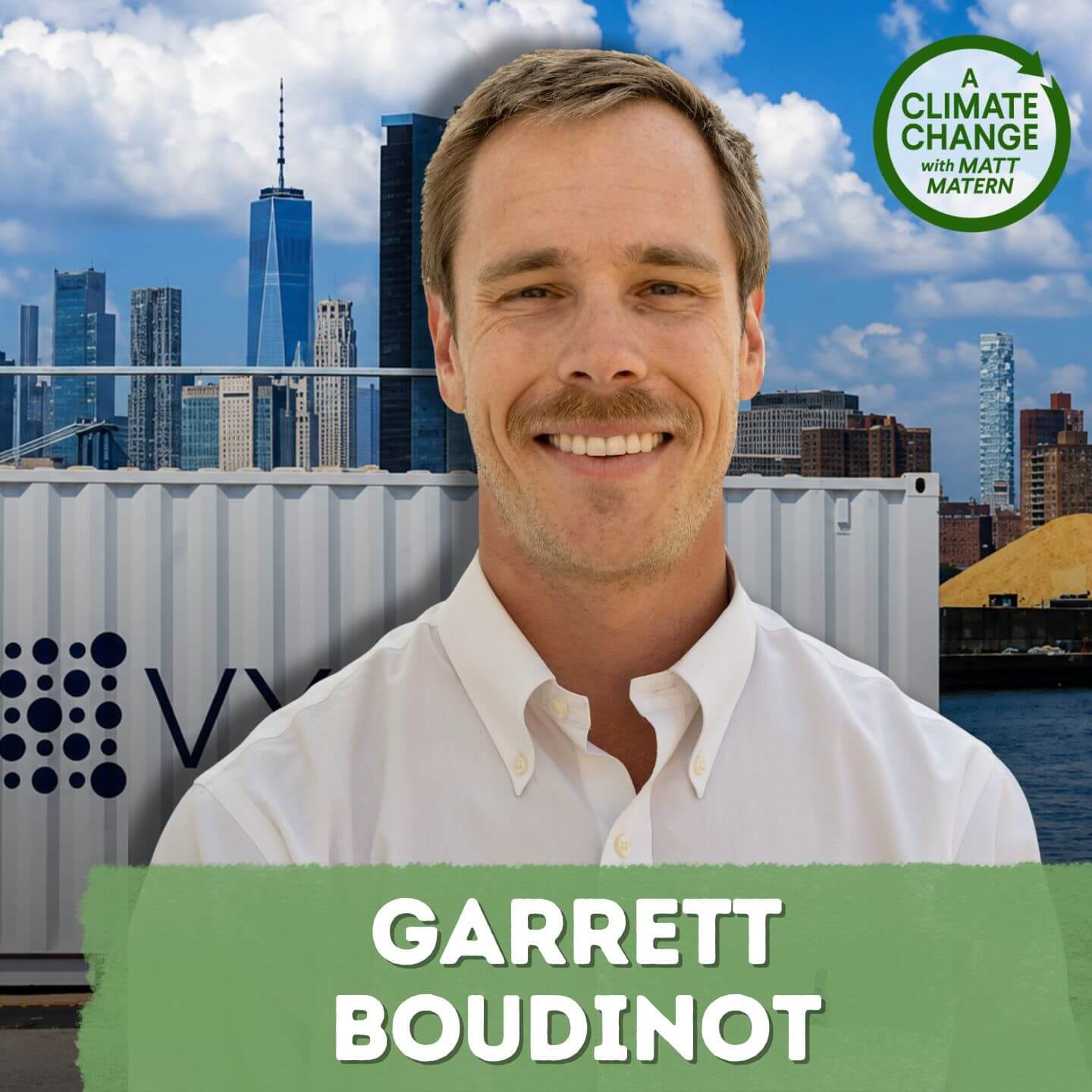
Boudinot didn’t begin his career as an entrepreneur.
He began as a climate scientist.
Growing up visiting national parks and wild spaces, he was simultaneously learning how those environments were being altered by climate change. That led him into climate science and eventually a Ph.D. focused on global carbon cycling and its effects on ocean and forest ecosystems.
But halfway through graduate school, he encountered a question familiar to many people working on climate change:
We understand the problem. What are we going to do about it?
He had spent years studying how carbon moves through the planet. Increasingly, he wanted to use that knowledge to build solutions.
After working in conservation, Boudinot joined Cornell University, where his research examined ways to accelerate natural chemical reactions that remove CO₂ from the atmosphere.
That work eventually led him to the Activate Fellowship, which supports scientists attempting to commercialize high-impact technologies.
The fellowship gave him two years to turn an idea into a real-world technology.
That idea became Vycarb.
Vycarb’s technology is based on chemistry that already occurs throughout the natural world.
CO₂ dissolves into water and forms carbonic acid. That acid interacts with abundant elements such as calcium and magnesium.
Through that reaction, the carbon can become bicarbonate (HCO₃⁻) — an invisible, dissolved and highly stable form of carbon.
This isn’t some exotic molecule invented in a laboratory.
According to Boudinot, more than 90% of the carbon at Earth’s surface is already stored as bicarbonate in the ocean.
Nature is doing this constantly.
The problem is speed and scale.
Natural processes sequester roughly 1 billion tons of CO₂ this way each year, while human activity emits around 40 billion tons.
Vycarb’s premise is essentially:
Take a carbon-storage mechanism the planet already uses and accelerate it.
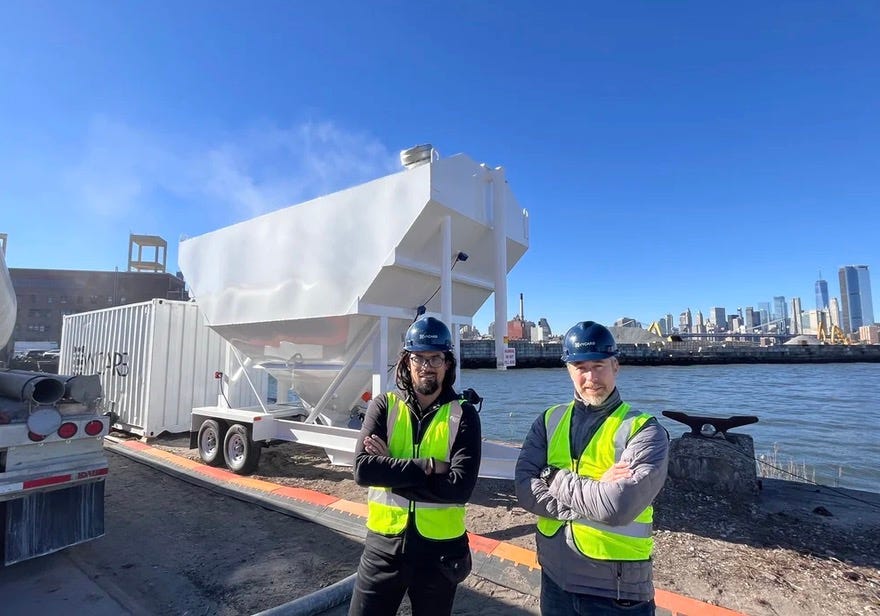
Inside Vycarb’s reactor, the conversion can happen on the order of minutes. The company says it has demonstrated the technology at pilot scale with capacity of roughly 200 tons per year.
There is another major advantage to bicarbonate: permanence.
Once formed, Boudinot explained, bicarbonate has an estimated residence time in the ocean of roughly 100,000 years.
That’s particularly important when thinking about carbon offsets.
Companies around the world are buying credits to compensate for emissions they cannot yet eliminate. But not every ton of carbon credited as “removed” carries the same degree of certainty.
Consider a forest-based offset.
Trees can absorb CO₂ for decades. But forests can also burn, be harvested or otherwise lose stored carbon.
That doesn’t mean forests aren’t enormously important. They are.
But when companies claim that a specific quantity of emissions has been permanently offset, measurement and durability matter.
As Boudinot put it during our conversation, the nightmare scenario is a company purchasing offsets only to discover later that the carbon went up in smoke during a forest fire — or that the amount supposedly removed was never accurately measured in the first place.
That can turn an environmental commitment into a greenwashing liability.
This is where another part of Vycarb’s system becomes particularly interesting.
The company isn’t only building a reactor.
It has also developed sensing technology intended to measure carbon molecules in water in real time.
That measurement system allows Vycarb to monitor the process and quantify how much CO₂ has actually been converted into bicarbonate.
For carbon markets, that could be critical.
A carbon credit ultimately represents a claim: one ton of carbon was removed or prevented from reaching the atmosphere.
The credibility of that claim depends heavily on whether someone can prove it.
Vycarb wants measurement to be built directly into the technology rather than treated as an afterthought.
There’s another potentially significant advantage.
Traditional carbon capture and storage can involve an entire chain of infrastructure.
An industrial facility emits CO₂ mixed with other gases. The CO₂ may need to be separated and purified, compressed to high pressure, transported — sometimes by pipeline or ship — and eventually injected into an appropriate underground geological formation.
Each step adds complexity, infrastructure, energy consumption and cost.
Vycarb is pursuing a different model.
Its system is designed to work with low-purity CO₂ directly at an industrial facility. Water is brought into the reactor, the CO₂ is converted into bicarbonate, and the resulting water can be returned to the natural water body.
That means the company could potentially provide an on-site carbon capture and storage system without requiring separate CO₂ purification, transportation and geological storage infrastructure.
That distinction matters because geological carbon storage is not equally accessible everywhere.
One of Boudinot’s best examples is Singapore.
Singapore has substantial industrial emissions and increasingly strong financial incentives to decarbonize.
What it doesn’t have is abundant domestic geological storage for captured CO₂.
Boudinot described studies examining a much more complicated alternative: capture and purify the CO₂ in Singapore, compress it, load it onto ships and transport it to Indonesia for geological storage.
Even setting aside the cost, think about the infrastructure and geopolitical complexity involved.
Singapore does, however, possess another resource in abundance:
coastline.
That’s precisely the type of geography where a water-based carbon storage system becomes interesting.
Similar dynamics exist in places such as Japan and parts of Europe, where major industrial emitters may face growing pressure to decarbonize without having convenient geological storage nearby.
Vycarb says it is already developing projects and partnerships in several of these markets.
Of course, promising chemistry means little if companies can’t afford to deploy it.
And this may be one of the most consequential parts of Vycarb’s proposition.
Boudinot says the company believes its technology can eventually operate well below $100 per ton of CO₂, with some facilities potentially approaching $50 per ton all-in.
The reason isn’t simply that the reactor itself becomes cheaper.
Vycarb hopes to eliminate entire portions of the conventional carbon-capture value chain.
No separate high-purity capture system.
Lower pressure requirements.
Potentially no CO₂ pipeline.
No need to transport carbon hundreds or thousands of miles to an underground storage site.
Every avoided step represents potential savings in capital, energy and operating expenses.
If those economics hold at commercial scale, the implications could be significant.
That’s the next challenge.
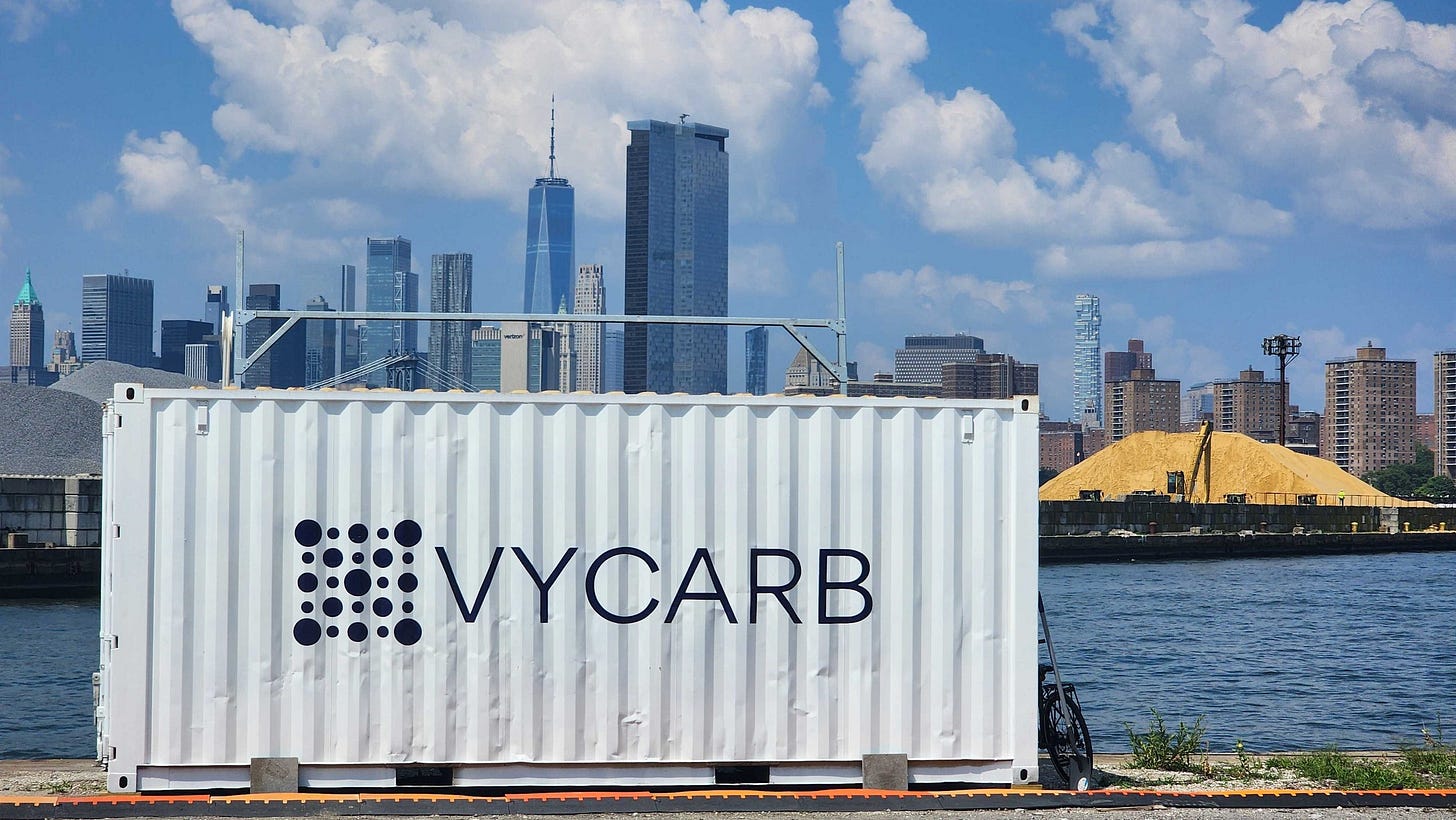
Vycarb has spent roughly three years developing and demonstrating its technology. Its Brooklyn pilot operates at approximately 200 tons per year, and the company says it has demonstrated its full-stack system, including its ability to work with low-purity CO₂ and obtain the necessary environmental discharge permits.
Now comes commercialization.
Boudinot said Vycarb is moving toward new projects in the United States and internationally, followed by several first-of-a-kind commercial projects potentially operating at 100,000 to 200,000 tons per year per facility.
The company’s target is to reach the point around 2029 where it can shift from proving the technology to replicating deployments.
That’s when things could get interesting.
Many large companies have 2035 or 2040 decarbonization targets. They don’t necessarily want to be the first company deploying an unfamiliar technology.
As Boudinot memorably put it, some companies want to be “first to be second.”
They want somebody else to prove it works.
Then they’re ready to move.
The transition may also accelerate as emitting carbon becomes increasingly expensive — or capturing it becomes financially attractive.
Different jurisdictions are experimenting with carbon taxes, emissions trading systems, tax credits and import-related carbon rules.
In the United States, Boudinot pointed to the 45Q tax credit, which can provide significant financial incentives for qualifying carbon capture and storage.
Elsewhere, Singapore’s carbon tax and European carbon policies create their own economic pressures.
That changes the conversation inside industrial companies.
Carbon capture stops being solely an environmental expense.
Under the right circumstances, capturing carbon can become less expensive than continuing to emit it — and potentially even generate revenue.

One of my favorite parts of the conversation came near the end.
Climate change is an enormous problem, and it’s easy to look at the scale of global emissions and become discouraged.
Boudinot knows that feeling.
After all, his path toward entrepreneurship began with an existential crisis while studying climate change in graduate school.
But years later, his perspective has changed.
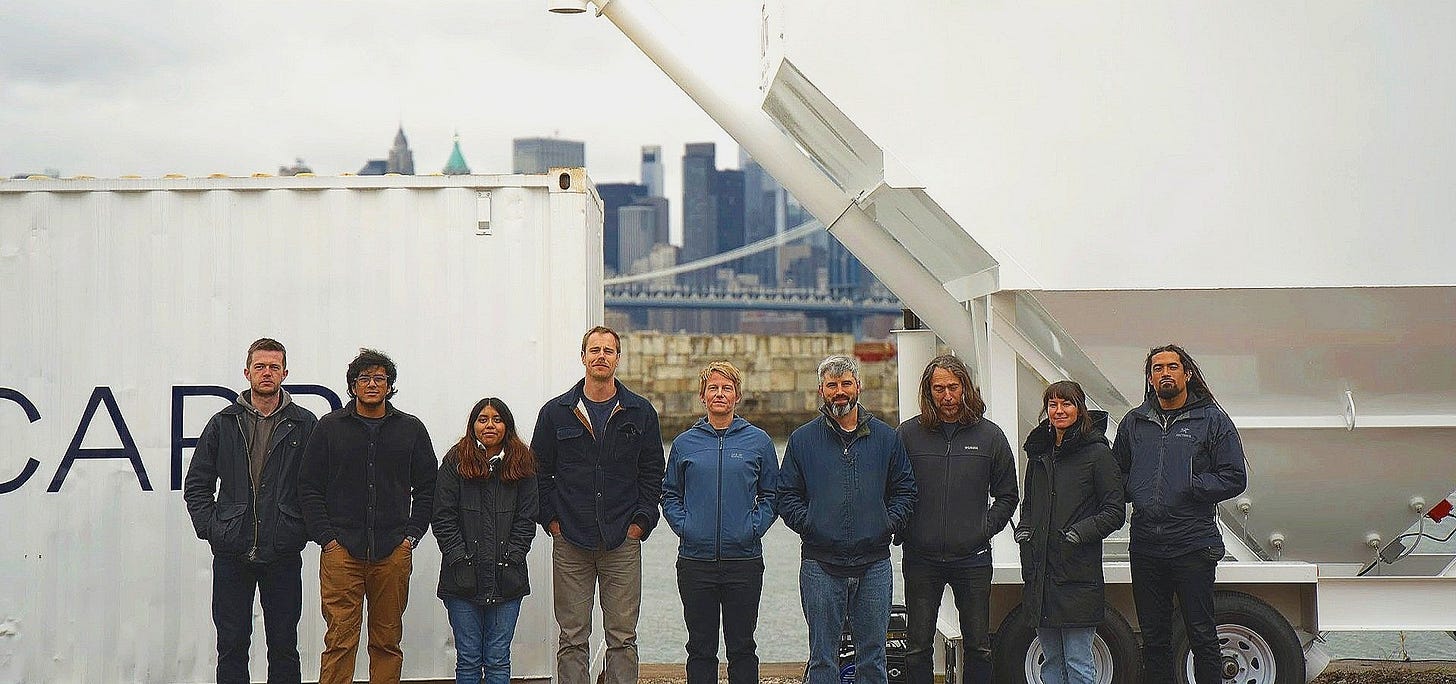
A relatively small team working out of the Brooklyn Navy Yard has developed technology, deployed pilots, attracted major industrial partners and begun preparing for commercial-scale projects.
His lesson was simple:
When you actually start doing the work, you begin seeing that solutions exist.
I think that’s worth remembering.
There isn’t going to be one miraculous technology that solves climate change.
We’ll need renewable energy, efficiency, electrification, better transportation, cleaner industrial processes, conservation — and technologies capable of dealing with the emissions we simply can’t eliminate quickly enough.
Some ideas won’t work.
Others will work but won’t scale.
And a few may begin as experiments in laboratories and pilot projects before eventually becoming pieces of global infrastructure.
Vycarb is still on that journey.
But its underlying idea is compelling:
Take a carbon-storage process nature has been running for millions of years, understand the chemistry, accelerate it, measure it — and put it to work on one of the biggest challenges humanity faces.
That’s the kind of climate innovation worth watching.
This article is based on my conversation with Dr. Garrett Boudinot, founder and CEO of Vycarb, on A Climate Change.
To hear the full conversation, subscribe to A Climate Change on Apple Podcasts, Spotify, YouTube or wherever you listen to podcasts.
No posts
Comments
Nothing yet. Say the first thing.
Sign in to join the conversation.