
What if one of the most promising climate solutions didn’t require more land, more freshwater, more fertilizer, or even more feed?
What if it grew underwater?
That is the vision behind regenerative ocean farming, an emerging industry built around crops like kelp, oysters, mussels, scallops, and clams. And few people have done more to advance that vision than Bren Smith, commercial fisherman turned ocean farmer and co-founder of GreenWave.
I recently spoke with Bren on A Climate Change about his remarkable journey—from fishing the waters off Newfoundland and Alaska to helping build a new model of agriculture that could restore oceans, strengthen coastal economies, and even help farmers on land withstand drought and rising fertilizer costs.
His story also carries a larger lesson for the climate movement: lasting solutions may not come from Silicon Valley moonshots or top-down mandates. They may come from working communities, local ownership, and people who know how to build things that can survive a storm.
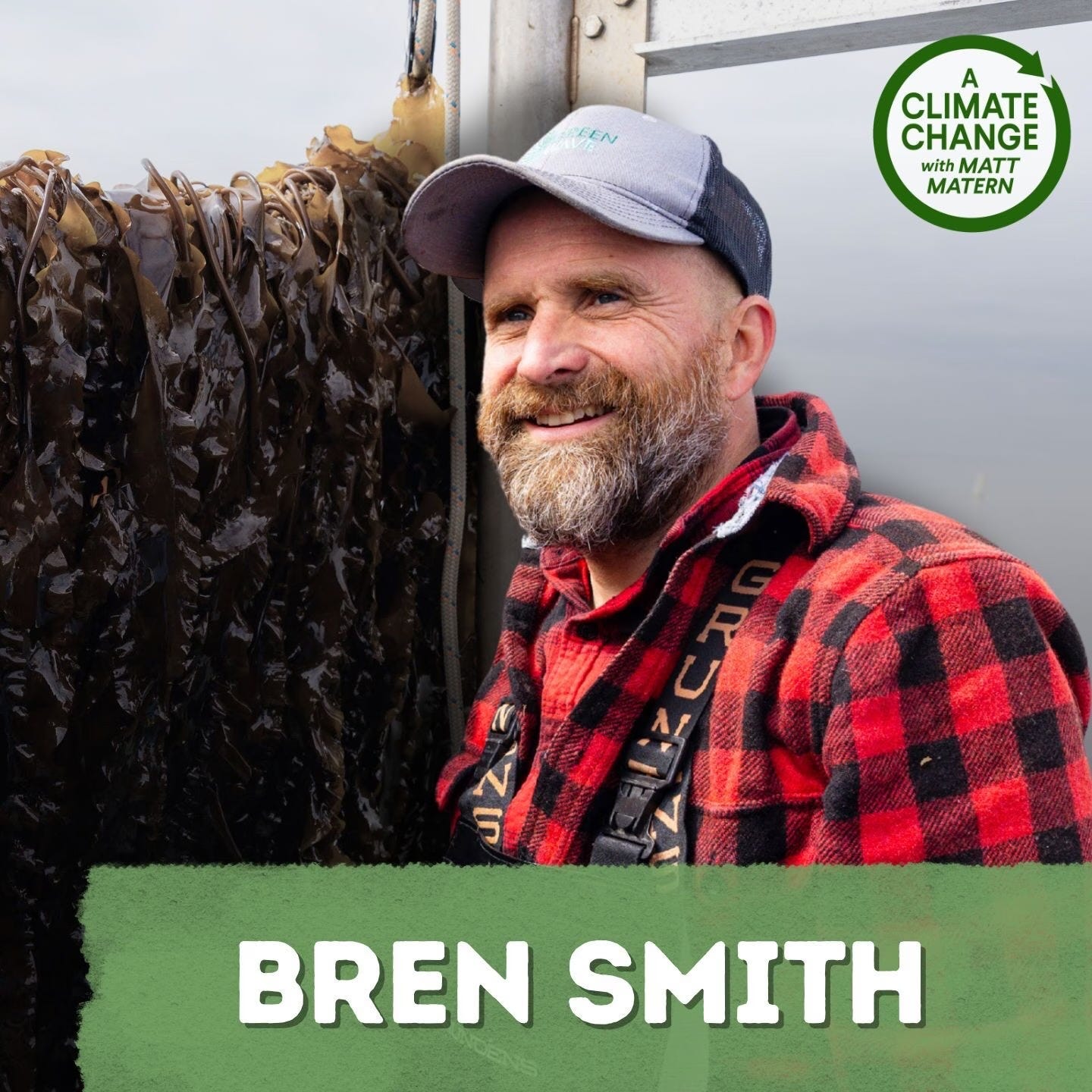
From a Fishing Village to Ecological Collapse
Bren grew up in Newfoundland, Canada, in a fishing village where the ocean was not an abstract environmental issue. It was life.
He remembers fishermen owning their own boats, working independently, feeding their communities, and taking enormous pride in their craft.
“All I ever wanted to be was a fisherman,” he told me.
He dropped out of high school at 14 and went to sea, eventually fishing lobster, tuna, herring, cod, and crab from Newfoundland to Alaska.
The work was thrilling. But the industry was becoming extraordinarily efficient.
Too efficient.
Modern fishing technology allowed fleets to extract more and more from the ocean until ecosystems could no longer keep up.
Then came the collapse.
In the early 1990s, Newfoundland’s cod stocks crashed, throwing roughly 30,000 people out of work and devastating communities built around fishing.
For Bren, it changed the way he understood environmentalism.
Until then, he said, environmental issues had seemed like they were primarily about “birds and bees and seals.”
The cod collapse showed him something very different.
“There aren’t going to be any jobs on a dead planet.”
That insight remains one of the most important ideas in the climate debate.
Ecological collapse is not separate from economic collapse.
For communities dependent on natural resources, they are often the same thing.
The Wrong Way to Farm the Ocean
Bren eventually moved into salmon farming, which at the time was being presented as a solution to declining wild fisheries.
Instead, he saw many of the same mistakes industrial agriculture had made on land being transferred into the ocean.
Monocultures. Antibiotics. Pesticides. Pollution. Feed-intensive production.
The problem, Bren realized, was that aquaculture was being designed around what consumers already wanted to eat.
People wanted salmon, so companies farmed salmon.
But Bren began asking a different question:
Instead of forcing the ocean to produce what markets demand, what does the ocean naturally want to grow?
That shift in thinking eventually led him toward shellfish and seaweed.
Unlike conventional agriculture, these crops require remarkably few inputs.
Kelp needs no freshwater.
No fertilizer.
No feed.
No farmland.
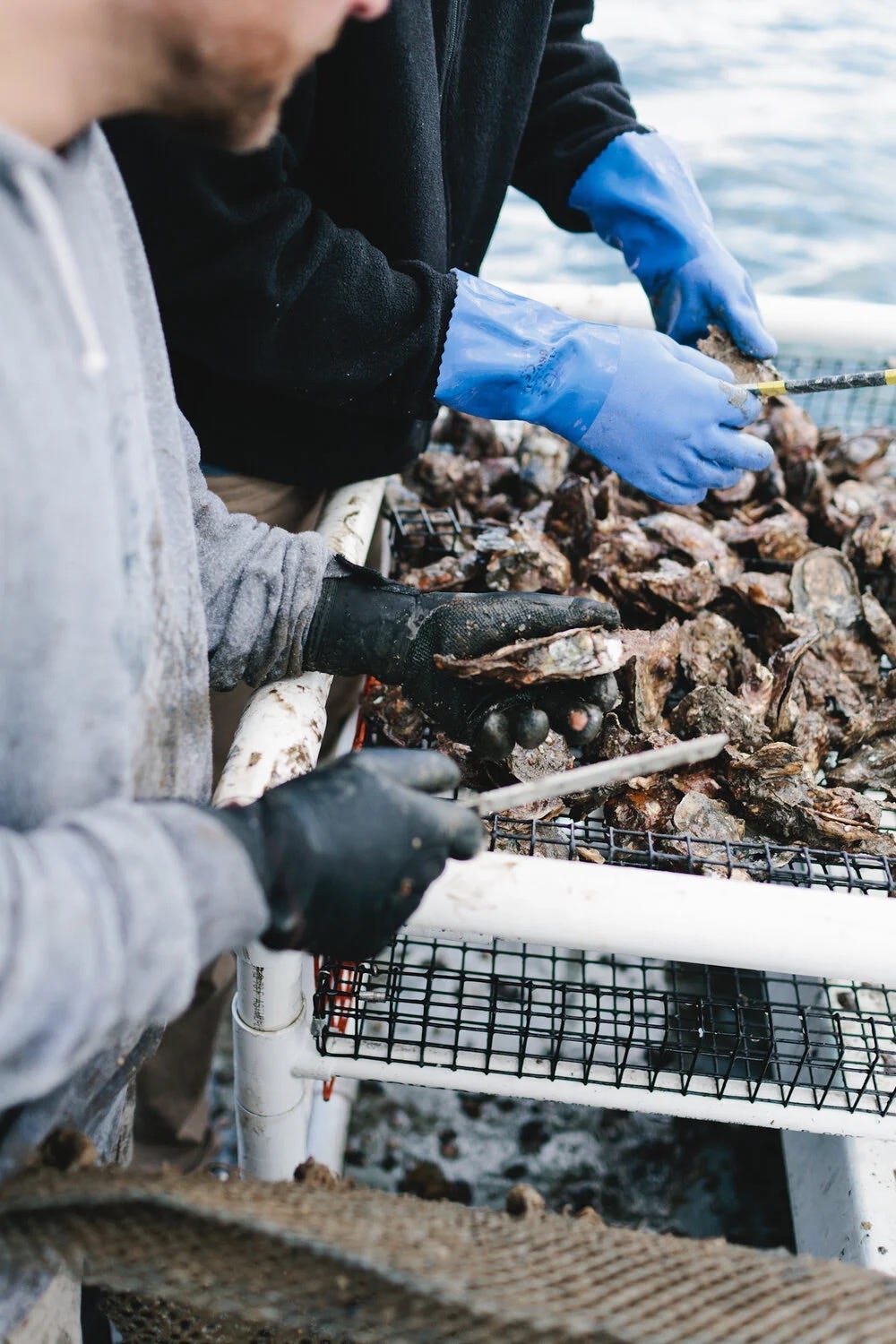
Shellfish such as oysters can filter enormous quantities of water while absorbing excess nutrients.
Seaweed can take up nitrogen and carbon while creating habitat for marine life.
Bren began seeing them not simply as sustainable crops, but as regenerative crops.
Beyond Sustainability
The word “sustainability” has become so common that it can lose its meaning.
Bren draws an important distinction.
Sustainability is often about reducing harm.
Use less water.
Produce fewer emissions.
Reduce fertilizer.
Create less waste.
Those are important goals.
But regenerative systems aim for something more ambitious: leaving ecosystems healthier than they were before.
Seaweed and shellfish offer that possibility.
They can absorb nutrients such as nitrogen and phosphorus that would otherwise contribute to damaging algae blooms and ocean dead zones.
They create habitat.
They support biodiversity.
And they can produce food and industrial materials without many of the inputs traditional agriculture requires.
That is why Bren describes crops such as kelp as having enormous “positive externalities”—economic language for benefits that society receives even though the market rarely pays farmers for producing them.
The problem is that markets are usually much better at pricing products than ecosystems.
A farmer can get paid for a pound of kelp.
It is much harder to get paid for cleaner water, restored habitat, increased biodiversity, or the nutrients that kelp removes from the ocean.
GreenWave has been working to change that.
Building GreenWave
After hurricanes Irene and Sandy destroyed Bren’s oyster farm in consecutive years, he began redesigning his operation for a changing climate.
Eventually, that work evolved into GreenWave, the nonprofit Bren co-founded with Emily Stengel.
What began as a relatively small effort quickly attracted enormous interest.
Thousands of people signed up for farmer training, and inquiries arrived from around the world.
Today, GreenWave operates as a kind of open-source infrastructure for regenerative ocean farming.
Its community includes thousands of farmers, researchers, entrepreneurs, and others sharing information about farm design, hatcheries, equipment, processing, financing, and markets.
GreenWave also operates several programs designed to help the industry mature.
One is the Kelp Climate Fund, which provides farmers with additional payments based on the ecological benefits their crops create.
Another collects farm data to better understand yields and industry performance.
GreenWave also runs intensive farmer training and an innovation center in New Haven that includes farming, processing, seed, and nursery operations.
The underlying philosophy is simple:
If this industry is going to grow, its knowledge should not be locked behind proprietary walls.
The Kelp Boom—and the Lessons From It
Kelp has attracted enormous enthusiasm over the past decade.
Not all of it was well placed.
Bren argues that too much investment initially flowed toward highly speculative markets, particularly biofuels and carbon credits.
The idea sounded compelling.
Turn kelp into fuel.
Use kelp to sequester carbon.
Create a new climate commodity.
But the science, policy, infrastructure, and economics were often not ready.
Large amounts of money went into projects that ultimately failed to create durable farms, processing facilities, or hatcheries.
At the same time, another part of the industry focused heavily on specialty foods—kelp noodles, pickles, and other consumer products.
Those markets helped create early demand, but Bren believes they were simply too small to support the scale the industry needed.
What emerged, however, was valuable.
North America now has thousands of permits, experienced farmers, nurseries, and enough infrastructure to produce kelp at significant scale.
The biggest challenge is no longer proving that farmers can grow it.
The challenge is finding large, reliable markets that can use it.
And that may finally be happening.
Kelp the Working-Class Problem Solver
One of the most interesting shifts in Bren’s thinking is how he now talks about kelp.
He no longer sees it primarily as a heroic “climate crop.”
He sees it as something more practical:
a working-class problem solver.
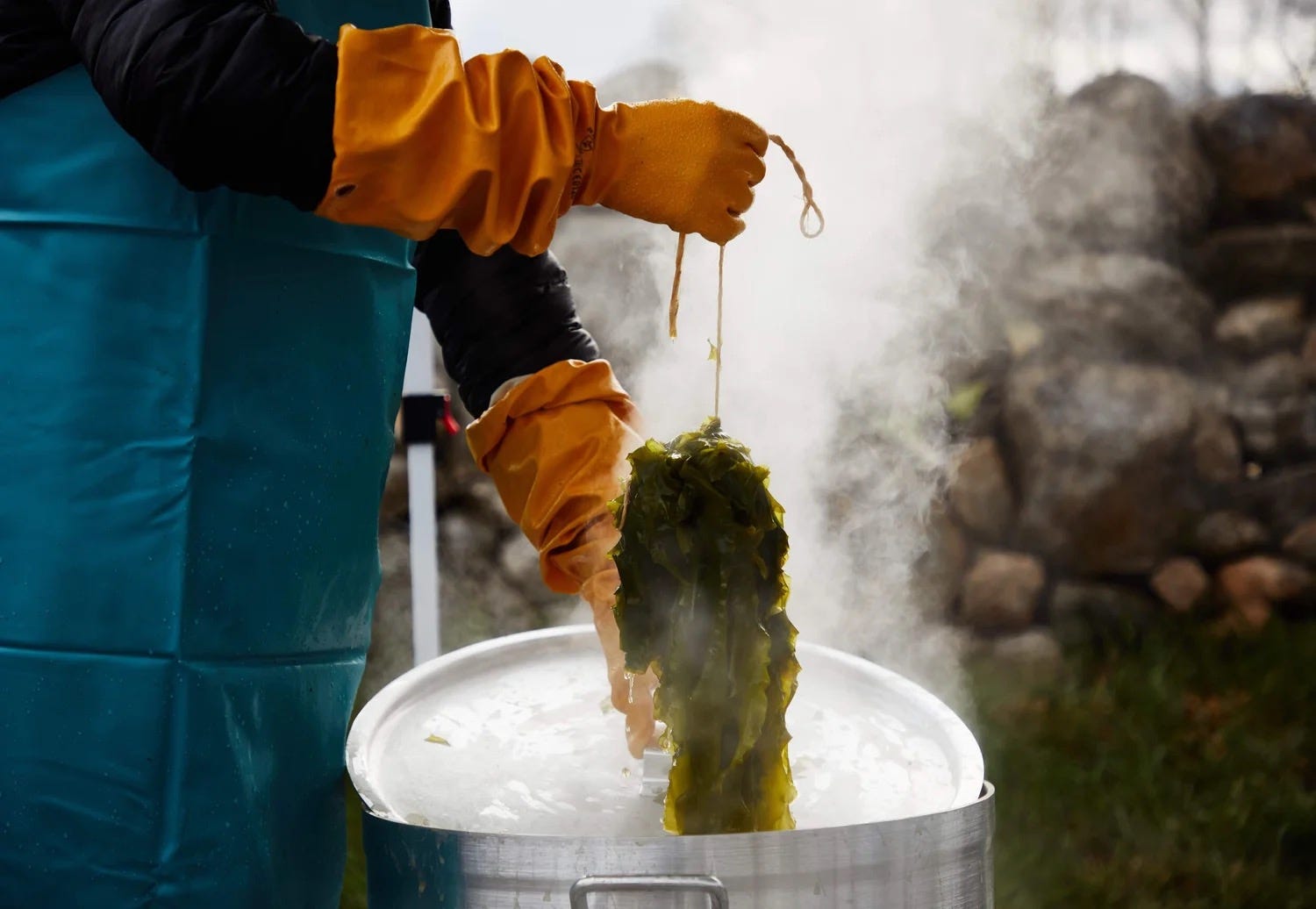
Kelp can potentially serve as an ingredient in food manufacturing.
It can be used in biomaterials and alternatives to certain plastics and coatings.
And perhaps most promisingly, it can be transformed into agricultural biostimulants.
Instead of asking consumers to dramatically change their diets, kelp can be woven into industries that already exist.
That matters because changing human behavior is slow.
Climate change is not.
The Land-Sea Nutrient Loop
One of GreenWave’s most promising areas of work involves using seaweed to help agriculture on land.
Much of the nitrogen and phosphorus used in conventional farming eventually washes into rivers and coastal waters.
Those nutrients can contribute to algae blooms, low-oxygen zones, and ecological damage.
Kelp can absorb some of those nutrients.
It can then be harvested and transformed into products that return those nutrients to agricultural soils.
In Bren’s words, it creates a kind of bridge between land and sea.
Historically, coastal communities have often turned to seaweed when their soils became depleted.
Today, that old practice is being reinvented through seaweed-based biostimulants.
Unlike conventional fertilizer, these products are not primarily designed to deliver nitrogen, phosphorus, and potassium.
Instead, they help plants use water and nutrients more effectively and may improve their ability to withstand stress.
According to Bren, farmers using seaweed biostimulants can sometimes reduce fertilizer requirements significantly while improving plant resilience during drought and heat.
That could become increasingly valuable as agriculture faces rising input costs and more extreme weather.
GreenWave is now involved in trials across dozens of crops and more than two dozen states.
One of the most intriguing findings so far is that seaweed biostimulants appear especially valuable when crops are under stress.
When conditions are perfect, the effect may be modest.
When plants face drought or heat, the difference can be much greater.
That is exactly the kind of tool farmers may need in a more volatile climate.
Why This Is Also About National Resilience
The appeal of kelp is no longer just environmental.
It is increasingly geopolitical.
COVID exposed the fragility of global supply chains.
The war in Ukraine disrupted agricultural and energy markets.
Growing geopolitical tensions are forcing companies and governments to think much more seriously about where critical materials and ingredients come from.
That includes everything from food ingredients to fertilizer inputs.
Kelp has an unusual advantage: it can be grown domestically at scale without competing for farmland or freshwater.
Bren pointed to GreenWave’s collaboration with Unilever as one example of companies beginning to explore kelp not simply because it is sustainable, but because it may help create more resilient domestic supply chains.
That change could be enormously important.
Climate solutions often gain traction when they solve several problems at once.
Kelp may help lower environmental impact.
But it may also help strengthen domestic production, reduce exposure to global supply disruptions, support coastal communities, and create new agricultural inputs.
That is a much more powerful economic case.
Technology Has to Work With Nature
Our conversation eventually turned to artificial intelligence, drones, and automation.
Could robots transform ocean farming?
Perhaps.
But Bren offered a useful warning.
The ocean is a brutal engineering environment.
Salt, waves, storms, biofouling, and marine life can destroy sophisticated equipment surprisingly quickly.
Again and again, he has watched technologies fail because designers underestimated the ocean.
He learned the same lesson personally after storms destroyed his farm.
His original instinct was to build stronger equipment.
Eventually, he realized strength was not the answer.
Flexibility was.
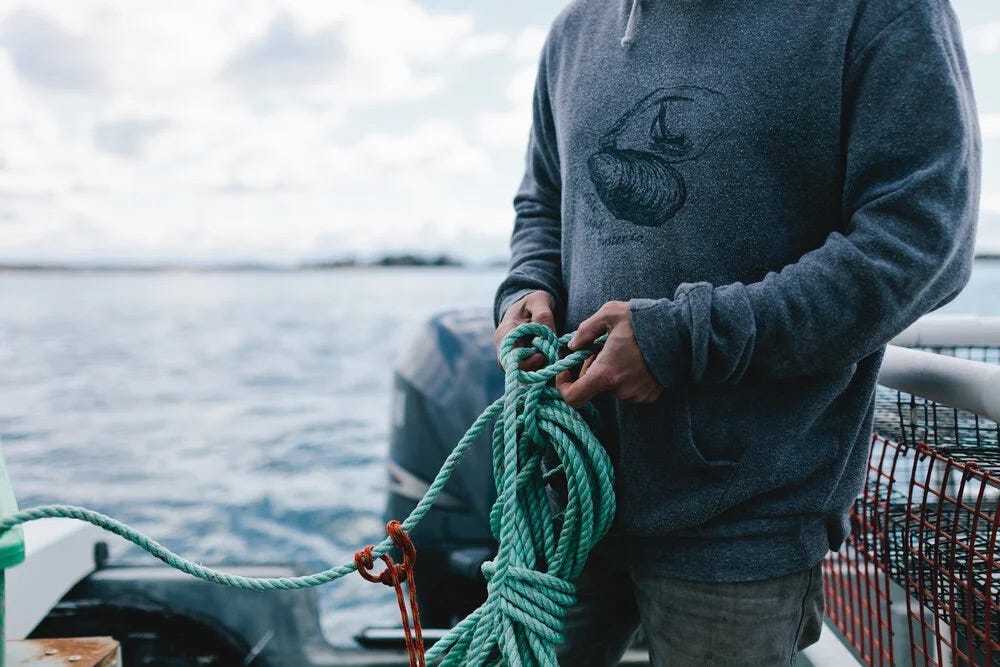
Instead of designing a farm that resisted storms, he redesigned it to bend underwater and rise again afterward.
“I need to be a willow, not an oak,” he said.
That philosophy extends beyond farm equipment.
Bren is enthusiastic about useful technology.
But he is deeply skeptical of a future in which automation eliminates the human communities the industry is supposed to support.
For him, regenerative ocean farming is not simply about producing the largest possible quantity of kelp at the lowest possible labor cost.
It is about creating meaningful livelihoods.
Fishing and farming have always been cultural occupations as much as economic ones.
People build identities around them.
Families inherit them.
Communities grow around them.
A climate economy that destroys those relationships in the name of efficiency would be missing something fundamental.
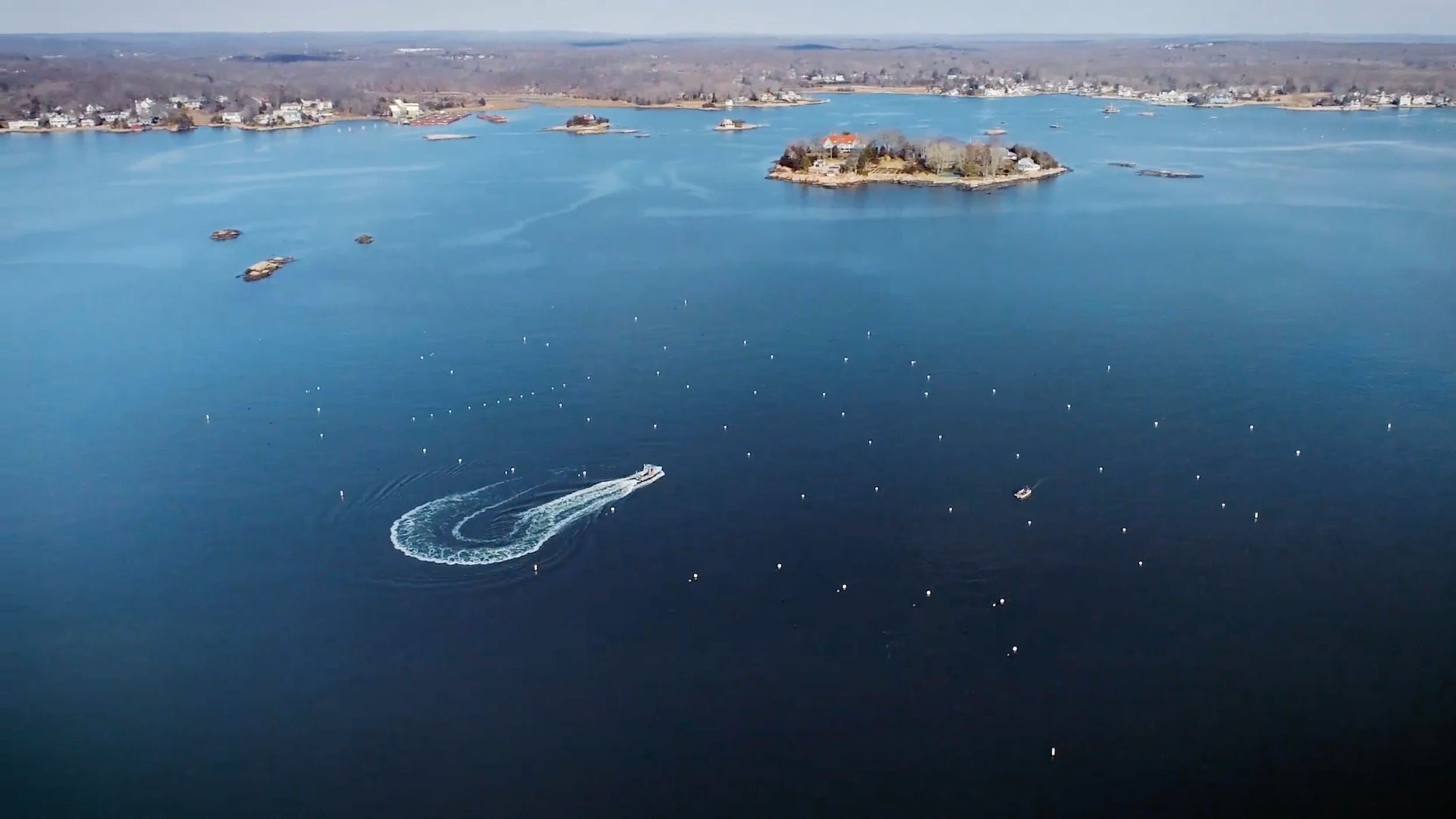
Building an Industry From the Bottom Up
Perhaps the most compelling part of Bren’s vision is not the kelp itself.
It is the structure he hopes grows around it.
He imagines coastal “reefs” of 20 to 50 farms supported by shared processing facilities, nurseries, seed banks, and networks of entrepreneurs creating new products.
Those systems could then be replicated along coastlines around the world.
But ownership matters.
Bren does not want farmers dependent on large corporations for proprietary seed.
He does not want essential infrastructure controlled by distant investors.
And he does not want the oceans transformed into another privatized industrial landscape.
Instead, he talks about cooperatives, shared financing, farmer-owned seed libraries, and community infrastructure.
It is a very different theory of climate investment.
Over the past decade, climate technology has often been framed around speed.
Scale as quickly as possible.
Raise huge amounts of capital.
Find the breakthrough technology.
Disrupt an industry.
Bren believes durable climate solutions may require something slower and less glamorous.
Build local infrastructure.
Train people.
Create ownership.
Develop markets.
Make mistakes.
Learn.
Then replicate what works.
Climate Solutions That Can Survive the Storm
That may be the biggest lesson from Bren Smith’s journey.
The climate movement understandably feels urgency.
The science demands urgency.
But urgency can sometimes push us toward fragile solutions.
Bren argues that rebuilding industries capable of responding to climate change will take decades.
Solar energy did not transform the energy system overnight.
Neither will agriculture.
Neither will ocean farming.
The goal should not simply be to build quickly.
It should be to build things strong enough—or flexible enough—to last.
“We need to build for the long haul,” Bren told me.
That means industries rooted in real communities.
It means infrastructure people can own.
It means productive jobs with dignity.
And it means recognizing that some of the best climate technologies may not look like technologies at all.
Sometimes they look like oysters filtering the sea.
Sometimes they look like kelp swaying beneath the surface.
And sometimes the smartest response to a storm is not to build a stronger wall.
It is to learn how to bend.
Bren Smith is the co-founder and co-executive director of GreenWave and the author of Eat Like a Fish. To learn more about regenerative ocean farming, farmer training, kelp markets, and GreenWave’s work, visit GreenWave.org.
A Climate Change explores the people, technologies, policies, and ideas shaping our response to the climate crisis.
Comments
Nothing yet. Say the first thing.
Sign in to join the conversation.