
Most conversations about climate change focus on what we need to stop doing.
Burn less fossil fuel. Waste less food. Emit less carbon.
But what if the next breakthrough isn’t about slowing the damage?
What if it’s about actively rebuilding nature—using robots that never sleep?
That’s exactly what Tom Chi believes.
Tom is the founding partner of At One Ventures, a founding member of the Google X team that helped create Waymo, and the author of Climate Capital. On this week’s episode of A Climate Change with Matt Matern, he shares a radically optimistic vision for how deep technology can help restore the natural world.
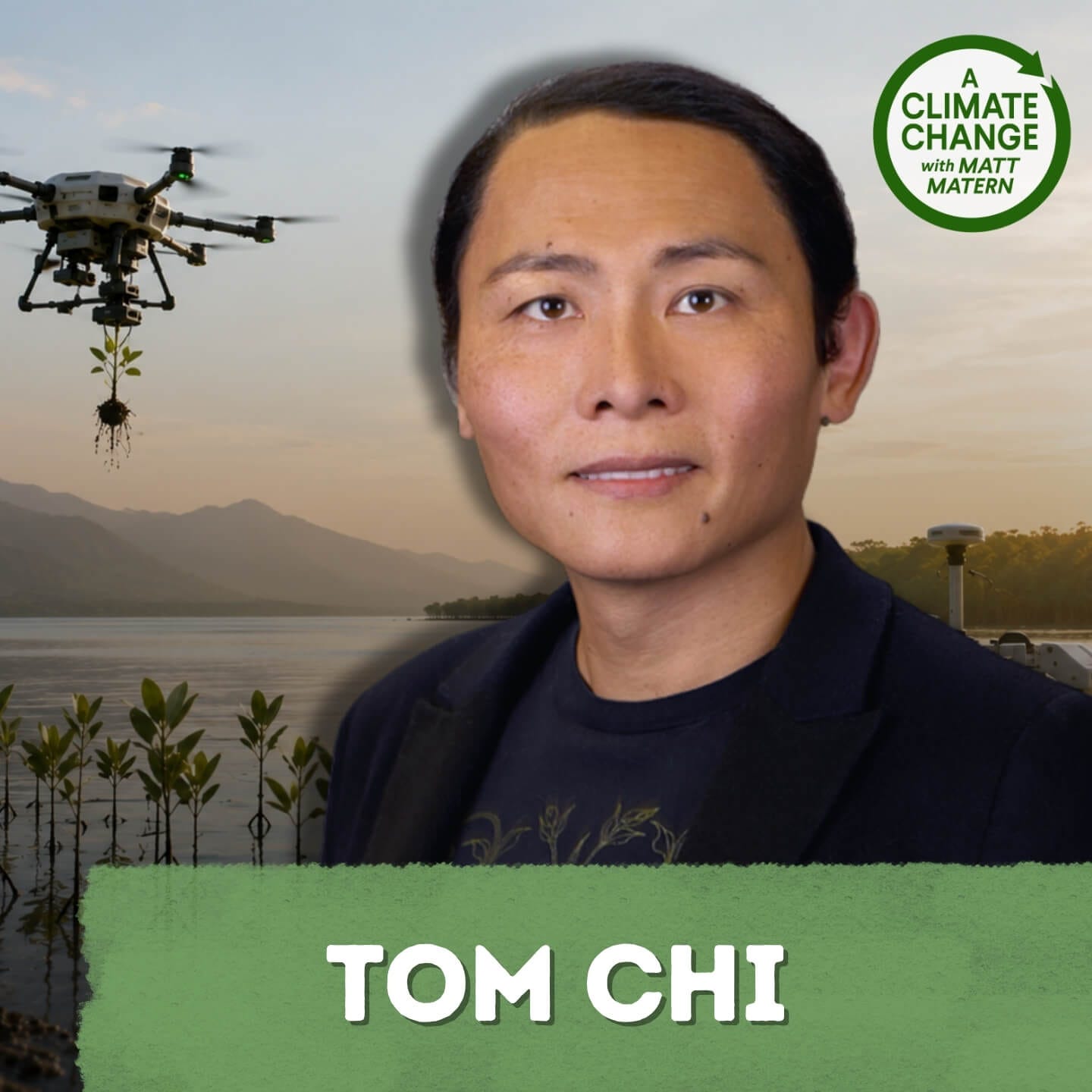
Imagine owning a robot that spends every day planting mangroves, restoring coral reefs, or rebuilding seagrass beds.
No salary.
No vacation.
Just clean energy and a mission to heal ecosystems.
Today, these restoration robots cost roughly $10,000. In a decade, Tom believes they could cost closer to $1,000, making them accessible to communities around the world.
Instead of waiting for governments or billion-dollar projects, local landowners, nonprofits, and neighborhoods could restore ecosystems themselves.
One observation from Tom is difficult to forget.
A park ranger in 1926 carried:
A Jeep.
A map.
Binoculars.
A hand clicker to count wildlife.
A century later?
The toolkit hasn’t changed very much.
Meanwhile, nearly every other industry has been transformed by computers, robotics, automation, and AI.
Tom argues that conservation has simply been left behind.
By applying the same technological advances that revolutionized manufacturing, logistics, and transportation, ecosystem restoration is becoming dramatically faster—and dramatically cheaper.
In fact, companies like Dendra Systems and ReefGen are already proving it.
One of the episode’s biggest ideas turns a familiar argument upside down.
People often frame environmental protection as being in conflict with economic growth.
Tom sees it differently.
The economy is a subset of ecology.
Every product we manufacture begins with something that is either grown or mined.
Healthy forests...
Healthy oceans...
Healthy soils...
These aren’t environmental luxuries.
They’re infrastructure.
Destroy that infrastructure, and everything downstream becomes more expensive.
Restore it, and the entire economy becomes stronger.
Tom is excited about artificial intelligence—but he’s also deeply concerned.
His worry isn’t that AI is becoming too smart.
It’s who currently controls it.
He argues that today’s AI race is being driven largely by organizations focused on accumulating wealth rather than maximizing public benefit.
But he’s optimistic about what comes next.
As hardware becomes cheaper and open-source AI continues improving, the same technologies powering billion-dollar companies could eventually help everyday people restore wetlands, monitor forests, rebuild coral reefs, and solve local environmental challenges.
Technology itself isn’t the problem.
How we choose to use it is.

Perhaps the most memorable idea Tom shares isn’t about robots or AI.
It’s something he calls the aperture of care.
Imagine widening the circle of things you genuinely care about.
Your neighborhood.
Your local creek.
A nearby forest.
The beach you visit every summer.
Tom believes the future won’t be built by a handful of powerful institutions making perfect decisions from the top down.
It will be built by millions of people using increasingly affordable tools to improve the places they know best.
As technology becomes more accessible, so does the ability to care for the world around us.
And that may be the most important innovation of all.
In this episode, Matt and Tom explore:
Why ecosystem restoration costs keep falling.
How autonomous drones are rebuilding mangroves and coral reefs.
Why AI regulation may actually strengthen the economy.
What Google X taught Tom about solving impossible problems.
How ordinary people can help finance—and accelerate—the regenerative economy.
If you’ve been looking for a hopeful vision of climate technology that goes beyond simply reducing harm, this conversation delivers exactly that.
🎧 Listen to this episode now and discover why the future of climate action may be built by thousands of inexpensive robots—and millions of people who care enough to use them.

No posts
Comments
Nothing yet. Say the first thing.
Sign in to join the conversation.