
Thank you for the beautiful song. It is the confession of the singer-songwriter Manfred Siebald on the existential questions that move us all: questions of
security,
freedom,
orientation,
meaning in life,
which each of us seeks somewhere, which we want to anchor somewhere, locate somewhere, must locate somewhere, and ultimately will locate somewhere.
I.
I would like to begin today’s sermon with a police question that we know well from detective stories: Where were you on the morning of February 1, 2026? Well? Who still remembers? That was when our sermon series on the topic of congregation began:
God and the congregation
We as congregation
I in the congregation
The congregation and its surroundings
Today I would like to take up the topic of congregation once again, this time with a question: How open is congregation at the point of contact with the surrounding society? You will notice that I have used the word “congregation” without an article. I would like to trace the basic idea, the origin, the concept itself. The connection to our own congregation here and now then emerges quite naturally. congregation: on the one hand, there is the image of a place that radiates a great “welcome,” a great openness, an invitation to locate oneself with the questions in our Manfred Siebald song.
The opposite image, the opposite of openness, is the bubble: an area separated on all sides from its surroundings by a often paper-thin membrane. People know one another, share a common history, have a common language, and so on. A bubble includes, offers a kind of home — but a bubble also excludes in a harsh way. You either belong, or you are outside.
Many of us will have heard of milieu studies, for example the studies of the Sinus Institute, which have been carried out regularly since 2008. They ask, for example: What makes young people under 27 tick these days? But also across all age groups, across society as a whole. They deal with life worlds, everyday socio-cultures, milieus in which people come together who tick similarly and have little or nothing to do with people who tick differently.
The result is represented in such diagrams: there is a y-axis, lower/middle/upper class; it is about money, financial resources, but also educational level, possibilities of influence, etc. The x-axis divides between attitudes, from traditional on the left to openness toward the new.
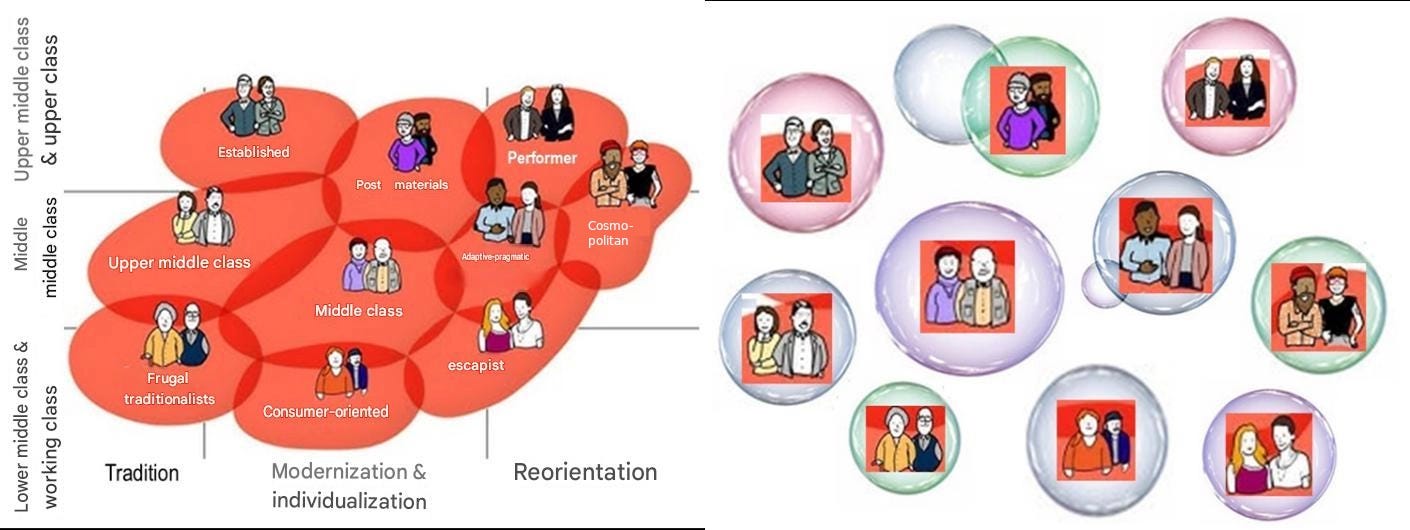
Such milieus, such everyday socio-cultures, do indeed tend to form bubbles. There is little permeability toward other life worlds. How difficult it is to create a welcoming structure that reaches people across the various milieus is something that clubs, associations, societies, and yes, even congregations, know all too well.
Should we therefore classify our congregation in this way?

II.
From its origin, congregation is completely different. I begin with the event of Pentecost. “Wait a minute!” I may hear someone object. “congregation existed long before that. You’re leaving out 1,200 years of Jewish tradition!” I know. But with regard to openness, the first Christian congregation really was a turning point, a change of era.
The Christian congregation began with an enormous challenge. Suddenly several thousand people from all milieus were together: poor and rich / merchants, craftsmen, farmers / elites: council members, scholars, priests / powerless widows and slaves, people with disabilities / native-born and newcomers — later Samaritans and so-called Gentiles, all in one pot, so to speak. No one had specifically recruited or invited them; they were simply there. And this was certainly not a group of people who ticked similarly.
Did they have anything in common at all? Yes, they actually did. They had all heard Peter’s sermon: In this Jesus of Nazareth, who until now has played no special role for you — on a spectrum ranging from “kindly noted” to “ignored” to “rejected” — in this Jesus you encounter God. And your attitude toward this Jesus unerringly reveals your true attitude towards God as well — likewise ranging from “kindly noted” to “ignored” to “rejected.” That went straight to their hearts. They were shaken, frightened by themselves, and at a loss. What are we supposed to do now? And they were willing to have their lives revalued, turned upside down, and to be aligned with God in and through this Jesus. The Bible calls that “repentance.” That was the first Christian congregation.
But even so, the people in it continued to think very differently. The Book of Acts tells us very honestly how conflicts soon arose, for example between the locals and the newcomers, or between the traditionalists who kept their distance from other peoples and those who had no such reservations; especially later, when Syrians, Greeks, and Romans actually joined them.
The congregation lived in a great field of tension, in the tension between
a shared experience, namely a personal encounter with God, a personal, life-changing experience of Christ on the one hand,
and, on the other hand, the still existing belonging to a particular milieu.
We here today are not several thousand people. But in this respect we still have something in common with that first congregation.
How did they manage to bear these tensions back then? How did they deal with their conflicts? The answer is: through love for one another. Jesus had repeatedly urged his disciples towards this especially. John 13:34–35. Love for one another — lived practically in awareness, respect, serving one another, listening to one another, bearing, comforting, sharing. That was more of a “welcome” than any program, however well prepared. People found that highly attractive. And every day new people joined.
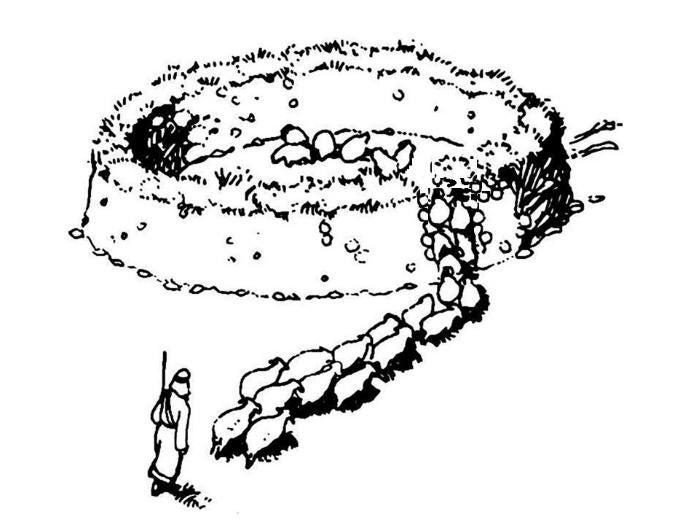
The reading covered the chapter about the sheepfold and the good shepherd. If we look at the image in this way, it presents a clear inside and outside.
It is easy to misunderstand the wall around the sheepfold as a boundary between the congregation and the surrounding world. Then the congregation would indeed be some kind of bubble. Much suffering has arisen in congregation history when the wall was misunderstood in this way. Why is that a false understanding? A few arguments:
The function of the wall is above all one thing: protection of the sheep during the night, not a boundary against other areas of life.
The idea of the wall as a boundary around a living space is nonsensical, because the sheep do not live inside the wall. They would very quickly starve there. They are led out every day. And even there, protection is guaranteed, namely through the shepherd’s presence.
In applying the image, Jesus promises the people who live under his guidance exactly what we sang earlier in Manfred Siebald’s song: security / freedom / orientation / meaning in life.
Then there is the matter of the door. Before Jesus says, “I am the good shepherd,” he says, “I am the door for the sheep.” A person who is also a door? Strange to us. But for his listeners at the time it was easy to understand. That is just how things worked in the shepherd’s trade back then.

By way of application: the boundary of the congregation is not rules, rites, memberships, or even orthodoxy. There is only one boundary, and that is a person, a door, a welcoming door. You can see in the Gospels how Jesus deals with people. Jesus Christ himself lays his hand on the individual man, the individual woman, and says, “Do you want to be mine? Then come!” That is a process that happens in complete freedom and then affects the whole of life (like marriage).
In that, the same shared initial experience is reflected that we already encountered in the very first congregation.
III.
I must, in closing, once again speak about the tension in which the congregation still lives today: there is, on the one hand, the shared experience of encountering Christ, and on the other hand belonging to very different milieus. How is this tension borne today? Just as it was then: through love for one another. John 13:34–35.
But now we must look very carefully. For if we understand this word about love for one another as merely a command addressed to us, then it becomes a demand without the means to fulfill it. We may fully agree with it, but we still do not manage to translate it into lived reality. After all, we still live entirely in our earthly dimension, sociologically, psychologically, ecologically; we are, quite literally, “in the world.”
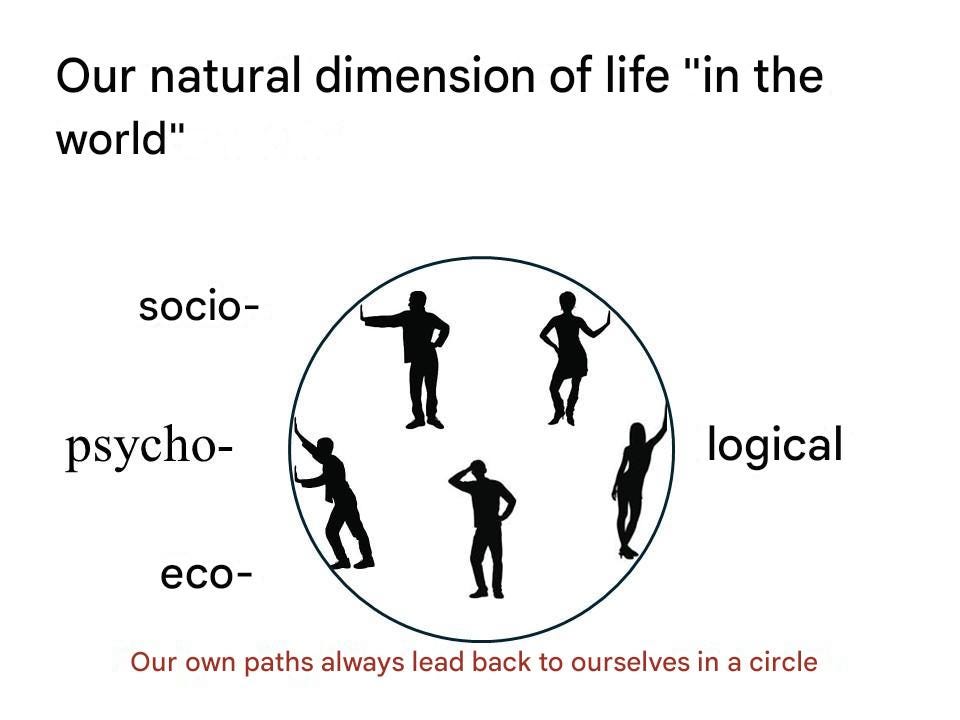
(Two-dimensional beings who know only the plane of paper cannot get out of their realm; for them the circle is a real, hard boundary.) Bonhoeffer put it like this: Our own paths always lead us in a circle back to ourselves.
If one can step out of the plane of paper, then leaving the circle is easy. So one needs a new dimension of life, and that can only be given to us. In the image of the two-dimensional beings: what is completely impossible in two dimensions becomes possible only when a new dimension is granted.
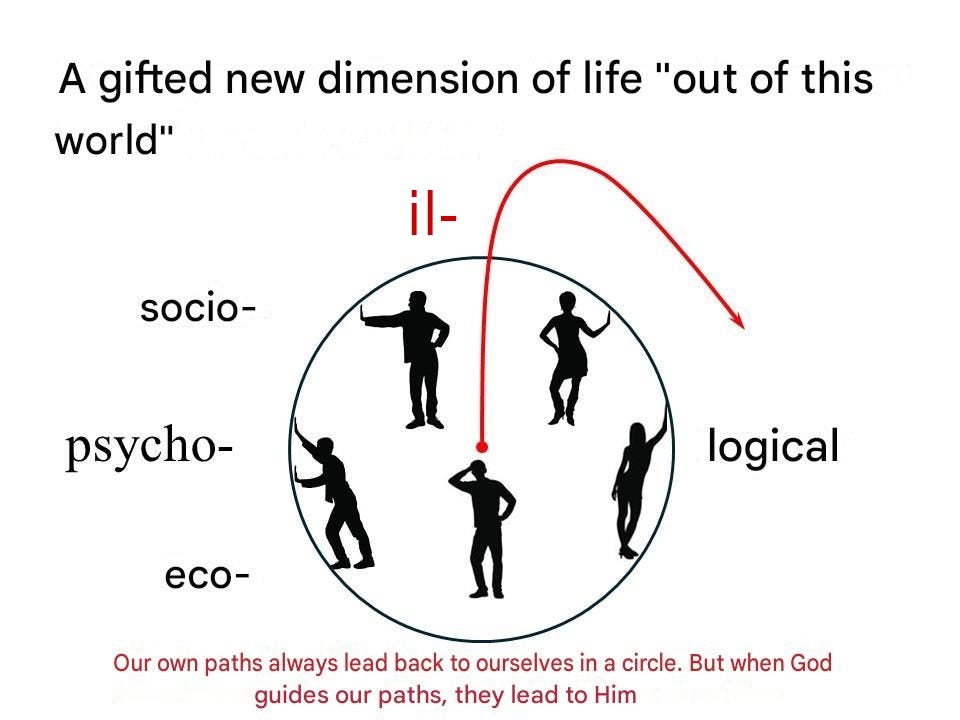
So do milieus, everyday socio-cultures, still matter in a real congregation? On the one hand: yes. We are still entirely in the world. And at the same time — perhaps quite illogically — no. We have been given a new dimension. We are no longer of the world, and that relativizes our milieu boundaries, both inwardly and outwardly.
The key is love for one another. I would like to quote a line from an old hymn. The hymn uses the language of 18th-century Pietism, and it may sound cheesy and sentimental to our modern ears. Nevertheless, I ask you to filter out the core message:
Heart and heart, united together
seek rest in God’s heart
Let the flames of your love
burn toward the Savior.
The core message is this: we are not primarily called to direct our love toward one another. It does not say, “Let the flames of your love burn toward one another.” It is almost a geometrical truth: the closer each one of us draws near to Jesus, the more we draw near to one another as well; the less our milieus, even our bubbles, matter; and love for one another happens as a consequence, without moral effort. The biblical expression for that is: fruit.
That is attractive. That makes people want to belong. And that is ultimately the effective access to the topic of openness and a welcoming culture in a congregation, which we must not lose sight of, despite all good programs.
Thanks for reading! This sermon isn’t mine btw. Subscribe for free to receive posts from me and perhaps more of these sermons.
Comments
Nothing yet. Say the first thing.
Sign in to join the conversation.