
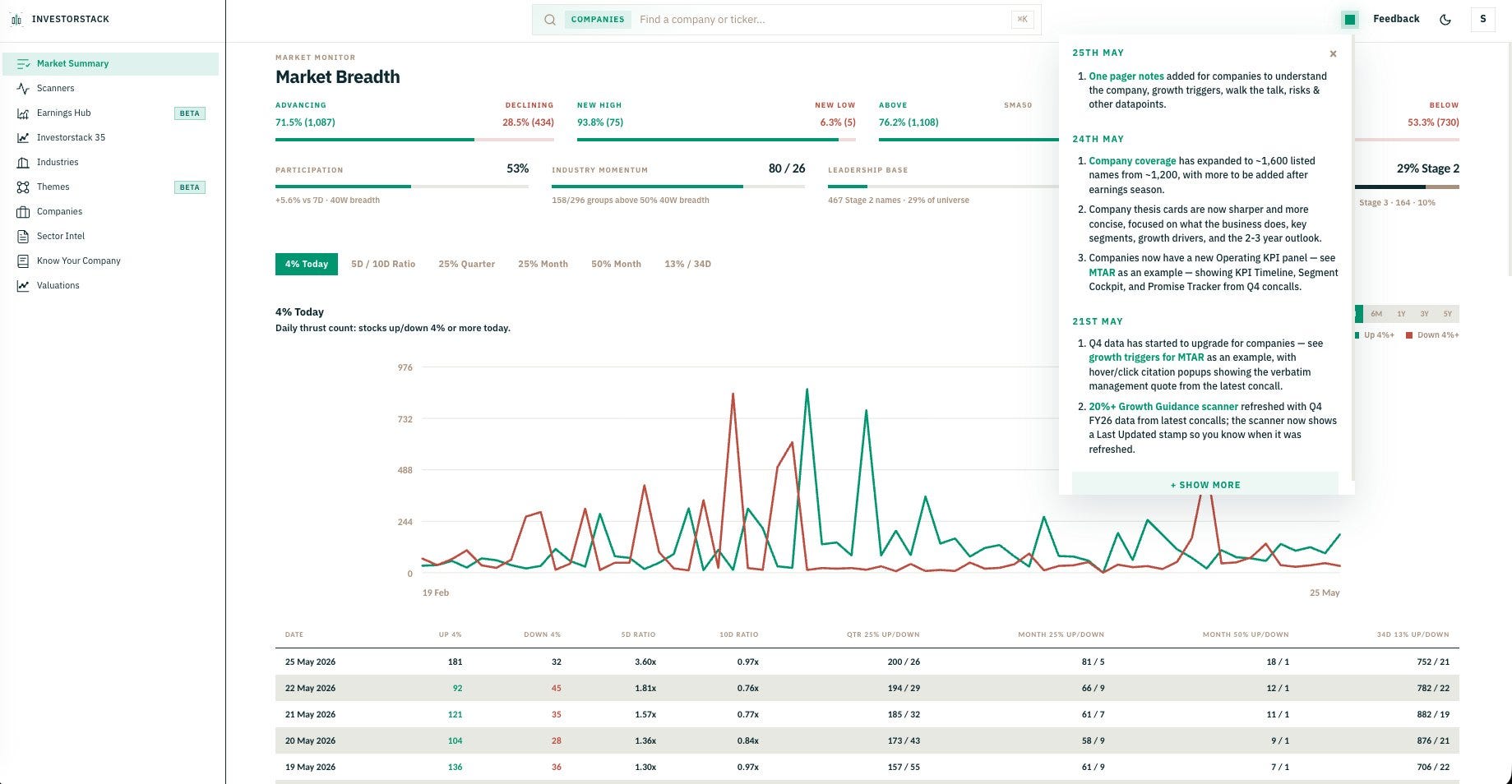
Before we begin, Investorstack is now 1 month old. Recap of what I launched this month & Roadmap:
Coverage universe expanded from 1000 to around 1650.
Themes tracker, Industry scans, Earnings hub
One pager, KPI dashboards, Capex tracker, Management consistency
Investorstack 35, Market Dashboard, Scanners
Valuation Models (Though they are still very bad & my priority to get them fixed & useful)
And many more features! Thanks for trying Investorstack out. For any feedback, reach out on Twitter.
Venus Pipes & Tubes Limited manufactures stainless steel pipes and tubes. The company was incorporated in 2015 and operates from a single integrated facility in Bhavnagar, Gujarat. It makes pipes and tubes across two broad categories - seamless and welded - and sells into oil and gas, power, petrochemical, pharmaceutical, food and beverage, chemical, and engineering sectors. It exports to more than 30 countries with Europe and the US as its two largest foreign markets.
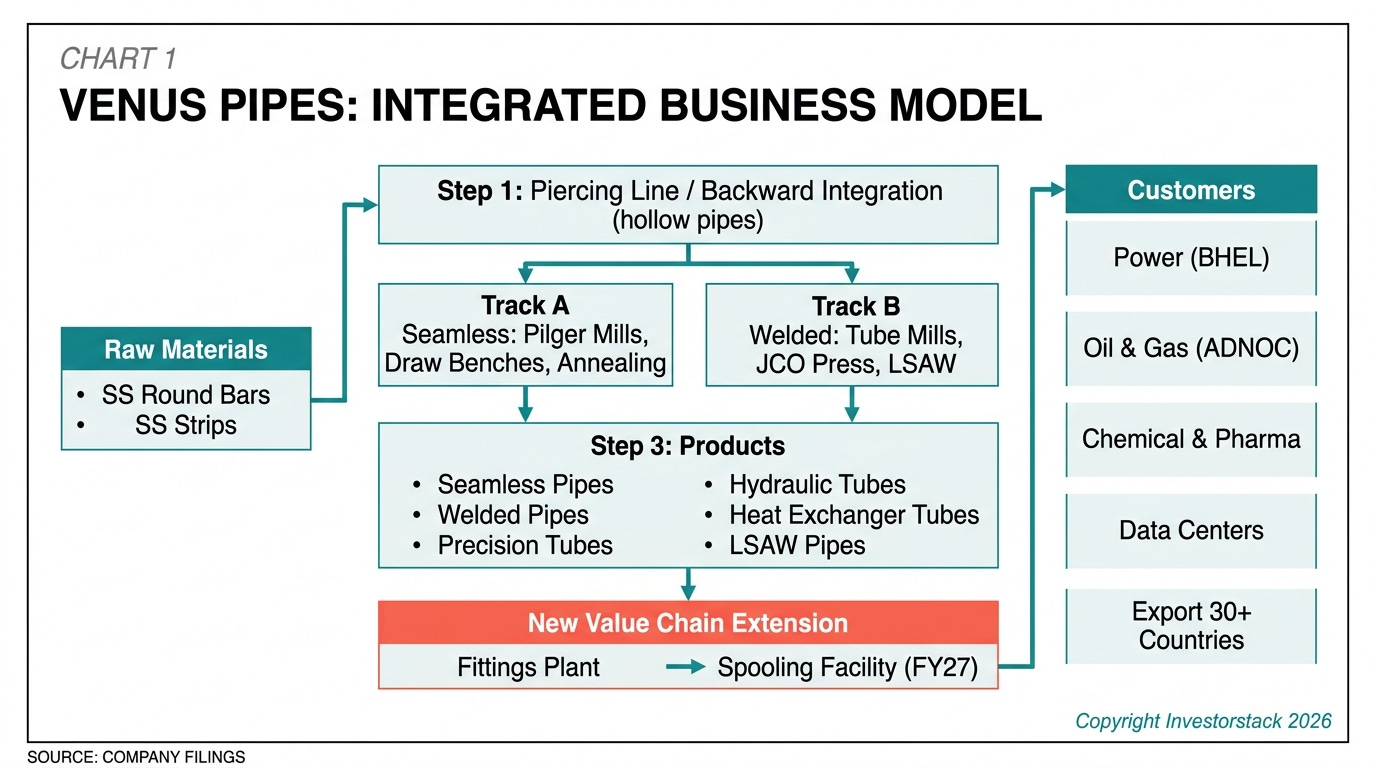
The business model is to buy stainless steel round bars, process them into hollow pipes (the backward integration), then roll or draw them into finished pipes and tubes. The “backward integration” piece matters more than it sounds. Most manufacturers buy mother hollow pipes from external suppliers, which exposes them to RM volatility and supply disruptions. Venus operates its own piercing line to convert solid SS round bars into hollow billets - making the company fully self-sufficient in raw material for seamless pipes. As of Q4 FY26, this backward integration capacity stands at 20,400 metric tons per annum, matching exactly the seamless pipe capacity.
The company’s founding thesis was to move up the value chain over time - starting as a welded pipe maker, adding seamless pipes, then adding high-precision and specialty tubes, then fittings, and now spooling solutions. Each step adds more technically demanding products, harder-to-win customer approvals, and higher margins. The FY26 commissioning of fittings and the LOI for a data center spooling facility mark the most recent step in this progression.
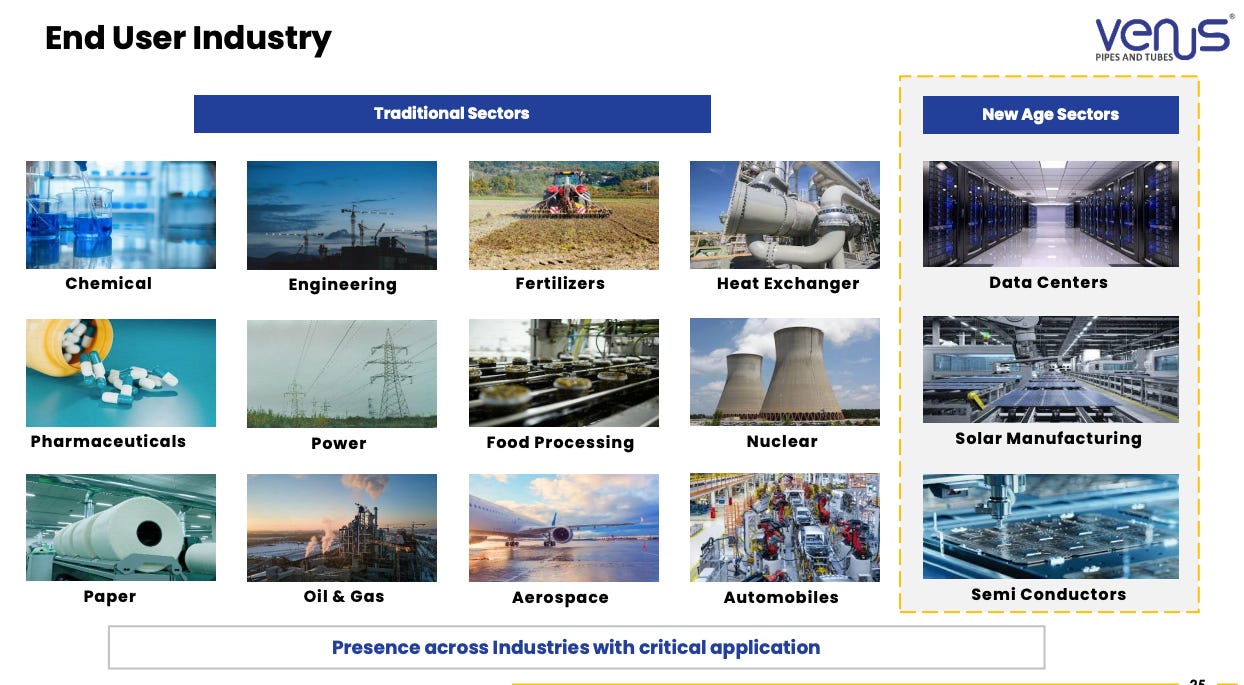
Venus is not a bulk commodity producer. Its products go into applications where contamination, corrosion, or dimensional imprecision cause operational failures - pharmaceutical clean rooms, high-pressure oil lines, nuclear condenser tubes, AI data center cooling loops. Customers who use stainless steel pipes in these settings do not switch suppliers easily because every new supplier must pass lengthy technical qualification processes.
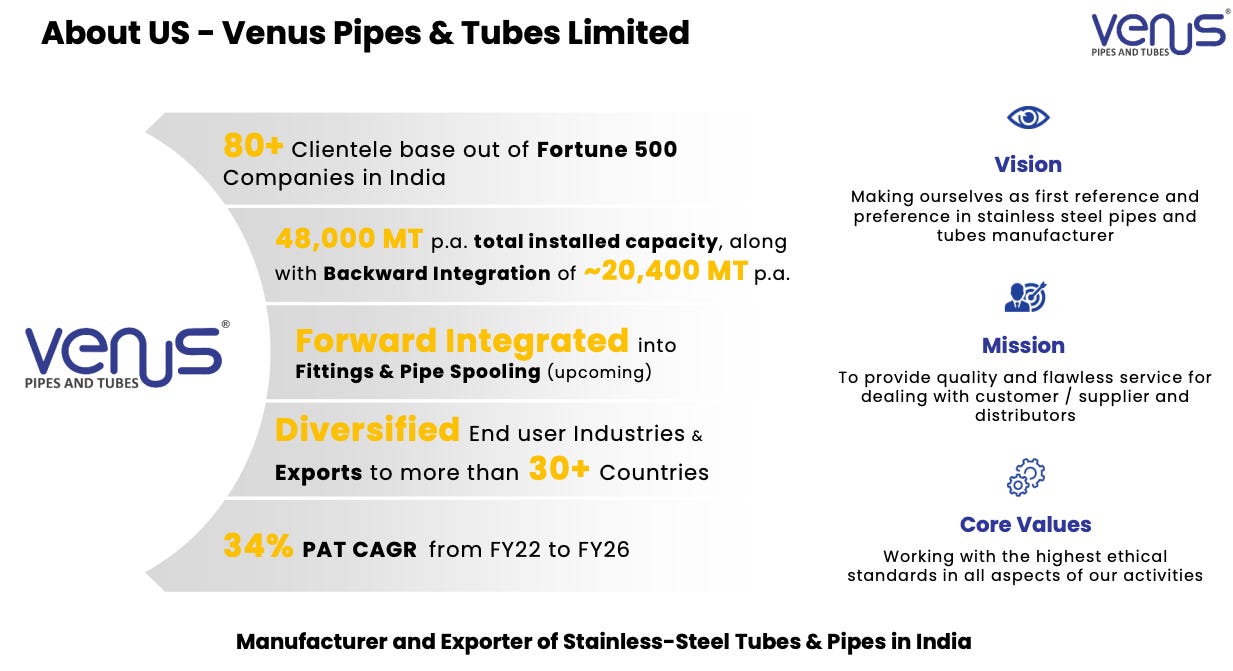
The company serves over 80 Fortune 500 companies in India, according to its website. Its domestic customer base spans large power equipment manufacturers (BHEL), oil and gas firms, and process industries. Its export customers sit primarily in Europe and the US.
Seamless pipes have no weld seam. They are made by piercing a solid billet into a hollow shell, then drawing or rolling it to the required diameter and thickness. The absence of a weld makes seamless pipes stronger under pressure and more suitable for high-temperature, high-pressure, or corrosive environments. This is the product that chemical plants, refineries, and high-pressure power boilers specify.
Venus entered seamless pipes as a deliberate strategic move to capture higher-value applications. The company installed a piercing line for backward integration - allowing it to make hollow shells from solid round bars rather than buying pre-pierced hollows. This gives Venus cost control and supply security that welded-only manufacturers do not have.
In FY26, seamless pipes contributed approximately 59% of quarterly revenue in Q4, and the segment ran at 90-95% capacity utilization through the year. This high utilization reflects the fact that Venus’s seamless capacity was fully absorbed by demand even before the new 4,200 MTPA expansion was commissioned on the day of the Q4 FY26 call. Total seamless capacity now stands at 20,400 MTPA, having grown from approximately 10,800 MTPA before the FY26 expansion cycle.
The seamless segment grew 18% in Q4 FY26 year-on-year in volume terms, and more than 15% for the full FY26.
Within seamless, Venus manufactures:
High precision and heat exchanger tubes (used in refineries, power plants, and process industries where precise wall thickness matters)
Hydraulic and instrumentation tubes (used in control systems, hydraulic lines, and measurement instruments)
Standard seamless pipes (oil and gas, chemical, structural)
Condenser tubes (power plant heat exchangers - new capacity started in late FY26, running at 25-30% utilization as of Q3 FY26)
The condenser tube capacity is particularly interesting because it broadens addressable applications into power generation equipment where qualification barriers are high and domestic competitors are few.
Welded pipes are formed by rolling flat stainless steel strip into a cylindrical shape and welding the seam. They are suited to lower-pressure applications, structural uses, and situations where cost matters more than pressure rating. They are generally cheaper to produce than seamless pipes.
Venus’s welded segment contributed 34% of Q4 FY26 revenue. The segment ran at 60-65% capacity utilization through FY26, lower than seamless. This headroom represents an opportunity - the welded business can grow without additional capex by simply filling the existing capacity.
Total installed welded capacity is 27,600 MTPA.
The company also added a tandem JCO press in FY26. JCO is a process for making large-diameter welded pipes through progressive bending. The new machine can make longer pipe lengths than the earlier JCO press. Kunal Bubna noted in the Q4 FY26 call: “only a limited number of players currently manufacture such products” - meaning Venus now qualifies for tenders that were previously closed to it because of the length specification.
Within welded, Venus makes:
Standard welded pipes (oil and gas, plumbing, structural)
LSAW (Longitudinally Submerged Arc Welded) pipes for large diameter applications
Box pipes
Value-added welded tubes (specialty alloys, tighter tolerances) - this sub-category runs at higher margins and was being expanded through FY26
Stainless steel fittings are the connecting hardware that goes between pipe lengths - elbows, tees, reducers, flanges, couplings. A complete piping system needs both pipes and fittings, and in critical applications the fittings must be made from the same grade and meet the same specifications as the pipes. Currently, customers who buy pipes from Venus have to source fittings elsewhere.
Venus commissioned its fittings plant in Q4 FY26. The investment in fittings was approximately INR 60 crores. Management guided an asset turn of 3x to 3.5x on this investment at maturity, implying a revenue potential of INR 180-210 crores from fittings alone at peak utilization.
The strategic logic is that a customer building a plant needs pipes and fittings from the same supplier to ensure compatibility, reduce procurement complexity, and meet quality standards. By adding fittings, Venus converts from a component supplier into a more complete solutions provider, deepens customer stickiness, and opens access to procurement contracts that require both pipes and fittings in a single order.
In FY27, management expected fittings to contribute roughly 50% of peak utilization. By FY28, it expects a “substantial portion” of capacity to be utilized.
Spooling is the factory pre-fabrication of pipe assemblies. Instead of assembling pipes and fittings on-site at a customer’s facility, a spooler takes individual pipes and fittings, welds them together with specific bends and connectors, and delivers pre-fabricated sub-assemblies that workers bolt together at the installation site.
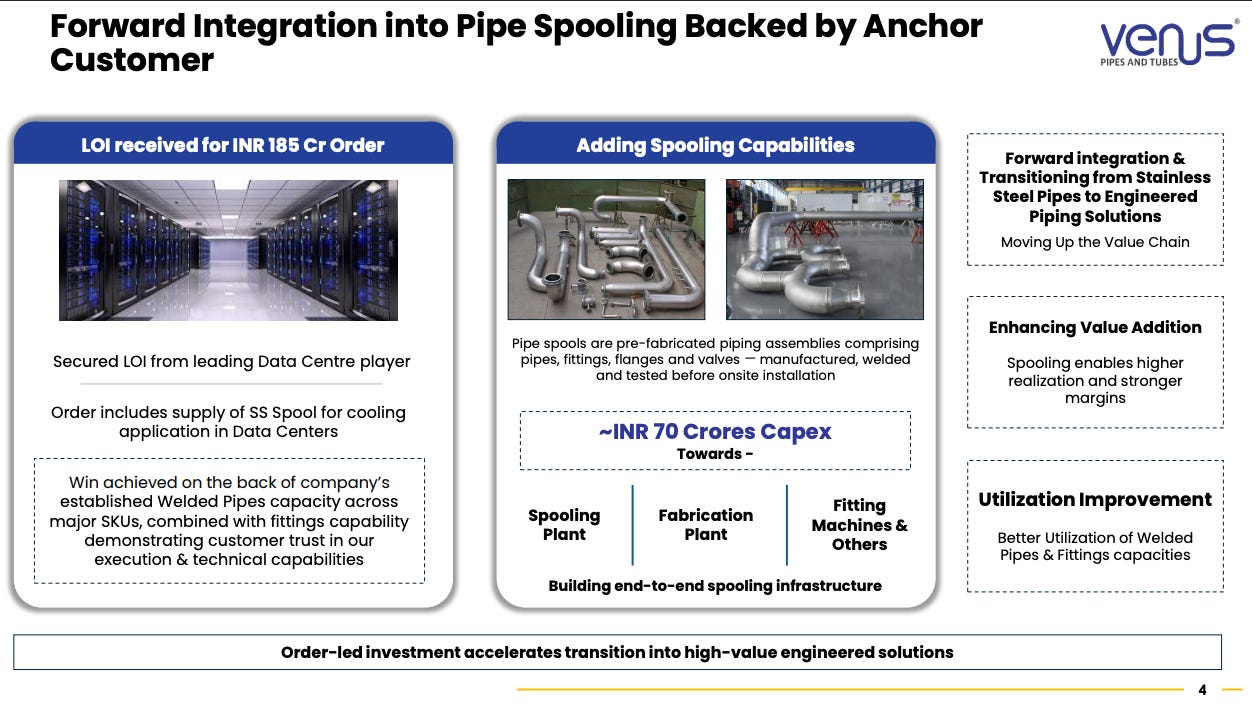
This matters for two reasons. First, on-site fabrication in critical environments (like a data center) is slow, creates contamination risk, and requires skilled workers at the job site. Factory spooling is faster, cleaner, and more consistent. Second, spooling commands substantially better margins than selling pipes and fittings individually because it is a service plus product combination.
Venus received a Letter of Intent worth INR 185 crores from a data center company for spooling solutions in FY26 - before it even had a spooling facility. The data center operator was interested in Venus because of its pipes and fittings capabilities, and gave the LOI on the basis of a commitment to build the facility. Venus is now investing INR 70 crores in a dedicated spooling and fabrication facility, targeting commissioning by December 2026 (trial runs by Q2 FY27, commercial production by mid-Q3 FY27).
Dhruv Patel described the application in the Q4 FY26 call: “cooling which circulates through a closed-loop network through the server and critical equipment... these fluid networks are increasingly being used in modern data centers, especially in AI and high-performance computing environments for advanced thermal management.”
The competitive position in spooling is noteworthy. Existing domestic spooling players are fabricators who do not make their own pipes or fittings. Venus is the first pipe manufacturer entering spooling, which means it controls the full material supply chain. Management made this explicit: “we are in a better position... everybody - data center operators will get timely delivery, timely execution.”
Asset turn guidance for spooling is approximately 3x, consistent with fittings. Management declined to confirm specific margin targets but acknowledged the question about Ratnamani’s nuclear spooling business running at 35% EBITDA margins by saying “it will depend on how things pan out.”
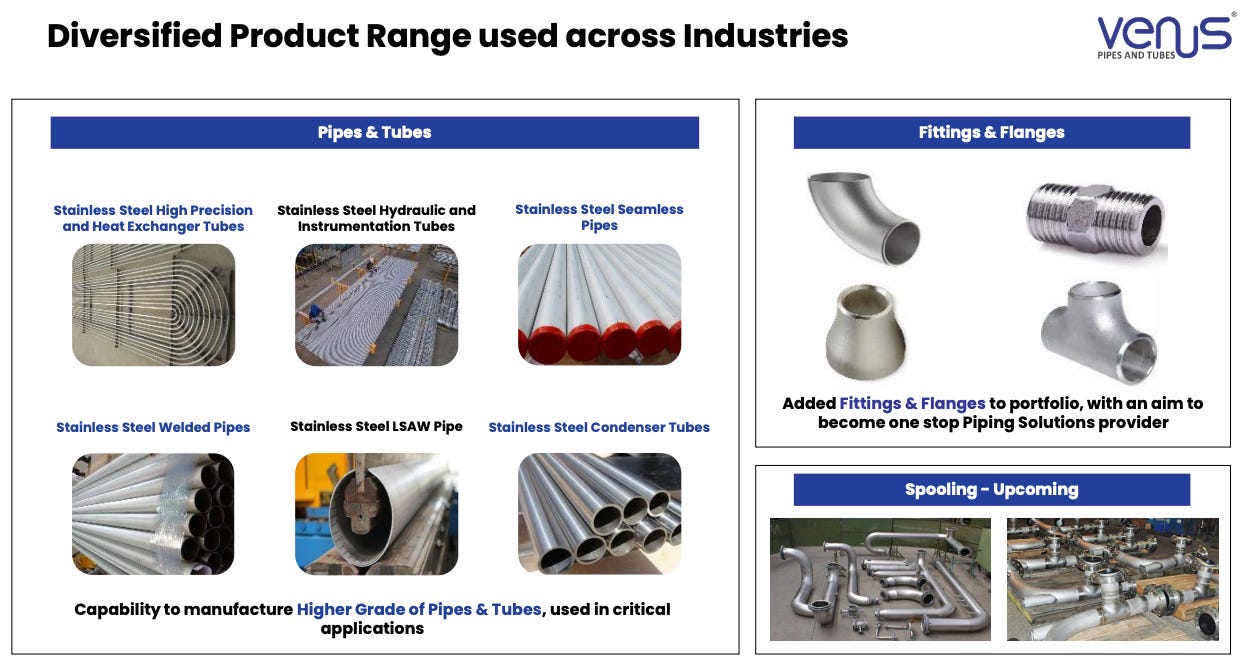
Product catalogue: Venus manufactures five primary product families:
Stainless steel high precision and heat exchanger tubes
Stainless steel hydraulic and instrumentation tubes
Stainless steel seamless pipes
Stainless steel welded pipes
Stainless steel LSAW pipes (large diameter welded)
And two new product additions in FY26: 6. Stainless steel fittings (elbows, tees, flanges, reducers) 7. Condenser tubes (a sub-category of seamless for power plant heat exchangers)
Grades: The company works in stainless steel grades including the standard 304/316 series, duplex stainless steels (for more corrosive environments), and higher alloys. The investor presentation mentioned “higher grades in welded pipes and tubes” as part of the FY26 expansion.
Sizes: 6 mm to 1422.4 mm - described on the company website as one of the widest size ranges in India.
Manufacturing facility: Single location in Bhavnagar, Gujarat. The facility has 40 production lines including Pilgers, Tube mills, JCO Forming Press, Draw benches, Annealing furnaces. The facility also has a fully-equipped in-house quality control lab.
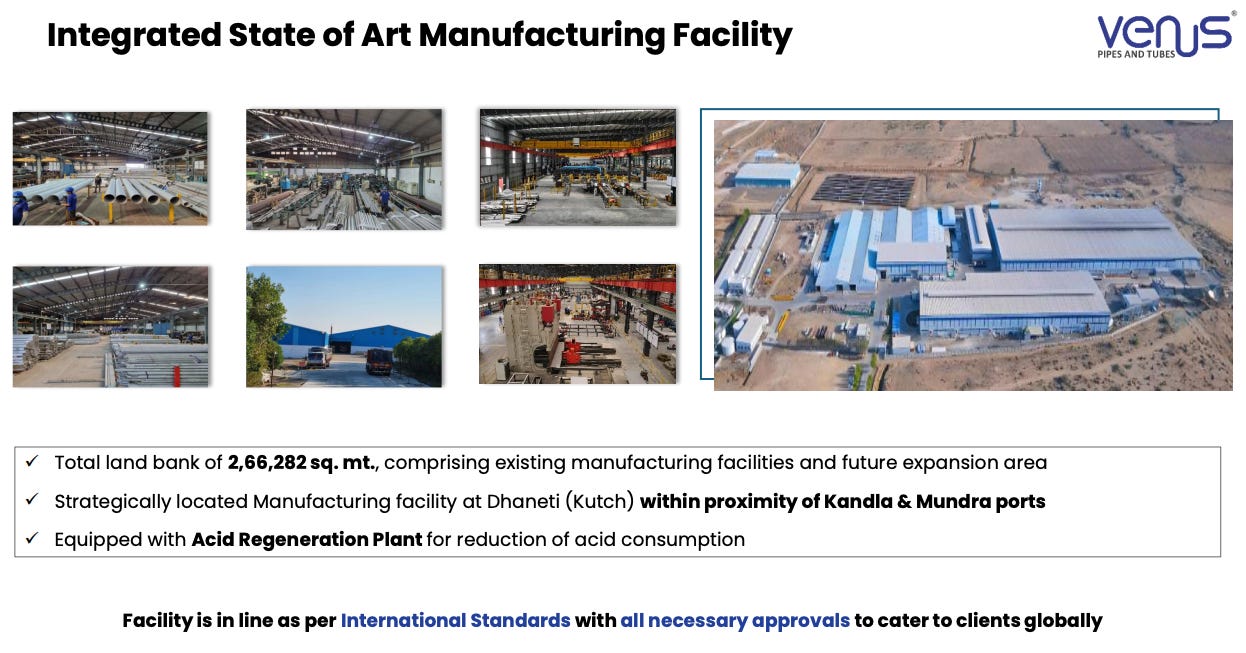
Total installed capacity post FY26 expansion:
Welded pipes and tubes: 27,600 MTPA
Seamless pipes and tubes: 20,400 MTPA (including 6,000 MTPA newly commissioned; the last 4,200 MTPA came online on the date of the Q4 FY26 call)
Backward integration (hollow pipe/piercing): 20,400 MTPA - making Venus 100% backward integrated for its seamless capacity
Fittings: capacity commissioned in Q4 FY26 (investment INR 60 crores; peak revenue potential INR 180-210 crores)
Total capex in FY26 cycle: “More than INR 200 crores” - covering seamless expansion, welded expansion, fittings, backward integration, and related infrastructure.
Additional land acquired: 15 acres adjacent to the existing facility in FY26, providing a platform for the spooling facility and future expansion.
Quality certifications: The company holds certifications for its products against international standards. Customers in oil and gas (ADNOC is cited as an existing approved customer), power, and chemical sectors typically require multi-year qualification processes before placing orders.
BHEL order: Venus won a large order (INR 190 crores) from a leading Indian integrated power plant equipment manufacturer (inferred to be BHEL from context) in early FY26. Less than 60% was executed by Q4 FY26, with the balance pending. New BHEL tenders worth INR 50 crores were at L1 (lowest bid) status as of the Q4 FY26 call, expected to convert in 30-45 days.
Venus sells to three distinct customer types, each with different buying behavior:
Industrial manufacturers (domestic): Companies like BHEL, steel manufacturers, chemical companies, and engineering firms who specify stainless steel pipes for plant construction and maintenance. These customers run competitive tenders and award multi-quarter orders. The qualification barrier is significant - Venus has been approved by ADNOC and other global names, which opens doors domestically. Arun Kothari noted in Q1 FY26 that the company does not publicly name most approvals it receives but confirmed ongoing receipt of them across oil and gas, chemical, and engineering sectors.
Export customers (EPC and industrial): In Europe (60-65% of export revenue), the US (15-20%), and the Middle East (currently suppressed by conflict). These customers buy through distributors or direct order, often against specific project requirements. The Section 232 tariff at 50% on stainless steel pipe imports to the US applies uniformly to all exporters - Venus is not disadvantaged relative to competitors in this market. The Q3 FY26 US trade deal (tariff certainty) was expected to revive US demand after a drop-off in Q2 and Q3 FY26.
Data center / new-age infrastructure: A single large data center LOI worth INR 185 crores represents the first customer in this category. The data center operator selected Venus not just for pipes but for its ability to supply both pipes and fittings and its commitment to build spooling capability. This is a direct relationship with the end data center owner, not an EPC contractor.
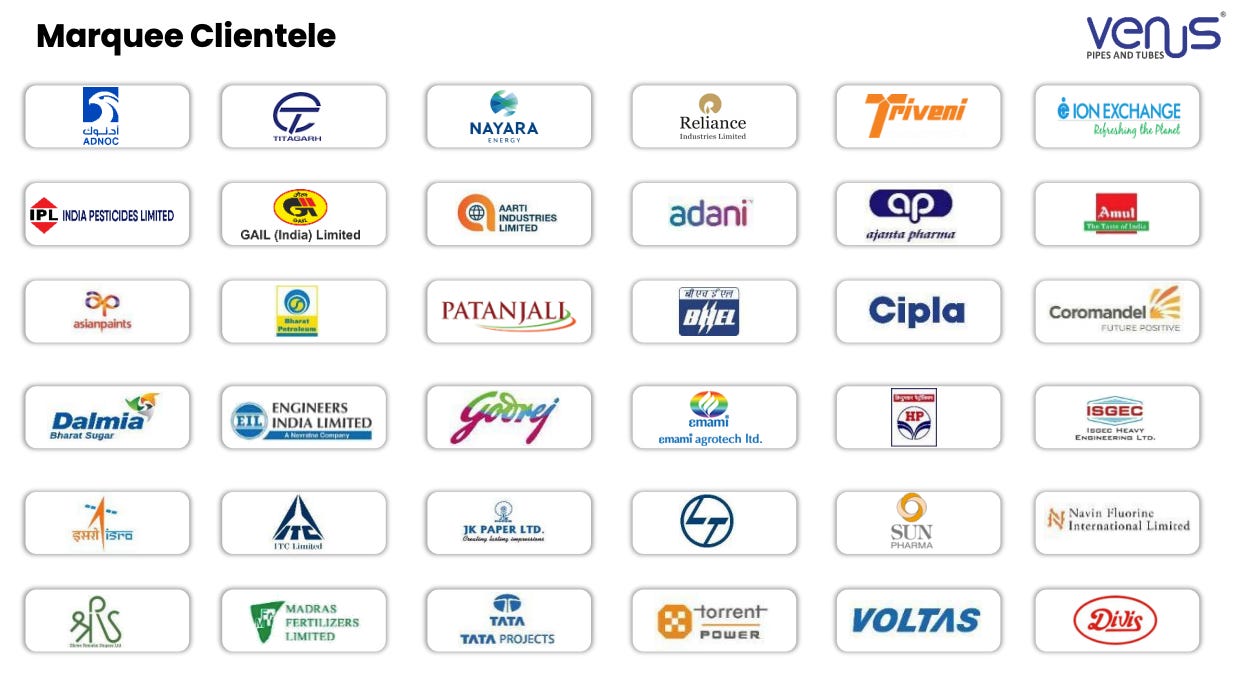
Customer concentration: With an order book of INR 450 crores plus the INR 185 crore LOI plus INR 50 crores at L1, the combined visibility is approximately INR 685 crores. The INR 185 crore data center LOI comes from a single customer, which is 20%+ of total visibility at this moment. Over the longer term, the company has served 80+ Fortune 500 companies in India and exports to 30+ countries, suggesting reasonable diversity in the pipe and tube business.
Switching costs: In critical applications (oil and gas, power, pharma), customers cannot easily switch suppliers without repeating the qualification process. This creates stickiness that shows up as multi-year supply relationships. The Q1 FY26 call mentioned ADNOC as an existing approved customer where “we keep on getting those approvals” - suggesting an ongoing supply relationship.
Contract structure: Orders in the pipe and tube business are project-linked, not recurring annuity contracts. The BHEL order is an example - a large order awarded against a power plant project, with staged delivery over multiple quarters. The data center LOI will convert to an order and execute over approximately 15 months per management guidance.
Domestic competitors: The stainless steel pipe and tube market in India has both organized and unorganized players. The organized players include:
Ratnamani Metals and Tubes - the largest organized player, with broader product range including carbon steel and specialty alloys. Ratnamani is also in spooling (nuclear focus).
Tubacex India, Sandvik, and other MNC subsidiaries - focused on very high-end specialty applications, less competition in Venus’s core market.
Smaller organized manufacturers at the regional level.
The unorganized segment is significant. In the Q2 FY26 call, Arun Kothari explicitly noted: “A significant portion of demand is still catered to by the unorganized sector and imports... This landscape is now changing with rising regulatory oversight and customers increasingly prioritizing quality.” This is a genuine structural tailwind - not just a talking point. Anti-dumping duties on Chinese imports have reduced the competitive pressure from the lowest-cost end.
Import competition: Historically, stainless steel pipes were imported from China, Taiwan, and Korea at prices that made domestic production difficult. Anti-dumping duties on Chinese seamless stainless steel pipes (which have been in place and were discussed favorably by management across multiple concalls) have reduced this pressure. The duty levels have made domestic high-quality production increasingly cost-competitive for customers who previously imported.
Venus’s competitive advantages:
Backward integration: Full backward integration for seamless pipes (piercing line + hollow production) protects margins when round bar prices fluctuate and ensures supply security. Most domestic competitors in the mid-tier are not backward integrated.
Customer approvals in critical sectors: Years of qualification work with global oil and gas majors, pharmaceutical companies, and power equipment manufacturers creates a defensible position. New entrants cannot replicate this without investing years in the approval process.
Product breadth: With welded, seamless, fittings, and now spooling, Venus is moving toward being a one-stop shop. This matters because customers running large projects prefer single-vendor procurement where quality standards are consistent.
Size range: 6 mm to 1422.4 mm is one of the widest size ranges in India. The large-diameter JCO press further extends this. This allows Venus to participate in tenders that specify unusual sizes.
Export track record: Having built export revenues to 30%+ of total revenue with customers in Europe, the US, and the Middle East provides a revenue base that is less correlated with domestic project cycles.
Barriers to entry for new competitors: New entrants face three barriers: (1) capital requirements - a meaningful seamless pipe facility with backward integration requires INR 200 crores+ in investment; (2) qualification time - getting approved by oil and gas majors or global chemical companies takes 2-5 years; (3) technical knowledge in product development for specialty applications like condenser tubes or instrumentation tubes. Venus has spent 10 years building these barriers.
Market size and structure: India’s stainless steel pipe and tube market is a subset of the broader SS pipes and tubes industry. According to the Q2 FY25 investor presentation, Venus’s domestic market share in seamless pipes was 8% in FY24 (up from 1.6% in FY20). The overall company market share was 6.2% in FY24 (up from 3.6% in FY20). This implies a domestic SS seamless pipe market of approximately 100,000+ MTPA, which at INR 500/kg SS prices implies a domestic market of INR 5,000-6,000 crores. Including welded, the addressable Indian market for organized SS pipe manufacturers is likely INR 10,000-15,000 crores. A significant portion of this is still served by imports and unorganized players.
Demand drivers:
Power sector capex: India’s power generation expansion - both thermal and renewable - requires stainless steel pipes for heat exchangers, boilers, and condenser tubes. Government capex target of INR 12.2 lakh crores in FY27 (per Arun Kothari in Q3 FY26 call) includes power sector allocation.
Oil and gas: Domestic refinery expansions and upstream projects drive demand for high-pressure SS pipes.
Chemical and pharmaceutical: Corrosion-resistant piping is mandatory in chemical plants and pharmaceutical manufacturing.
Data centers and semiconductor manufacturing: AI data center buildout requires stainless steel cooling infrastructure. This is a structural new demand source. Venus noted in Q4 FY26: “data center are creating demand for cooling and applications. Semiconductor manufacturing requires high-quality piping solutions for cooling systems.”
Shift from organized to organized sector: Tighter quality norms and anti-dumping protection are moving demand from unorganized players and Chinese imports to organized Indian manufacturers.
Steel sector capacity expansion: Management cited in Q4 FY26 that large Indian steel companies expanding capacity are increasingly specifying SS pipes over MS pipes for process lines: “most of the operations, they prefer to use the SS pipe for the longer life of their plant.”
Import dynamics: Anti-dumping duties on Chinese seamless stainless steel pipes have been a consistent positive for domestic producers. In the Q2 FY26 call, management noted these duties were “supporting domestic high-quality manufacturing.” The Section 232 tariff in the US (50%) makes US exports challenging but applies uniformly to all exporters, so Venus is not competitively disadvantaged.
Cyclicality: The business has moderate cyclicality. Project-linked demand from power, oil and gas, and chemical capex is lumpy - Venus received a single INR 190 crore power sector order in FY26 that added significant order book. Export demand has been disrupted by Middle East conflict and US tariff uncertainty in FY26. However, the diversity of end markets across sectors and geographies provides some stabilization.
Regulation: Quality standards for stainless steel pipes in critical applications are enforced through customer qualification requirements rather than government regulation. Anti-dumping duties on imports are the key regulatory variable - these have favored domestic producers.
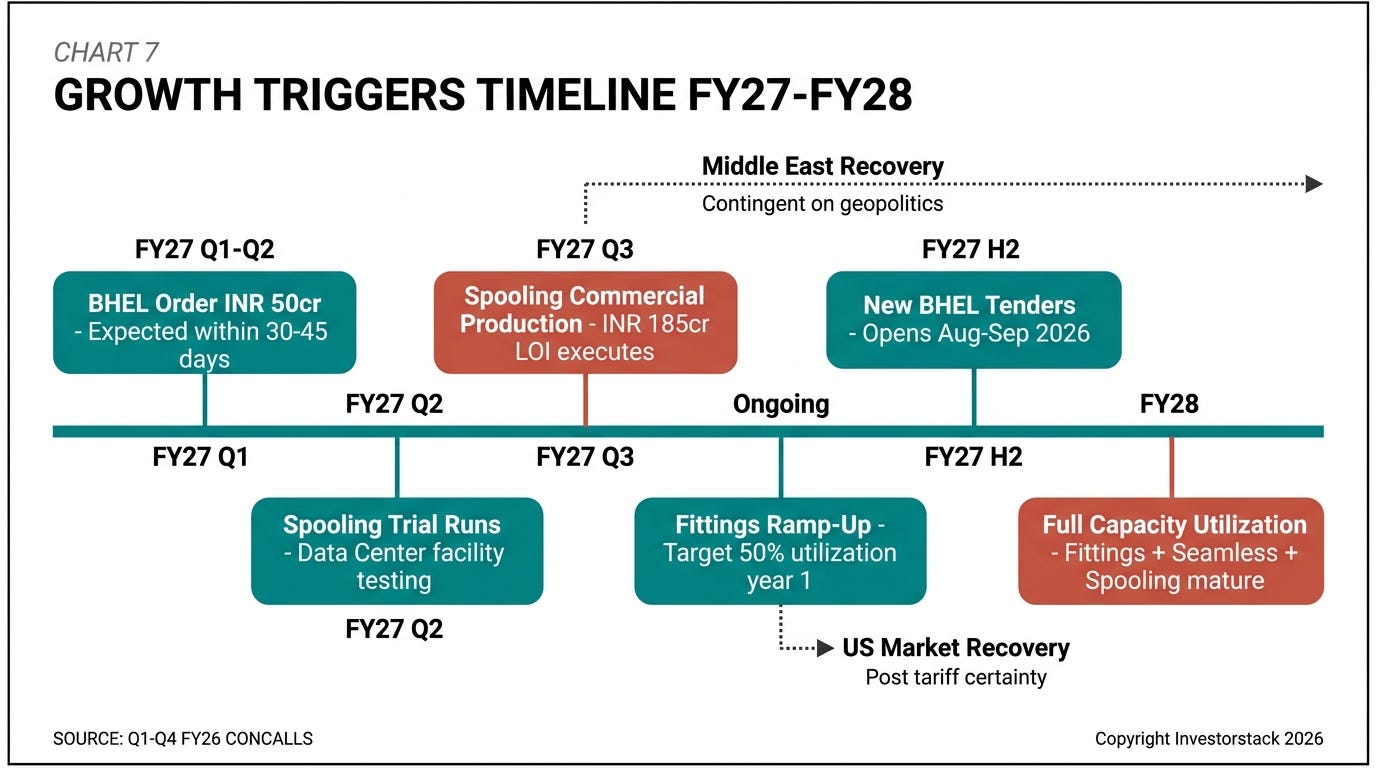
Spooling facility commissioning for data center application: 185 crore LOI received from a data center company. Facility to be commissioned by December 2026. Trial runs expected in Q2 FY27, commercial production from mid-Q3 FY27 onwards. INR 70 crore investment with guided asset turn of approximately 3x. Management in Q4 FY26 call stated: “We are first who will do like this - created this facility in particularly in stainless steel pipe industry, who is providing this solution to clients.”
Fittings capacity ramp-up: Fittings plant commissioned Q4 FY26. Management guidance of 50% utilization in FY27, scaling to substantial utilization in FY28. Peak revenue potential of INR 180-210 crores. In Q3 FY26 call, Kunal Bubna guided: “the investment is roughly in the range of INR 60-odd crores in our fitting business, and we can see an asset turn of around 3x to 3.5x.”
Seamless capacity ramp-up: 6,000 MTPA of new seamless capacity was added in FY26 (1,800 MTPA in November 2025, 4,200 MTPA on the date of Q4 FY26 call). At 80%+ utilization in FY27 (as guided by management), this capacity generates meaningful incremental revenue. Management in Q3 FY26 stated “seamless total would be roughly between INR220 to INR250 odd crores” at 80% utilization.
BHEL and power sector orders: INR 50 crores at L1 status as of Q4 FY26 call, expected to convert within 30-45 days. New BHEL tenders opening August-September 2026 (Q2 FY27). Arun Kothari in Q4 FY26: “we are already L1 in some of the tender, which we’re about to get order in the next 1 or 1.5 months, almost more than INR 50 crores order we’re L1.”
Middle East demand recovery: Middle East export orders disrupted by conflict in FY26. Venus has approvals with Saudi Aramco and ADNOC. When conflict eases, management expects meaningful order flow. Arun Kothari in Q4 FY26: “a lot of inquiries pending from Middle East market... Once this Middle East market will open, a lot of inquiries pending.”
US market recovery post tariff clarity: Section 232 tariff uncertainty suppressed Venus’s US export volumes in Q2 and Q3 FY26. The tariff deal in early 2026 provided certainty. Kunal Bubna in Q3 FY26: “that ease has been done in the recent 2-3 days back. So I think as a pipe perspective, we should see order from USA also coming forward in coming quarters.”
New approvals from oil and gas and chemical companies: Management noted in Q4 FY26 that approvals had been received from “global oil and gas companies, a few from sewage treatment plant, a few approvals from chemical companies” in the last few quarters. Each new approval opens a new revenue stream.
Data centers, semiconductors, CNG/PNG as new demand vectors: Management cited data centers, semiconductor fabs, and CNG/PNG infrastructure as entirely new demand pools in Q4 FY26: “we, as a company, also exploring CNG/PNG sector where there can be a good demand for our products.”
JCO press for longer pipes: Tandem JCO press commissioned in FY26 enables manufacturing of longer pipe lengths - a specification required by certain tenders. Kunal Bubna in Q4 FY26: “it gives a competitive edge where very few in the country manufacture those lengths... it will help us to qualify for many of the tenders where we are currently not able to.”
Raw material price volatility: Stainless steel round bars and strips are the primary input. Their prices are driven by nickel, chromium, and iron ore prices, which fluctuate with global commodity cycles. While backward integration insulates Venus from hollow pipe supply disruption, it does not hedge nickel price risk.
Middle East geopolitical exposure: Historically a meaningful export market, the Middle East contribution dropped sharply in Q4 FY26 due to conflict. If conflict persists or escalates, this revenue stream remains suppressed. Management’s optimism about recovery is contingent on external factors beyond their control.
Customer concentration in spooling: The entire INR 185 crore LOI is from a single data center. This is a new business, a new customer type, and a new product form. If this customer delays, reduces the scope, or cancels, the entire spooling segment economics change. Venus has committed INR 70 crores in capex based substantially on this single customer.
Execution risk in new segments: Three new businesses (fittings, spooling, condenser tubes) are all ramping simultaneously. Each has its own learning curve, approval process, and operational challenge. Running all three in parallel while executing the base business growth strains management bandwidth and increases the probability of at least one execution disappointment.
Export market structural risk (Section 232 and protectionism): The US Section 232 tariff at 50% is a permanent feature. It limits Venus’s pricing power in the US market. If the EU introduces similar protective measures or if Venus’s key European customers face recession-driven demand slowdown, the export segment - which is 30%+ of revenue - contracts.
Condenser tube ramp-up uncertainty: As of Q3 FY26, condenser tube capacity was running at only 25-30% utilization while waiting for power sector approvals. If approvals take longer than expected or if power sector tenders are delayed, this capacity remains underutilized and the fittings and value-added welded complex (collectively guided at INR 350 crore revenue potential) takes longer to reach its potential.
3/5. Management delivers on capacity expansions but faces delays in value-added projects
Management successfully executed on seamless/welded capacity expansions and backward integration, but value-added product capex (fittings, titanium tubes) remains delayed. Export growth outperformed guidance, while BHPL order execution is on track.
The critical assumptions that need to hold for the bull case are: fittings ramps to 70%+ utilization in FY27, the data center spooling order converts to full commercial production by Q3 FY27, BHEL and power sector orders continue flowing, and Middle East demand recovers in FY27.
In this scenario, FY27 becomes the year that all of Venus’s capex investments from the past 24 months begin generating returns simultaneously. The seamless business runs near 90% utilization. The 60-65% welded utilization ticks up as new SKUs from the JCO press and value-added tubes add volumes. Fittings adds incremental revenue that did not exist in FY26. The spooling facility - the first of its kind in Indian stainless steel - wins follow-on orders from the same data center customer and from other data center operators who are evaluating domestic supply chains for their cooling infrastructure.
The data center and semiconductor pipe opportunity is genuinely large. If Venus captures even a fraction of the procurement for the wave of data centers being built across India, the spooling segment grows from a single LOI into a repeating revenue stream with margins substantially above the base business. Arun Kothari’s positioning in Q4 FY26 - “we are first who will do like this - created this facility in particularly in stainless steel pipe industry” - suggests first-mover advantage in a segment where relationships and trust matter.
In the bull case, EBITDA margins move from 16.3% in FY26 toward 17.5%+ in FY27 as fittings (higher margin product) increases mix, and the operating leverage from higher utilization drops to the bottom line. The PAT which has been flat in the INR 25-26 crore quarterly range breaks out as depreciation and interest costs are now absorbed against a materially larger revenue base.
Venus executes FY27 broadly in line with management’s stated guidance: 20%+ revenue growth, EBITDA margins improving modestly from 16.3% to the 16.5-17% range, and PAT growth resuming after the FY26 capex absorption.
Fittings ramps more slowly than in the bull case - perhaps 40-50% utilization in FY27 as customers go through qualification. The data center LOI converts to a formal order but commercial deliveries begin only in Q4 FY27 rather than mid-Q3, pushing most spooling revenue into FY28. The BHEL pipeline delivers INR 50 crore of new orders in H1 FY27 with more tenders in H2.
Middle East remains partially closed with some recovery as geopolitical conditions ease. Europe holds steady. US exports recover modestly after tariff certainty. Domestic demand - power, oil and gas, chemical - continues to grow at 15-20% supported by the government capex cycle.
In this scenario, Venus exits FY27 as a business that has successfully transitioned from a two-product company (welded and seamless) to a four-product company (adding fittings and spooling), with the growth engine intact and the margin trajectory credible even if not yet fully realized. The company is larger, better positioned, and carrying a stronger order book into FY28 when the full benefit of all new capacities should be visible.
The bear case does not require catastrophe. It requires only that several things go modestly wrong at once.
Middle East conflict continues through FY27, suppressing 8-10% of the historical export base. The data center LOI does not convert to a formal order on schedule, pushing the spooling facility commissioning investment into a cash drag without corresponding revenue. Raw material prices (nickel in particular) stay elevated or rise further, compressing margins even as revenues grow. The BHEL tenders open on schedule but Venus wins fewer than expected because domestic competitors have sharpened their bids.
In the bear case, revenue grows at 12-15% rather than 20%+. Margins stay at 16% as operating leverage is offset by RM and energy cost pressure. PAT growth remains modest. The spooling capex - INR 70 crores - generates no revenue in FY27 and only partial revenue in FY28. Fittings utilization reaches only 30-35% in FY27.
The deeper bear case concern is not operational failure but working capital strain. If Venus is growing revenue at 15%+ while simultaneously deploying INR 90-100 crores in capex (FY27 guided level) and carrying 120 days of working capital, the cash conversion cycle tightens. Any slowdown in customer payments - particularly if the data center project delays - would force Venus to increase borrowings at what management acknowledged are relatively high interest rates, further suppressing PAT. The CFO conversion of EBITDA to cash was 59% in FY26 - decent but leaving 41% trapped in working capital, a drag that must be managed carefully as the business scales into new, unfamiliar segments.
Thanks for reading! Do check out Investorstack.
No posts
Comments
Nothing yet. Say the first thing.
Sign in to join the conversation.