
Before we begin, Check our Investorstack - Your one stop destination to become a better investor. Here’s Everything we shipped this week:
Thematic baskets like data center proxies, CMDO, GLP-1s
New scanners including RSI breakout, VCP
Investorstack 35 (caught many stocks early using this scan)
Walk the talk analysis using past 3 years of concalls
Capex Tracker for all companies
Updated market dashboard with multiple data points & so much more!
HFCL is a 30 year old telecom infrastructure company that manufactures equipment, builds networks, and integrates systems for telecom operators, enterprises, and defense forces. The company operates three interconnected businesses: making telecom gear (Wi-Fi, wireless backhaul, optical fiber cable), building out physical networks, and system integration. Together, these form a complete stack - HFCL supplies the hardware, installs the networks, and makes sure everything works end-to-end.
The core problem HFCL solves is this: telecom operators and enterprises need reliable, high-speed networks built fast, but they don’t have the internal expertise or capacity to do it alone. HFCL shows up with proven products, skilled installers, and project management to execute. For defense forces, HFCL solves a more specific problem - secure, ruggedized communication networks that can survive harsh conditions and can’t depend on commercial supply chains. This defense angle matters more now than it did five years ago because India’s defense modernization is accelerating.
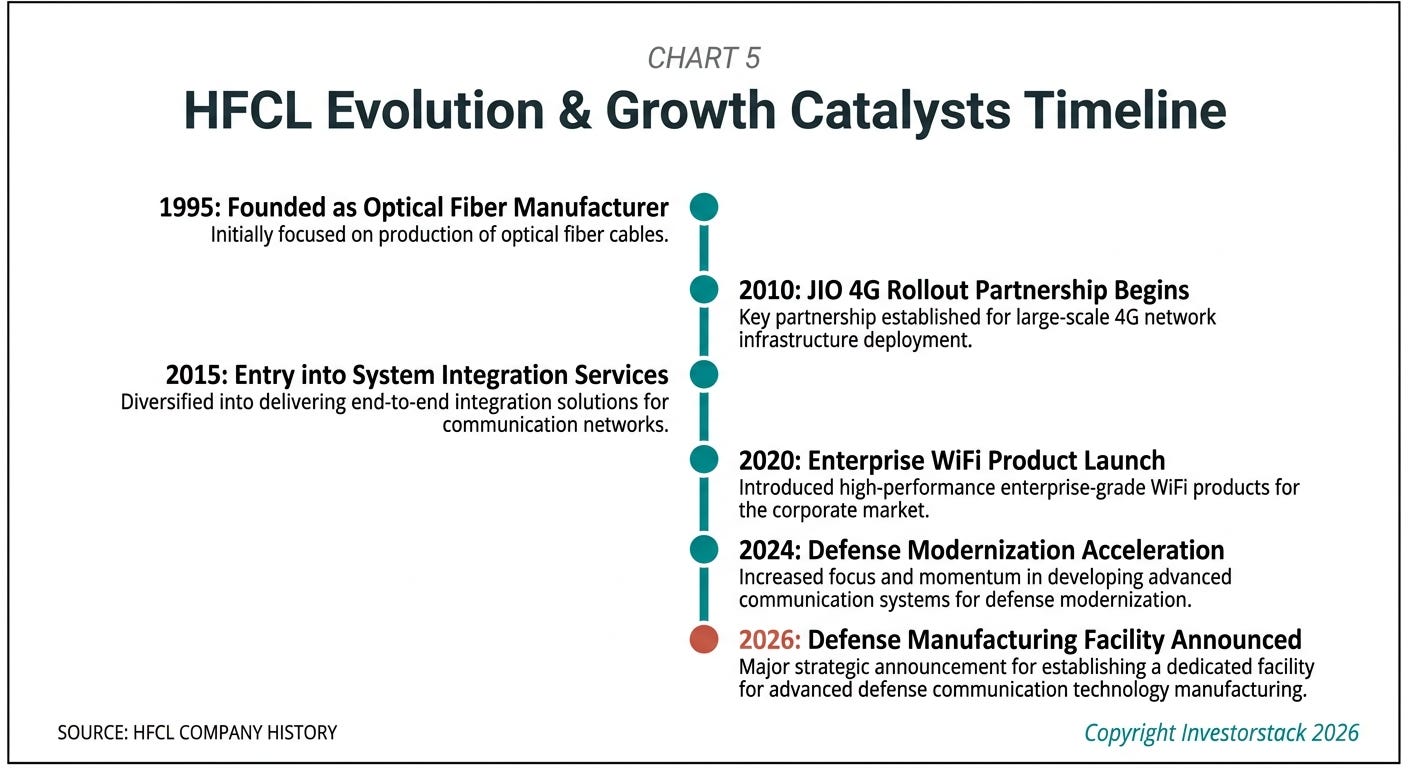
The company started as an optical fiber manufacturer and evolved into a full-stack telecom services player. Today’s revenue mix (as of FY26) is roughly 59% telecom products, with the remainder split between system integration and infrastructure development. What this split reveals is that HFCL is no longer purely a manufacturing company - it’s a services and solutions player that happens to make the hardware too.
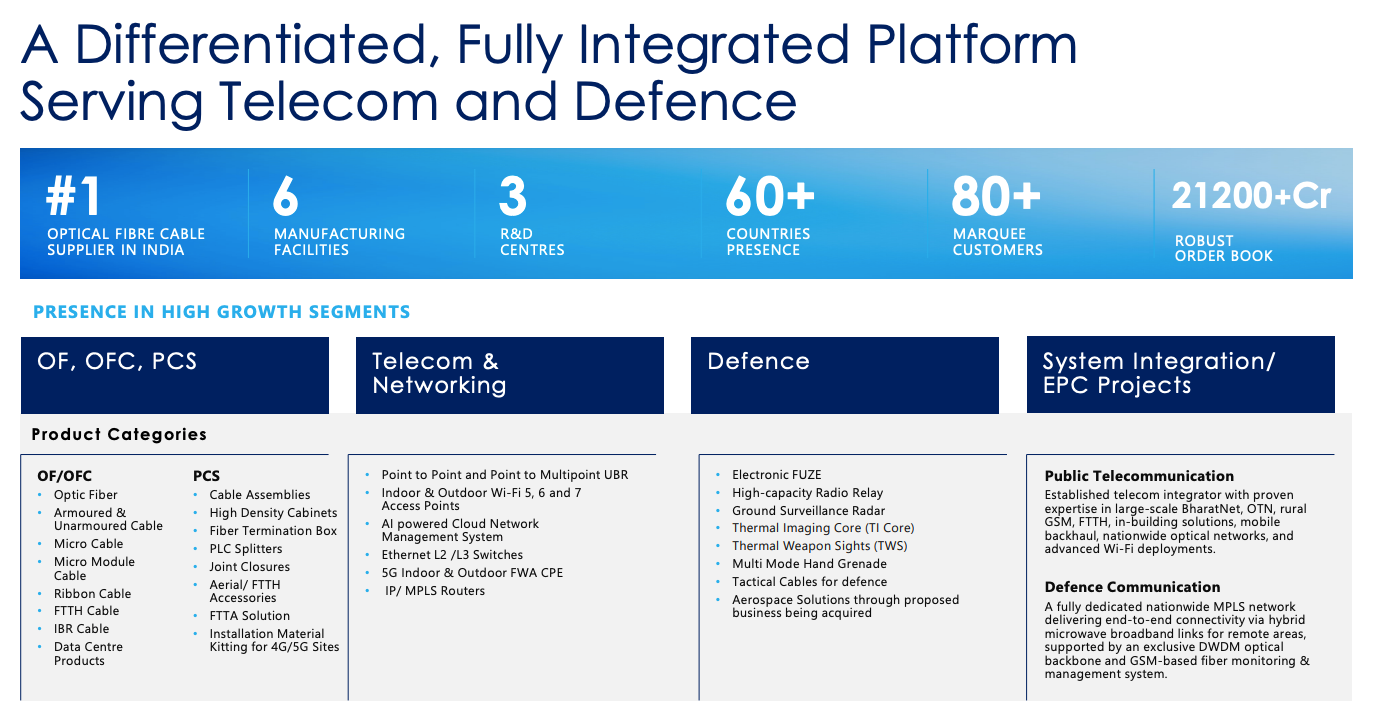
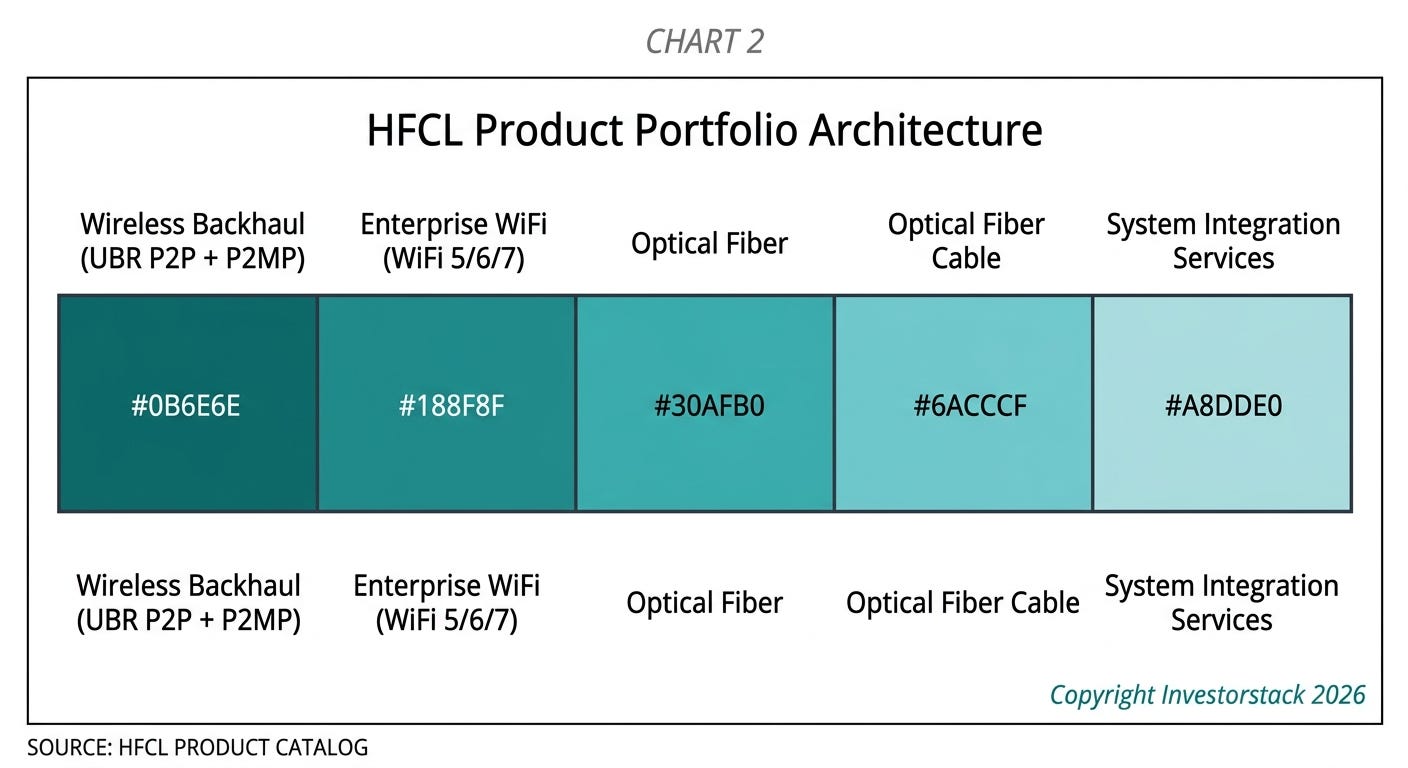
This segment manufactures the physical equipment HFCL sells. The product range breaks into three categories: wireless backhaul, enterprise networking, and optical fiber infrastructure.
Wireless backhaul is the backbone carrying data between cell towers. HFCL makes two types here: Point-to-Point (P2P) solutions that send data from tower A to tower B in a straight line, and Point-to-Multipoint (PTMP) solutions that send data from one tower to many others simultaneously. These use unlicensed spectrum radio technology - a critical detail because operators don’t have to bid for spectrum licenses. The business logic here is simple: spectrum scarcity makes licensed 4G/5G backhaul expensive. Unlicensed band solutions offer operators a cheaper alternative for last-mile connectivity and cluster backhaul. HFCL positions these as the “superfabric” of networks - the glue holding everything together.
Enterprise Wi-Fi is the second category. HFCL makes indoor and outdoor Wi-Fi 5, Wi-Fi 6, and Wi-Fi 7 access points. These compete directly against companies like Ubiquiti, Meraki (Cisco), and Ruckus. HFCL’s positioning here is around manufacturing in India and integration with telecom operator networks. For large deployments (universities, hotels, metro systems), HFCL bundles hardware plus installation and optimization. The technology itself isn’t differentiated from global players, but supply chain control (Made in India) and direct access to telecom operators (existing sales channels) is.
Optical fiber and optical fiber cable is the legacy business. HFCL manufactures fiber (the glass strand itself) and makes it into cable (fiber bundled with protection and armor). This is a commodity business with high capital intensity and economies of scale. HFCL faces direct competition from global suppliers (Corning, Prysmian) and smaller Indian players. Margins compress as volumes grow because customers can demand price concessions. What saves this segment from being pure commoditization is custom cable designs for specific applications (submarine cables, armored cables for harsh environments) and the fact that fiber is critical to every network expansion project. As India’s telecom ops expand 5G and fiber-to-home (FTTH), demand for cable remains steady.
The telecom products segment as a whole has favorable unit economics for orders above a certain size, but suffers from pricing pressure in a competitive market. Gross margins likely range 30-40% on wireless products and 20-30% on commodity fiber cable. The segment’s strength is in order visibility - when a telecom operator commits to a 5G rollout, HFCL’s revenue is predictable for 2-3 years. As of Q4 FY26, HFCL had a 7,685 crore order book, most of it in this segment.
This segment is where HFCL shifts from supplier to contractor. When Jio (Reliance Industries’ telecom arm) needs to build out backhaul in a new region or a defense ministry wants to upgrade communication networks, HFCL doesn’t just supply equipment - it executes the full project. This includes site surveys, equipment installation, fiber laying, network commissioning, and ongoing maintenance.
Why is this valuable? Because operators prefer a single contractor who handles everything rather than managing multiple vendors. One point of accountability matters when you’re commissioning a network with 10,000 cell towers or running a defense mission-critical system. HFCL has been doing 4G rollout execution since 2010 and built defense networks for the Indian Armed Forces. This history creates switching costs - the operator knows HFCL’s processes, has trained personnel who speak HFCL’s language, and moving to a new contractor means retraining and re-proving execution capability.
The service margins are higher than product margins (likely 15-20% net margin vs 8-12% for products) but the capital and people requirements are heavier. You can’t scale infrastructure services as quickly as you can scale product manufacturing. Yet the segment is strategically important because it locks in customers, creates long-term relationships, and provides a reason for customers to buy products from the same vendor (lower integration risk).
HFCL is specifically building out a defense manufacturing capability (approved by the board in April 2026) to deepen the moat here. Defense orders often come with “Make in India” requirements and can’t be sourced from commercial supply chains. A dedicated facility signals seriousness and may unlock larger orders from the Ministry of Defense and Defense PSU contractors.
This could be called a sub-segment or its own line of business depending on how you look at it. HFCL manufactures fiber itself (optical fiber as a raw material), makes it into cable, and sometimes lays and operates fiber networks for operators. The raw materials side is capital-heavy - you need furnaces, precision equipment, and proprietary manufacturing know-how to draw fiber to exact specifications. The cable side is more labor-intensive but less capital-heavy. The network operations side is a services play - HFCL owns or operates fiber networks and sells capacity to operators.
This segment is strategic for India because the government is pushing fiber-to-home (FTTH) under the Bharat Net program. The government wants universal broadband, which requires massive fiber infrastructure. HFCL has existing fiber manufacturing capacity and can win government contracts for cable supply. It’s also been involved in Bharat connectivity projects (mentioned in case studies on the website).
The fiber/cable segment is cyclical - it depends on capex cycles from telecom ops and government fiber rollouts. When capex is high, HFCL has full plants. When capex drops (like in 2020-2021 during COVID), fiber plants have excess capacity. Margins compress during supply gluts. The advantage HFCL has is vertical integration (makes fiber, makes cable) and scale (can supply very large orders) compared to smaller competitors.
HFCL’s product catalog is deep enough that customers see it as a one-stop shop for network infrastructure. This is intentional - having multiple products under one roof increases switching costs.
Wireless backhaul: The flagship product here is the Unlicensed Band Radio (UBR) line. These come in Point-to-Point variants (typically 1 Gbps to 10 Gbps throughput) and Point-to-Multipoint variants (1 Gbps to 5 Gbps shared). They operate in the 5 GHz, 6 GHz, and higher unlicensed bands. Prices are likely in the range of 2-10 lakhs per unit depending on throughput. An operator building backhaul for 1000 towers might need 500 P2P and 500 PTMP radios, putting an order size in the 5-10 crore range. HFCL’s competitive edge in UBR is the software stack (traffic management, failover, optimization) - the radio hardware itself is increasingly commoditized.
Enterprise Wi-Fi: HFCL makes access points for indoor (500-1500 sq ft per AP) and outdoor (stadium, campus, smart city). The outdoor Wi-Fi products are the differentiator because they need ruggedization, weather resistance, and power efficiency. Pricing is 50k-150k per access point for enterprise-grade units. A large university deployment (2000 APs) is a 20-30 crore order. HFCL bundles these with managed services (heat mapping, optimization, help desk support), which improves retention and creates recurring revenue.
Optical fiber: HFCL manufactures standard Single-Mode Fiber (SMF), Dispersion-Shifted Fiber (DSF), and specialty fibers for long-haul telecom. Production capacity is likely in the range of 500,000-1,000,000 km/year based on industry norms and HFCL’s scale. Prices are roughly 30-50 per km of raw fiber. A large operator might order 50,000 km/year, putting order size at 1.5-2.5 crore. Margins are thin (15-20% gross) but volumes matter.
Optical fiber cable: HFCL makes armored cable (for outdoor/underground), submarine-grade cable (for undersea routes), and standard telecom cable. The value-add versus raw fiber is protection and engineering (choosing the right armor, the right sheath, the right core structure for the application). Prices are 100-200 per km of cable. Orders are similar size to raw fiber (50,000-100,000 km).
System integration services: HFCL executes full projects: site surveys, installation, commissioning, testing, and handover. For a 5G rollout, HFCL might quote a “per-site” price (say, 2-5 lakhs per tower to install backhaul) or a “per-km” price for fiber laying (say, 1-2 lakhs per km). A regional 5G build-out (500 towers, 200 km of fiber) is a 15-20 crore project with 2-3 year execution timeline.
HFCL has manufacturing facilities in Delhi, Bengaluru, and other metros, and a pan-India service network for installation. This domestic footprint is a regulatory advantage - defense and government projects often require “Make in India” and “local execution.” HFCL can commit to both; global competitors face tariffs and can’t promise on-ground execution.
Customer concentration and order visibility: HFCL’s largest customer is Jio (Reliance Industries). Jio is probably 30-40% of revenue based on industry patterns and the scale of Jio’s rollouts. Second-largest is likely Indian Government (Defense, BSNL, fiber-to-home programs). Third-tier customers include other telecom ops (Airtel, Vodafone), enterprises, and international governments/operators. Having 30-40% revenue from one customer creates concentration risk, but it also creates order visibility - Jio’s network expansion plans are multi-year roadmaps, so HFCL can forecast 2-3 years ahead.
HFCL serves three main customer types: telecom operators, enterprises, and governments (Defense + civilian).
Telecom operators are the largest segment. Jio (Reliance’s telecom unit) is the dominant customer. Jio is rolling out fiber-to-tower and fiber-to-home across India, and HFCL supplies wireless backhaul, fiber cable, and installation services. Airtel (Bharti Airtel) is the second-largest operator and also a HFCL customer, though at smaller scale than Jio. Vodafone-Idea (the merged carrier) is a smaller customer because it has less capex budget. The logic for operators buying from HFCL is: HFCL has proven 5G/4G execution capability, has done this for Jio before, has all the products in-house, and de-risks the project. Switching costs are real because re-engineering the network design with a new vendor takes time and money.
Enterprises are the second segment. This includes telecom companies’ enterprise divisions (selling corporate Wi-Fi), IT departments in large corporations (universities, hospitals, banks, hospitality), and system integrators who build networks for enterprise customers. Enterprises buy HFCL Wi-Fi when they want “Cisco-level quality at lower cost plus integration with Indian telecom infrastructure.” The stickiness here is less than with operators (an enterprise can replace Wi-Fi access points more easily) but stickiness improves when HFCL provides managed services (monitoring, optimization, support).
Government and Defense is the third segment. This includes the Ministry of Defense, service-specific commands (Army, Navy, Air Force), Armed Forces operators, and government agencies rolling out broadband (like the Bharat connectivity project). Defense purchases have unique characteristics: no price shopping (national security justifies cost), long evaluation periods (6-18 months), large order sizes (100+ crore), and contract stickiness (once approved, the vendor gets follow-on orders). The April 2026 announcement about HFCL establishing a dedicated defense manufacturing facility signals HFCL’s intent to expand share here. This is a high-margin segment (no competition from Chinese vendors, “Make in India” premium) but order pipeline visibility is lower than commercial operators.
Why customers buy from HFCL specifically: (1) vertical integration - HFCL can supply hardware, software, services from a single vendor, reducing integration risk; (2) local manufacturing - critical for defense, beneficial for capex (no import duty); (3) execution track record - HFCL has executed 4G rollouts, knows Indian geography, has solved on-ground logistical challenges; (4) prices are competitive because HFCL manufactures in-house rather than importing; (5) relationship stickiness - telecom ops have long-term engagements with HFCL and prefer continuity to re-bidding.
HFCL competes in multiple markets simultaneously, and the competition changes by segment.
Wireless backhaul and UBR: The direct competitors are microwave manufacturers. Globally, these include DragonWave (now part of Kabelmetal), Ceragon Networks, and Radcom. In India, smaller local players exist but most telecom operators prefer global-quality vendors. HFCL’s competitive edge here is not superior technology (the underlying radio spec is standardized by IEEE and 3GPP) but software and integration. HFCL’s UBR platform has tools for network optimization, failover, and troubleshooting that rival competitors’ platforms. Additionally, HFCL’s advantage is proximity - HFCL has local support, can customize for Indian frequency bands, and can bundle with other products (fiber, installation). The competitive threat is not from other Indian vendors (none exist at scale) but from global vendors entering India at lower prices. Ceragon and DragonWave have India operations but less distribution than HFCL. Switching cost helps HFCL retain customers once won - changing vendors means redesigning network architecture and re-certifying the system.
Enterprise Wi-Fi: This is a crowded segment. Global leaders (Ubiquiti, Cisco Meraki, Arista) have strong product reputations and global scale. Arista’s managed Wi-Fi is particularly strong in India because of its relationship with data center operators. HFCL competes on price (Made-in-India cost advantage) and distribution (bundled with telecom operator networks). HFCL’s competitive challenge here is product differentiation - Wi-Fi is increasingly commoditized, and price competition is fierce. HFCL likely has 5-10% share of the India enterprise Wi-Fi market, a distant second behind Cisco. The segments where HFCL wins are: (1) large operator-led enterprise deals (Jio Fiber’s enterprise Wi-Fi offering), (2) government projects (Bharat Fiber, smart cities where “Make in India” is mandated), and (3) price-sensitive customers (who trade some feature richness for cost).
Optical fiber and cable: This is the most competitive segment. Global giants (Corning, Prysmian, Furukawa) have massive scale, established customers, and cost advantages. In India, cable manufacturers include Sterlite Technologies, Polycab, KEI Industries, and smaller regional players. HFCL competes on (1) vertical integration (owns fiber manufacturing + cabling, so can offer integrated solutions), (2) custom capabilities (submarine cable, armored cable for telecom-specific applications), and (3) cost (domestic manufacturing avoids import duty). The threat is commoditization - as fiber demand grows and more competitors enter India, margins compress. HFCL’s edge is eroding over time, which is why HFCL is moving upstream into services (system integration) where margins are higher.
System integration and network services: Here, HFCL’s main competitors are large Indian system integrators like Tech Mahindra, HCL Technologies, and Wipro. HFCL’s advantage is vertical integration (can supply and install its own products, reducing cost and complexity) and deep telecom execution experience (20+ years building 4G networks). The challenge is that large integrators have broader service capabilities (they can build entire data centers, not just networks) and deeper enterprise customer relationships. HFCL wins in telecom operator and government segments but struggles against large integrators for general enterprise system integration work. HFCL is protecting its turf by staying focused on telecom infrastructure (where HFCL has deeper expertise than generalist integrators) rather than competing on breadth.
Defense segment: This is the least competitive because only a handful of vendors can meet the security and “Make in India” requirements. HFCL has established relationships with defense forces from prior orders. New competitors (like Tata Advanced Systems or other PSUs) could enter, but the switching cost for defense is extremely high (re-certification, re-validation of security). HFCL’s defense order book is likely very sticky once won.
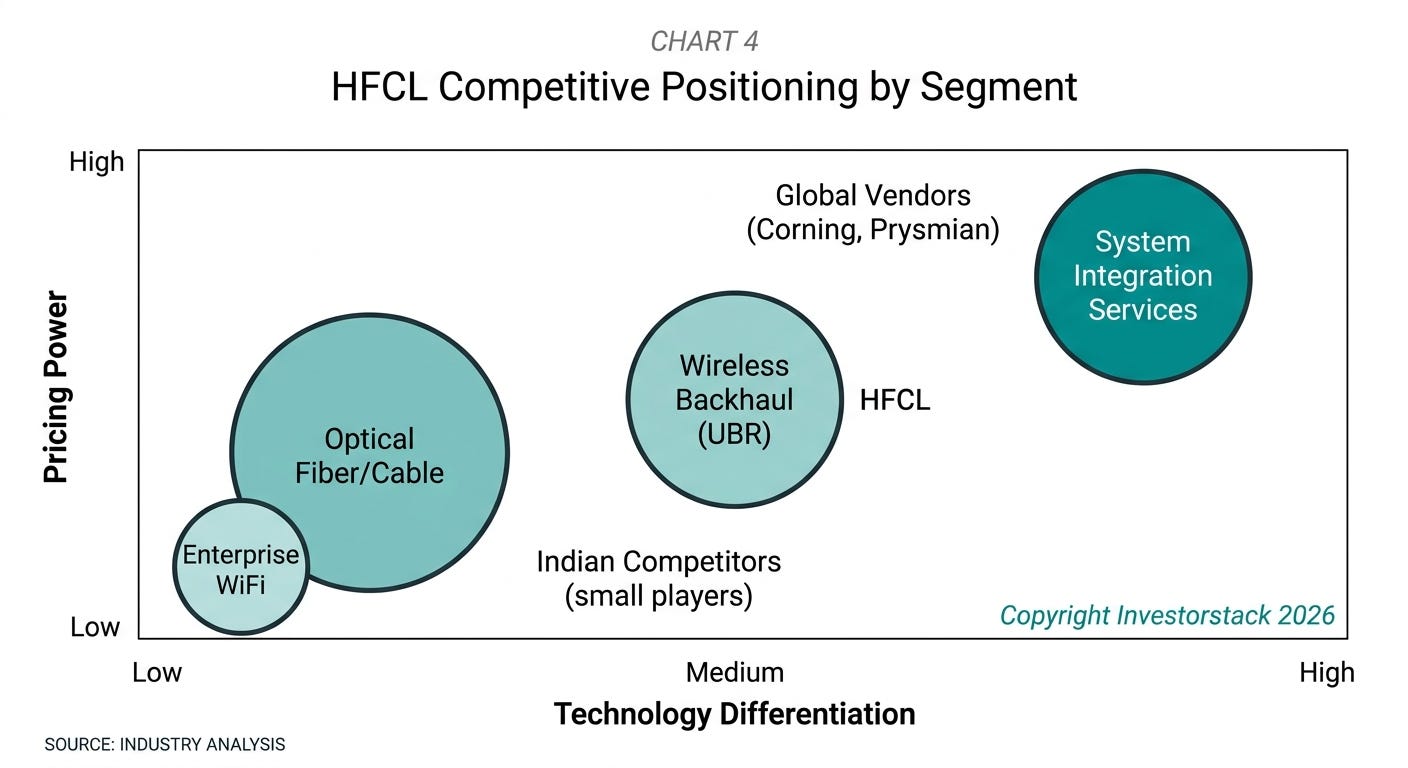
Overall, HFCL’s position is strongest in telecom operator and defense segments (where integration and execution matter), medium in enterprise Wi-Fi (commoditizing market, price pressure), and weakest in commodity fiber/cable (global competitors, scale disadvantage). The company is deliberately exiting the lowest-margin fiber/cable commoditization trap by bundling with higher-margin services, which is the right strategic move.
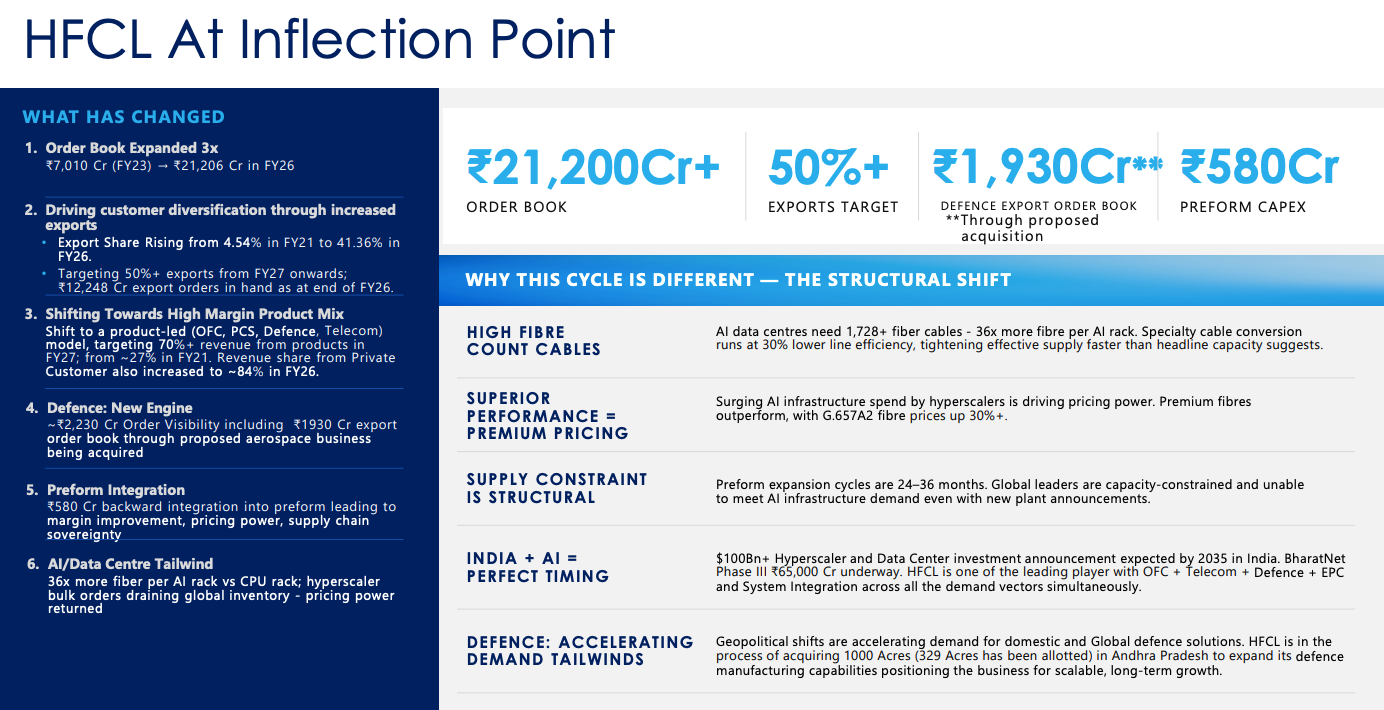
HFCL is expanding optical fiber cable manufacturing capacity to 42.36 million fiber kilometers by FY2026, with planned backward integration through a ₹580 crore Preform Manufacturing Facility and a ₹375 crore defense ammunition facility in Andhra Pradesh. Defense manufacturing and high-fiber-count cable projects are in early stages.
Backward integration into preform manufacturing with ₹580 crore capex to reduce costs by 15-20% and strengthen margin expansion
Landmark USD 1.1 billion (₹10,159 crore) global optical fiber cable contract to provide multi-year revenue visibility
Order book of ₹21,200 crore including ₹12,250 crore export orders (58% of total) to drive revenue sustainability
Data center interconnect solutions to generate ₹400 crore incremental revenue in FY26-27 and ₹800 crore in FY27-28
Defense aerospace business acquisition with ₹1,930 crore export-oriented order book to expand defense revenue to 10-12% of FY27 total revenue
Ammonium facility in Andhra Pradesh for electronic fuzes, hand grenades, and artillery shells to add significant revenue post-launch
Optical fiber capacity expansion to 33.9 mn fkm by December 2026 and 42.36 mn fkm by December 2026 to meet hyperscaler demand
FY27 capex of ₹600 crore (including preform integration and defense scaling) and FY28 capex of ₹350 crore to fund growth initiatives
Strategic restructuring committee evaluating demerges/mergers to sharpen execution focus in defense, EPC, and telecom segments
Expected 3-4% EBITDA margin improvement in FY27 from higher-margin data center interconnects and defense products
Defense order book expansion to ₹2,230 crore (including ₹1,930 crore export orders) to drive multi-year growth
Export revenue share to increase from 12.23% in FY25 to 41.36% in FY26, with 70% of cable production now exported
HFCL faces several material risks that could slow growth or compress margins:
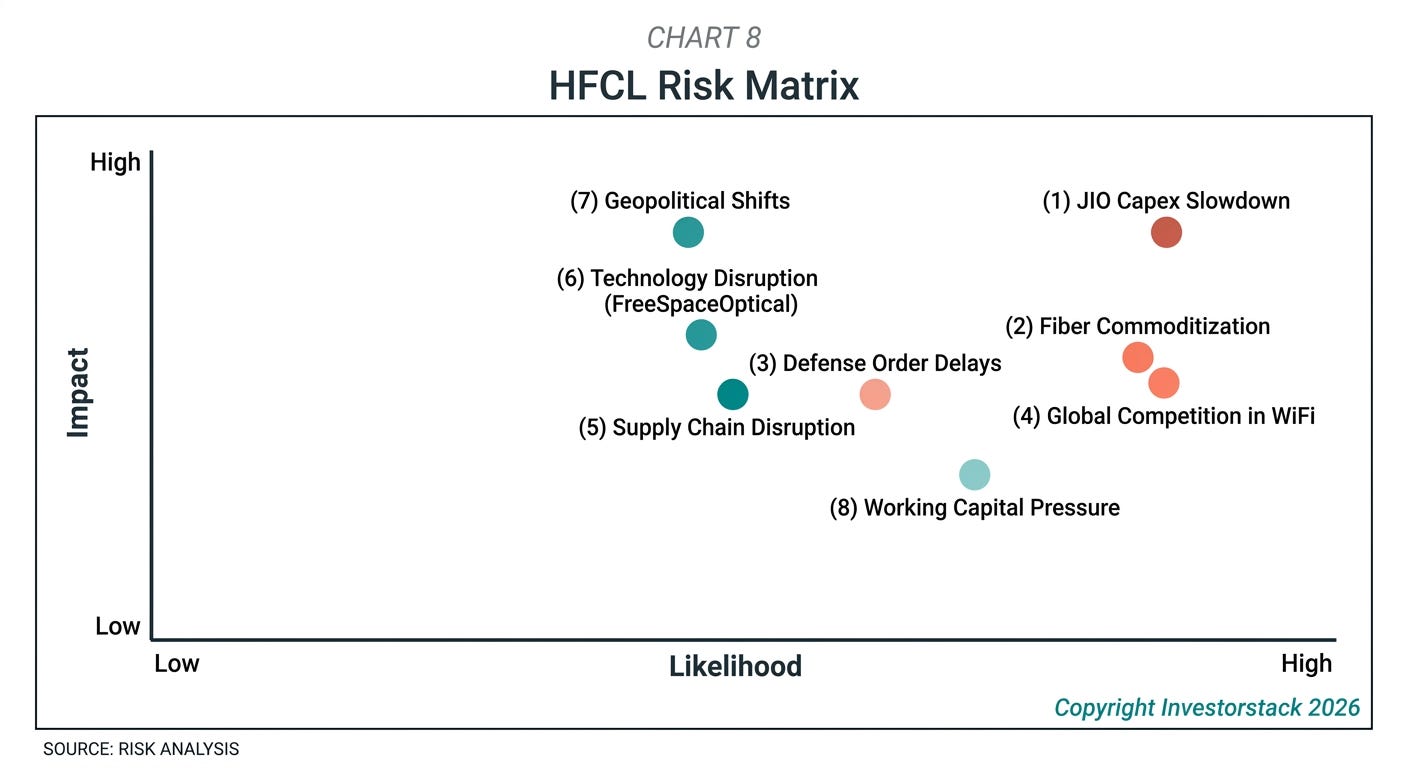
1. Concentration on Jio (30-40% of revenue) - If Jio slows capex, HFCL’s growth slows proportionally. Jio’s capex cycle is driven by return-on-capital targets set by parent Reliance Industries. If Reliance’s overall capex priorities shift (toward retail, petrochemicals) or if Jio faces pressure on returns (from pricing competition, subscriber pressure), Jio capex could decline. This would create a short-term headwind for HFCL. Mitigation: HFCL is explicitly diversifying into defense and government segments to reduce Jio dependence.
2. Commoditization of fiber and cable - HFCL’s original business (optical fiber manufacturing) is increasingly commoditized. As competitors enter and volumes grow, prices compress and margins thin. HFCL’s fiber/cable segment gross margins have likely declined from 35% (10 years ago) to 25-30% today. Without innovation or differentiation, this segment becomes a low-margin commodity. Mitigation: HFCL is consciously shifting toward services (higher margin) and custom cable applications (niche differentiation).
3. Competitive pressure in wireless backhaul - Global vendors (Ceragon, DragonWave, Ericsson) are increasingly aggressive in India with lower pricing. HFCL’s UBR products are good but not technologically differentiated - software and support are the edges. If a global competitor enters with aggressive pricing and localized support, HFCL’s UWB market share could decline. Additionally, some operators are vertically integrating (building their own backhaul solutions) which would reduce equipment sales.
4. Geopolitical risk and government order volatility - Defense and government orders are subject to geopolitical shifts and policy changes. An election or change in government procurement policy could alter the pipeline. Additionally, defense procurement timelines are very long (1-2 years from tender to order) and outcomes are uncertain. HFCL’s recent defense facility investment is a bet that government capex will remain strong, but this is not guaranteed.
5. Technology disruption - Wireless backhaul is slowly being displaced by wireless mesh networks (multiple hops, self-healing) and eventually by Free-Space Optical (FSO) technology. HFCL’s traditional point-to-point and point-to-multipoint radios may become less relevant if mesh or FSO becomes dominant. HFCL has to innovate to stay relevant, which requires R&D investment and risk-taking.
6. Supply chain risk - HFCL sources microwave chips, optics, and power components from global suppliers (mostly U.S., Taiwan, Japan). Geopolitical tensions or supply disruptions could impact HFCL’s ability to manufacture. Additionally, semiconductor shortage (like 2021-2022) impacts all hardware vendors. HFCL lacks the scale of Samsung or Nokia to secure component allocations and may face supply constraints in periods of global shortage.
7. Execution risk on defense facility - The new defense manufacturing facility (announced April 2026) requires capex investment and operational ramp-up. If HFCL cannot achieve economies of scale in the new facility or if defense orders don’t materialize as expected, the capex could become a drag on returns. Additionally, defense manufacturing has complex compliance and quality requirements - failure to meet these would damage HFCL’s reputation.
8. Working capital risk - Large projects (infrastructure build-outs, defense contracts) require significant working capital (component inventory, payroll for installation teams, customer payment delays). If HFCL scales operations faster than cash collections, working capital pressure could constrain growth and require external financing.
4/5. HFCL Delivers on Key Promises in Fiber Capacity, Defense Contracts, and Export Growth
HFCL has successfully expanded its high-fiber-count cable manufacturing capacity, secured significant defense contracts, and achieved export revenue targets. Management’s promises around 5G product development, defense partnerships, and global market share in unlicensed band radios were largely fulfilled. However, some 5G Fixed Wireless Access (FWA) CPE revenue targets were delayed but later exceeded expectations.
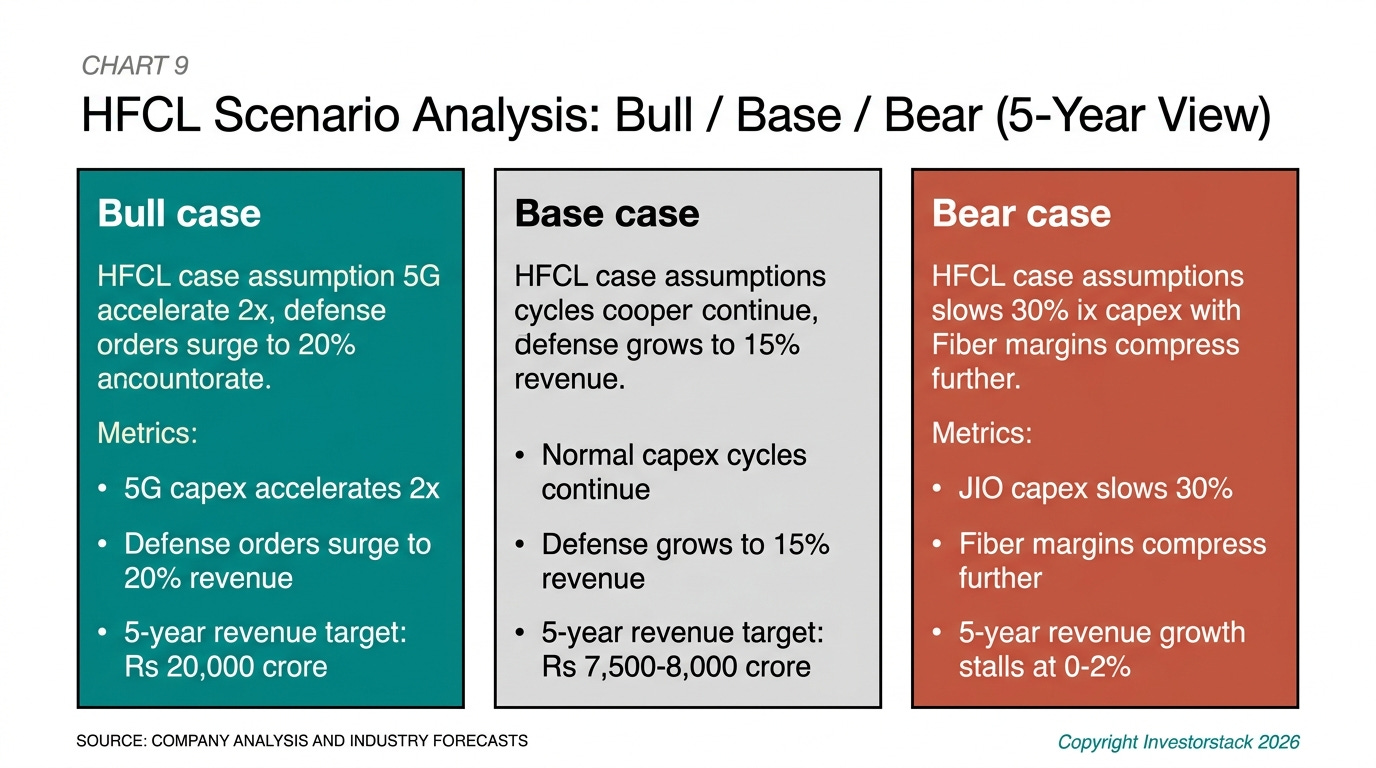
HFCL is the primary beneficiary of India’s infrastructure buildout over the next 5 years. Jio’s 5G rollout accelerates beyond current plans (adding 2x more capex than expected), government commits additional funds to Bharat Fiber, and defense modernization accelerates due to border tensions. In this scenario, HFCL’s order book grows to 15,000+ crore within 2 years, and the company raises utilization at existing plants. Margins in telecom products remain healthy (35%+ gross margin) because demand is strong and HFCL can push price increases.
Additionally, the new defense manufacturing facility becomes a major revenue driver. HFCL wins 3-4 large defense contracts (500+ crore each) because the facility signals capability and “Make in India” mandate ensures HFCL is preferred. Defense margins are high (20%+ net margin) due to limited competition. International orders grow as HFCL exports products and services to Southeast Asia and Africa, where 5G and broadband investment are accelerating.
The company then redeploys cash to R&D and new product lines (next-gen Wi-Fi, 6G precursors) to stay ahead of global competition. Over 5 years, HFCL becomes a 15,000-20,000 crore revenue company with diversified order sources (Jio 30%, defense 20%, government 20%, enterprise 20%, international 10%) and more resilient to any single customer slowdown.
HFCL grows in line with industry trends (4-6% annually) over the next 3-5 years. Jio’s 5G capex proceeds as planned, government fiber rollout continues at current pace, and defense spending remains steady. HFCL maintains its 3-5% market share in telecom equipment and services. The company faces incremental pricing pressure in commodity fiber/cable but offsets it with growth in higher-margin services and custom products.
The defense manufacturing facility is built and becomes operational, but orders ramp slowly (1-2 large contracts in first 3 years). Enterprise Wi-Fi segment grows but remains a small percentage of total revenue because competition is intense. International orders grow modestly as HFCL expands distribution but remain less than 10% of revenue.
Over 5 years, HFCL grows revenue to 7,000-8,000 crore (from current ~4,500 crore estimated) with operating margins in the 8-12% range. The company is profitable but not transformational. Jio remains 30-40% of revenue. HFCL is a solid, defensive, low-growth business - not exciting but stable.
Jio’s capex slows due to return pressures or macro slowdown. Government fiber budgets are cut or reallocated to other priorities. Enterprise Wi-Fi market intensifies with global vendors entering India aggressively. The defense manufacturing facility underperforms - either due to construction delays, compliance issues, or lack of order follow-through. In this scenario, HFCL’s order book declines or remains flat for 2-3 years.
Simultaneously, commodity fiber/cable margins compress further as more competitors enter India and global suppliers gain distribution. HFCL’s wireless backhaul business faces price pressure from global vendors willing to subsidize market entry. The company is forced to cut costs, consolidate plants, and potentially divest underperforming assets.
Growth stalls at 0-2% annually. HFCL is profitable (customers still need products) but faces existential pressure. In the most extreme version of this scenario, HFCL becomes a takeover target - either by a larger Indian industrial conglomerate (TCS, Wipro) or by a global telecom equipment vendor seeking Indian manufacturing capacity. The shareholder base is diversified (promoters 28%, institutions, public), so a large deal is plausible. No acquisition is announced, but the company’s options narrow.
Over 5 years, HFCL remains a 5,000-5,500 crore revenue company with declining growth momentum, high competitive intensity, and shareholder frustration over underperformance relative to broader market growth.
Thanks for reading! Do check out Investorstack.
No posts
Comments
Nothing yet. Say the first thing.
Sign in to join the conversation.