
When people start learning about acemannan, one of the first questions they ask is how much to take. It’s a reasonable question, and it’s one most supplement conversations never actually answer. So we’re putting the amounts first, right up top, and then explaining the science behind why they’re set where they are.
Acemannan comes two ways: a powder (Alovéa AE) and capsules (Immūn).
They deliver the same compound.
1 scoop of Alovéa AE = 400 mg = 2 Immūn capsules (200 mg each).
Maintenance — your steady daily amount to keep the immune system primed:
400 mg daily = 1 scoop of Alovéa AE, or 2 Immūn capsules
Therapeutic — a higher-support window when the body needs a stronger response:
1,600 to 2,000 mg daily = 4 to 5 scoops of Alovéa AE, or 8 to 10 Immūn capsules
It mirrors the amounts researchers use when studying stronger biological effects
It’s a higher-support window, not a permanent daily amount
Build up, don’t jump. When you’re working toward a therapeutic amount, increase by 400 mg (1 scoop, or 2 capsules) at a time, spacing it out over about two weeks so your body can adjust. Acemannan is non-toxic, with no strict ceiling.
The same principles apply to children, infants, and pregnant or breastfeeding women, with amounts adjusted by age and body size. Acemannan is a food-derived compound, not a pharmaceutical, and it’s completely non-toxic. That safety profile is what makes it appropriate across all life stages, including the most sensitive ones. Powder or capsule works for any of these — open a capsule and use the powder for little ones.
Infants (under 6 months)
½ capsule (or ¼ scoop) mixed into food or milk, when support is needed
Use when an infant is showing signs of skin or gut irritation
Open the capsule and mix the powder into breast milk, formula, or soft food
Children 6 months to 2 years
Maintenance: 1 capsule (½ scoop) daily
Therapeutic: 2 to 3 capsules (1 to 1½ scoops) daily
Open capsules or use the powder, mixed into juice, yogurt, applesauce, or smoothies. It has a mild, earthy taste most children tolerate well
Children over 2 years
Maintenance: 2 capsules (1 scoop) daily
Therapeutic: 6 to 8 capsules (3 to 4 scoops) daily
Pregnant and breastfeeding women
Maintenance: 2 capsules (1 scoop) daily
Therapeutic: 8 to 10 capsules (4 to 5 scoops) daily
Safe at both amounts throughout pregnancy and while breastfeeding
Unlike many aloe-based products, this extract contains no anthraquinones, the compounds in the outer leaf that carry laxative and potentially harmful effects. Their absence is what makes it appropriate during pregnancy and breastfeeding, where most aloe products carry a caution
Acemannan is completely non-toxic. There’s no established upper limit that causes harm. The guidance above is based on what the research shows to be effective, not on safety thresholds. More isn’t always necessary, but it’s never dangerous.
In biological research, there’s a meaningful difference between a detectable amount of a compound and the range where measurable biological responses actually begin. A molecule can be present in a product, but the amount delivered may be very different from the amounts scientists use when studying immune signaling, tissue repair, or cellular protection.
This helps explain why some supplements seem to help and others don’t. The difference often isn’t the ingredient itself. It comes down to structure, standardization, and dosage.
When researchers study a compound, they rarely test only one amount. They observe a dose-response curve, slowly increasing the amount and watching how the body responds at each level. At very low amounts there may be little measurable activity. As the amount increases, the body begins to respond, until the systems being studied clearly notice the compound and interact with it. That range is the therapeutic range.
This doesn’t mean more is always better. It means there’s a window where the body is most likely to respond. That principle holds for pharmaceuticals, nutrients, and plant compounds alike, and it’s especially relevant for acemannan.
Acemannan research spans decades and covers immune signaling, gut barrier integrity, tissue regeneration, and cellular protection. In most of these studies, researchers aren’t working with tiny amounts of aloe. They use meaningful amounts of intact acemannan polysaccharides.
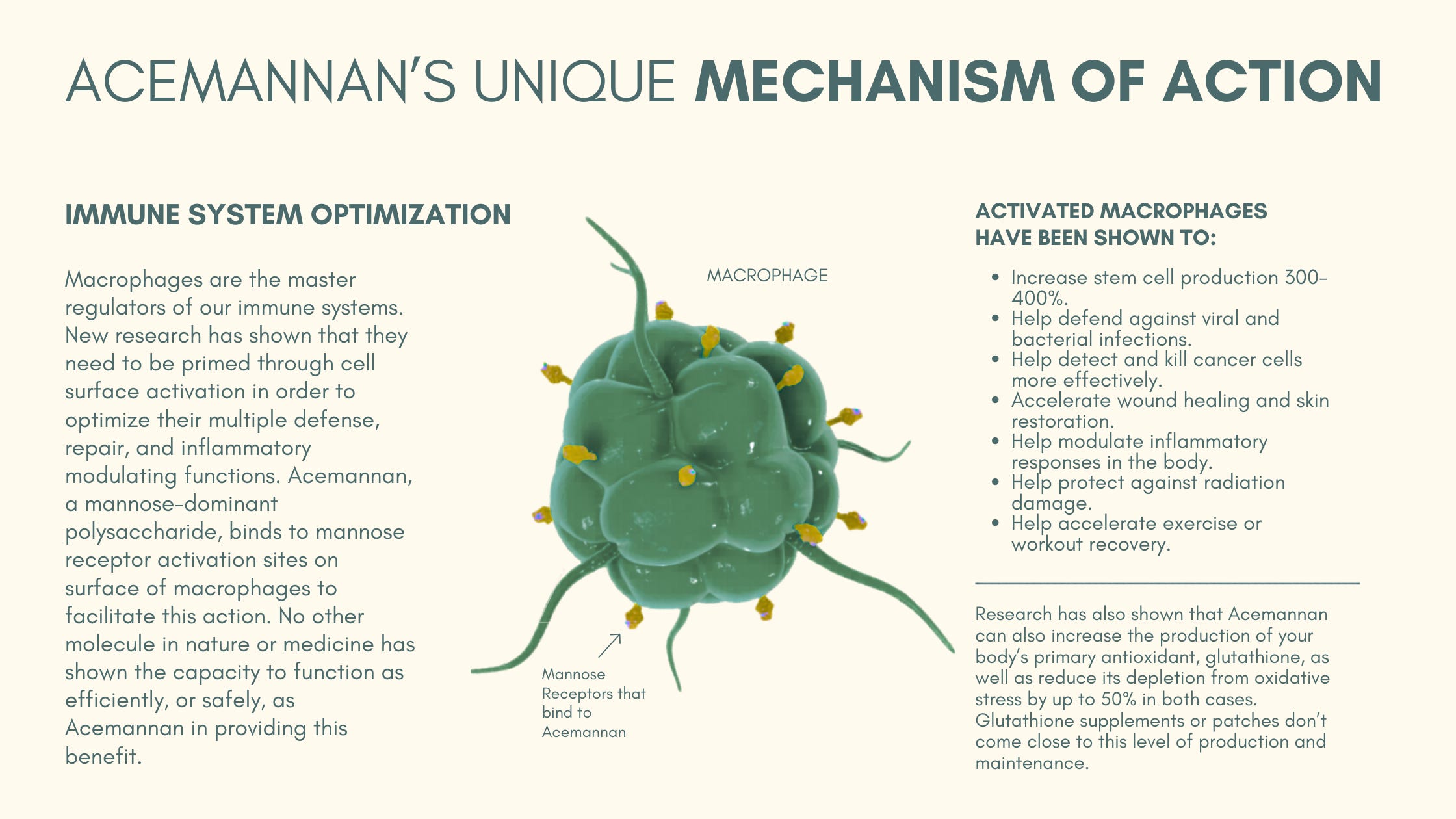
Acemannan interacts primarily with macrophages, one of the main control centers of the immune system. Macrophages identify threats, coordinate immune responses, and signal tissue repair. When researchers study how acemannan affects them, they use amounts where the immune system clearly notices the molecule. The presence of a compound on a label doesn’t automatically mean the product delivers amounts that reach those levels. That gap is where a lot of aloe products fall short.
Labeling in the aloe industry isn’t standardized, which makes comparing products genuinely difficult. Different products report their contents in very different ways:
Some list aloe powder weight
Others list aloe extract weight
Some reference polysaccharide content
Others simply list aloe as an ingredient with no active-compound concentration
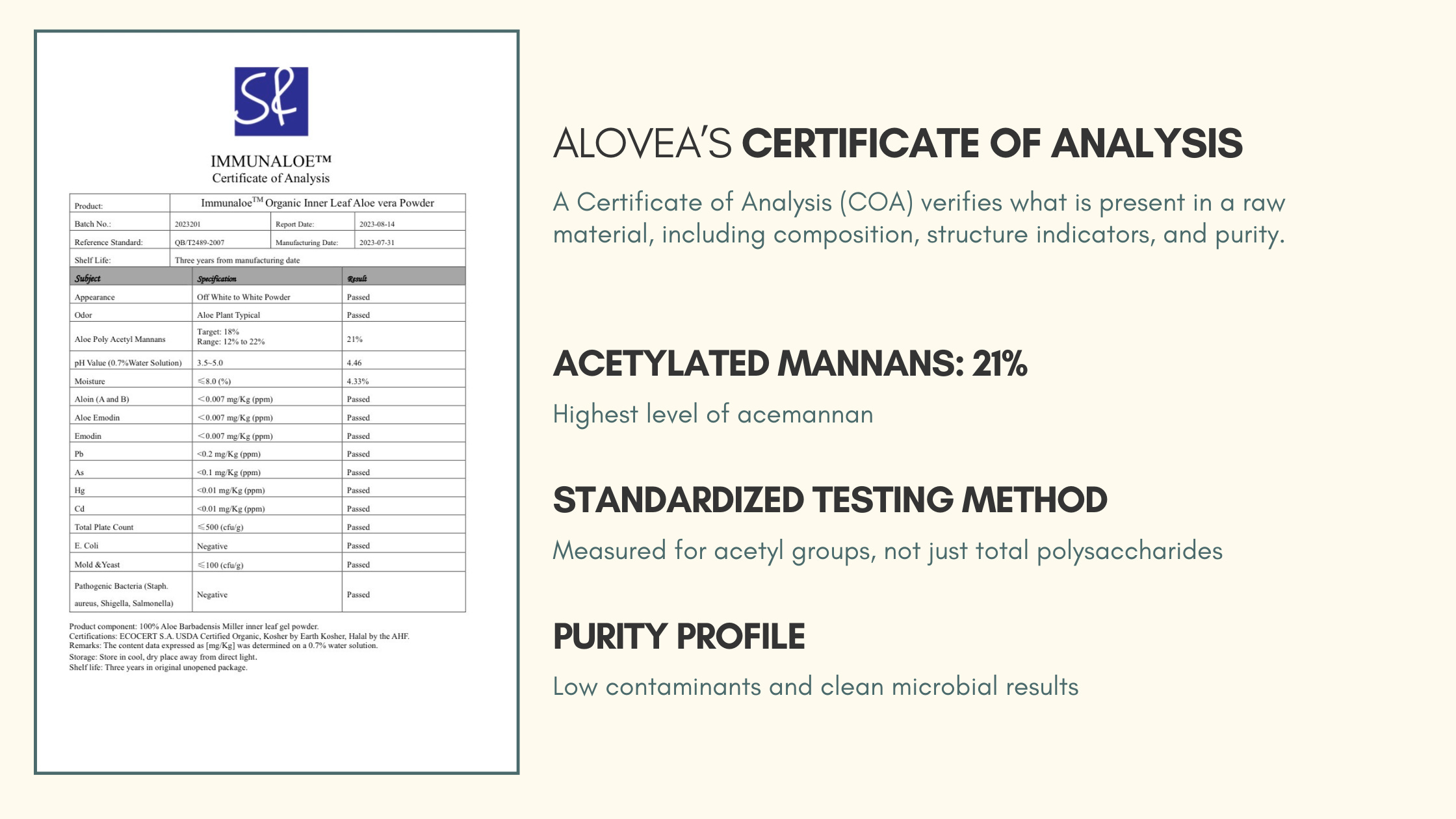
Without knowing how much acemannan is actually in a serving, comparing two products becomes very hard. Two capsules can look identical on a label and deliver very different amounts of the polysaccharide that matters. That difference usually comes down to standardization. Standardized extracts measure and preserve specific compounds so the amount stays consistent from batch to batch. Without that control, the amount of intact polysaccharide can vary significantly, and you may be getting very little of what the research actually studied.
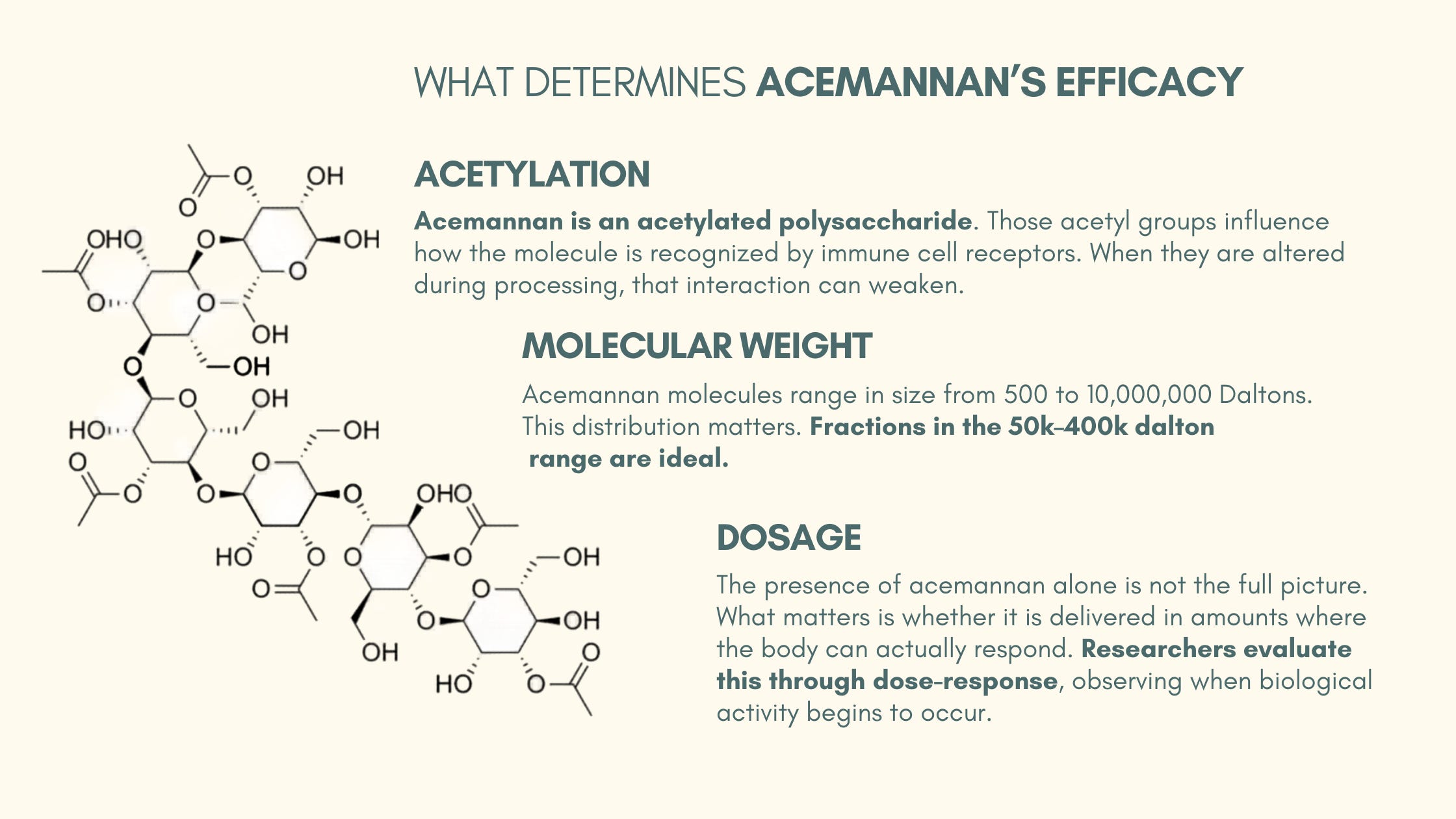
Dosage alone doesn’t tell the whole story. Acemannan’s biological activity depends heavily on its size and integrity. It isn’t a single uniform structure. It exists as a spectrum of polysaccharide fractions with varying molecular weights, and those fractions don’t all behave identically.
Some fractions fall within a functional range, large enough to be recognized by the immune system and able to interact with pattern-recognition receptors on macrophages. Other fractions fall outside that range. They aren’t wasted, they follow different pathways. Larger fractions, in particular, move into the digestive system where gut microbes ferment them, functioning as prebiotics that support the microbiome.
Structure and dosage work together. A small amount of fragmented polysaccharide isn’t the same as a meaningful amount of intact acemannan. Both have to be right.
Here’s what makes this practically complicated. Reaching 1,600 to 2,000 mg of genuinely standardized, high-molecular-weight acemannan requires a product with a verified concentration of the active compound. Many products can’t get you there no matter how many capsules you take, because the acemannan they contain was never preserved at that level to begin with.
Only a small number of extracts in the world are standardized and verified at the concentration required to make therapeutic dosing possible. As of this writing, the exclusive rights to the most rigorously documented acemannan extract available are held by a single company, Alovéa. That isn’t a marketing claim. Those rights were donated to Alovéa because of its Buy 1, Nourish 1 mission.
Across decades of acemannan research, three things appear consistently:
Structure. The acetylated form of the molecule must be preserved.
Molecular size. High-molecular-weight fractions interact more effectively with immune receptor sites.
Dosage. The amount must reach a range where the immune system actually responds.
When all three line up, researchers observe clear effects on immune signaling and cellular communication. When one is missing, the response becomes much less predictable. So instead of asking only whether aloe is present, the more useful questions become: How much intact acemannan is delivered per serving? What molecular size distribution is preserved? And does the product make it possible to reach both maintenance and therapeutic ranges without an unreasonable number of capsules? Those questions tell you more than any ingredient list.
These statements have not been evaluated by the FDA. This product is not intended to diagnose, treat, cure, or prevent any disease. Consult your provider about what’s right for you and your family. Every purchase nourishes a child in need through the Buy 1, Nourish 1 initiative.
No posts
Comments
Nothing yet. Say the first thing.
Sign in to join the conversation.