
A founder can sell a company for millions of dollars and still walk away with nothing. Not a reduced payout. Nothing. The deal closed, money moved, and their share of it was zero.
It almost never comes down to the sale price on its own. It comes down to a few words they agreed to years earlier and never looked at again, the ones sitting in the term sheet under headings most people skim past. So here’s what those words mean, and why they decide who walks away with money.
Thanks for reading Accounting with AI! Subscribe for free to receive new posts and support my work.
Two kinds of shares
Start with who owns what. The cap table, short for capitalization table, is just the list of who owns a piece of the company and what kind of piece they hold. There are two main kinds, and the gap between them is the whole story.
Common stock is what founders and employees hold. Plain ownership, no special treatment when the company sells.
Preferred stock is what investors get for their money. It’s “preferred” because it carries rights that put investors ahead of common when it counts, and the moment it counts most is a sale. Each round (Series A, Series B, and on up) usually creates its own class of preferred with its own terms.
The waterfall: the line everyone stands in
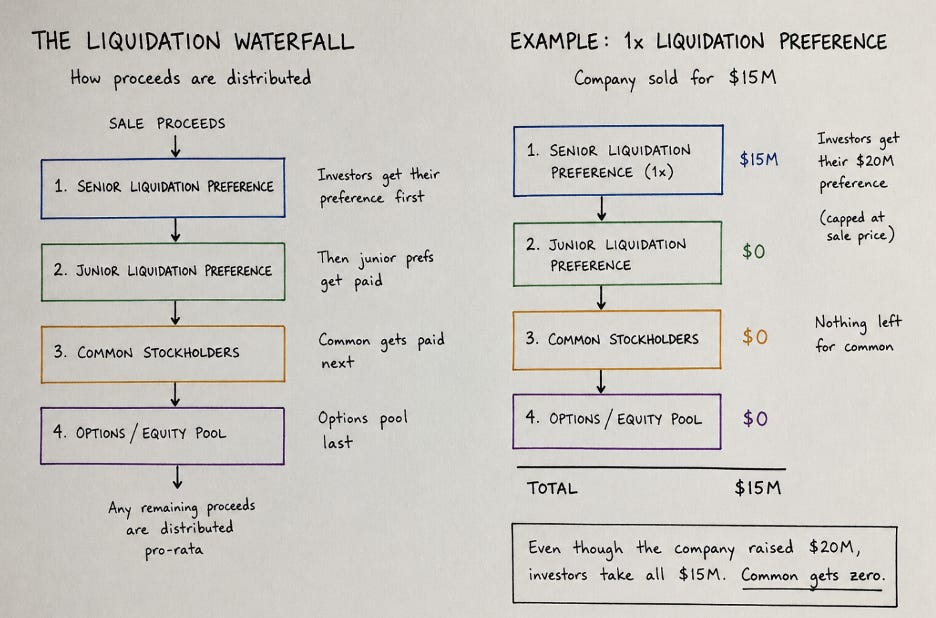
When a company sells, the money doesn’t get divided by who owns what percentage. It gets paid out in a set order, written into the company’s charter. Picture a line where each person has to be paid in full before the next one sees a dollar. People call that order the waterfall.
The investors stand at the front. What they collect first is their liquidation preference, the promise that in a sale they get their money back before the common sees a cent. The base amount is usually what they paid per share when they invested, the original issue price, times the shares they hold.
Preference multiples and participation
Two terms set how big that first claim gets.
The preference multiple is how many times their money they take off the top. At 1x, they get their money back once before common gets anything. At 2x, they take twice their money first, which is far more aggressive and leaves far less behind them.
Then there’s participating versus non-participating, which is really about one bite or two. Non-participating means the investor chooses the better of two outcomes: either they take their liquidation preference, usually their money back first, or they convert into common and take their normal ownership share of the proceeds. It is one or the other, not both. Participating means the investor gets the preference first, and then also shares in whatever is left, as if they had converted to common. So they get downside protection and extra upside. If you’re a founder, you generally want non-participating preferred. Participating preferred can stack the deck against the common shareholders because the investor gets paid first and then still participates in the remaining value.
One more wrinkle, the pecking order among the investors themselves. Sometimes every preferred round ranks equally and they share at the same level. (Lawyers call that pari passu.) Sometimes the later rounds are senior, meaning they get paid ahead of the earlier ones. When there isn’t enough to go around, that order decides who collects.
Why common can end up with nothing
Now the part that surprises people. Add up every investor’s preference across all the rounds. That sum is the bar a sale has to clear before common gets anything. Sell above it, and common gets a piece of the extra. Sell below it, and the investors take everything there is, sometimes without even being made whole, and common gets zero.
Put numbers on it. Say investors have put $20 million in across a few rounds, all with a 1x preference. The company sells for $15 million. The investors take the full $15 million and are still $5 million short of whole. The founders and the whole employee option pool walk with nothing.
That’s how a sale can repay investors only partway and still leave the people who built the company empty-handed. The preferred come first. The cash runs out before it ever reaches the back of the line.
Why the big valuation doesn’t save you
Founders tend to assume a company once valued at a big number will pay out like one.
It won’t, not on its own.
Valuations come in two versions. Pre-money is what the company is judged to be worth before new money goes in. Post-money is that plus the new money. Both are just what someone was willing to pay for a small piece while things were heading up. Neither is the price the company sells for later, and neither changes the order of that line. You can have a sky-high old valuation and a low sale price sitting right next to each other, and only the sale price fills the waterfall.
You’ll also bump into fully diluted shares, the count you’d get if every option and warrant that could become a share did. It’s useful for working out ownership percentages. But in a sale, only the pieces worth cashing in get paid.
Options and warrants
Two more line items sit on almost every cap table.
An option is the right an employee has to buy shares later at a fixed price, the strike. A warrant is the same basic idea, usually held by an investor or a lender instead of an employee. Neither is a share. It’s a right to buy one.
When the sale price is high, holders exercise: they pay the strike and turn the right into shares worth more than they paid. When the price is low, the strike can sit above what a share is even worth, and there’s a name for that: out of the money, or underwater. Nobody pays more for something than it’s worth, so those options and warrants just lapse, worth nothing. In a small sale where common already gets zero, they’re dead on arrival.
How the sale is built matters too
The shape of the deal changes both who gets paid and how hard the tax hits. Three shapes come up most.
A share deal, or stock purchase, is the straightforward one: the buyer buys the shares directly from the shareholders. The owners are the sellers, they’re paid directly, and the buyer takes the whole company, problems included.
A merger combines two companies, and the owners of the one being bought get cash or the buyer’s stock for their shares. Again, the owners are paid fairly directly.
An asset deal is the different one. The buyer buys specific things the company owns, say the code and the customer contracts, and leaves the company itself behind. Buyers go this way when they want the good parts but not the liabilities, the lawsuits, or some subsidiary they have no use for. The catch for shareholders: the buyer pays the company, not them. To get anything, the company then has to wind down: shut itself down and hand out whatever’s left. And that hand-out runs back through the same waterfall.
Any of these usually counts as a deemed liquidation event in the charter, which is just the trigger that switches the liquidation preferences on. And here’s a detail that catches founders off guard: the preferred often control whether a sale can happen at all. Their sign-off is usually required, so the structure may not be the founder’s to choose.
The asset route carries a tax sting worth knowing about. It can get taxed twice, once at the company on any gain, and again at the shareholders when the company pays out what’s left. A company that’s piled up losses over the years carries them as net operating losses, which it can use to soak up much of that first layer. Even so, two layers is why an asset deal tends to be cleaner for the buyer and more expensive by the time the money reaches the seller.
When the buyer pays in its own stock
Sometimes the price isn’t all cash. Part of it, or all of it, can be the buyer’s own stock, which raises a question nobody enjoys asking: what’s that stock really worth?
If the buyer prices its shares off some old number, like its last funding round a couple of years back, that price is probably stale, especially if the business has grown since. Hand over stock at a price below what it’s truly worth, and a tax authority can treat it as a discount, with the gap counted as extra income to whoever got the shares. That’s a big reason companies pay for a 409A valuation, an outside appraisal of what the shares are worth, so the number they use holds up. The fix is dull but it works, and it’s the one I’d insist on: get a fresh valuation close to the deal instead of dusting off an old one.
Two more terms tend to hide in the fine print. Change of control provisions kick in when the company is sold, and can do things like speed up someone’s options or warrants. Anti-dilution provisions raise an investor’s share count if the company later sells shares cheaper than they paid. Either one can move the math, so read them before the sale, not after.
The safety nets
If all of this sounds bleak for founders and staff, two things usually take the edge off.
A management carve-out is a chunk of the proceeds the board sets aside for founders and key people regardless of what the waterfall says, so the ones who built the thing don’t leave with nothing in a deal that only repays investors. Retention equity is fresh stock or options the buyer grants to the people it wants to keep, separate from the purchase price. Both exist for one reason: left to itself, the default math can wipe the team out.
So what should you do
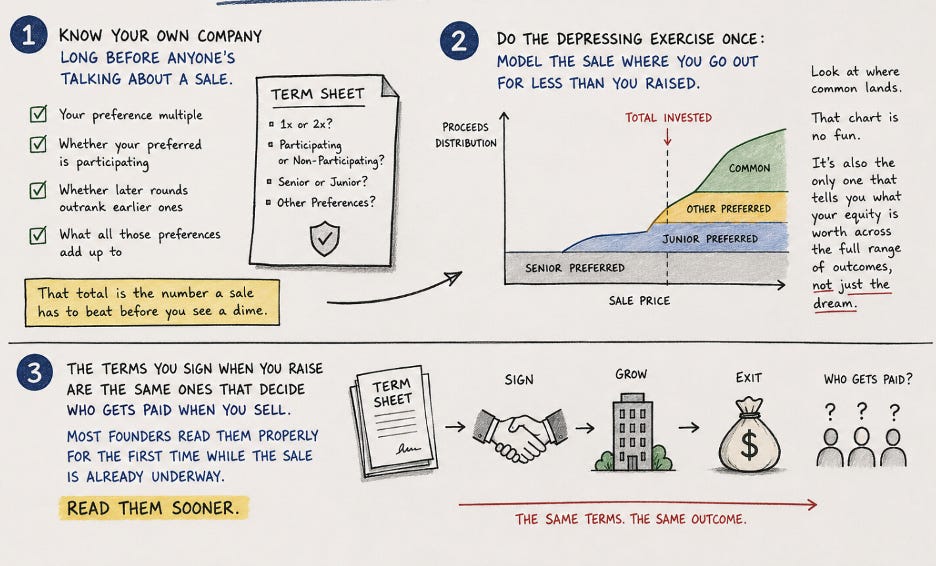
You don’t need a law degree. You need to know four things, and you need to know them before you take the money, not when a buyer shows up. Your preference multiple. Whether your preferred is participating. Whether later rounds outrank earlier ones. And what all those preferences add up to, because that total is the number a sale has to beat before you see a dime.
Then do the depressing exercise: model the sale where you go out for less than you raised, and look at where common lands. Run it before you sign a term sheet, and update it after every round. The chart is no fun. It’s also the only honest picture of what your equity is worth if things go south.
The terms you sign when you raise are the same ones that decide who gets paid when you sell. Most founders read them properly for the first time while the sale is already underway. Read them sooner.
Thanks for reading Accounting with AI! Subscribe for free to receive new posts and support my work.
Comments
Nothing yet. Say the first thing.
Sign in to join the conversation.