
In February, an artificial intelligence system filled out a partnership tax return. The form, a 1065, asks an accountant to track the income, losses and capital of every partner in a business and reconcile the pieces into a filing the Internal Revenue Service will accept. It is the kind of work that ruins a junior associate’s spring. A New York company called Basis said its software did it from start to finish, on its own. Days later, investors led by Andreessen Horowitz valued the company at $1.15 billion, the first pure-play accounting startup to reach a billion dollars on the strength of artificial intelligence alone.
Basis is one company in a sudden and well-financed rebuild of the software that runs corporate finance. The plumbing of accounting, the ledgers and approval queues and reconciliation spreadsheets that almost no one outside the function ever sees, has become one of the most active corners of enterprise technology. The reason is scarcity.
Roughly 300,000 accountants have left the profession in the United States since 2020, by the estimate of the practice-management vendor IRIS, and about three-quarters of certified public accountants are near retirement age. Firms cannot hire fast enough to replace them. In Accounting Today’s annual survey of the field, recruiting and retention ranked as the top concern for large firms, and burnout was close behind. The shortage created a problem that headcount could no longer solve, and it arrived at the same moment that a new generation of software learned to do the work.
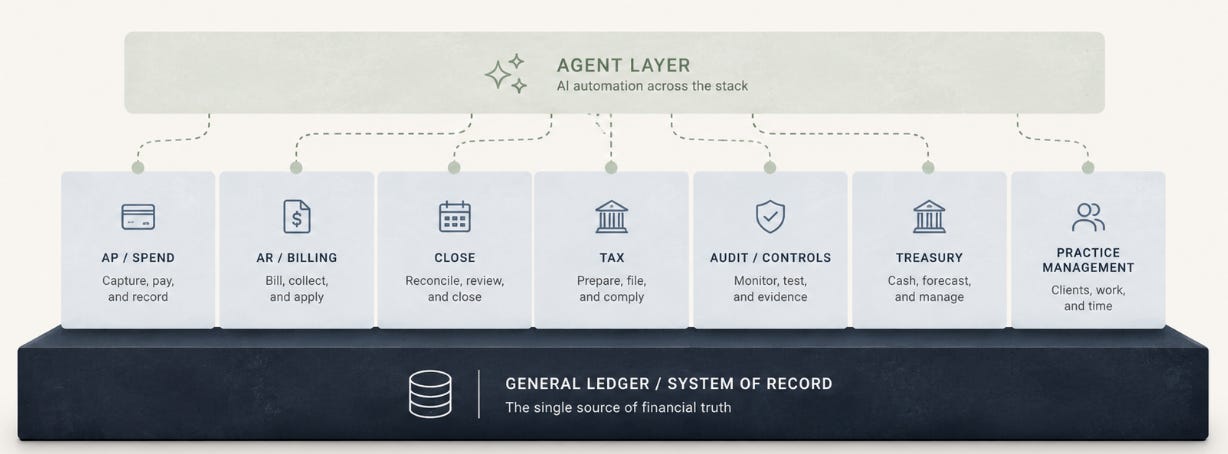
Finance teams run on a layered set of tools that follows money through a company. At the base sits the general ledger, the system of record, still dominated by Intuit’s QuickBooks at the small end and by Oracle NetSuite and Sage Intacct in the middle market. Above it sit the specialized layers: accounts payable and spend, accounts receivable and billing, tax, the monthly close, audit and controls, treasury, and, for the firms that sell accounting as a service, practice management.
The now holds several hundred distinct accounting and finance tools, and a clear majority of them advertise some form of artificial intelligence. A few years ago that claim would have meant a chatbot bolted onto an old product. Today it increasingly means something that acts. A January report from Deloitte found that 63 percent of finance organizations had fully deployed AI in their operations, and that close to half of chief financial officers had folded AI agents into parts of the function such as forecasting and expense management.
Ramp, the spend-management company, was valued at roughly $44 billion last month. BILL, which runs the payments rail beneath much of small-business accounts payable, says the share of transactions its AI agents now process end to end has climbed more than fivefold, at about 92 percent accuracy. The pattern repeats across every layer of the stack, from billing to the close.
The new entrants are making one of two bets:
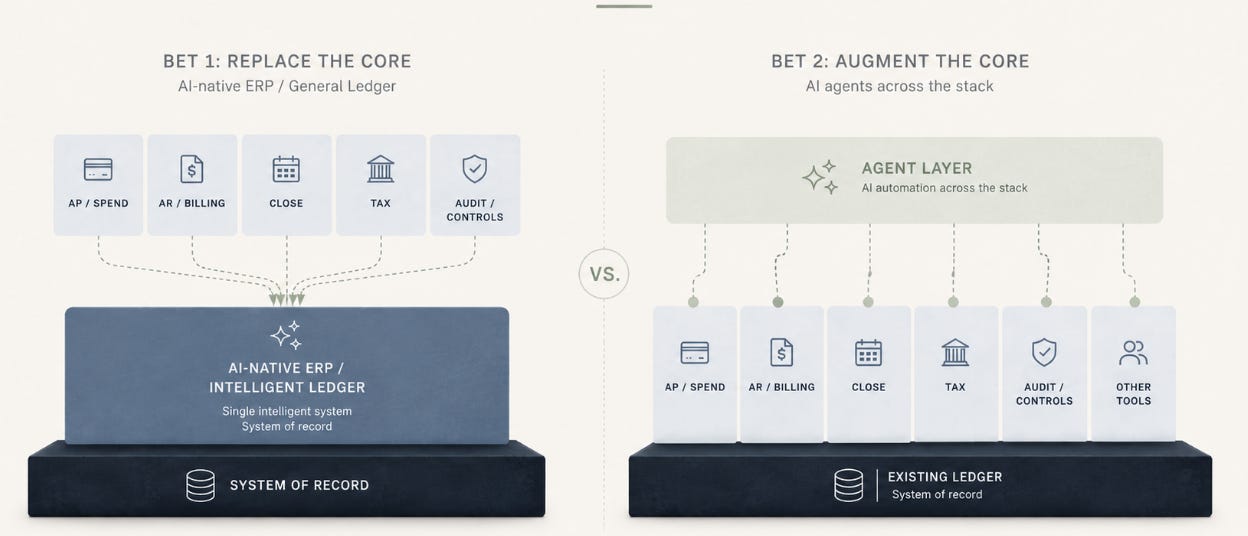
The first bet is to replace the system of record itself. A cluster of startups, including Rillet, Campfire, Light, and DualEntry, is building what they call the AI-native enterprise resource planning system, a modern general ledger designed around automation rather than retrofitted with it. These companies argue that the incumbents cannot catch up, because automation is only as good as the data it can reach, and the old systems were built to store data with little action.
The second bet is more modest and, for now, more common. Rather than rip out the ledger, sit on top of it as an agent. This is the wager behind Basis, behind a quieter group of companies including Concourse, Lumera, Mesh, Zalos, and TenKey that aim their agents at the work that falls between existing systems.
Lumera, founded by a former controller at OpenAI and Rippling who had also led corporate accounting at Square, has a phrase for the gap it is chasing. Companies have systems of record, the argument goes, but no system of work. The high-judgment processes that span several tools at once, an accrual that draws on usage data and a contract, a bank reconciliation that lives in a spreadsheet and a memorized set of rules, fit cleanly into no single product. That long tail is where finance teams still spend their nights, and it is the part that artificial intelligence is now able to reach.
Much of that work begins in an inbox. Invoices, payment questions and new-vendor requests arrive as email, and a person reads each one, decides what it is, and routes it. Several companies, including Ramp with its automated W-9 collection and a set of smaller startups, including Modai, Appzen, Auditoria, and TenKey have built agents that read the shared accounts-payable inbox, classify what they find, check it against the accounting system and draft a response for a human to approve.
The technology is real. The harder problem is trust, and the industry knows it.
An autonomous agent that posts journal entries is one bad automation away from a material misstatement, the kind of error that produces a public restatement and ends careers. Large language models fail in a specific and dangerous way for accounting. They can be confidently wrong, returning a clean, plausible answer that happens to be incorrect, which is worse than an obvious crash because no one thinks to check it.
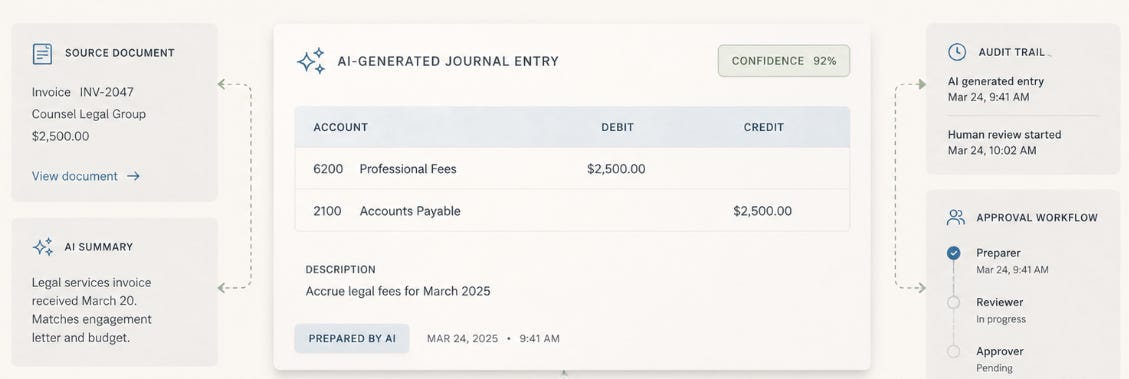
The serious products have converged on the same answer. Basis logs every action its agents take with a timestamp, a source document, the rule applied and a confidence score, and it routes a task to a human whenever confidence falls below a set threshold. The newer agent companies talk less about replacing accountants than about audit trails, role-based access and human review at the points that matter. Governance seems to really really matter!
Not everyone is so cautious. Synthetic, a startup that raised $10 million this spring and is led by a co-founder of the bookkeeping service Bench, describes its goal plainly as removing human accountants entirely, producing real-time books for early-stage software companies at $49 a month. The bet there is that for a narrow enough customer, the long tail is short enough to automate away.
For the firms that sell accounting, the change cuts two ways. Automation that lowers the cost of serving a client also threatens the business model built on billing hours, and it puts particular pressure on the offshore outsourcing that has long handled exactly the tasks the agents now perform. Private equity, which has spent the past few years buying up accounting firms, is paying for outcomes and scale, not for time, and AI agents change that math.
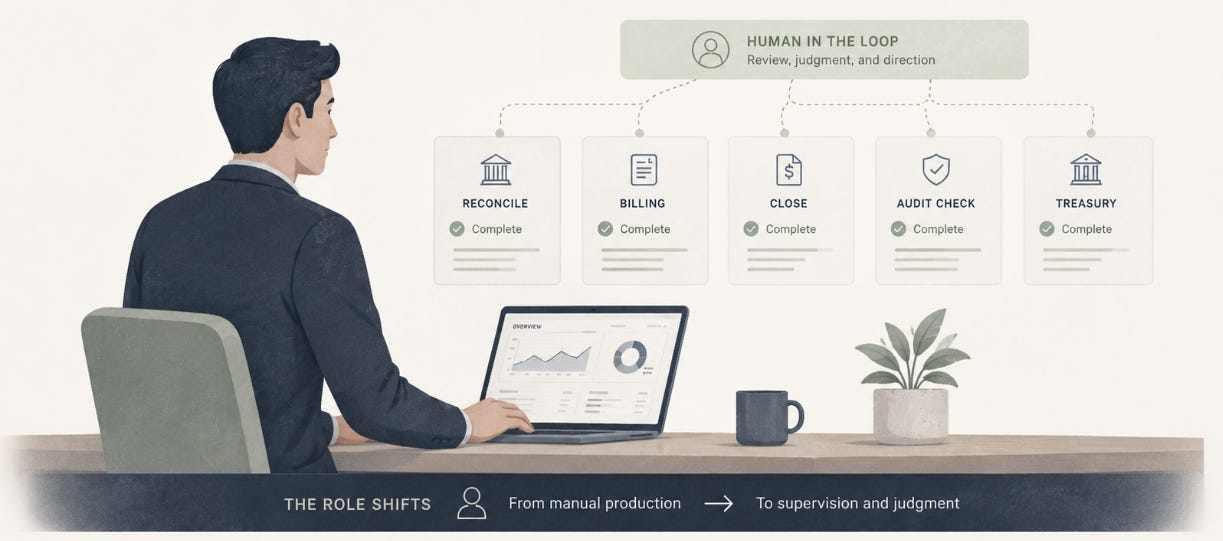
Inside the firms, the job is being redrawn rather than erased. The framing that recurs across the industry is the associate as supervisor. A first-year accountant who once spent sixty hours a week in spreadsheets instead reviews the work of a fleet of agents, applying judgment at the moments the software flags and signing the return the machine prepared. Capacity goes up without headcount, which is the entire point in a profession that cannot find enough people.
That leaves the question the technology has not answered. An agent can reconcile an account, draft a return and explain its reasoning. It cannot be held responsible. When the books are wrong, a person still signs them, and a person still answers for them to an auditor, a board or the I.R.S. The software has learned to do the work. The accountability stayed with the human, which may turn out to be the most durable thing in the entire stack.
To make the market easier to understand, TenKey put together a public map of the modern accounting AI stack. The resource breaks accounting and finance software into functional segments rather than treating “AI for accounting” as one broad category.
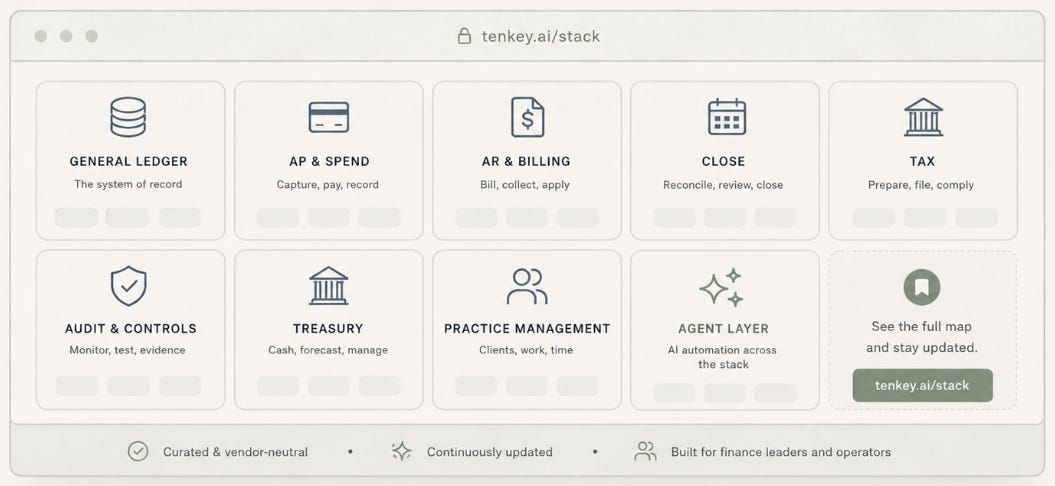
The map is meant to make the software landscape legible for accountants, operators and finance leaders deciding what to buy, what to watch and what still needs to be built.
It likely is incomplete….feel free to share if that’s the case and we will continue to update!
No posts
Comments
Nothing yet. Say the first thing.
Sign in to join the conversation.