
There’s a story going around finance circles right now: AI is about to make the spreadsheet obsolete. Why would anyone manually wrangle cell references and VLOOKUPs when a model can build the dashboard, query the database, and hand you the answer?
I spend my days in the weeds of finance and FP&A by building the models and running deal scenarios across a portfolio of investments, and I’ve spent the last year automating that work with AI. I think the ‘think piece’ stories that talk about spreadsheets disappearing have it backwards. Tools like Claude in Excel make the spreadsheet itself several times faster to build and maintain. That makes the case for replacing it weaker, not stronger.
Here’s why.
The premise everyone gets wrong
The replacement narrative assumes Excel has only stuck around because nothing better existed. Now that AI native platforms can ingest your data and generate the output directly, why would anyone still build things cell by cell?
But the fact that better technology exists doesn’t mean your organization can use it today, and most finance teams are stuck in that gap.
For some workflows, an AI native platform is a perfectly reasonable end destination. But getting there means solving a much less exciting problem first: getting your underlying data into a state where a platform like that can function at all. That’s a data infrastructure problem, and those take years to solve, not product cycles.
Until that’s solved, the AI native platform doesn’t have clean rails to run on. The real question isn’t whether the new platform is smarter than Excel. It’s whether it can work with what you actually have. For a lot of us, the answer is “not yet.” Excel, with AI working inside it, can.
Customizability
Anyone who’s actually built financial models for a living knows this in their bones: every stakeholder wants the same underlying information, sliced a little differently. Investors want it framed one way, the lender another, internal IC a third. Sometimes even different investors and lenders want the same information shown slightly differently, through different lenses.
Excel’s real superpower is so basic it’s almost invisible - reshaping output for a new lens doesn’t mean rebuilding anything. Change a formula and adjust a filter, and the same underlying data tells a different, equally accurate story in minutes.
A software engineer (or even a finance professional like me) working with Claude today can build a genuinely good tailored reporting tool or a dashboard quickly. That part of the AI story is true.
But being able to build something quickly isn’t the same as being able to rely on it, and in finance, the gap between those two comes down to two things.
First, there’s no deployment cycle in Excel, and there is one for everything else. Even a custom tool that takes an afternoon to build still has to clear review, testing, and sign off before anyone downstream is allowed to depend on its numbers, and that’s appropriate given it’s feeding investment decisions or external reporting. In Excel, when a stakeholder asks for the same information sliced differently, you change a formula or rebuild a view in minutes and it’s usable immediately. When a deal is moving fast, minutes versus a multi-day review cycle is the difference that matters.
Second, the audit trail in Excel is native, and the trust in it is already established. Auditors and regulators have spent decades learning to trace a number back through formulas and cell references; that’s how they verify things. A custom coded tool can be just as accurate and just as well documented, but the institutional habit of trusting it the way you’d trust a traceable formula chain doesn’t exist yet. That kind of trust gets built up over time, through repetition, through every audit season where the trail held up. Excel already has that. Nothing else in finance does, at scale. Admittedly, this edge has a shelf life. As AI native tools mature and auditors build new habits, this gap will narrow.
What This Looks Like in Practice
I ran into a good example of this during a recent fundraise. We got a due diligence questionnaire (DDQ) asking for a long list of financial metrics, and we didn’t have more than half of them sitting ready made anywhere. What we did have was base level data, built out in Excel, across our whole portfolio. Using Claude in Excel, I built one sample model that applied the requested logic to a single example, then had it apply that exact same logic across the rest of the portfolio. The full set of metrics came out the other end, not because we found new data, but because the data we already had got reshaped into the form the question was actually asking for.
By hand, with the nested formulas and macros that would’ve required, that’s a four week job. With Claude in Excel doing the reshaping, it took a fraction of that.
It’s worth being precise about what actually made that possible. Excel didn’t get smarter. I had a tool that could apply a defined piece of logic across a large, already existing, already transparent dataset instantly, without setting up a pipeline or getting some new platform approved and onboarded. The data was sitting there in a flexible format the whole time. AI removed the friction of propagating logic across it by hand.
This shows up in smaller ways constantly too, like when you’re trying to win over a specific investor and need to show them terms tailored to their situation instead of generic fund level numbers. That used to be a slow, manual slog: pull that investor’s data, run scenario after scenario by hand, adjust assumptions, eventually land on something defensible. Now I can rework investor level data and run that scenario analysis fast enough to test more combinations of terms and assumptions than I used to be able to try in the time it took to build one. Same story as the DDQ. The data and the logic were already there. What changed was how fast I could reshape and rerun it.
Stage 1 vs. Stage 2
Most arguments for AI replacing Excel are really about what the ideal end state for financial data infrastructure looks like. They then quietly assume that whatever’s ideal in that end state is also the best tool for the data a company actually has right now. But those are two different problems. Here’s the framework I use.
Stage 2 is the AI native end state, where data is fully centralized and accessible to software that can reason over it directly, no spreadsheet layer required. It’s a genuinely good destination. I’m not skeptical of it as a goal. I’m skeptical of how close most organizations actually are to it.
Stage 1 is where most finance organizations actually live: data spread across systems that don’t talk to each other, historical records in formats that predate any current data strategy, the same metric defined slightly differently by different teams, a patchwork that took a decade to build and will take real money, time, and organizational will to unwind. Getting from Stage 1 to Stage 2 isn’t a software purchase. It’s a multi year transformation project, and most finance leaders I talk to know that, even if it’s not the version of the story you hear in vendor pitches.
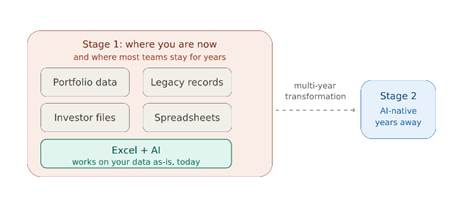
Excel plus AI is what you reach for while you’re still in Stage 1, because it works on the data you have, in the format it’s already in, today. No migration, no six month integration project. You point the AI model (i.e. Claude) at the spreadsheet you’ve already got and it goes to work. For most companies, given where their data actually sits, it’s the only approach compatible with reality right now.
Where this leaves us
For most of finance, over the next several years, the dominant working model is going to be Excel plus AI, because it already matches the shape of the data we actually have and the trusted infrastructure we’ve already built around it. Full migration to AI native platforms is coming for parts of the industry. But it’s a second order shift, gated by a data maturity problem that no amount of model intelligence solves on its own.
However smart the model gets, it still has to sit on top of real data. Right now, for most of us, that’s still a spreadsheet, just one that finally moves at the speed the work actually requires.
No posts
Comments
Nothing yet. Say the first thing.
Sign in to join the conversation.