
Intellectualising the shape of your hand is very easy to do when you know how to waffle. You could talk about a myriad of things: the shape of this hand, how it bends through air, and how our loss of dexterity over time is an allegory for the way human life eventually slips through our fingers. The ridges and wrinkles of a palm wink at the world as you move through it, grabbing things and touching people, hovering over a sweaty back, fisting a digital brick.
The hand is so many things at once that in this chasm of ideas, you struggle to find the point of it. If you were a poet or a philosopher, you might be tasked with uncovering a smart, searing angle that other poets and philosophers will call daring and poignant someday in the future. The hand, however, a mass of bones and flesh and cartilage at the end of it all, is performing its function.
If we were to turn every normal, unnoticed function into a spectacle for the sake of producing a deep, thought-provoking moment, what would the future of normalcy look like? Much like the hand, I presume, working on all sides to prove its worth outside of picking things up, pushing buttons, and feeling texture. Much like the hand is the worth of an inanimate object. The journal, these leather-bound silos brimming with consciousness, become museums. A colonised artefact. What can the journal do that the mind cannot? Transcribe? Convey? It does the job of the mind in more detailed steps, except this way, through the narrow cracks in our digital day-to-day, we can share what doesn’t need to be shared.
It’s cool to be uncool now in the same way we’re becoming aware of the imitations living within our online walls. I covet a lot of the things I see online simply because another person has it, and really, if I were to ask myself what that thing would represent, it would be because I can’t seem to form my own person. My hands twitch at the sight of another set of hands, squirming right in front of me. I am a mimic. I want to live as a pastiche, but with social media, there is a desire to satirise the art of imitation when all of us are the sum of splintered parts.
When it comes down to it, there’s not enough perspective to go around. The essays you’ve bookmarked, the videos you watch, all say the same thing. The same modes of thought are recycled through many a think piece, and the only ideas worth dissecting are pushed into obscurity because it does not incite perverse lengths of spiritual violence. Something that negates your uproar for morality and ignites instead a taste for controversy and contention.
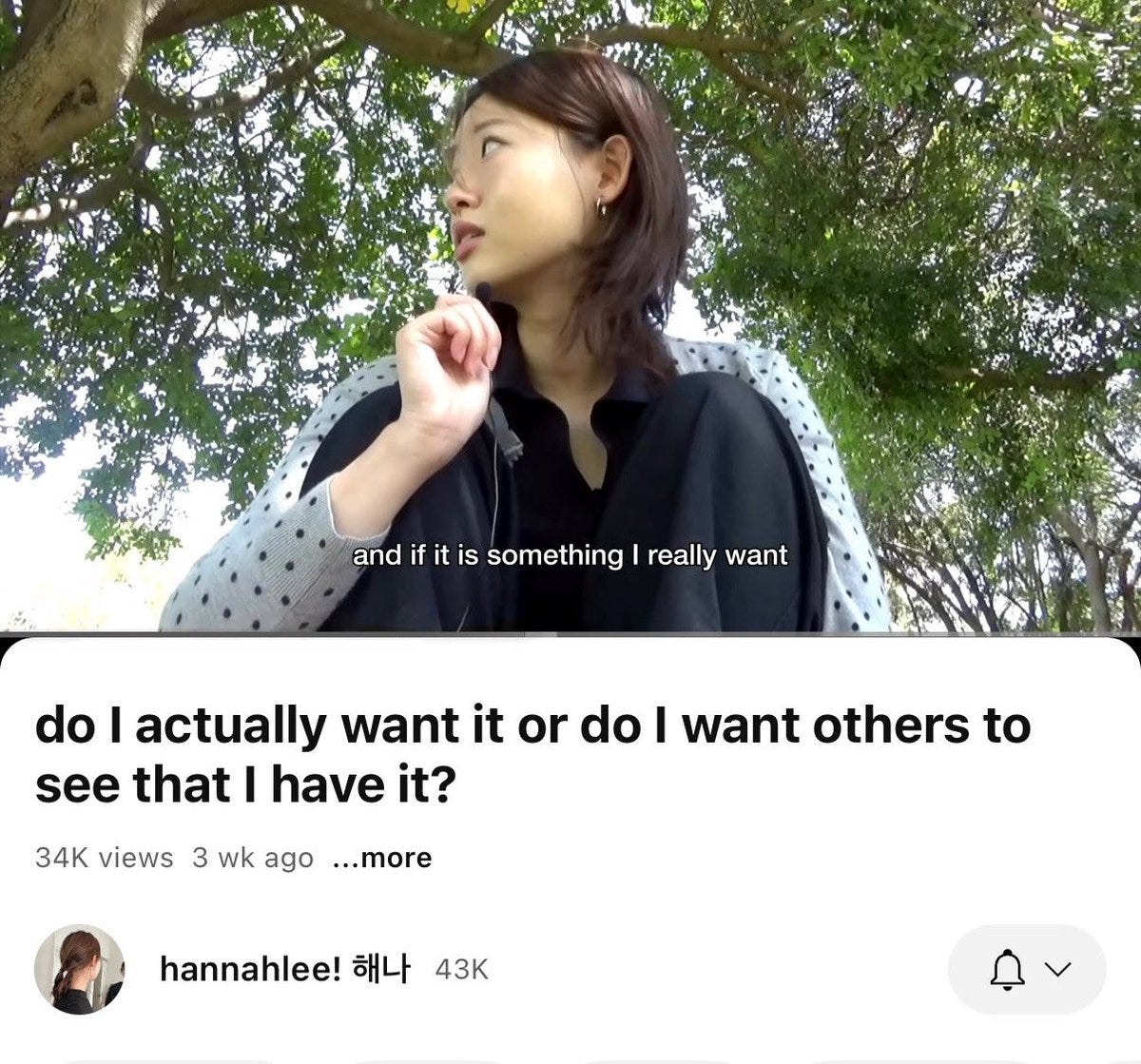
This essay was originally about how we need to stop forcing the desire to come across as critical thinkers, but along the way, I realised that this essay was becoming just that, a smokescreen created purely to spark flames across the dark cave that is anti-intellectualism. What I’m realising about myself is that the things I find cool and interesting now are quite literally the things I used to complain about. I used to be the type of person to downplay my intelligence for the sake of ‘humility’ when really I love being smart. I love to pretentiously languish over texts that are difficult and uncompromising in the act of holding my hand towards a conclusion because I have to work for that. The muscles in my head contract as they churn out thought, churn out truth. In the small worlds we occupy, there is not much work that has to be done for thinking. So this is no longer an essay about forcing the persona of being smart, but rather, who these personas belong to.
Pretentiousness is no longer the crime I used to know it as. Pretending seems to act as our default setting these days, and so the argument of authenticity over pretence is muddied with the semantics of what each concept is meant to argue. Are you more or less authentic for crying about something deeply personal online, or are you simply baring your soul in hopes that one person might understand? Are you more or less pretentious for disliking simplistic and flattened literature? Who is the arbiter of taste in both scenarios? Who do we trust with our desire for dissection?
In her essay, in defence of pretension, ayan artan writes, “capitalism has turned us into selfish, contradictory beings. Why do we see the internet grouse at fiction readers, pointing to self-help books by men in grey business suits as the only reading that ‘counts’?”
This battle of authenticity is omnipresent; it lives within us and outside of us, across the spheres of influence that we turn to for inspiration, comfort, and confirmation. The bias isn’t lost on me; in fact, I recently went to a workshop with two behavioural scientists who named three types of bias:
Present bias - the tendency to settle for a smaller present reward rather than wait for a larger future reward, in a trade-off situation.
Confirmation bias - the tendency to search for, interpret, favour and recall information in a way that confirms or supports one's prior beliefs or values.
Cognitive bias - the deviation from rational thought in judgment, leading to inaccurate perceptions, illogical interpretations, or flawed decisions.
These are perhaps the largest issues most people struggle with when it comes to their perceptions of authenticity, and the subsequent search for it in places where that might not be entirely possible.
I’m of the belief that there is no such thing as an original thought, only a unique perspective. We have been alive for long enough that most concepts yet to be discovered have followed a similar paradigm in the way they’re established or presented. Religion, Education, Marriage, Medicine, Law; all of the largest institutions and their offsprings have been teased and poked and prodded, perhaps not to their fullest, but with enough motion that we see their values, and more importantly, their flaws. The only issue is the lack of acknowledgement (See. Cognitive bias)
In a way, I think we’ve found ourselves suffering through a bit of a paradox. Some find no fortune in authenticity, and instead sell out their morals for the easiest path to wealth and success, whilst others are constantly in search of a deeper meaning behind subjects they’ve barely scratched the surface of. These deeper meanings are encased in short-form TikToks and video essays that shrink their quality whilst bloating the watch time, which again, might be answering my own question:
The decline of quality and incline in quantity across all of our media makes it easier to spot insincere work, but because we’ve been conditioned to satiating our bias, the most authentic answer is often the one that validates your beliefs without further questioning.
Take, for instance, Emerald Fennell’s new trailer for her adaptation of Wuthering Heights, coming out in February 2026. The consensus is that she’s leaning towards a more anachronistic approach with the cultural amalgamation of a horny love story between two actors with intense iPhone face, set in the 19th century, against the backdrop of a windswept Yorkshire moor and a CharliXCX soundtrack. I wouldn’t dislike this if there were not already a significant historical context missing from Fennell’s adaptation, which is the fact that Heathcliff, the main protagonist—and antagonist—is a brown man. Fennell’s Heathcliff is being played by Jacob Elordi, who is famously white.
I’m characteristically irate about this, for many reasons, but if we pull back and look at the main critique people have had for naysayers like me, the general idea is that we’re all being wimpy little Literature-obsessed babies. Now, I am paraphrasing, but I do find it interesting that this is meant to be some sort of insult when, honestly, I don’t take offence. I am obsessed with literature, and whilst I’m by no means a source material loyalist, it is maddening that Fennell took a character she knew she probably couldn’t understand, and did the least work possible to try; she changed his race.
“nobody understands the value of knowing things more than a working-class kid,” is a line from the same essay by Ayan, and as someone who did not go to university, it’s ringing true to me now more than ever that I cherish my snobbery due to how it’s being ripped from my hands in real time. I tend to feel strongly about the deeper meaning behind characters like Heathcliff and stories like Wuthering Heights because, despite Emily Brontë’s own failings with writing characters of colour, the opportunity to examine the work through a contemporary lens was right there, and it was not taken because there is no point in understanding further what does not affect you directly.
Side tangent: I think this is the central issue I find myself having with white people, particularly white women who don’t question their involvement in the largely racialised systems of entertainment that have formed over several decades. As Lani’s Lens puts it in her video essay, The Evolution of the Culture Vulture, “People do not care about racism when it gets in the way of their entertainment.” Why do you feel the need to use AAVE as a form of humour when, outside of social media, you never do? Why are Black Twitter memes always centring a Black woman existing at her most extreme? Why does your interrogation of racism end when you predominantly use Black media to entertain yourself?
The way we use critical thinking does not encourage enough self-interrogation into the ways our media and our humour and our thirst for authenticity have stemmed from larger systems, usually of oppression, and usually with a person of colour at the helm. This isn’t to say that you should politicise every aspect of your life, but I do wonder why the people who barely question the origins of their online personalities are the loudest in critiquing the descent into an eroded future.
The hustle for a deep thought requires much more than a firmness in your personal beliefs. It requires introspection, questioning the criteria you’ve used to share these beliefs and what the actions following must look like in order to stay honest. Honesty is not always doubling down. You might come across new information and change your thinking according to how that information strikes you. You might be right, you might be ignorant, but you must always be willing to question.
Despite how it sounds, I am still curious to watch the movie and marinate on its entirety, but I’m also aware of the bias I have walking into it. The point I’m trying to make is that we need to be more earnest about deep thinking. The surface-level dissection of online discourse does not enrich, it ensnares, and that is the sort of trap that becomes hard to untangle after a five-hour doom scroll. The hustle for a deep thought comes with many opinions being thrown into the ether with no real grip on the mind, past a quick session of wonderment, and then it’s back to being angry.
Anger seems to be what drives our love for critical thinking recently. There is always something to be angry about, and rightfully so, considering the political and economic state of the world right now, but there is no introspection alongside the anger. We’ve been primed for defence as a way to shield ourselves whilst also begging for an authenticity that requires some level of laying ourselves bare. As someone who mistook being angry about something with having a salient point to make, I am not here to criticise, only to question.
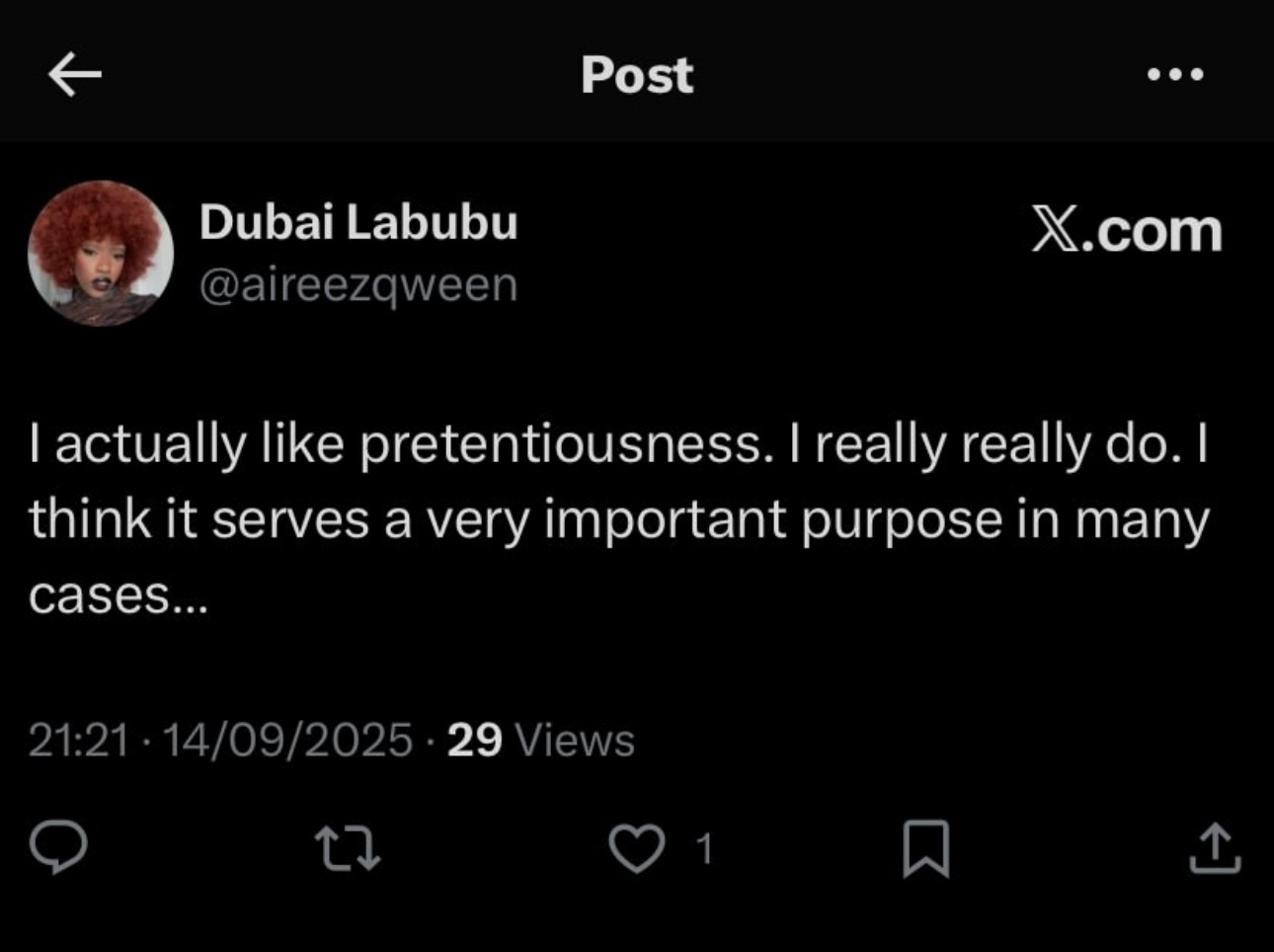
There is a lot of joy in being pretentious. Most recently, I’ve taken to reviewing the collections this fashion week season with the fervour of a dedicated journalist. I believe the reason I’m doing this is because, one, I’m ignited by the curiosity for understanding why things are the way they are, especially when it comes to silhouettes and styling choices made by some of these designers, but also because I’m manifesting a job in fashion. I’m actively working towards a career in beauty and fashion, and I’m putting into the world what I want to get from it. These choices I’m making this year are deeply intentional, and I don’t care to look cool or unbothered because I’m not. I’m pathetically in love with beautiful things, and it is my dream to tell the stories of people who make these beautiful things. I want to give myself and the better parts of my life to these stories, to learning, to curiosity.
The quick virality of complaining becomes a momentary cure for anti-intellectualism that, once worn off, leaves us worse than where we started. What is the point of thinking deeply if not to question? The anger itself is not an issue, but the things we’re quick to be angry about prove that time and time again, the quantity of information presented to us regresses our ability to reflect earnestly.
These days, I’m finding it easier to share and withhold as I please. There is no rush to post something unless I really feel that the five people who actively engage with my manic Instagram stories need to hear what I have to say on the state of New York Fashion Week. When I turned 23, I promised myself that a shift would take place. In some ways, it did, because I’m going out more and actively nurturing my curiosity as a hobby and a career choice. Learning has stepped back into the picture for me as I’ve also started a personal curriculum recently.
Each week, I dedicate one to two hours learning about the sociology of morality complexes, the history of French Erotica, the globalisation of architecture, and the history of linguistics and sociopragmatics. I find myself, for those few hours, completely enmeshed in these rabbit holes of academic papers and digitalised texts from the 1700s, surprised but positively overwhelmed by how much there is for me to learn. Much like the hand, I’m still aware of the time that slips through my fingers like sand, unwilling to let me catch up to the imaginary goalposts set in place by the world around me, but it’s all the more reason why I spend time being as earnest about all the things I want to gain from this one, fragile life.
Comments
Nothing yet. Say the first thing.
Sign in to join the conversation.