

The intellectualising to neutrality pipeline.
I spent the majority of my Covid-mandated solitude learning how to intellectualise my emotions. Instead of feeling them, I interacted with them, pushed them around like strange, foreign foods on my plate. Experiences tied to racism, colourism and misogyny were seen and engaged with as concepts to explore from a controlled position, things to survive and bypass rather than things to be felt and understood. I used to think that intellectualising meant that I was doing something right. I was looking in from the outside like an arbiter of my own morality.
This deprived me of any real beliefs or opinions. I created a mirage of a personality, the essence of self-efficacy. As a teenager, it was always easier to make the self-deprecating joke first, as a way to ensure that I was laughing along with everyone instead of being laughed at. It led me towards this path of disillusionment, and now, in my early twenties, and as I continue to age every second, I am feeling first and thinking later. Regressing, even.
I spent five years making myself the joke and another five intellectualising the aftermath. What I’m left with is a hollow sense of self and a motley crew of emotions that take odd shapes inside my body. Twitching fingers, stuttering thoughts, quick and harsh tones that I’m too prideful to take back. I can’t seem to intellectualise as well as I used to, perhaps because the well with no bottom is finally brimming.
Though the dredges of internalised misogyny and low racial self-esteem have finally filtered through my system, along with these new uncontrollable emotions, follows a particular affinity for strong opinions. The positive I’ve gained from this is that these strong opinions are sandwiched between an almost ‘philosophical empathy’, as Khadija Mbowe puts it in her video about Bonnie Blue’s (almost) petting zoo. I am used to looking from the outside in, and so often, I find myself wanting to know what an ethically morose person was thinking right before they committed an act.
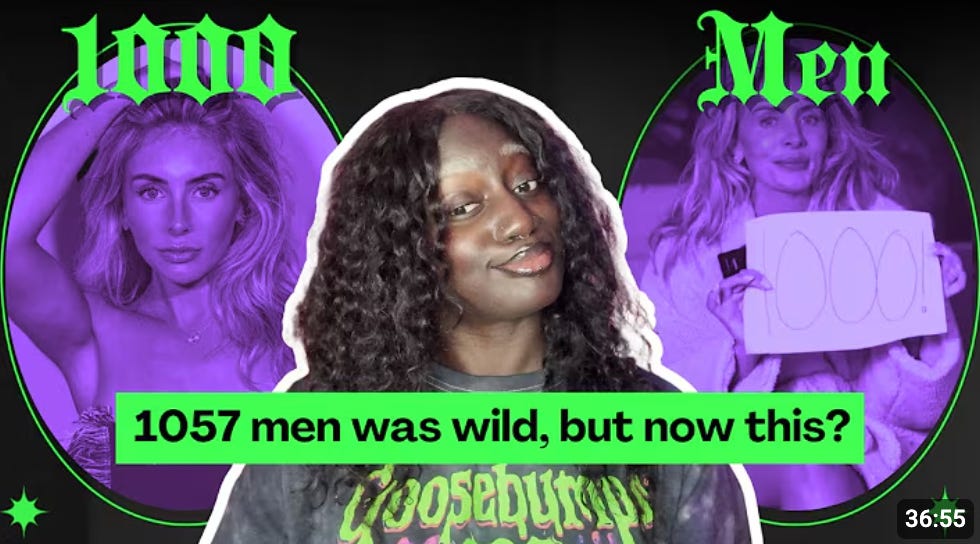
Sometimes I wonder if Bonnie Blue hates herself despite knowing that I don’t really respect her. Sometimes I wonder if Andrew Tate knows at what age the loserdom will compound enough for him to regret becoming a red-pilled MLM slinger, even though I most definitely don’t respect him. There are many levels to the crusade of forming a self. The self is comprised of many things, and for a long while, I did what Merleau Ponty taught against;
‘What defines man’, according to Merleau-Ponty, ‘is not the capacity to create a second nature – economic, social, or cultural – beyond biological nature; it is rather the capacity of going beyond created structures in order to create others’ - Philosophical Attitudes to Body and Spirit, with particular reference to the works of Merleau-Ponty - Professor Eric Matthews.
If I were to describe to you how most of my opinions formed throughout secondary school, I would fail miserably because there was no real foundation, only a hodgepodge of pressured thoughts sifting through my inner circles. Everyone held pretty much the same opinions, and when someone didn’t, the fear of being ostracised was enough to have a change of heart. The modern concept of ‘having no original thought’ is, of course, not as modern as we’d expect, but social media makes it incredibly easy to muddy the origins of your own beliefs. Do you form a belief in a silo? Can an opinion or belief change based on new information? Should it? And how often? If too often, is it fair to assume that you are assimilating by way of craving likability?
I fell into that last bracket quite often because it had only been the opinions of others that I found myself latching onto—I use passive language there for a reason. These opinions seemed to occur to me in lieu of forming my own based on perspective or self-belief. I held an opinion because it was popular, not because it made sense for my values. Simple as that. Neutrality is born by way of many things, but ultimately it leads to a central deciding factor: A desire to be diplomatic. Wanting to be accepted by a certain subculture even when, to your core, a contradiction lies dormant.
Online neutrality and parasocialism
My hesitancy to hold a firm opinion on anything, of course, stemmed from this, leading further down the ethical quagmire of being liked. I don’t want to be disliked for having too strong an opinion that somehow indicates pride, apathy, or, for those who like a stronger kick to their online vernacular, narcissism. There’s a fear in seeing journalists and writers and people who’ve dedicated themselves to true expressions of creativity suffer through the added backlash of online paracosialism.
I’ve partaken in a lot of Love Island discourse this year, unfortunately for my peace of mind, but it has somehow strengthened my ability to hold firm on an opinion without teetering on the edge of mindless neutrality. For me, neutrality in the context of discourse is what comes after you’ve talked yourself into circles with losers on the other side of a glaring screen about who’s right or wrong. At some point, I wave the white flag and cross over to the camp of IDGAF in hopes of regaining my sanity, and sometimes licking my wounds in secrecy. But being liked is not a goal. Being liked often has its own tipping scale, and depending on who you talk to, there are immeasurable requirements for likability, especially if you’re in the public eye.
Ocean Vuong is someone who comes to mind. In the past few months, I’ve come across anti-fans on Reddit who refer to him affectionately as a ‘charlatan’ for his ‘cringe’ and ‘overly earnest’ writing. I haven’t gotten around to his work, but I know that I like the way he speaks. The way he articulates himself in slow and considered bouts of speech is pleasing. I had a coworker who spoke the same. I could practically see the words forming at the base of his throat before they came out.
Perhaps I can find a way to separate the art from the artist if I do get around to his writing and find it cringe and overly earnest as well, but the point I’m trying to make is that it is hard to be liked, and it is hard to be liked by everyone. For a very long time, I could not wrap my head around this because I’d lived primarily in the silos of thought cultivated around me and in some ways by me. I am a very imaginative person, and I’ve had arguments and confrontations with myself to mimic how I would deal with them in real life. I would give myself thoughts and opinions that are honest and reflective, knowing somewhere in the recesses of my mind that these hold the weight of an unplugged bucket. All of it will come seeping out if faced with real conflict.
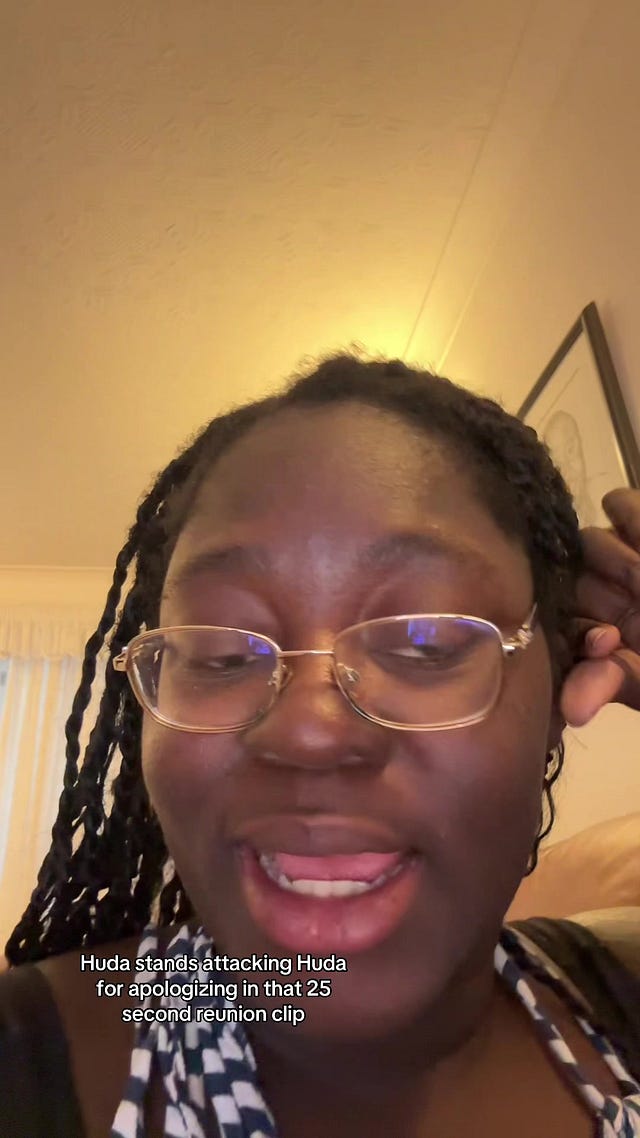
 Tiktok failed to load.
Enable 3rd party cookies or use another browser
The way I’ve remedied this is with social media (don’t judge me for my vices, I’m a growing girl). In indulging in other spheres of parasocialism where I can deeply enmesh myself into one camp or the other, I have no choice but to be honest with myself. This outlet was Love Island USA S7. I don’t like Huda, as a matter of fact, I think she’s done deplorable things on that show. I am also aware that Huda is one of many reality TV pawns that are used and discarded when the vitriol for and against her is no longer profitable. I empathise with the ways the women on this season have gotten far worse criticism than the men, who, by way, are comprised of an illuminating lineup of the intensifying conservatism in America.
In the face of many distasteful opinions about my D1 ship, Nicolandria, I continue to make the same arguments again and again until they grow in credibility and double in resistance. I am unabashedly in support of these two people who don’t know me, and I have never been more spiteful than when dealing with those who do not agree with me.
Still, a balance must be struck. To avoid a full-blown case of parasocialism, whilst also maintaining a sense of fortitude in my beliefs, I step back and look from the outside in. What is it about this relationship that I like? Do the individuals involved in this ship have flaws that are irredeemable for me? What are my limits for their behaviour? What can I defend? What can I criticise?
It may sound simple, but answering these questions when you’re steeped in fandom culture is very difficult. Judging or critiquing people you like, especially within groups and spaces of people who also like them, is a risky play. You might get jumped (digitally, through the use of hateful speech and funny gifs) or you may get a sister in arms. Either way, you will piss some people off by standing on your beliefs, no matter how the pendulum swings.
In response to a comment about how Ocean Vuong “basically turned his own life into a spectacle”, another Redditor replied as follows:
“I mean, is this not the defining cultural practice of our age? The personal brand as self, 'content creation' as art and actualisation, letsplays and unboxings and 'boomers react to skibbidi toilet' - his popularity is the least surprising thing about him.”
Another responded to the response by saying, “It’s very common to fuse mythos and writing.”
I remember a night on the way home from work, I was at the bus stop, waiting for the 205 to Liverpool Street, where I’d get on a Greater Anglia train and watch the world around me dim. The apartment lights and the large glare of the ABBA Arena lights and all the lights of London fusing and disappearing all at once as we left the city and slipped into the countryside. I thought of this before I’d even gotten on the train, and how it made me sad to leave. Somewhere in my notes app right now is a poem about how I was feeling that night, and it went unfinished because I couldn’t find words pretty enough to describe the simplicity of an unsolvable emotion. I couldn’t make my sadness striking enough, so I didn’t try. This is the experience I face often as a writer, in an attempt to merge all my little worlds together in hopes that something poignant and memorable feeds into wider culture. I want attention. I think most people want attention, but I’m unsure if I have the strength to receive it from all sides.
Morality complexes and finding self-belief.
I think at a certain point, we all find ourselves in the crosshairs of moral complexity. As much as I enjoy reading about complex characters and rooting for unlikable women and abusive vampires (AMC’s IWTV, you will always be loved by me), there is a difficulty in accepting that same complexity in people who resemble too much of our own experiences.
In her video, “The Internet’s Evilest Lesbians: Revisiting Anna Campbell”, YouTuber Bittnia recalls an interaction she had on Reddit with someone she considered to have a morality complex. “Not using Twitter doesn’t make you inherently better than me or more ethical. Opting out in many ways is a privilege.” Bittnia recognises the parasocialism in asking about a celebrity’s sexual orientation, given the discourse it’s spawned in the past, but she also makes note of the fact that people are quick to assign you into a category of moral good or moral bad for the mere act of using an app like Twitter, which Bittnia goes on to admit is, “right wing leaning, fasiscm-curious, and aggressively algorithmic.” The nuance here is that an app like Twitter and spaces similar to it, despite their issues, are platforms that, when on the correct side, provide the community and mutual aid that queer left-leaning people need. “That kind of representation hits different when it’s so rare.”
In ’s video about the spectacle of cheating, she covers the topic of cheating as grounds for public humiliation with cases like Coldplay concert gate, Ariana Grande and the SpongeBob Man, Ned Fulmer’s brand as the ‘I love my wife’ guy, and even Jojo Siwa’s recent scandal where she cheated on her partner Kath Ebbs, which adds another layer of complexity because the dynamic of Siwa and Ebbs’ relationship isn’t tranditionally patricarchal.
Nevertheless, the concept of scrutinising an act like cheating on a public scale, Le suggests, is always placed into categories based on the individual experiences of the audience. She goes on to point out that on both sides of the political spectrum, there is a shared desire to uphold moral goodness, or as I’d put it, moral righteousness. Conservatives are historically obsessed with traditional and religious ideas of morality, whereas Liberals, though ‘less overtly violent’, feel an urgency to align with goodness and cast away evil, where cancel culture is involved. Nuance is left out of discussions of cheating, oftentimes because the act alone is repulsive enough to unsubscribe from trying to justify or shift blame. But is there reform for cheaters? In thinking about this myself, I wavered on my conclusion.
I want to say yes, perhaps for the overarching idea that grace can be awarded to most people, but also, my knee-jerk response was no. In the video, Le also touches on the ‘personal being political’, a slogan coined by Carol Hanisch's 1969 essay of a similar name, which concludes that women’s personal struggles are not isolated, but rather illuminate the systematic oppression perpetuated by larger patriarchal powers.
Some of the comments under Le’s video highlight the financial and public loss a woman faces if cheated on by a man, and on the other side, the aggravated speculation a woman would face if she were the cheater. In the case of Ned Fulmer and Coldplay concert gate, the issue of abusing power was also called into question, with the women in both situations working for the men and still walking away with worse scrutiny than the cheating husbands. Either way, the consensus is that women often stand to lose more on the subject of cheating, no matter which side they fall on. I imagine this only skims the surface of the individual opinions that make up the culmination of an audience perspective.
Our desire for moral good and moral bad to be neatly defined gets in the way of progress. There can be no singular truth in all circumstances, but because some self-beliefs border on intolerance, discourse is reduced to the same arguments of who is right and who is wrong. The way we ordain and absolve guilt and blame from others is very indicative of a desire for moral righteousness over moral good. It is a cry for a sheep-like mentality over nuance, and unfortunately, the one person that has been mistreated the most in the age of the internet is nuance herself.
I really suggest Mina’s video on this because it asks you to put aside your own implicit bias and assess the personal and political relationships we have with applying moral righteousness to people we don’t know.
But again, it calls into question our readiness to question. If we, already prepared with a legion of arguments, entertain discourse for the sake of being right or being vindicated in our opinions, then what is the right course of action when forming and upholding self-belief?
The balance I spoke about earlier is the chosen course of action for me. Forming a sort of hypothesis, researching, ideating, informing, and defending. Beliefs are an ever-evolving thing. Values are the pillars that dictate how you go about forming those beliefs, be it through kindness, empathy, intolerance, or justice. I personally choose kindness and empathy, or at least I try to, and it works out how you’d expect. The moments of ego and wounded pride are nursed as real feelings, not just things to be ignored as unfelt strangers to my system. When I can laugh about it, I widen my perspective. I regroup. I might be more careful with my defence, but still, the belief stands. It holds up against the obstacle of neutrality. I find that when you’re able to cultivate nuance as a worldview and not just a cultural tool, it allows for more than just conversation. You become nuanced in your decision-making, in your extensions of grace, and in how the world glows.
I am also thinking about how much longer I have left to nurture my ways of thinking. How many more emotions will plague me with a frightening sense of mortality, and how I will eventually survive that. But I do find myself a little more open to living fully as someone who experiences and nurtures the resistance, the care, and the kindness the world has to offer. Don’t worry, I’ll find a way to intellectualise that too.
Thanks for reading Accident Prone! Subscribe for free to receive new posts and support my work.
Comments
Nothing yet. Say the first thing.
Sign in to join the conversation.