
Recession risks are through the roof. We’ve been worried for months that the current policy mixture would tip the U.S. economy into a mild recession. Our latest forecast puts the likelihood of a mild stagcession (recession with elevated inflation) at about 75%. Last month we were worried that negative animal spirits, stemming from heightened uncertainty on federal and trade policy, would force households and businesses to pull back on spending while they wait to see what’s ahead. We’re in the future now, and it’s not good. Fears that bad vibes would force people to stay home have morphed into fears that bad vibes and surging costs will force people to stay home. In other words, we’ve moved from the theoretical into the real.
If the economy is more resilient than we estimate, we still expect a significant slowdown in growth - with a quarter of contraction in real GDP growth - in 2025.
No, this isn’t a fire drill. Break glass.
(Email research@accessmacro.com to learn how to access our full post-tariff forecast suite, which includes detailed economic and financial forecasts).
Walking it all back is unlikely and it’s probably too late. A lot of ink has been spilled on the reasons why the Administration would come out of the gate so forcefully on tariff policy. We won’t speculate on causes, or find fault with methods, but given what happened with the early March tariffs on Canadian and Mexican goods, we view the White House as serious as a heart attack on tariffs. The good news is that Trump delayed enactment on goods covered under the USMCA, a trade pre-existing trade agreement with Canada and Mexico. That suggests that a component of the “reciprocal” tariffs is a negotiating tactic, but it is unclear how much and what the conditions are for removal. Over the weekend, President Trump reaffirmed that other countries need to close their trade deficit with the United States. We view that as an unrealistic objective. Even narrowing a trade deficit will take time. Further uncertainty was thrown into the mix, when the White House refuted reports that Trump is considering a 90-day implementation pause. Every headline causes more confusion.
While we think that negotiation and armistices are likely, we are concerned that there isn’t enough time to negotiate with every major trading partner - let alone every country - before enactment of the larger round on April 9th, or in time to stop the impact of the blanket 10% tariffs that went into effect on Saturday. And even if wide agreement could be reached quickly, the psychological damage to consumers and businesses has already occurred. No matter what, prices will rise in the near-term, and households and businesses will pull back on spending until the shock wears off and tensions subsided.
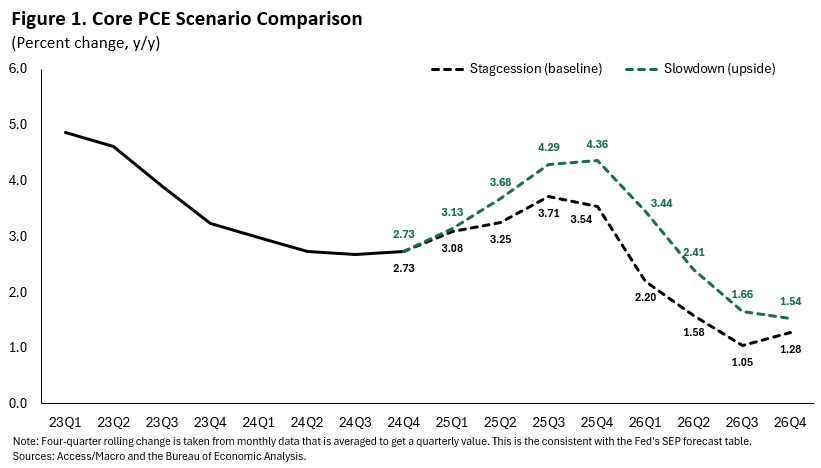
Inflation will surge. There’s no good way to say this, inflation on most things is about to pick up. The monthly change in core PCE was much too fast in February, a point that has been lost in all the tariff hoopla. And that was before the widespread explicit tariff announcements. As Figure 1 shows, our model has inflation reaching 3.7% in a mild downturn and almost 4.4% if we avoid a recession.
(Don’t miss out on our full analysis, which includes a detailed yield curve forecast through 2026 and what we think the upcoming budget fight means for market rates. Email research@accessmacro.com to stay ahead).
The Fed may have to raise in 2025. The world changed on April 2nd. The announcement of widespread tariffs came on the heels of data showing that some measures of inflation expectations are starting to head north. We’re not in a world of unanchored long-run expectations yet, something that would be game over for the Fed, but the latest round of tariffs will add a lot of fuel to the fire. We still expect policymakers to react by cutting rates should the economy hit a recession (again, we think that is likely). They’ll just do a lot less than they otherwise would have. If the economy outruns the chaos, we think there’s a good chance that policymakers will be forced to raise later this year. Core inflation approaching 4.5% with expectations heading higher, coming out of a historic inflationary period where the Fed fell behind, will be too much for policymakers to ignore. We don’t think they’ll go overboard with it, but we do think they’ll have to react. That’s going to complicate matters and send markets into a tailspin. In other words, 2025 is just getting started.
Stay ahead of the volatility with our timely economic and financial market analysis. Email research@accessmacro.com to learn how to get our latest research and forecasts.
Thanks for reading Access/Insights! Subscribe to stay current on how to navigate today’s volatile world.
Comments
Nothing yet. Say the first thing.
Sign in to join the conversation.