
The message and tone will likely be similar to January’s. Don’t expect policymakers to sound the alarm on tariffs in March. While the economic data is starting to hint at stress, it’s simply too early for the Fed, especially an FOMC as data-driven as this one, to make a lot of noise about the economic impacts of federal policies. There will be plenty of questions from reporters on the forever trade war and whether policymakers are worried that the DOGE reductions and spending cuts will impact the broader labor market, but don’t expect any mention of those things in the FOMC statement, or more than tidbits from Powell at the press conference. This is all unprecedented. The data is inconclusive. And policymakers are hyper-focused on avoiding the same mistake they made in 2022. They’re going to be cautious and hawkish.
(Email research@accessmacro.com to learn how to access our full FOMC preview, thematic research, and detailed economic and financial forecasts).
Expect deterioration in the economic forecast. The FOMC releases a set of economic projections four times a year. Each member submits a forecast for growth, the unemployment rate, headline and core inflation, and the appropriate trajectory of monetary policy over the next couple of years. The table below is what we expect to see in the March projections. We anticipate an across-the-board deterioration in the economic forecast (lower growth and higher inflation) and fewer interest rate cuts in 2025 and 2026.
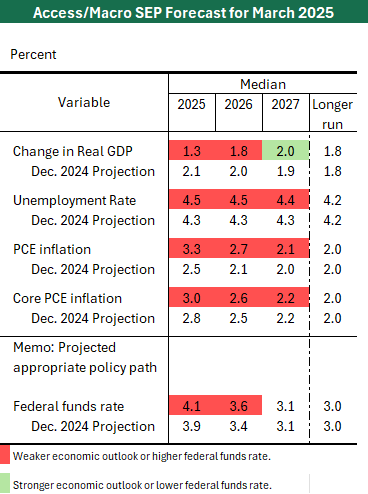
If it walks like a duck and talks like a duck…There’s absolutely no chance that Powell, or any policymaker, uses the word “transitory” when talking about the impact of tariffs, but given how they affect the economy, it’s likely that’s what the projections will suggest. Tariffs are a one-time price shock, with the inflationary impact front-loaded around the time of announcement/implementation. In theory, prices should move up quickly and then stabilize unless, of course, there are more tariffs. The Trump Administration’s continuous tariff threats and rolling window of implementation elongates that impact significantly. It’ll be interesting to see what the projections reveal about FOMC members’ views on the duration of the trade war, but overall, we believe they’ll view it as something that lasts through the end of 2025, with some inflationary impact in 2026. That’s how you say transitory without saying transitory.
They’ll say the labor market is fine. One of the more interesting economic stories of 2024 was the rapid summer shift from concerns over inflation to labor market worries after a soft patch of late mid-summer data. Powell went so far as to repeat, on more than one occasion, that he personally didn’t want to see any additional cooling in the labor market. Then inflation picked back up, and we all moved on. But below the surface, there has been additional deterioration in labor market conditions since the fall. We expect Powell, and others, in their post-FOMC comments will do their best to avoid showing concern about the recent labor market data. That’s not because they’re not worried; it’s because we’re standing on the edge of economic contraction, and they don’t want to speak it into existence.
Stay ahead of the volatility with our timely economic and financial market analysis. Email research@accessmacro.com to learn how to get our latest research and forecasts.
Comments
Nothing yet. Say the first thing.
Sign in to join the conversation.