
(This is a selection from our larger research note previewing the December 2025 FOMC meeting. Email research@accessmacro.com to learn how to access our full research suite, which includes detailed economic and financial forecasts from former Fed insiders).
NY Fed President Williams ended the fight - a rate cut is coming. It shouldn’t be a surprise to anyone when the FOMC decides to cut the federal funds rate by 25bps tomorrow at 2:00pm Eastern. John Williams, one of the most intentional communicators and influential members of the Committee, said as much three weeks ago. Half of the Committee has expressed concerns over inflation, but Williams comments, which normally aren’t so telling, are a sign that the rate cut will be pushed through, even with a likely three dissents. That’s partially because…
The inflation data are playing ball, finally. It flew a bit under the radar, but last Friday’s PCE inflation data showed that, so far, the impact from tariffs has been less than many expected, and inflationary pressures may have peaked in April. The monthly pace of core PCE inflation - price growth excluding food and energy, which is the Fed’s preferred inflation gauge - has slowed in each of the last three months. The yearly change in inflation, which is what makes most of the headlines, will remain elevated until we get the January data due to statistical technicalities called base effects, but the clear easing in the monthly pace of price growth provides cover for timid hawks who may be queasy about inflationary pressure but not willing to stir the pot with a full revolt in December. Don’t get caught flat-footed staring at the yearly change in inflation. The action is happening at the monthly level.
2025 > 2026 in upcoming fed forecasts. December will bring the FOMC’s last Summary of Economic Projections (SEP) for 2025. Unsurprisingly, forecasts are decent this time of year. The summer data showed an economy that is growing at a strong pace, and what little data we’ve received over the fall has dispelled fears that the economy is currently in a recession. Growth likely slowed in the final quarter, and we’re entering 2026 on very shaky footing, but the economy’s solid performance in 2025, especially given all the chaos, is likely to show up in the December SEP as higher growth and lower unemployment in 2025, with lower inflation. However, expect to see some downgrades for 2026 as storm clouds continue to gather on the horizon. Our table below lays out exactly how we expect the SEP forecast to change in tomorrow’s release.
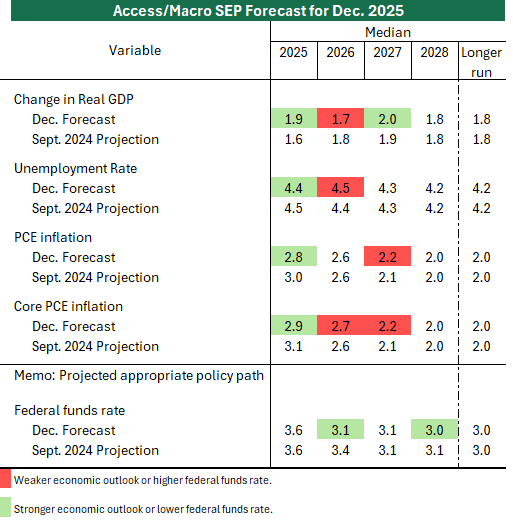
Three things to watch at tomorrow’s press conference:
Did the recent inflation report change any minds? Did the recent improvement in the inflation data assuage the concerns of any hawks? Expect Powell to sound a little less hawkish than he did in October if the data were only a little persuasive. However, he might explicitly state that members were less worried about inflation if a tidal wave of relief overtook the Committee. The latter would have implications for January.
Which labor market data did they find more compelling? Another interesting storyline that has gotten less attention is the discrepancy between the private and public labor market data in September. Data from payroll provider ADP showed a contraction of 32k in private sector employment in September. However, the official Bureau of Labor Statistics (BLS) data showed that the economy added 119k jobs in the month. That data is likely to be revised down, but not by a 120k. The BLS won’t report data for October, and ADP showed a rebound, but a question is like to surface on which data series carried more weight at the December meeting.
How worried are policymakers about “financial market plumbing”? There have been signs that that the banking system may again be short on reserves and liquidity. Those issues caused a spike in the repo rate back in September of 2019, and there are whispers that policymakers overdid it on quantitative tightening. A question about “financial plumbing” is almost guaranteed to come up, and Powell’s reaction will be a telling sign on whether the Fed is worried they made need to step in next year to assure smooth market functioning.
Stay ahead of the volatility with our timely economic and financial market analysis. Email research@accessmacro.com to learn how to get our latest research and forecasts.
Thanks for reading Access/Insights! Subscribe to stay current on how to navigate today’s volatile world.
Comments
Nothing yet. Say the first thing.
Sign in to join the conversation.