
(Email research@accessmacro.com to learn how to access our full research suite, which includes detailed economic and financial forecasts from former Fed insiders).
The productivity boom that leads to a weak and concentrated economy. Citrini Research and Alap Shah published a provocative treatise/scenario on the tail risk from an explosion in AI productivity that leads to immense employment and wage destruction for white-collar work, and a historic slowdown in consumer spending that never truly recovers because, well, nobody has a job except the owners of capital. It’s a truly dystopian future, and as my colleague Guy Berger said, a liquidity trap since monetary policy can’t do anything to stop it. To be fair, the authors note that it’s just a tail-risk scenario they believe hasn’t received enough consideration. But it sent markets spiraling and made headlines today, so we decided to weigh in.
Citrini asks us to imagine that the year is 2028 and we’re looking back at how we arrived in a world dominated by machines and uber-capitalists, where the once “scarce input” of human intelligence has been replaced by an abundance of 24/7 AI data crunching and coordination that has led to massive layoffs for the upper income quintiles who “drive 65% of discretionary spending”. Without that spending, the economy hits a wall. Those who own the capital have buckets of money. More than they can ever conceivably use to buy their fourth yacht. And the rest of us, well, we’re sucking dirty water through a straw. Dark days indeed.
But how likely is this world to unfold? Is this the worst outcome to expect from years of runaway AI investment? And, even if it is, would it happen before the next presidential election? That’s a lot to unpack. If you’ve got better things to do, I’ll summarize by saying: it’s a cool piece that goes astray because the timeline is infeasible, and the assumptions needed are too improbable and unlikely to perfectly align in a way that is needed to bring about the apocalypse.
The assumptions don’t hold. In the abstract, this all might seem possible. If you’re concerned about AI, it might even seem likely. The growth in AI capabilities over the last three years is truly remarkable. And the investment in new models and data center capacity is staggering. But a liquidity trap where the Fed becomes impotent to battle a structurally weak economy with massive white-collar layoffs leading to massively contracting household consumption rests on a few impractical assumptions.
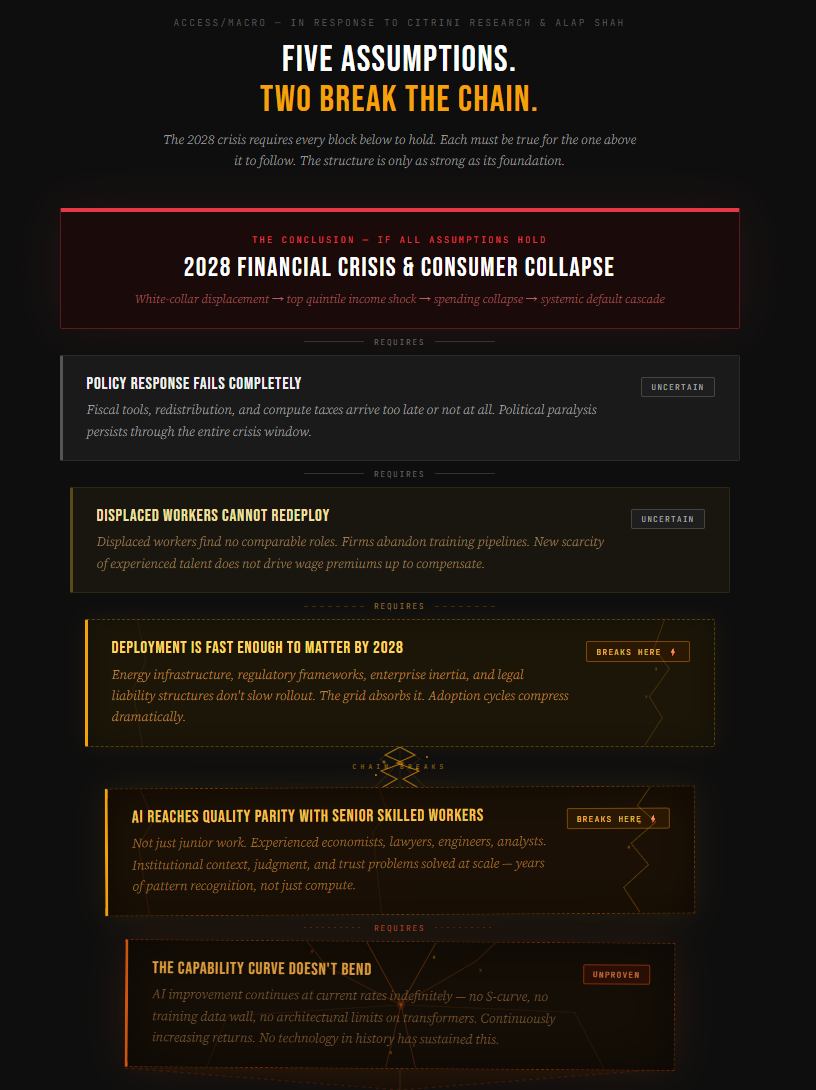
The capability curve doesn’t bend. Technological advancements have traditionally followed an S-curve: they start slowly, then rapidly accelerate as growth and adoption explode, and then level off as it becomes harder to advance, and the technology reaches performance limits. AI is no different (check out bullet 10 here). And say what you want about your new favorite model, but the gap between a trained expert and AI is still wide - don’t ever let it do your financial modeling without a watchful human eye and strict review.
AI reaches quality parity with senior, skilled workers. The dystopian AI-liquidity trap outlined in the Citrini piece requires AI to make leaps and bounds, quickly, to close the gap with skilled humans across so many industries that it shows up in the national data. That seems more than a few years away, and questionable if we ever get there. I don’t have data to support his claim, but as a regular advanced AI user, I can confidently say that the technology is both incredibly powerful and incredibly wrong much of the time, even with good prompting. Recently, and by that, I mean last week, I asked a new AI model to give me an answer to two questions. The first was on retirement accounting for small businesses. The second was on contracts. In both cases, I ended up turning to a human expert to fact-check the AI assessment. And in both cases, the AI model was wildly wrong.
Deployment is fast enough to matter by 2028. We’re humans, which means we get over our skis a lot. The AI boom is no different. The current pace of AI-related construction does not match our existing infrastructure. In other words, we don’t have enough power generation or connection across our power grid to meet what’s coming. Yes, tech companies are trying to match with on-site power generation, but it won’t be nearly enough to meet the basic needs of any of these facilities, so they’ll still be taking power from the grid. That’s going to be costly and politically explosive as rates rise quickly in certain parts of the country. That makes 2028 impossible. And that matters because the slower the pace of AI change, the better the human response will be.
Displaced workers can’t redeploy. As economists and extensive users of AI, we’ve long felt that the greatest threat from AI will be to younger workers who don’t remember how to do things the old way. The Citrini piece agrees but doesn’t address the very likely scenario in which businesses recognize AI’s limitations (more on this below) while failing to address the obvious talent pipeline issue by investing in their younger workforce through training. This isn’t just a pie-in-the-sky hopeful scenario; we hear from businesses all the time that they see the risks AI poses to their future workforce and are already planning on how to ensure that the next generation is ready, willing, and able.
The policy response fails completely. The idea that our policy institutions completely fail us may seem plausible in 2026. We won’t argue that. However, under this aggressive timeline, where things really start to degrade over the next few years, we’ll be entering a presidential election cycle, and it’s hard to imagine that massive across-the-board layoffs of large swaths of white-collar America wouldn’t be the centerpiece of every presidential platform on the menu.
The capacity limits of energy. There is little question that running AI models at scale is a national energy suck. The question is: can demand for energy be met by supply and/or by energy-efficiency improvements? The latter is happening, but as Anthropic recently found out, compute costs can skyrocket when users use more advanced models with longer context. And officials in major energy markets are already calling out the surge in demand and the lack of infrastructure as significant hurdles. We didn’t build the smart grid, and now we’re building data centers in every pocket of cheap power in America. At some point, it comes due, and even if there is technically enough power, getting that power across independent system operators (ISOs) that manage power for a region is a complicated issue, both politically and economically. In short, there is a power limitation on AI that no one has yet solved.
Technology has always been a job destroyer and creator. Lots of ink has already been spilled on how previous technological advancements both destroyed jobs and created them. I won’t rehash things here, but AI will need to buck all of modern human history if it is to be the apocalyptic job crusher that the Citrini piece lays out in their tail-risk scenario. And so far, there are signs that pandemic over-hiring has more to do with the recent weak job gains than AI. That’s not to downplay or dismiss those who have and will lose their jobs. It’s merely a statement of fact that technology often creates jobs while destroying others. There is no compelling evidence that AI is any different.
Don’t forget to quality adjust. The main argument in the Citirini piece, also made by others, is that AI unit labor costs are so drastically below those of a human worker that, even with a sharp rise in computing and energy costs, AI will remain cheaper than a human. But you need to quality adjust. As discussed above, there is still a vast gulf between a trained expert and AI. Even if AI were able to produce 75% of what a skilled human in noncoding tasks can produce, that 25% loss in quality is a steep cost to pay, even if you are saving money in labor costs. Even worse, it creates an opportunity for a competitor to swoop in and gain market share. You can’t enshitify everything and not expect someone to figure out that people will pay more for better. AI can’t produce that “better”, but a talented human (probably with AI) can.
AI has a major trust problem. In the course of writing this post, I had a long, very long conversation with AI about its strengths and weaknesses, as well as the themes described in the Citrini piece. At multiple points during that conversation, even when prompting it to “promote correct responses over social cohesion” or just “please don’t be a sycophant and agree with me”, the agent bounced back and forth, straining to do exactly what I asked it to do, pressure check my answer, and play devil’s advocate, and agree with me. It just couldn’t help itself, even at one point telling me that it had become confused and was struggling not to read between the lines of my prompts for a deeper meaning that it could align with. It just couldn’t stop being a people pleaser, which makes it extremely unreliable without human guidance to ask the right questions.
The mass layoff —> wage deflation —> spending collapse is unlikely. For all the reasons listed above, the dreaded super productivity boost, where AI essentially puts everyone out of a job, which causes a collapse in household spending and an economic crisis that the Fed is powerless to stop, isn’t even a credible tail risk. There will be economic losses, but there will also be gains. Those kinds of offsetting shifts are exactly what have happened in all previous periods of rapid technological advancement. It unfortunately creates winners and losers. But in aggregate, it’s unlikely to do enough damage to tip the entire economy into a prolonged period of depression and economic stagnation, as the Citrini scenario implies.
It still could cause economic damage, especially to vulnerable groups. Just because we don’t all end up on a palladium farm mining for our robot and uber-capitalist overlords, doesn’t mean that there won’t be economic consequences. While a macro-level liquidity trap is extremely unlikely, a regional one or industry-specific pain is probable. Programmers are likely to face a permanent downshift in demand for their labor. SaaS companies, particularly those that serve as admins and assistants for rote tasks, are likely to be squeezed or driven to extinction. And the greatest risk is that young workers will fall behind, creating economic instability for those unable to adjust and robbing companies of a pipeline of talent, unless, of course, they invest in training the future - one of our keys to surviving the AI fallout.
Don’t sleep on the dangers of AI group-think. It’s true that two users asking AI a similar question are likely to get two different answers. But that doesn’t mean the underlying process of arriving at those answers is completely different. AI is energy-minimizing and searches for the quickest approximate answer. If you prompt it to dig deeper, it starts by reading every source it can find, trustworthy or not. Narrow down the search to only respected sources, and it’s very likely that you’ve reduced the range of inputs down far enough that if two people, or 1000 people, were asking the same question, they’d get a very similar process. Groupthink is already an issue with humans, but adding a seemingly all-knowing black-box machine that will take a stab at answering any question you throw at it will lead to groupthink, which, as we saw in 2008, can lead to catastrophic economic events.
Stay ahead of the volatility with our timely economic and financial market analysis. Email research@accessmacro.com to learn how to get our latest research and forecasts.
Comments
Nothing yet. Say the first thing.
Sign in to join the conversation.