
This month’s Labor Market Outlook covers two topics: the reversal in labor market fortunes between two of America’s largest states, California and Florida. Three years ago, Florida was one of America’s labor market stars while California was in the middle of a mini-recession. These days, Florida is the one experiencing a mini-recession while California stages a mild recovery.
The second topic is the recent decline in the unemployment rate, and the degree to which we should discount it due to falling labor market participation. The answer: we shouldn’t, because the share of people outside of the labor force who want a job is also falling.
In May 2023, Florida was riding high. A post-pandemic boom lowered its unemployment rate to 2.8%. Workers were streaming to the state; employment had grown by a massive 3.7% over the prior year. On the other coast, California had hit hard times: employment was still growing, at 1.0% Y/Y; but this was not enough to keep up with an immigration-fueled labor supply surge, and the unemployment rate had already risen over the prior 9 months from 3.8% to 4.6% (and would rise further). This fueled a plethora of think pieces about the triumph of Florida’s policymakers and the failure of California.
Fast forward three years later, and those conclusions have aged poorly. Florida’s unemployment rate rose by 2.0% percentage points - a deterioration comparable in size to a small recession. And while California’s unemployment rate reached 5.5% in the spring of 2025 (another mini-recession!), it has since fallen slightly (5.3% as of this writing). The employment growth ranking has also reversed: Florida, at 0.1% Y/Y, has trailed the national average (0.3%), whereas California has slightly outpaced it (0.6%).1
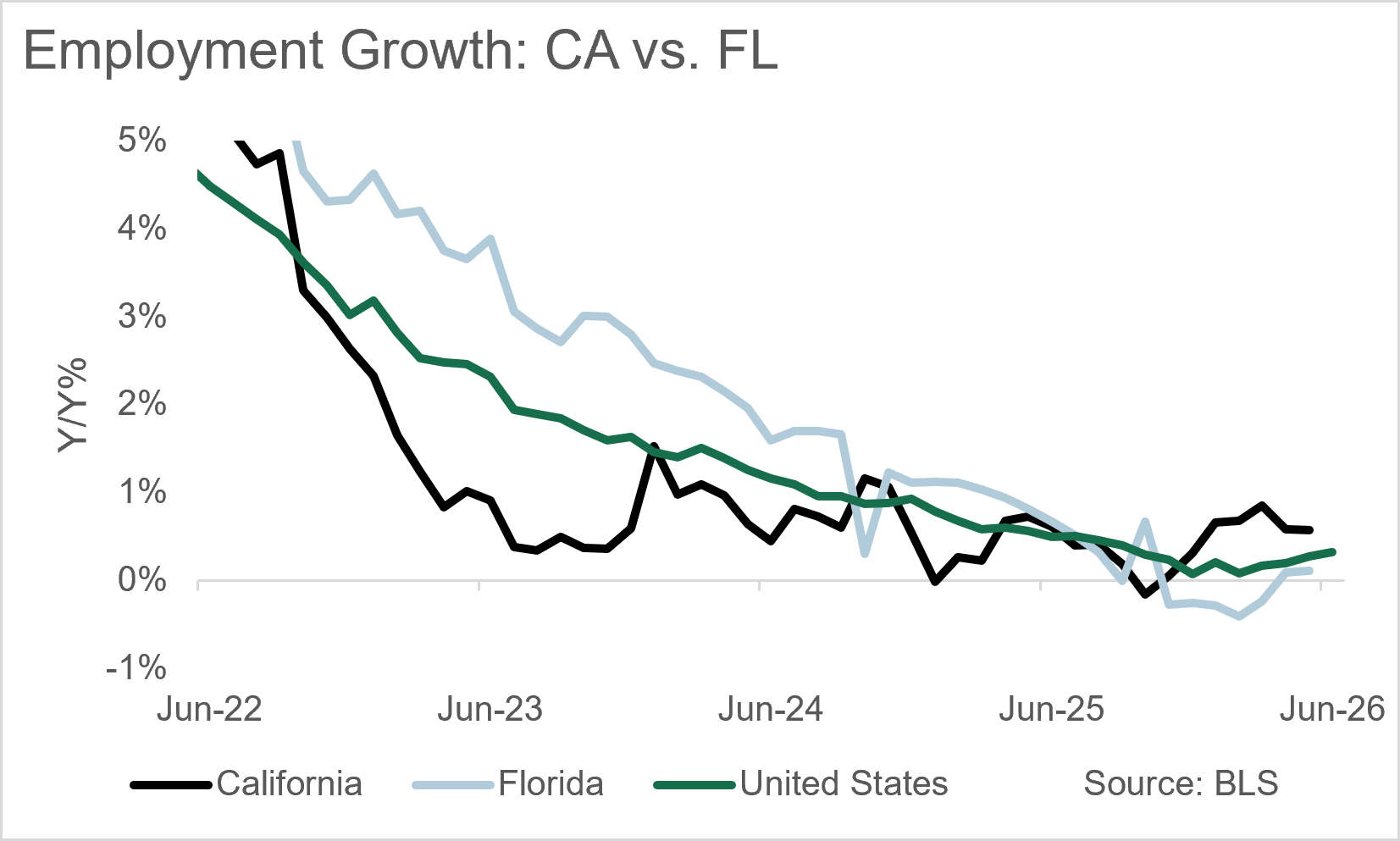
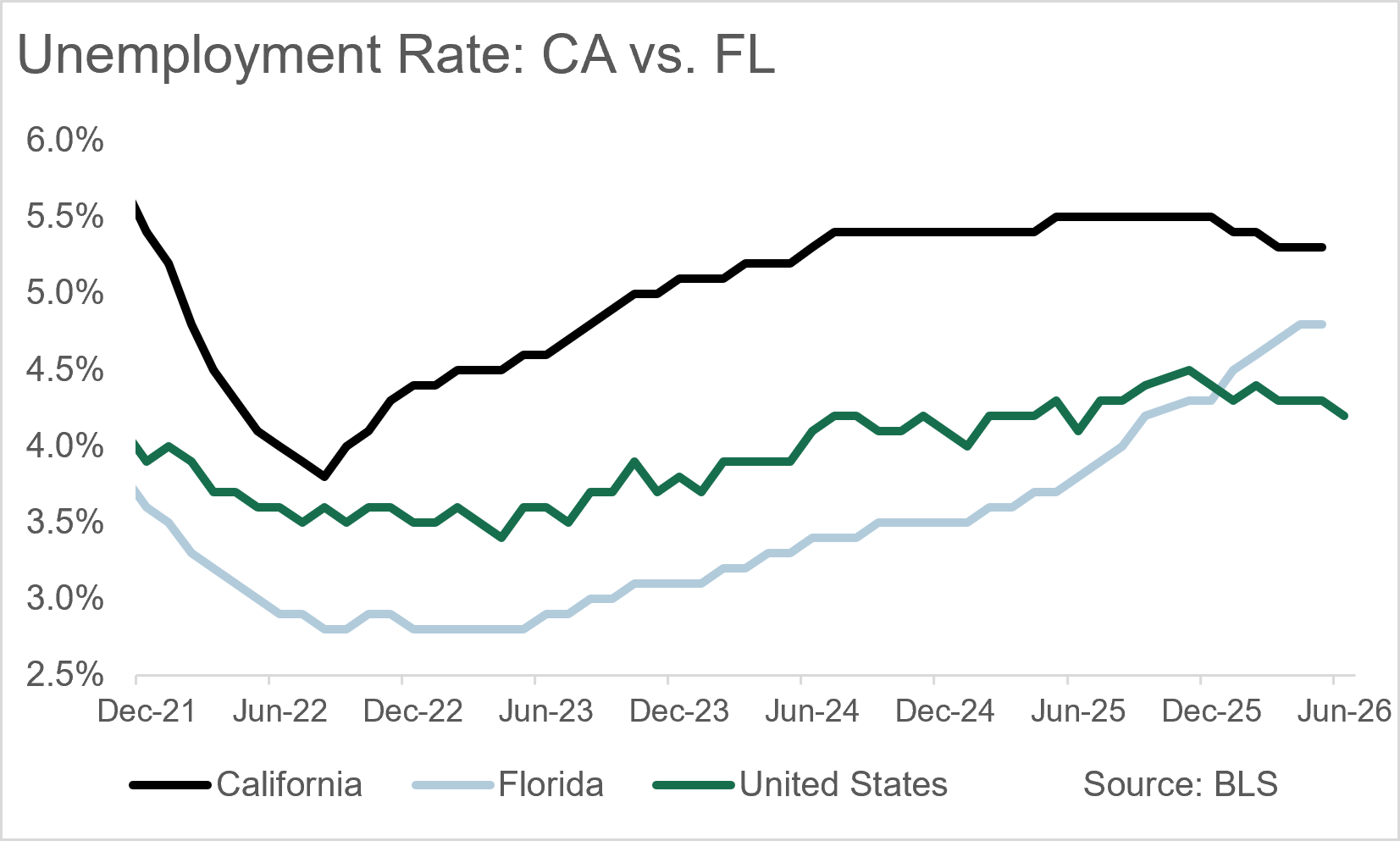
What’s caused this reversal? Given California’s reputation as a “big government state”, a naive reader might think it’s government jobs. But the opposite is true. Over the past year, government employment has fallen by 1.0% in the Golden State, led by cutbacks in federal (-8.9%!) and state (-3.2%) government payrolls. Meanwhile, Florida government employment has fallen by less (-0.8%) than California’s, mostly because federal and state employment have fallen by a lot less (-5.3%, -1.5% respectively).
Another hypothesis that comes to mind is tailwinds from the AI boom. But that isn’t showing up as a direct impact: California’s information services sector is shrinking a little faster than Florida’s. Nevertheless, it’s possible that we’re seeing a spending spillover from the wealth generated by that boom. A hint lies in the fact that private service sector employment in California is growing by 1.2% Y/Y, whereas in Florida it’s creeping up by a meager 0.3%.
California is also experiencing much faster growth than Florida in retail trade (+0.6% vs. -0.7%), real estate, rental & leasing (0.0% vs. -2.2%), health care & social assistance (+4.3% vs. +1.9%), accommodation & food services (+1.8% vs. -0.7%), and other services (+1.1% vs. -1.2%). In other words, Californians are spending money, and that’s boosting employment in these labor-intensive industries; Floridians are not. As an aside, these California growth sectors also have relatively low exposure to AI.
A cynic might chime in that a lot of these new Californian jobs are relatively low-paying; it is not a coincidence that average hourly earnings are growing faster in Florida, which is adding fewer of these low-paying jobs. But I think when unemployment is rising rapidly, lower-paying jobs are better than no jobs.
My final takeaway from doing this professionally for a long time: resist easy, moralistic explanations for why some regions or industries are growing faster than others. Florida was well-placed for a labor market boom a few years ago; now it’s struggling. California was doing very poorly a few years ago, but is now getting some of its mojo back. I suspect that in the coming years, the tables will turn again and again and again…
If you read this newsletter, you know that I believe the unemployment rate is a pretty good labor market barometer. It’s fallen by about 0.2 percentage points since December 2024, and 0.4 percentage points since November. But I’ve seen some pessimists latch onto the big decline in the published labor force participation rate over this period (a full percentage point) as a signal that the labor market is actually getting worse. I think this argument is a combination of mathematical and conceptual errors.
Comments
Nothing yet. Say the first thing.
Sign in to join the conversation.