
What do soldiers, clinicians, and beauty influencers all have in common?
Increasingly common use of AI in delivering a product.
I had the opportunity to once again join Stanford University’s Future of Decision Making Project to discuss just two of those examples. War and medicine require nuanced decisions that AI can optimize or undermine -adding yet another decision: trust or don’t trust my AI. Beauty influencers face no such dilemma in their use of AI enhancement… until they show up on r/instagramreality.
Absurdly Rational is reader-supported. Please consider becoming a free or paid subscriber if you enjoy unorthodox takes on the appreciation of reality.
In this episode, we explore the nuances of rolling out AI lawyers to the bleeding edges of human activity from war to medicine -because real lawyers aren’t out bombing targets of interest or assisting in pancreatoduodenectomies. Not that they should be, but the needs and implications for having a real-time legal opinion when doing things that could skirt that which is illegal are explored in the context of our brave new world of semi- and fully autonomous systems.
Check it out here (that’s a link, not just a picture of a midlife Zoom crisis):
A crumb of context:
This episode is hosted once again by its creator Col. Bradley Boyd (whose extended and impressive biography is covered in my piece on the debut of this series), and this time features Dr. Lena Trabucco, who holds two separate PhD’s in international relations from Northwestern University, and in law from the University of Copenhagen (I shudder at the thought of how much work that must have been).
Not content to simply learn more than 99.9% of the rest of humanity, Dr. Trabucco is concurrently an assistant professor of military studies at the University of Copenhagen, and a fellow of the Stockton Center for International Law. Her highly specialized research spans multinational military operations, legal interoperability, artificial intelligence (Al) and international humanitarian law, and the meaningful human control of autonomous weapon systems under international law.
Dr. Trabucco has done extensive work into creating AI legal agents that could work in concert with autonomous weapons to prevent small errors like committing atrocities and war crimes in the course of swiftly meeting strategic objectives with AI-enhanced war tools. This is unquestionably noble and necessary, and Col. Boyd provides gritty clarity of how troops on the ground can be affected -both positively and negatively, by giving the ghost in machine a Juris Doctor.
What follows is NOT a summary of the podcast: it is related but distinct. Please listen to the podcast to get the perfectly-marbled meat of the conversation on emerging AI technology straight from the lips of smarter people than me.
You don’t need Skynet to live in a dystopian AI society
Most of the AI adopted by medicine is for assistance in documentation, followed closely by decision support and image processing. There are even a handful of examples of AI legal agents working in medical contexts (bedside informed consent and malpractice liability checkers). These are handy, but do not (yet) oust the clinician from making decisions, even if the inputs are enhanced by AI.
Medical penetration of AI into daily operations pales in comparison to the scope of current military AI implementation, where intelligence gathering and target selection are broadly and successfully employed with superhuman results. Paradoxically, use of AI legal support in military contexts appears to be nonexistent compared to even the paltry offerings of such uses in medicine.
But use doesn’t mean success. The largest-scale implementations of AI legal agents in healthcare thus far have yielded body counts that rival military AI applications:
UnitedHealth, Cigna, and Humana all employed AI agents to mercilessly reassure human physician claim reviewers in the loop that denying healthcare to the insured -was completely legal (and coincidentally lucrative). Said physicians (almost exclusively shitty, non-practicing doctors with a history of poor clinical performance necessitating their employment by insurance companies) went from agonizing about the implications of what their decisions would do to the faceless human being on the other end of the transaction, to ignoring each patient’s circumstances with newfound confidence provided by AI legal support.
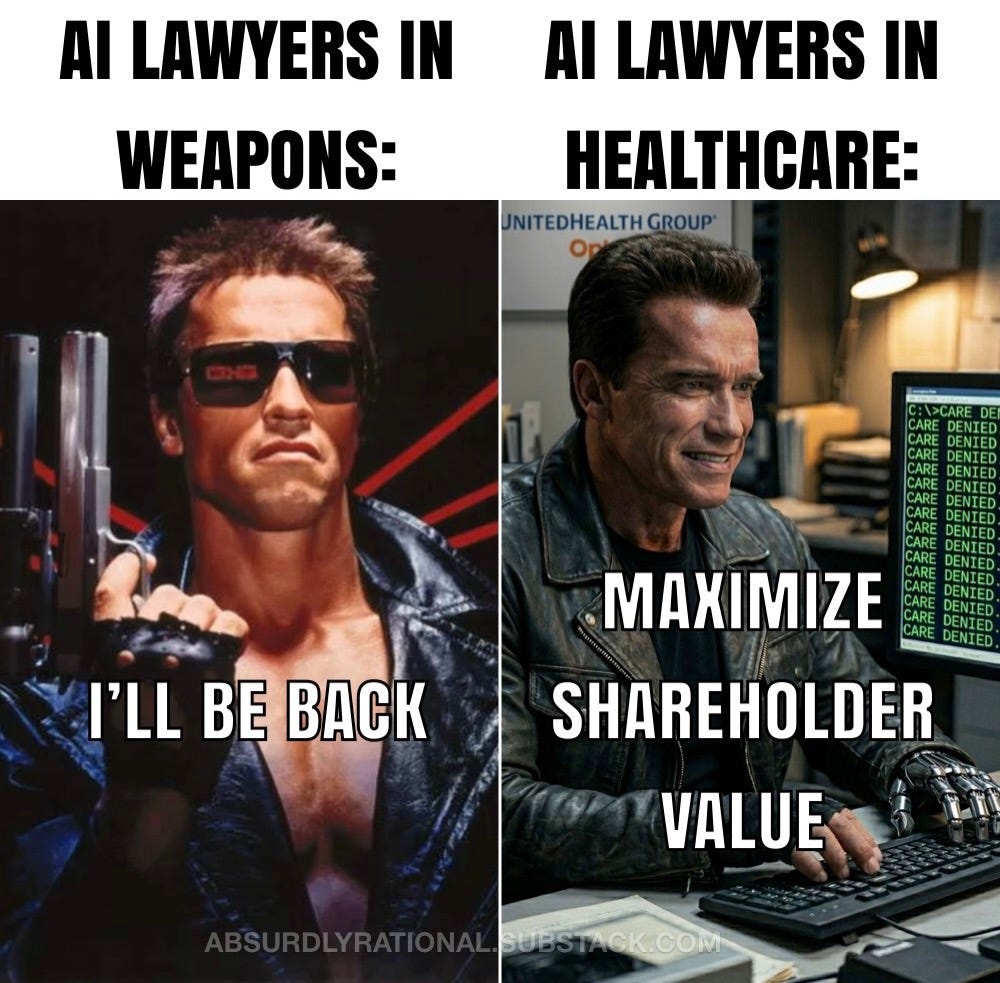
Col Boyd astutely argues that legally trained AI agents may hesitate or decline to take lives when deployed in combat. His point is unarguable, but I offer that legally trained AI agents were able to endanger human life at speeds not attainable by human agents. The problem is clearly nonlinear.
But…
The history of all human endeavor teaches us that past failures do not eliminate the possibility of future success.
You have to break a few eggs to make an omelette. You have to kill a few patients to find a cure for syphillis. You have to liquify a few physicists to harness the power of the atom.
The catastrophic failure above was destined to happen because it was implemented by the most parasitic and self-serving subset of healthcare: health insurance companies. The outcome was predictable because these AI systems were specifically tuned to prioritize profit with a wide tolerance of human suffering -which means it succeeded in meeting its primary goals. It even met its secondary goals of suppressing human guilt to make those decisions more quickly than ever before.
Why so morbid? Because even though AI is involved, these are human-mediated tragedies: UnitedHealth’s AI denial system didn’t fail -the humans in charge of shaping its training failed.
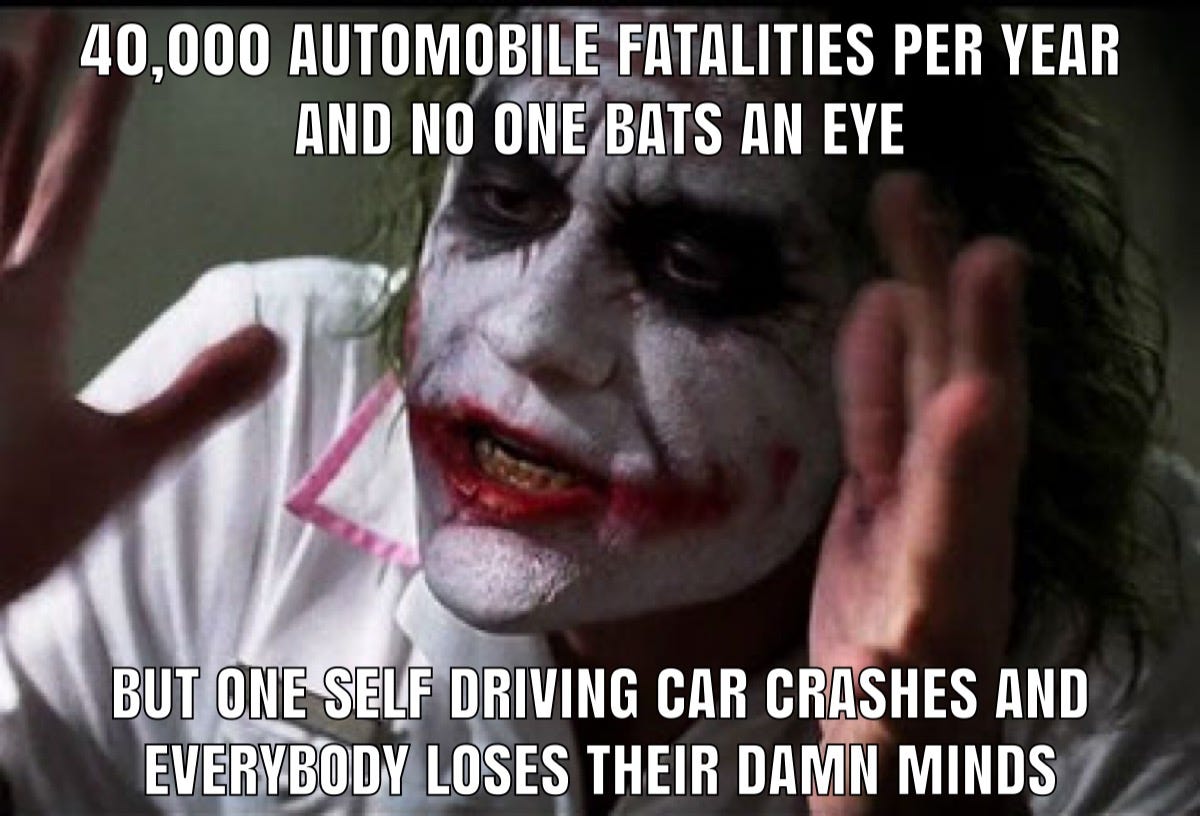
People cringe and clutch their pearls when machines cause disability and death due to errors, oblivious to the fact that people have been hurting and killing other people (not even accidentally) for as long as there have been people.
Despite my relentless skeptical pessimism, I am encouraged by the intent of Dr. Trabucco’s research and hope that it finds success. While I take some time in the podcast to frame situations I’ve witnessed that would have helped or harmed patients with the assistance of an omnipresent virtual lawyer, that doesn’t mean I hate the idea; it means that I think it needs to be explored thoroughly and implemented judiciously.
Machines don’t have a conscience, and while I find it supremely ironic that we are using lawyers as bridge to simulate one in artificial intelligence, there is a caveat to consider:
The concept of conscience itself comes from humanity -the inner voice of right and wrong that guides us. When I said “machines don’t have a conscience,” many unconsciously finish that sentence with “but humans do,” which… is not entirely true. Certainly, some humans have a conscience, but not all of us. Just enough of us don’t that we need things like laws and prisons and police and… lawyers.
While I can find scenarios that break the hypothetical digital lawyer, this is an embryonic technology, barely born let alone matured; it still needs to be fleshed out with aggressive cynicism. And it’s important because even through artificial general intelligence isn’t yet here, it would be really nice if it already had a well established code of conduct in place, because Skynet jokes are only funny until the robotically-targeted bombs are uncaringly dropped on you for arbitrary and capricious reasons.
Humans are not free of error, inconsistency, or sociopathy. AI is not innately prone to malice, but essentially operates in domains bounded by field-specific training that is ethically unbounded beyond the coincidentally ethical constraints already baked into expertise itself.
While law is not ethics, the former is better codified and more widely agreed upon than the latter. Disagree? Consider:
Stealing tickets is illegal.
Scalping tickets is unethical.
One of those two activities has a whole business dedicated to it, with a market cap slightly larger than Yelp or GoPro.
The way forward is not without uncertainty, but the inherent consistency of automation offers the promise of greater machine safety with better-than-human predictability if an additional layer of lawfulness can be integrated into its thinking.
The existence of autonomous killing machines implies we have already missed the boat on Asimov’s three laws of robotics, but research continues on finding a suitable alternative.
Oh my. You read all the way to the end! I know you’re no cheater who would skip down here without reading! Please consider becoming a free or paid subscriber. Your support is important to me!
Comments
Nothing yet. Say the first thing.
Sign in to join the conversation.